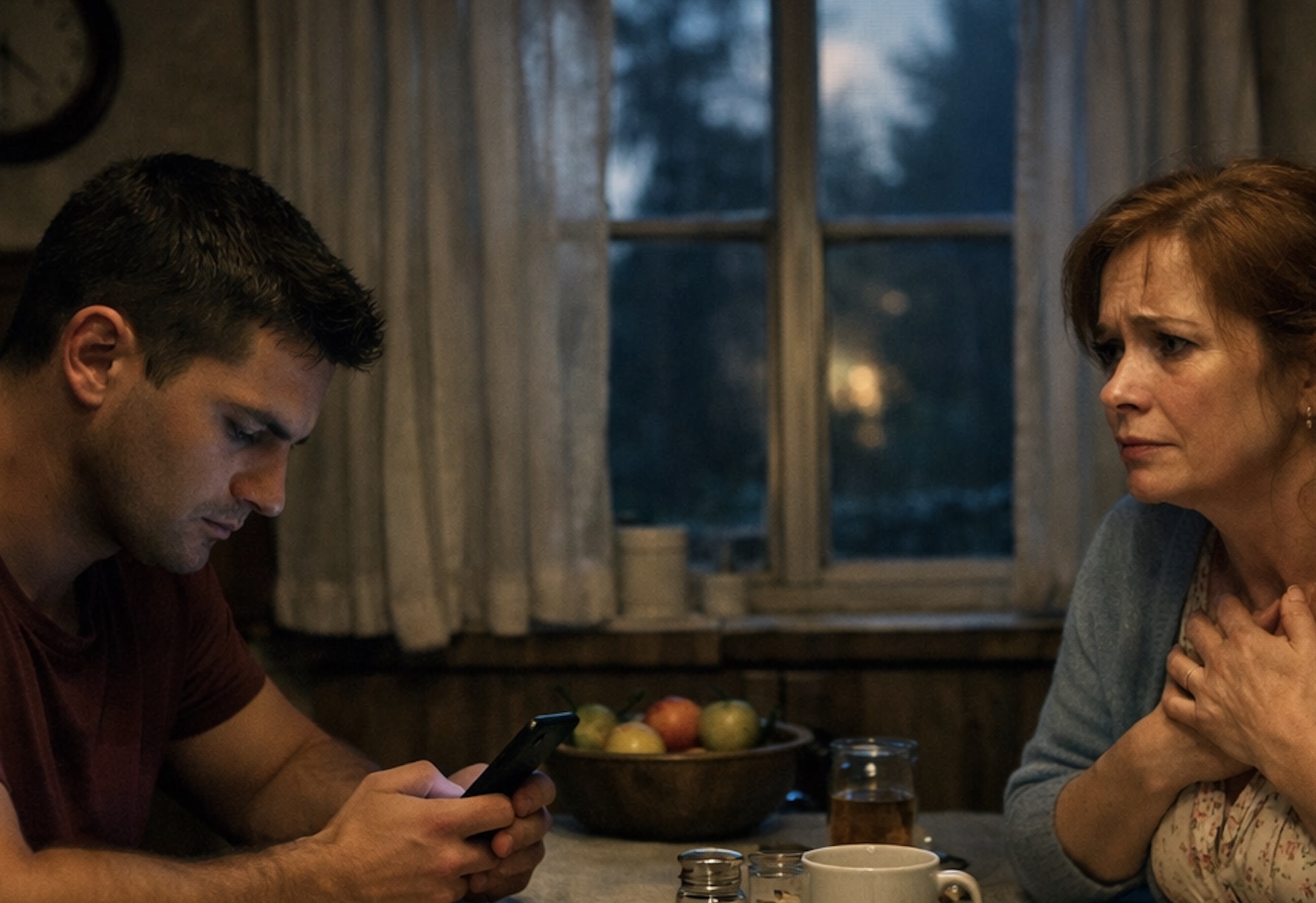
“Are you serious right now, Zakhar?” Olga slowly set her fork on the rim of her plate, feeling a fine tremor of cold rise inside her.
Her husband did not even look up from his phone. He kept scrolling through the news feed, sipping his tea, as casually as if they were discussing a loaf of bread from the corner shop rather than her money.
“What’s the big deal, Olya? Just think about it. Lera’s having a hard time. She got a job out in the suburbs, and by the time she gets there after three different minibuses, she’s exhausted. But now there’s a ready-made sum. Your father did well giving you that gift when he did. It’s enough for the down payment, and I’ll cover the rest with a loan.”
“Your father… did well…” Olga repeated hollowly. “Zakhar, that money was for my thirtieth birthday. Dad saved it for two years so I could see the sea for the first time in my life. Do you even hear what you’re suggesting?”
“I’m suggesting we do the decent thing,” Zakhar said at last, putting the phone aside and looking at her with the expression Olga had once mistaken for masculine strength, but now recognized as pure, shameless arrogance. “We’re a family. And family means one for all. Lera is my own blood. Is your ten-day tan really more important than my sister’s comfort and safety? Don’t be selfish, Olya. It’s ugly.”
The word selfish hit Olga like a slap.
She stared at her husband and no longer recognized the man she had married five years earlier. Back then, Zakhar had seemed like the embodiment of reliability. Tall, broad-shouldered, open-faced, he had known exactly how to surround her with care until she felt protected, as if by a stone wall.
Only later had she realized that behind that wall lived not just her, but his entire extended family—and the wall itself had been built entirely out of Olga’s resources.
They had met at a design firm. Olga was a senior engineer, Zakhar a mid-level architect. He always had a thousand ideas, but somehow they never turned into anything. A boss had ruined one project, coworkers had sabotaged another. Olga believed him. She supported him, helped him with drawings late into the night, believed in his unrecognized genius.
“Olya, you’re my engine,” he would whisper in the darkness of their tiny rented apartment. “You’ll see, we’ll move mountains together. Soon we’ll have our own house, a big car, and you’ll never have to want for anything.”
Olga believed him. And she worked twice as hard.
When, a year after the wedding, she was offered a department head position with a salary three times higher than Zakhar’s, she hesitated. Would that hurt his pride?
“Are you silly?” Zakhar had laughed then. “This is our victory. Our family budget only benefits. We’re a team!”
A team. That became the key word in their household. Only the rules of that team were always written by one person alone: Captain Zakhar.
First came his mother’s “dental emergency.” Olga handed over the money she had been saving for a fur coat without thinking twice. After all, family mattered. Then Zakhar’s younger brother “accidentally” wrecked someone else’s car, and compensation had to be paid quickly to avoid court. Olga was understanding again. Her bonuses paid off debts; her salary bought medicine for distant aunts.
But the crown jewel of this family charity project was Lera. Zakhar’s younger sister, an “eternal child” at twenty-four, was sacred to him.
“Lera is delicate,” he would explain whenever his sister quit yet another job two weeks after getting hired. “She needs a special environment. She’s still finding herself.”
“Zakhar, she’s been finding herself for four years,” Olga tried to argue. “Maybe she should start finding herself as an employee who shows up to work on time. We’ve been paying her rent for six months already. We can’t even save for our own apartment.”
“Don’t count pennies, Olya,” her husband would say with a frown. “You earn more anyway. What, you begrudge a loved one a little help? Personal boundaries may be trendy, but real families are built on mutual support.”
Olga would sigh. She had grown used to yielding. She thought if she just kept being a good wife, Zakhar would appreciate it one day and finally take her side.
The conversation about the vacation money became the last straw.
Olga’s father, a simple retired factory worker, wanted to give his daughter a gift. He knew how hard she worked, how she never saw daylight, how her skin had taken on a grayish tone from endless hours at the office.
“Go to the sea, sweetheart,” he said, handing her the envelope. “Breathe in the salt air. Look at the horizon. You’re my only daughter, and I want to see you happy—not worked to the bone.”
And now those bills, carrying the scent of her father’s tobacco and endless love, were supposed to buy Lera a car so that the “delicate soul” would not have to ride the bus.
“I’m not giving that money to Lera, Zakhar,” Olga said quietly, but firmly.
Her husband froze. Slowly lifted his head. Genuine disbelief flashed in his eyes, quickly replaced by irritation.
“What did you just say?”
“I said no. That money is a personal gift from my father to me. I’m going to a sanatorium. Alone, or with you if you earn your own ticket. But I am not buying Lera a car.”
Zakhar smirked, though the sound was sharp and unpleasant.
“Well, look at you. Got some teeth all of a sudden. Has your job title gone to your head? Forgotten who the man of the house is? I’ve already made the decision. Tomorrow I’m taking the envelope and we’re going to a dealership to look at options. Lera’s been browsing listings all day—she was thrilled when I told her.”
“You already told her?” Olga shot to her feet. “You gave away my money without even asking me?”
“Olya, why are you making such a scene?” Zakhar rose too, looming over her with his size. “Those are our shared funds. We’re husband and wife. There is no yours and mine. There is only ours. And right now ours needs to help Lera. End of discussion. Go to bed. Tomorrow’s a big day.”
He turned and walked out of the kitchen, completely certain he had won. He knew Olga would cry, protest, maybe sulk, but in the end she would do as he wanted. She always had.
But this time, something inside her broke.
It happens sometimes: you tolerate and swallow hurt for so long, keep excusing someone else’s greed, and then—click. Suddenly there is a ringing silence inside you. And in that silence, you understand with perfect clarity that the person standing before you is not a wall of protection at all, but a parasite.
Olga did not go to bed. She sat down on a chair, folded her hands in her lap, and remained there until dawn. In her mind, like in an engineer’s program, formulas and calculations began to line up. She remembered every single time her interests had been pushed aside for the sake of Zakhar’s “family.”
She remembered missing her best friend’s wedding because Zakhar had bought his sister an expensive laptop. She remembered wearing old boots for two winters because his mother had “urgently” needed new furniture for the living room. She remembered how he kept “forgetting” to pay utilities, and how she always ended up covering the bills from her private savings.
Justice blazed in her mind like a neon sign. Where had justice been all these years?
The next morning, Zakhar came into the kitchen cheerful and glowing.
“So, grumpy girl, have you cooled off?” He tried to put an arm around her shoulders. “Get dressed. I made plans with Lera—she’s meeting us by the metro in an hour. We’ll go look at that little red hatchback I told you about.”
Olga gently stepped aside.
“I’m not going anywhere, Zakhar.”
“Still on this?” He frowned. “Olya, don’t push me too far. I don’t like it when a woman argues.”
“And I don’t like being robbed,” Olga said calmly. “The envelope is no longer in the drawer. I took it back to my father last night while you were sleeping.”
For a second, Zakhar was speechless. Then his face slowly darkened to a furious red.
“You did what? You stole money from this family?”
“No, Zakhar. I returned it to the rightful owner so you wouldn’t be tempted to play the generous hero with somebody else’s money.”
“Do you even understand what you’ve done?” he shouted. “I promised my sister! I gave my word! What do I look like in her eyes now—a liar? A weakling?”
“You made yourself look that way the moment you promised something that wasn’t yours,” Olga said without fear. “And I’ve been thinking. You talk so much about what’s ours. Let’s calculate what ours actually means.”
She pulled a sheet of paper from a folder.
“In the last three years, I contributed eighty percent of our household income. Nearly half of that went to your relatives. I counted every transfer, every bill, every ‘gift.’ The total is impressive. Enough for a mortgage down payment on our own home. But we don’t have an apartment. Your mother has a new renovation, your brother has a paid-off loan, and your sister doesn’t work but somehow looks just fine.”
“How dare you count?” Zakhar shouted, raising his hand as if to strike, but Olga did not even blink.
“I’m an engineer, Zakhar. I believe in numbers. I also believe in truth. And the truth is, you’re a kept man. An ideological one, maybe, hiding behind ‘family values,’ but still a kept man. You live off me and then try to command me.”
“I’m leaving!” he spat. “I won’t live with a woman who throws bread in her husband’s face! You’ll come crawling back, begging my forgiveness when you realize you’re all alone! Who do you think needs a dried-up woman in a skirt at thirty?”
“Leave,” Olga said with a nod. “But don’t forget the keys. This apartment is rented in my name, and I pay for it.”
Zakhar began furiously throwing his belongings into a suitcase. He did it theatrically, waiting for Olga to break down, to drop to her knees, to apologize.
She simply stood at the window, watching children play in the sandbox downstairs.
When the door slammed behind him, Olga felt… not pain. Relief. Enormous relief. As though some dusty old furniture had finally been dragged out of the room, and she could breathe again.
But that was only the beginning.
Two hours later, her phone started exploding with calls.
“Who do you think you are, you little tramp?” screamed her mother-in-law, Maria Ivanovna. “My son is out on the street because of you! You threw him out like a dog! And Lera is crying—her blood pressure is through the roof! You destroyed that child’s life!”
“Maria Ivanovna,” Olga answered calmly, “Lera is twenty-four. At that age, children earn money for their own cars instead of draining other people’s fathers.”
“How dare you! We welcomed you like family!”
“You welcomed me like a sponsor,” Olga corrected. “No more payments. Goodbye.”
She blocked the number.
Then came the venomous messages from Lera. Then Zakhar’s brother called. Olga sent them all, one by one, into the blacklist.
That evening she called her father.
“Dad, you were right. I’m not going anywhere.”
“What happened, Olya?” His voice was full of worry.
“I’m getting divorced. And I need that money not for a trip, but for a good lawyer. Zakhar is threatening to divide our property.”
“What property, sweetheart? You don’t own anything together.”
“That’s what I thought too. But today I looked through the documents in his desk—the ones he forgot in his hurry.”
It turned out that poor struggling architect Zakhar had a secret.
While Olga paid the bills and carried the household, Zakhar had been quietly setting aside his modest salary into a separate account opened in his mother’s name. Even worse, the tiny apartment Lera was supposedly renting had actually been bought with a mortgage a year and a half earlier. And it had been registered in the names of… Zakhar and his mother.
Olga sat on the floor amid scattered papers, laughing so hard she could barely breathe. He had been paying the mortgage on “Lera’s rental” with money Olga thought was going toward rent. He had looked her in the eye every day, talking about partnership and team spirit, while deceiving her all along.
This was not ordinary betrayal. It was deliberate, cold-blooded fraud.
Trust is fragile. It is like a porcelain vase: once broken, you can glue it back together, but the cracks will always show. What Zakhar had done was not one careless blow. He had smashed that vase bit by bit with a hammer, smiling in Olga’s face the entire time.
The lawyer she visited the next day only shook his head.
“This is a textbook case, Olga Nikolaevna. Financial abuse in its pure form. He siphoned money out of the family while pretending there were no savings. But don’t worry—we have something to work with. Statements from your accounts, receipts, witnesses who can confirm that you were effectively supporting his entire family… We can prove that the mortgage was being paid out of joint funds.”
The court battle lasted almost eight months.
It was a brutal time. Zakhar, who had once styled himself as a noble protector, turned into a petty saboteur. He tried to smear Olga at work, sent complaints to her management, accused her of abusing her position.
“He’s sick,” Olga told her colleagues calmly. “This is just the death throes of a man who lost his free food source.”
In court, Zakhar was openly defiant.
“She knew everything!” he shouted, spitting with rage. “She gave them the money herself! They were gifts to my family! And now she wants to steal an apartment she had nothing to do with!”
But documents are stubborn things.
When Olga’s lawyer presented payment charts that lined up perfectly with Olga’s bonus payments, along with recorded conversations she had started making after that night in the kitchen, the judge’s face darkened.
“Sir,” the judge said to Zakhar, “are you claiming that your wife voluntarily denied herself basic needs in order to pay the mortgage on an apartment in which she held no share?”
“Yes!” Zakhar declared dramatically. “She loved me! She wanted my family to be happy!”
“Love does not include fraud,” the judge cut back sharply.
The decision was just, even if it did not come quickly. Olga was awarded substantial compensation equal to half the value of the apartment and the money that had been siphoned away.
When it was over, she stepped out of the courthouse. It was spring. The air smelled of hope and freshly cut grass.
Zakhar was waiting near the entrance. He looked terrible: rumpled suit, unshaven face, restless eyes.
“So, are you happy now?” he hissed bitterly. “You stripped me bare. Lera has a real job now, hard labor. My mother’s in bed with heart problems. Is this what you wanted, Miss Justice?”
Olga stopped and looked at him.
Strangely, she felt no anger. No triumph. Only a faint disgust, the kind one feels at the sight of a crushed insect.
“You know, Zakhar,” she said softly, “I really did love you. I would have followed you to the ends of the earth. But you confused a wife with an ATM, and family with a feeding trough.”
“Oh, to hell with you…” He turned and strode away.
Olga watched him go. She knew he would do what he had always done. He would find another woman like her—kind, trusting, ready to save and support him. He would sing the same songs about teamwork. But that would no longer be her story.
She went to her father’s house. They sat on the veranda of his tiny summer cottage, drinking thyme tea.
“So, daughter,” her father said, putting an arm around her shoulders, “will you go to the sea now?”
“I will, Dad. Absolutely. But now I won’t just be going there for rest. I’ll be going to begin a new life.”
“You’ve got strength in you, Olya,” he said seriously. “You defended your boundaries. That’s the most important thing in life. Without boundaries, a person ceases to exist. They become a public hallway everyone walks through.”
A month later, Olga really was standing on the shore. The wind tossed her hair, and salty spray touched her face. She looked out at the endless horizon and understood: happiness is not when someone else decides for you. Happiness is when you choose your own road.
She had learned to say no.
She had learned to value her labor and her time.
And most importantly, she had learned that real family is not the people who drain you dry while hiding behind the word blood. Real family is the people who celebrate your success and protect your peace.
When she returned home, she was different. She changed jobs, moving to a major international company in an even higher position. She bought herself a small but sunlit apartment. No mortgage traps. No outside “advice.”
One day, while passing the very dealership where Lera had wanted to buy her little red car, Olga spotted Zakhar. He stood outside with some young girl who was gazing up at him in admiration. Zakhar was waving his hands, talking animatedly.
Olga slowed down without meaning to.
“…you see, Katya, we’re a team!” his voice carried over, painfully familiar. “We just need to push a little harder now, help my nephew with his studies, and then we’ll live like royalty!”
Olga gave a bitter smile and walked on.
She felt sorry for Katya, but she knew this too: everyone has to learn their own lesson. Everyone must take their own road to understanding their worth.
That evening, sitting in her new living room, Olga opened her laptop and began to write. She wanted to share her story—not to complain, but to warn others.
“Girls,” she wrote, “if someone tells you love means giving up your own needs, if your money becomes ‘shared’ while your husband’s debts become your personal responsibility, if you are called selfish for wanting to rest on the money you earned—run. Run and don’t look back. Because behind all that talk of teamwork is plain theft. Guard your boundaries. Your life belongs only to you.”
Her post gathered thousands of likes and hundreds of comments. People shared their own stories, cried, thanked her. Olga realized she was not alone. Financial and emotional parasitism, sadly, was far more common than she had imagined.
But now she knew the secret.
The secret was simple: self-respect.
When you respect yourself, you do not let anyone wipe their feet on you. You do not let them belittle your work. And you certainly do not hand your father’s gift over for the whims of someone else’s spoiled little princess.
Olga closed the laptop and walked to the window. The city below glowed with light—beautiful, vast, full of possibility.
She knew there was still so much ahead. Maybe one day she would meet someone who truly understood what a team meant. Someone who would give as much as he took. And if not, she had already proven something far more important: on her own, she was already a whole universe.
Two years passed.
Olga sat in a cozy café waiting for a meeting with business partners. The door opened, and in walked… Lera.
She looked nothing like before. The polish was gone. The fashionable clothes had been replaced by a cheap padded jacket, and her face carried the mark of constant exhaustion. When she saw Olga, she stopped short, as if ready to turn around and leave. But instead she came over.
“Hi,” she muttered.
“Hello, Lera,” Olga replied evenly. “How are you? How’s the car?”
Lera flushed.
“Are you mocking me? There is no car. After the trial, Zakhar fell apart completely. There’s no money. My mother’s sick all the time. I work in a warehouse now, twelve hours on my feet. Happy?”
“Lera,” Olga said, looking her straight in the eye, “I never wished you harm. I simply stopped financing your laziness. You were a young, healthy woman. Why did you think anyone owed you a living?”
“Because we’re family!” Lera shot back automatically, though there was no confidence left in her voice.
“Family means responsibility,” Olga said gently. “Did you ever once ask your brother where the money for your wants was coming from? Did you ever once stop to think he was taking it from his wife?”
Lera said nothing. She lowered her head, and for a second Olga felt a flicker of pity.
Only for a second.
Pity without action is just participation in weakness.
“I hope you find your own way, Lera,” Olga said, getting to her feet. “But remember this: everything we take without asking has to be repaid someday. With interest.”
She left the café, feeling the spring sun warming her shoulders.
Her life was full now. She traveled often, helped her father, devoted herself to work she loved. And every now and then, when she looked at the sea, she remembered that envelope carrying the scent of tobacco. The gift that had become the beginning of her freedom.
The truth always comes out.
Deceit always pulls people down.
And strength… strength is born in the moment you realize your life is worth fighting for.
Olga smiled at her reflection in a shop window. She was happy. Truly happy. No conditions. No teamwork obligations to people who had never deserved her.