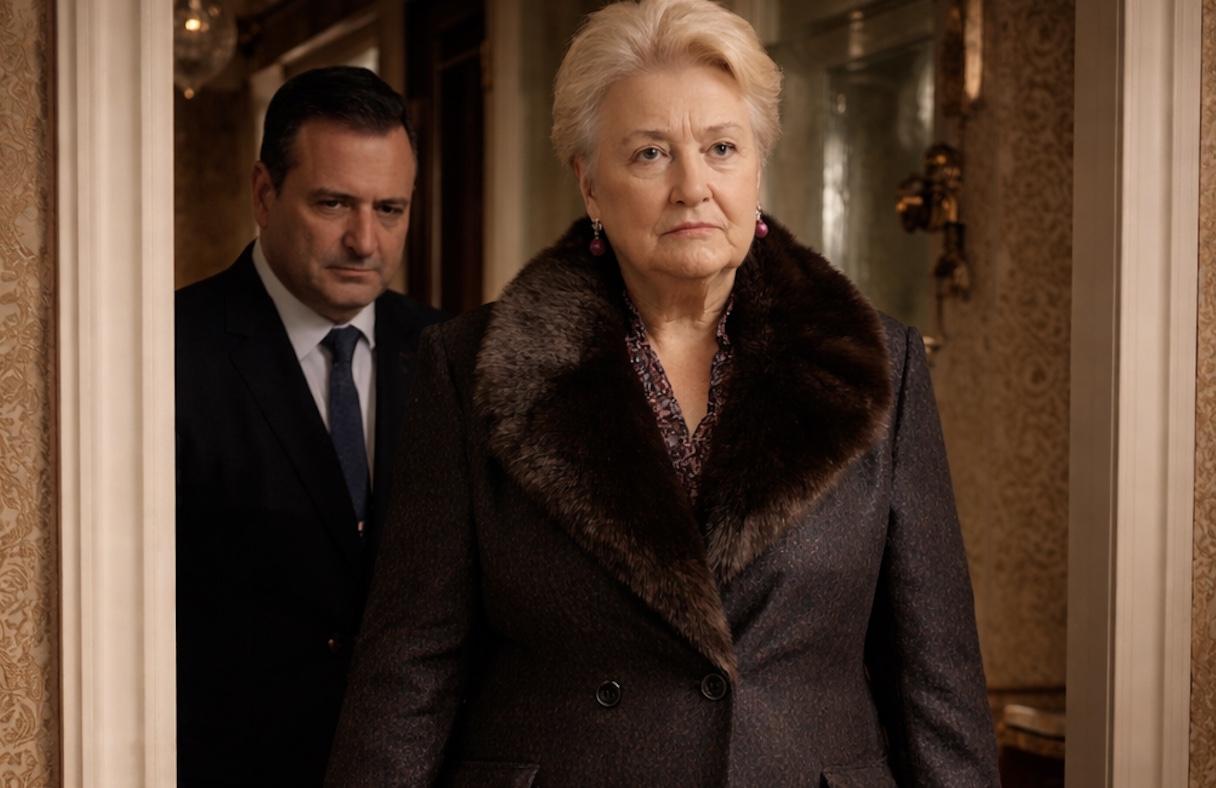
“So here’s how it’s going to be, Marina. I’ve packed my things. I’m moving in with you tomorrow.”
Tamara Vasilyevna stood in the doorway of our apartment in a mink coat, two suitcases in hand, looking at me as though I owed her something. Behind her, my husband Kostya kept his eyes down, too ashamed to meet mine. I felt the floor shift beneath me.
“Wait… what do you mean, you’re moving in? We never talked about this.”
“What is there to talk about? I raised my son. I gave my whole life to him. Now he’s responsible for taking care of me. And you’re supposed to put up with it.”
Her coat smelled of mothballs and expensive perfume. I had hated that scent from the very first day I met Tamara Vasilyevna, five years earlier, when Kostya brought me to meet her.
“So this is Marina?” she had said, looking me over from head to toe. “Kostya, are you sure? She looks so… plain.”
Kostya said nothing then.
Just as he said nothing now.
I worked as a nurse at a neighborhood clinic and earned next to nothing, but I had bought that small two-room Khrushchyovka apartment myself. I had saved for seven years. No vacations, no new clothes, no little indulgences — just one goal.
And Tamara Vasilyevna had lost her spacious three-room apartment downtown. Literally lost it. She had poured everything into some financial scam and ended up with nothing.
“Kostya,” I said, turning to my husband, “did you know?”
He shrugged.
“Mom called yesterday… I didn’t get the chance to tell you.”
“You didn’t get the chance? In twenty-four hours?”
Tamara Vasilyevna walked right past me, leaving wet marks on the parquet floor I had spent three months choosing.
“I’ll take the smaller room. Kostya, bring in the suitcases.”
And he did.
My husband.
Into my apartment.
Carrying the luggage of a woman who had called me “that one” for five years.
For the first week, I endured it.
Tamara Vasilyevna got up at six every morning and clattered around with the dishes. She rearranged the furniture because “it worked better this way.” She threw out my flowers from the windowsill because they were “dust collectors.” She cooked separately for Kostya and made a point of covering his plate with a napkin.
“And what about Marina?” he asked once.
“Marina is an adult. She can cook for herself.”
At work, I caught myself nodding off over patient files. At home, I lay awake listening to snoring through the wall and feeling like a guest in my own home.
On the tenth day, Tamara Vasilyevna called us in for a “family meeting.”
“So here’s the situation. I spoke to a lawyer. Kostya is my son, which means he has a right to half of your living space. And I’m his mother, so he is obligated to support me.”
I nearly choked on my tea.
“This apartment was bought before the marriage. With my money. Kostya is registered here, but I’m the owner.”
“Exactly — registered!” Tamara Vasilyevna said with a triumphant smile. “You won’t be able to take him off the registration. Which means you won’t be able to get rid of me either. As his mother, I have the right to live with my son.”
Kostya stared down at the table.
“Kostya,” I said, my voice unsteady, “do you actually agree with this?”
A pause.
Long as a winter night.
“Mom, maybe we should…”
“Kostenka! I gave you my life! I stayed up night after night for you! And this… this woman…”
“This woman,” I said, “is your son’s wife. And the owner of this apartment.”
That night I didn’t sleep.
I lay there staring at the ceiling, remembering.
The first time Kostya came to see me, holding a cheap bottle of wine and wearing that shy, uncertain smile. The way we painted the walls together. The way he carried me over the threshold after the wedding.
And then all the times he stayed silent.
Every time his mother said something vicious.
Every time he looked away.
Every time he agreed without saying the words.
For five years I kept telling myself it would pass. That he would grow up. That one day he would choose me.
He never did.
A month later, I found a note on the kitchen table. Tamara Vasilyevna’s handwriting was large and bold.
“Marina, we need to have a serious talk. You need to understand your place.”
My hands were shaking, but my mind was clear. I sat down and wrote something of my own.
“What is this?” Kostya asked that evening, staring at the papers I placed in front of him.
“A divorce petition. And an eviction notice.”
Tamara Vasilyevna jumped to her feet.
“You wouldn’t dare!”
“I already did. The apartment is mine. It’s premarital property. Kostya is registered here as the spouse of the owner. After the divorce, that basis disappears. You’ll have thirty days to move out.”
“Marina…” Kostya went pale. “Are you serious?”
“Completely.”
“But I… I thought we…”
“You thought I would keep enduring it. That I had nowhere to go. That I was ‘plain’ and would swallow everything. I swallowed it for five years, Kostya. I’m done.”
Tamara Vasilyevna screamed until her voice turned hoarse. She threatened lawsuits, curses, and every “important connection” she claimed to have. Kostya tried to bargain — “let’s just talk,” “maybe we can work out a compromise,” “Mom is just upset.” I stayed silent. For the first time in five years, I had nothing left to say.
Because I had finally understood something: my husband was never choosing between me and his mother.
He was choosing comfort.
His own.
Always.
And I chose myself.
They moved out three weeks later. Kostya never signed the divorce papers, so I had to go through the courts. Until the very last day, Tamara Vasilyevna kept rearranging my furniture and cooking borscht for her son. As she was leaving, she stopped in the doorway and looked at me. No fur coat now, just a cheap travel bag in her hand.
“You’ll regret this,” she said quietly. “You’ll end up alone. Unwanted by anyone.”
I closed the door.
And for the first time in months, I exhaled.
Now, a year later, I think about Kostya sometimes. People say he’s renting a room in a communal apartment with his mother. People say she’s still making him borscht. And me? I repainted the walls. I got a cat. In the mornings I drink my coffee in silence, and I owe nothing to anyone.
Tamara Vasilyevna was right about one thing: I did end up alone.
But “unwanted by anyone” doesn’t describe me.
It describes her.
And the son she never learned to let go.