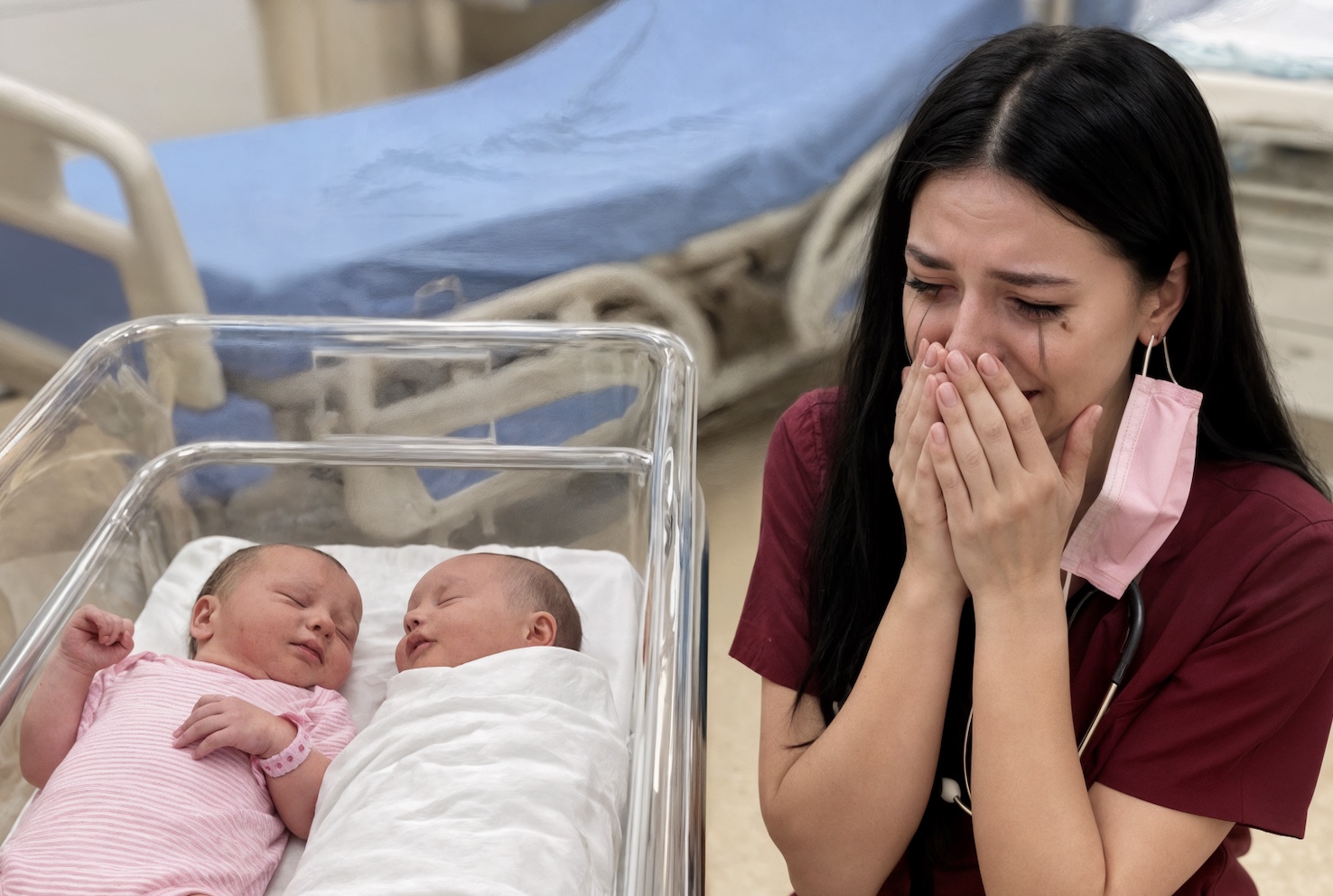
People still tell me that I took too great a risk that day. That I had no right to step outside the rules. But if I had done only what the protocol allowed, one tiny little girl might not have lived until morning.
I had already pulled off my gloves after the shift when a scream came from the maternity ward. And a few days later, it was me who placed an almost fading baby beside her sister — and in that same instant, the room fell so silent that the only thing anyone could hear was the anxious beeping of the monitor.
That evening, I was barely able to stand.
At the Cherkasy Regional Perinatal Center, that happens sometimes: one shift feels as if it burns away half your life, and afterward you find yourself standing by your locker in the changing room, unable to remember whether you ate anything all day besides cold coffee from the vending machine.
I had worked nearly eighteen hours.
The day had brought strokes, road accidents, severe bleeding, and two resuscitations — everything that can drain a person down to the very last drop.
All I wanted was a shower, silence, and bed. Even when my phone trembled inside my bag with a message from my brother, I did not have the strength to answer.
And that was when the scream cut through the corridor.
Not the kind that comes from pain. A different kind — ragged, wild, the sound a woman makes when she has lost control over both her voice and her fear.
The doctors in admissions were already rushing around.
A pregnant woman had been brought in from Smila. Twenty-eight weeks. Twins. Sudden deterioration, a spike in blood pressure, contractions already starting.
“Oksana, don’t leave,” the obstetrician threw over his shoulder without really looking at me. “We’re doing a C-section now. We don’t have enough hands.”
I did not argue.
I simply turned around, put my gown back on, and followed the gurney.
The woman’s name was Iryna.
She was pale, drenched in sweat, shaking with fear. She clutched my sleeve and kept repeating the same words:
“Will you save my babies? Tell me honestly. Will you save them?”
Her husband, Serhii, was walking beside us.
He wore a dusty sweater, as if someone had dragged him straight from work. He was not shouting, not panicking — he had just gone so white that even his lips had turned gray.
The surgery began at once.
In moments like that, there is no time for extra words. Only commands, movement, and seconds.
The first little girl was delivered almost immediately.
Tiny, wrinkled, but stubborn — as if she had already decided from her very first second that she would fight.
The second came a minute later.
And when I saw her, something tightened inside me. She was smaller, limp, far too quiet.
Both babies were taken to neonatal intensive care.
Tiny bracelets appeared on their wrists. I always look at those a little longer than I should. On those narrow strips are already a name, a date, a time — an entire life written across a few centimeters of plastic.
The older one was registered as Marta.
The younger one as Solomiia.
Iryna cried quietly, and somehow that made it even harder to bear.
Serhii stood beside the incubators and looked at them the way men look at something that cannot be fixed with their hands.
“They’re so small…” he whispered.
“We’re doing everything we can,” I answered. And for the first time that day, those were not just routine words.
In the days that followed, I kept going in to see the girls even though they were no longer my responsibility.
I simply could not do otherwise.
Marta was holding on well for a baby born that early.
Her breathing was evening out, her numbers were improving, and she reacted to touch.
But Solomiia seemed to be slipping away.
Her oxygen would drop, then her heart rhythm would turn erratic, then her skin would darken so much that Iryna would start crossing herself right there by the incubator.
The doctors searched for an explanation.
They suspected congenital abnormalities and tested everything they could. Iryna had serious hereditary health issues, so no one was giving the family easy promises.
On the third day, I saw Serhii standing by the window in the corridor.
He was speaking quietly on the phone, as though he were ashamed that someone might overhear his misfortune.
“Mom, don’t sell the ring… We still have enough for now… No, I’ll manage. If needed, you can send it later…”
He noticed me and fell silent.
A receipt from the pharmacy was sticking out of his pocket — more than six thousand.
Iryna hardly ever left the babies.
She sat in a chair, expressing milk, drinking tea from a plastic cup, and looking at the two incubators as though a whole abyss stretched between them.
On the fifth day, Solomiia took a sharp turn for the worse.
Her skin turned violet, her breathing became uneven, and the sound of the monitor grew broken and alarming.
I walked in at the exact moment when Iryna could no longer speak.
She simply pressed her fist against her mouth to stop herself from screaming.
Serhii stood motionless.
That is how people stand when they are almost shattered but still somehow holding themselves together.
There were no medical staff nearby — someone had run to get a doctor, someone else was trying to save another child.
In the room, there were only the three of us and two incubators.
I do not know why that was the exact moment I remembered an old seminar.
Not a protocol, not an article — just one thought: sometimes twins, if their condition allows it, stabilize better when they are placed close together.
It was a risk.
I understood that.
But looking at Solomiia, I understood something else too: she had almost no time left.
“If I try something unconventional… will you let me?” I asked.
Iryna lifted her eyes to mine.
There was no fear in them anymore. No doubt either.
“Do everything… please. Everything.”
I opened the incubator.
My hands were cold, and my back under the gown was soaked.
Carefully, literally millimeter by millimeter, I moved Solomiia next to her sister.
Under one blanket for the two of them.
Marta stirred slightly.
Barely at all. And it seemed to me that even the air stopped moving.
I reconnected everything — the oxygen, the sensors.
The monitor pounded in my ears.
Then the door flew open.
A doctor entered with the team.
She looked into the incubator and went pale with anger.
“What are you doing?! Who gave you permission?!”
I tried to explain, but she was already reaching out to separate the girls.
And at that exact moment, the sound of the monitor changed.
At first, I thought I had imagined it.
Then everyone froze.
The rhythm that had been falling apart only seconds earlier began to steady.
The doctor’s hand stopped in midair.
No one said a word.
All we could hear was the steady sound.
“Don’t touch them,” I said quietly.
She looked at the readings.
“It could be a coincidence… Quickly — blood gas, saturation, pulse. And don’t touch anything.”
For half an hour, none of us stepped away.
Solomiia’s pulse slowly began to even out.
Not normal yet. But no longer on the edge of the abyss.
Iryna sank to the floor.
Serhii cried without making a sound.
“Write down the time,” the doctor said.
Later, I was called in to see the department head.
“Do you understand that you acted without permission?”
“Yes.”
“And that you could have made her condition worse?”
“Yes.”
“Then why did you do it?”
I wanted to give the proper answer.
But I said something else.
“Because she was fading. And I could see it not from the numbers. From her mother.”
He was silent for a moment.
“Officially — a reprimand. Unofficially — go get some sleep.”
But I could not.
I went back to see the girls again.
They were lying together.
Under one blanket.
And they no longer looked like two separate tragedies. They were one story.
Solomiia began to recover, slowly.
Not all at once. Millimeter by millimeter.
Through weeks, through fear, through sleepless nights.
And one day, we were told they could be prepared for discharge.
“Home? Both of them?” Iryna asked, unable to believe it.
“Both.”
Serhii covered his face with his hands.
“Both of them…”
The whole family came for the discharge.
Laughter, tears, noise.
And the little hats they had been too afraid to take out before.
Later, they came back again.
“We want you to be Solomiia’s godmother.”
“Why her?”
“Because you were there when she was almost gone. And Marta… Marta has already been her godmother for life.”
Years passed.
I saw them again — first in a stroller, later running toward each other.
And every single time, I remembered that night.
This is not a fairy tale.
There was fear, exhaustion, mistakes, and risk.
But there was something else too.
Sometimes a person is held here not only by medicine.
Sometimes they are held by another person.
Simply because someone stayed beside them.
And when people ask me what saved Solomiia that night, I do not give them a simple answer.
Because maybe it was not only the machines that kept her here.
Maybe it was her sister, who refused to let her go alone.