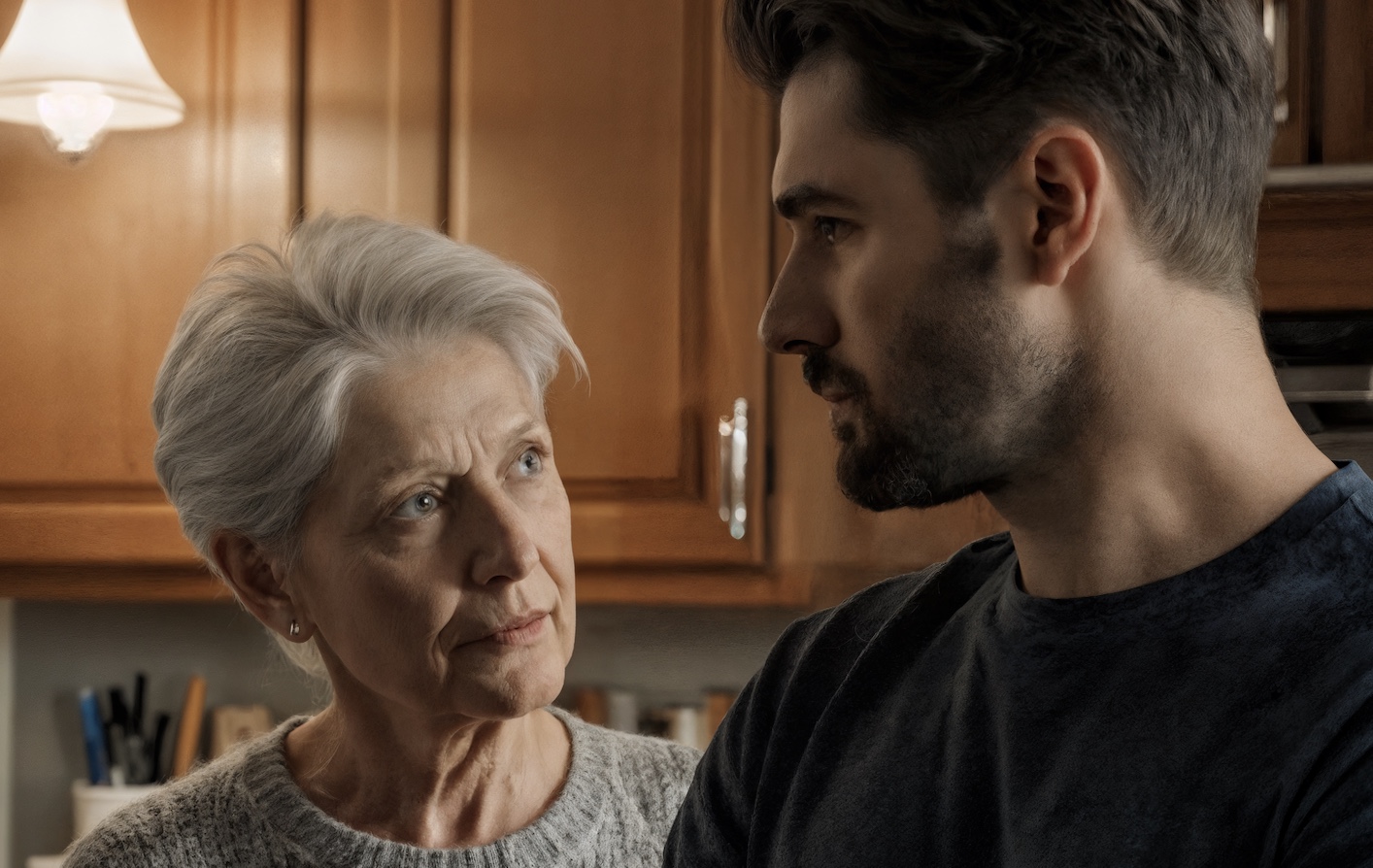
“Did she leave? Is it over?” Kirill’s voice on the phone was stretched tight, like a wire about to snap.
For a moment, there was only silence on the other end. Not long—just a second or two—but in that brief pause he had already imagined the worst. Then Alina answered, her voice soft and worn out, as if she had no strength left.
“She’s gone.”
“Are you okay? Did she… do anything?”
Again, the same silence, heavy enough to swallow every word. He could hear her breathing—steady, almost inaudible—and somehow that frightened him more than sobbing or screaming ever could.
“I’m okay, Kirill. Really. Just come home.”
He did not ask another question. Leaving his unfinished coffee on the desk and snatching his jacket from the back of the chair, he rushed out of the office.
The drive home was torture. The traffic jam on the bridge, which usually caused nothing more than dull irritation, now felt like a real obstacle, a wall someone had built on purpose between him and his apartment. He gripped the steering wheel so tightly that his knuckles turned white. In his mind, all his earlier conversations with his mother played over and over like a scratched record. All those pleas: “Mom, please, don’t.” “This is our family. We’ll handle it ourselves.” “Alina is an adult.” Every single time, she had looked at him with those pale, piercing eyes, nodded, and promised. Promised she would stop dropping by unannounced. Promised she would no longer “teach the young wife how to run a household.” Promised she would respect their home. And every single time, those promises crumbled into dust a week or two later.
He turned the key in the lock. The door opened too easily—Alina had not even locked it from the inside. That was the first warning sign.
The first thing that hit him was the smell: his mother’s perfume, thick and suffocating, some cloying blend of lily of the valley and carnation. That scent had seeped into the walls of his childhood, and now, here, it felt like an act of invasion—hostile, foreign, aggressive. The hallway was perfectly clean. Too perfectly clean. Alina’s bag, usually tossed carelessly onto the console table, stood neatly by one of its legs.
He walked into the living room. On the coffee table, the stack of books Alina had been reading before bed was lined up as if measured with a ruler. The kitchen carried that same sterile, lifeless order. Only one thing stood out: on the countertop, like evidence left behind by a criminal, lay an open cookbook. Not Alina’s, but an old, worn volume printed back in Soviet times. His mother’s. It was opened to a page titled How to Cook Proper, Rich Borscht. Next to it stood a pot with last night’s dinner inside. Kirill lifted the lid. The soup was cold, but he could clearly see oily patches floating on top that had not been there the day before. His mother had “improved” it by adding butter or oil. To make it “more filling.”
He found Alina in the bedroom. She was sitting on the edge of the bed, stiff as a board, staring blankly at the opposite wall. She was still wearing the same comfortable house clothes he had seen on her that morning, but now they looked strange on her, almost like some uniform. Her hands lay flat on her knees, palms down. She was not crying. Her face was calm, almost peaceful, and that calmness sent a cold wave down his spine. It was the face of someone who had already taken the blow, but whose pain had not reached them yet—only numbness remained.
“Alina?” he called quietly, stepping closer.
Slowly, she turned her head toward him. Her eyes were dry and impossibly wide.
“She said I store grains the wrong way. That there should be bay leaves in the cupboard to keep bugs away.” Her voice was flat, colorless, like she was reading a weather forecast. “Then she said I iron your shirts at too low a temperature, and that’s why the collars look dingy. She took one of your shirts out of the closet and showed it to me.”
He sat down beside her, not yet daring to touch her.
“And then?”
“And then she started saying I don’t know how to do anything. That I’m a bad wife. That if it weren’t for her, you would have been buried in dirt long ago and living on nothing but sandwiches. I didn’t say anything. I just stood there in silence. And then she…” Alina stopped and rubbed her forearm, even though there was no bruise there, no scratch, nothing visible. “She came very close. And said she would teach me to respect my elders. Whether I wanted to or not.”
Kirill stared at her hand, at the place she had touched.
And in that instant, something inside him clicked.
Every attempt he had made to smooth things over, to find a compromise, to be both a good son and a good husband—all of it had failed with a violent crack. He realized he had been trying to glue together a broken cup while someone kept smashing it against the floor.
He stood up.
“Stay here. I’ll be back soon,” he said.
There was no anger in his voice, no open threat. Only the cold, final resolve of a surgeon who has concluded that the tumor must be cut out immediately, together with everything around it.
He left the apartment, got into the car, and drove to his mother’s place. He knew exactly what he was going to say.
He opened the door with his own key. His mother’s apartment greeted him with its familiar smell of baked apples and heart drops, a scent that had long since seeped into the wallpaper. Everything here was in its place; everything felt like an extension of her—lace doilies on the old television, a row of porcelain elephants on the polished cabinet, a photograph of him in his school uniform on the dresser. This was her world, her fortress, the place where she was the only true mistress and absolute ruler.
Lyudmila Petrovna was in the kitchen. She was humming softly to herself while wiping down a table that was already shining with cleanliness. The moment she saw her son, she brightened. Her face instantly took on that familiar expression of warm hospitality mixed with the faint weariness of a woman devoted to righteous забота—care, duty, sacrifice.
“Kiryusha, why are you here so early? Did something happen at work? Come in, I just put pies in the oven. Cabbage ones, the way you like them.”
He did not take off his coat. He stayed where he was, standing in the hallway in his overcoat and outdoor shoes, deliberately breaking the order she worshipped. He looked at her—at the neat apron, at the capable hands gripping the rag. There was not a trace of remorse on her face. Not even the smallest doubt that she had done the right thing.
“Mom, you are not coming to our apartment anymore,” he said.
His voice was level, stripped of all emotion.
It was not a discussion.
It was a verdict.
Lyudmila Petrovna froze. Her smile slid from her face, replaced by bafflement, as though she thought she had misheard him. She placed the rag on the table and straightened up, planting her hands on her hips.
“What nonsense are you talking about? I come to help, to check on things. Your Alina can’t manage on her own. She doesn’t know the simplest things. The house is in disorder, the food is bland. I’m doing this for you, for your family.”
“Our family is me and Alina. And we’ll manage just fine by ourselves. So your visits are over. Completely. If we want to see you, we’ll call and invite you.”
That was when the dam burst. The confusion on her face turned into angry crimson blotches. She took a step toward him, her whole body tensing.
“How dare you forbid me from coming into your home? I’m your mother! And I will teach your little wife to respect her elders and do things the way I say, whether you want it or not!”
Her voice broke into a shriek that rang through the little apartment. She began pacing around the kitchen, from table to window and back again, her gestures sharp and slashing.
“So she’s been poisoning your mind, has she? Whispering that your mother is some kind of monster? I saw her when I came in! Sitting there like some princess, filing her nails, while a dirty cup from the morning was still in the sink! I said one word to her—just one—kindly, as an older woman speaking to a younger one, and she stood there staring at me in silence! As if I were nothing!”
Kirill stood motionless, like a rock in the middle of a raging sea. He did not interrupt her. He watched her twisted face, watched her hands cutting through the air, and saw not his mother but a stranger—someone consumed by the hunger for control. He let her speak. Let her pour out everything boiling inside her.
“I told her about the grains, and your shirts too! Who else is going to teach her if not me? She’s an orphan, no one ever taught her anything, so I’ll take that role on myself! For her own good! And instead of thanking me, you defend her! You tell me I can’t come into my own son’s home! Have you forgotten who I am?”
She stopped right in front of him, chin lifted high. Her eyes glittered. She had released the first, fiercest wave of fury, and now she was waiting for his response—for him to shout, to explain, to beg her not to be offended with Alina. She was completely certain that this was the point where he would break. That was how it had always gone before. She created the storm, and afterward he picked up the pieces and made peace with everyone.
But he said nothing.
He just looked her in the eyes, and there was no fear in his gaze. No guilt. Only coldness. And exhaustion. That silence was more terrifying than any scandal, and for the first time Lyudmila Petrovna felt an unpleasant chill crawl down her spine. She had expected surrender. Instead, she was looking at a stranger.
The silence after her shouting was dense and oppressive. Lyudmila Petrovna breathed heavily, her chest rising and falling. She stared at him with a victorious, challenging look, expecting that any second now he would crack, start excusing himself, start pleading. This pause was part of her tactic, her moment of triumph, the instant when the enemy was supposed to fall.
But Kirill did not fall.
He held her gaze. And when she was already opening her mouth to deliver the final blow, he said the sentence that changed everything.
“You will not teach her anything.”
His voice was just as quiet and steady as before, but now there was metal in it.
“Because you’re never going to see her again.”
Lyudmila Petrovna blinked. For a moment, her face became completely blank, confused. The certainty that had filled her only seconds ago vanished like steam from a pot. She did not understand. This did not fit into any of the familiar scenarios of their old arguments.
“And why is that?” she asked, and instead of anger there was something almost childlike in her voice now—genuine bewilderment.
And then Kirill began, calmly and methodically, to dismantle her world piece by piece. He spoke quietly, but every word fell into the ringing silence of the kitchen like a stone dropped into a deep well.
“Because today I filed for a transfer. To a branch office in another city. A thousand kilometers from here. I already put the apartment up for sale. Alina and I are leaving in two weeks.”
Shock.
Not disbelief—shock, pure and unfiltered, freezing the mind. Her face went from crimson to deathly pale. She stared at him as though he had begun speaking some monstrous, unfamiliar language. Selling the apartment? Leaving? Impossible. It could not be true. This was her son, her Kiryusha, her extension. He could not simply vanish.
“You… what?” she whispered. “You’re lying. You’re trying to scare me.”
“I’m not lying, Mom. The listing is already online. The realtor is coming tomorrow to take photos. I’ve taken two weeks off to pack. This is not open for discussion. It’s decided.”
Awareness started breaking through the haze of shock, and it was ugly. This was not a bluff. This was not a threat meant to silence her. This was a plan that had already been set in motion. Her son—her boy—had built an entire conspiracy behind her back. And panic, cold and sticky, began to flood her from the inside out.
“You can’t!” she cried, and her voice shook with rising horror. “You can’t just throw everything away and leave! What about me? What am I supposed to do? You want to leave me here alone?”
She clung to that argument like a drowning person clutching a straw. A son’s duty. Care for an aging mother. That had always worked before. But Kirill only shook his head.
“You have a sister. You have friends. You won’t be alone. You’ll simply lose the ability to control my life. That’s all.”
Control.
The word struck her like a slap across the face. He dared—he actually dared—to call her “care” control. Her rage came back, but now it was different: desperate, cornered.
“So this is all because of her! That little schemer is taking my son away from me! I knew it! I knew from the very beginning she would destroy our family! She turned you against your own mother, made you betray me!”
She was shouting again, but there was no real force left in it. Now it carried notes of hysteria, of helplessness. She was no longer the queen of her castle; she was a deposed monarch watching her empire collapse. She moved wildly around the kitchen, clutching at the back of a chair, then at the edge of the table, as if the ground were slipping out from under her feet.
“You will not sell that apartment! I won’t allow it! It’s my home too!”
“That apartment is mine, Mom. I bought it. And I will do with it whatever I believe is best for my family’s well-being,” he cut in.
His calm was unbearable. It was like a wall all her emotions crashed against and shattered.
She stopped in the middle of the kitchen and looked at him. Terror swirled in her eyes now—the terror of complete, total defeat. Every lever she had ever used, every manipulation, every year of experience steering her son exactly where she wanted him, had suddenly become worthless. He stood before her like a stranger who had come only to deliver terrible news. And in that moment she understood this was not yet the end. He still had more to say. He was looking at her as though he intended not merely to leave, but to burn every bridge behind him. And for the first time, she was truly afraid.
She stared at him, and the fear on her face was primal, animal. Not the fear of losing a son, but the fear of losing power over him. It was the terror of a dictator suddenly seeing the army turn its weapons the other way. She took a step toward him, stretching out a hand as if one touch to his sleeve might restore everything to its old order.
“Kiryusha, my son… don’t do this. Let’s talk. I… maybe I was wrong. Too harsh. But I only meant well. We’re family.”
Her voice, which had been ringing with iron only moments before, had turned soft, pleading. This was her final trick—the shift from whip to sugar, the tactic that had never failed on him when he was young. But he did not flinch. He only looked at the hand she had extended, then back into her eyes, and his gaze was as cold as a surgeon’s scalpel.
“You wanted to teach my wife respect,” he said so quietly that she had to strain to hear him. “Instead, you taught me.”
She froze, not understanding.
“Taught you… what?” she whispered.
“You taught me that some problems cannot be solved with conversations. That there are people you cannot defend yourself from with words. Year after year, you showed me that any agreement with you means nothing. Do you remember when you came to our housewarming with that ‘gift’? The old tablecloth, stained and worn, for our new table. You said, ‘This will do for now, until you can afford something decent.’ You humiliated Alina, her taste, and my income. I asked you not to do things like that. You promised.”
He paused, giving her time to remember. She did remember. And she remembered the rush of superiority she had felt in that moment.
“Do you remember when Alina was preparing for an important project, working from home, and you called her boss to say she ‘looked ill’ and needed rest? You called it concern. It was sabotage. You nearly cost her a project she had been working on for half a year. I spoke to you again. And again you promised not to interfere.”
Every word he spoke was like a nail driven methodically and mercilessly into the lid of her world. He was not accusing. He was stating facts. And that cold recital was more frightening than any shouting or blame.
“Today you came to ‘teach her how to cook borscht.’ You entered my home as if it were your own pantry, as if you had every right to straighten our lives. You touched our things. You criticized our way of living. You tried to intimidate my wife physically. The person I love. And you thought I would come here and let you put me back in my place like some guilty schoolboy.”
He stepped a little closer, and Lyudmila Petrovna instinctively moved back until her spine hit the kitchen cabinets. There was no hatred in his eyes. There was something worse—complete, total indifference.
“So, Mom, your lesson has been learned. You taught me that the only way to protect my family from you is to remove it as far away from you as possible. Completely. Permanently. This is not escape. It’s an amputation. You are the disease poisoning my life, and I am cutting you out of it. Radically. окончательно.”
Lyudmila Petrovna opened and closed her mouth, but no sound came out. The air was gone. The words she wanted to scream got stuck in her throat like dust.
“No need to call. I’m changing my number,” he added from the kitchen doorway.
Then he turned and walked out. Without looking back. His footsteps in the hallway were even and steady. The lock clicked. Then came the sound of the front door opening and closing.
And that was all.
Lyudmila Petrovna remained standing there, her back pressed against the cold kitchen cabinets. The apartment was wrapped in total silence, broken only by the thin, sweet smell of cabbage pies beginning to drift from the oven. The smell of home. Of comfort. Of care. Now it felt sickening, like the smell of a lie. Slowly, she slid down the cabinet door and sank onto the floor. She did not cry. There were no tears. Inside her there was only emptiness. As if someone had taken everything out of her—bones, muscles, soul—and left behind only a shell. She sat on the floor of her immaculate kitchen, in the fortress that had just turned into her prison, and stared at the opposite wall.
A calendar hung there. Once, her son had circled her birthday in red marker.
She stared at that red circle and understood that the day it marked would never come again.
Not for him.
Which meant not for her either.
The pies in the oven began to burn, filling the apartment with the bitter smell of smoke.
But she no longer noticed.