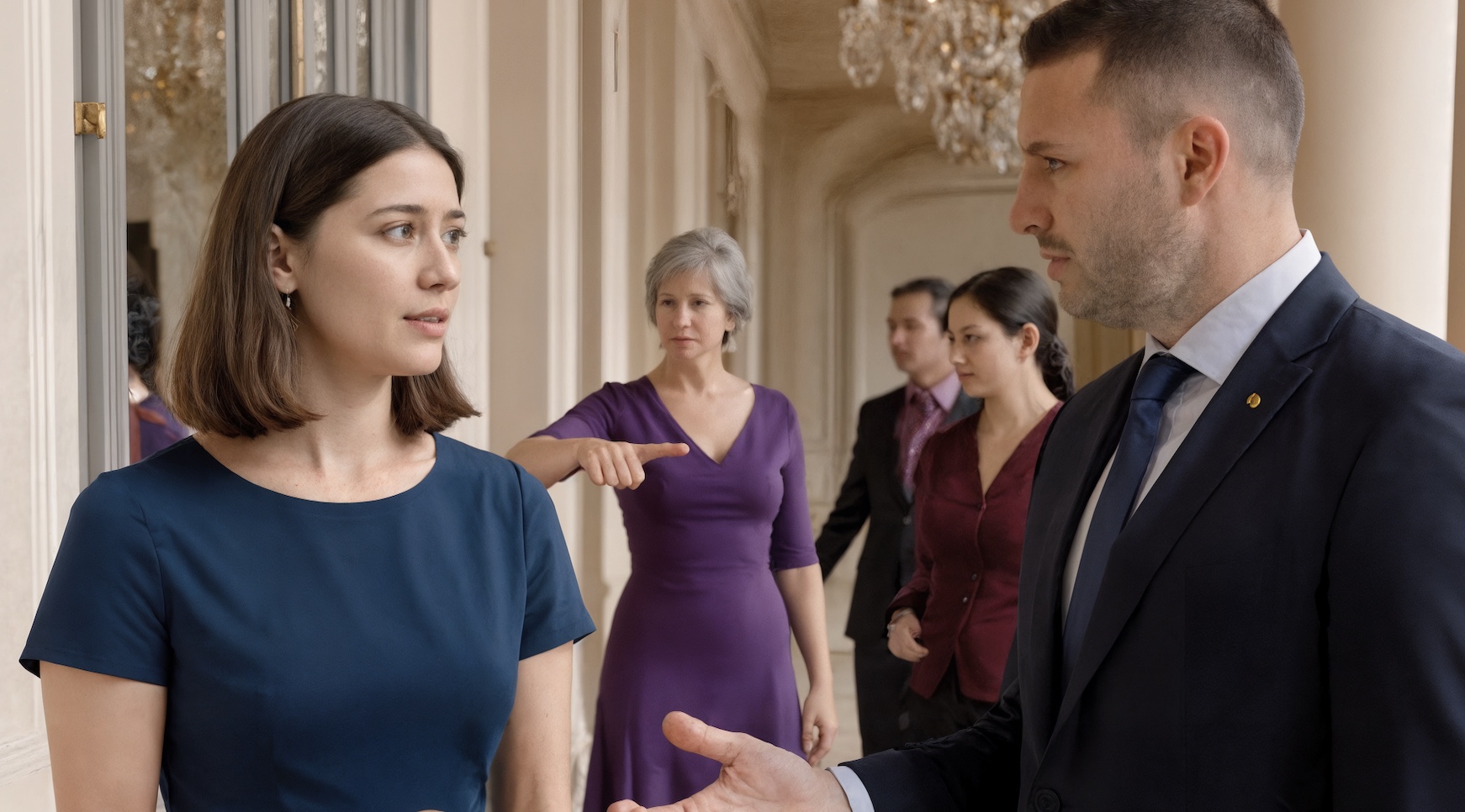
The security guard looked at me politely, but with the kind of firmness people reserve for someone who has clearly shown up at the wrong place.
“Your name isn’t on the list.”
I was standing at the entrance of my parents’ mansion on Rublyovka, holding a gift box in my hands — a Swiss watch, the exact one my father had been talking about for the past three years. I had spent two weeks choosing it and paid for it with my project bonus. And now the guard was shrugging apologetically, as if I had come there to beg for scraps instead of attending my own parents’ anniversary celebration.
“Please check one more time. Vlada Somova.”
He scrolled through the tablet and shook his head. Then I heard laughter from inside — sharp, familiar laughter. Katya, my younger sister. Then music. Then my mother’s voice, cold and precise, as if she were issuing instructions to staff:
“Get that beggar out of here. I don’t want her ruining our evening.”
For a second, I didn’t even understand she meant me. The guard did not understand right away either — he froze, then gave an awkward cough. I turned around on my own. The watch box slipped from my fingers; I caught it before it hit the ground, but the corner was already crushed.
The taxi ride back to the city took two hours. I wasn’t really crying — the tears were just there, running down silently while streetlights and strangers’ houses slid past the window. For twelve years, I had called every week, sent money, fixed problems, paid debts. Roman had jumped from one ridiculous business idea to another — electric scooters, a farm, then something else. Katya went on beach vacations with her children and sent me photos captioned, “Thank you, sis!” My parents never said much. They simply accepted everything, like it was their due for having raised me.
Beggar.
My loft on Vasilievsky Island was silent. I sat down at the computer and opened the spreadsheet — the same one I had kept since the very first transfer. An architect’s habit: document everything, calculate everything, check everything twice. The total at the bottom of the screen glowed like a verdict.
Twenty-two million rubles.
Vacations I never took. An apartment I never bought. A life I never lived.
I poured myself a glass of water. My hands were no longer shaking.
The next morning, I started canceling everything.
My parents’ house renovation — the work was supposed to start in a week, but I terminated the contract.
The cruise — canceled.
Roman’s loan — I had been his guarantor, but not anymore.
Katya’s children’s education program — the second payment would not be going through.
The shared family account everyone had access to — closed in less than ten minutes.
With every call, I felt something sticky and suffocating peeling off my shoulders. By lunchtime, my phone was exploding with calls. I didn’t answer.
They showed up that evening — all of them together. They pounded on the door, rang nonstop, shouted into the intercom. I didn’t open right away. I let them stand there for a while, hoping they might cool down.
They didn’t.
“What the hell do you think you’re doing?!”
My mother stormed in first, her face red, her voice already breaking.
“You ruined the renovation! You canceled the cruise! Have you completely lost your mind?!”
I stood by the table with my arms crossed and said nothing.
“Vlada, this is family,” my father said at last. “You can’t do this. We’re not strangers.”
“Not strangers?”
I lifted my hand. On the table was a printed ledger — all twelve years of support, item by item.
“Twenty-two million rubles. That’s the price of your family.”
Roman frowned, clearly trying to calculate the figure in his head. Katya stared at the floor.
“Yesterday you called me a beggar. In front of the security staff. In front of your guests. You didn’t even let me step through the door.”
“Your mother made a bad joke,” my father muttered.
“A joke?”
I looked at my mother. She looked away.
“For twelve years I was your ATM. I’m Vlada. And you will not get another kopek from me. You crossed me out of your lives, and I’m crossing myself out of your debts.”
“You can’t do this!” Katya finally snapped, lifting her head. “I have children! They need an education!”
“Your husband works. You work. Let your children live on your money.”
“And how are we supposed to finish the renovation?” my mother cried, clutching at her chest. “The roof is leaking!”
“Sell the car. Sell the land. Get jobs. Neither of you is sixty yet, and both of you are healthy.”
My father stepped forward and tried to take my hand.
“Sweetheart, don’t be rash. We were always there for you. We raised you…”
I pulled my hand away so sharply that he actually recoiled.
“You raised Roman and Katya. I raised myself. I started earning money at sixteen. Now get out. Right now.”
They left. The door slammed. I stayed alone in the apartment, and for the first time in twelve years, I went to bed without that weight pressing on my chest.
My mother tried reaching me through mutual acquaintances. “She’s become so bitter,” they told me she was saying.
Roman sent long messages about betrayal.
Katya filled social media with posts about cold-hearted people.
I didn’t read any of it. I blocked them and kept living.
Three months later, I heard my parents were putting the house up for sale.
Roman got a job as a regular manager at a construction company — no grand schemes, no big ideas, just an ordinary position.
Katya stopped posting beach photos.
I didn’t gloat. I just lived.
But the most interesting moment came in August.
I stopped by a café near my bureau and saw my mother sitting at a table in the far corner with a woman about her age. She was speaking intensely, waving her hands. I recognized the woman immediately — Vera Nikolaevna, my mother’s old school friend, a wealthy woman who had often helped people with money.
As I walked past their table, I caught a piece of the conversation.
“Please, just lend it to me, Vera. I’ll give it back in a month, I swear…”
Vera Nikolaevna shook her head, stood up, and left without even finishing her coffee. My mother stayed where she was, staring at the empty cup. Then she pulled out her phone and dialed another number. I stopped by the counter, pretending to choose a pastry.
“Hello, Rimma? Listen, could you maybe… What? No, wait — hello? Hello?!”
She shoved the phone back into her bag. Her face looked gray, tired, deflated. Then she lifted her eyes and saw me.
She froze.
I looked at her calmly — without anger, without triumph, just looked — and walked out. Behind me I heard her hurriedly gathering her things, but she didn’t come after me.
Later, people told me my mother had gone from relative to relative, friend to friend, asking for money. No one gave her any. Everyone knew she had a daughter who had paid for everything for twelve years. And everyone knew how that story had ended.
I started seeing a therapist. I worked. I accepted projects I used to postpone because of endless family “emergencies.” My bureau flourished — for the first time, I stopped scattering my energy everywhere and focused on what I did best.
Then, in September, on my birthday, a package arrived.
Inside was an old jewelry box and a letter. The handwriting was my grandmother Olga’s — she had passed away five years earlier. The letter was short:
“Vladochka, if you are reading this, it means you have finally stood up for yourself. I always knew they would keep taking from you until you put a stop to it. Inside the box is a key to a bank deposit box. My inheritance is there. I left them nothing, because they do not know how to value anything. But you do. Live for yourself, my dear. Love, Grandma.”
I sat on the floor holding the letter against my chest.
Someone had seen me after all.
Someone had known.
I used the money to create a scholarship fund — the Olga Somova Fund. It was for people who carry entire families on their backs and are afraid to break that bond. I knew how many people lived like that. I knew what it was like to be needed only when money was involved.
Two years passed.
My parents never called.
Roman kept working, remarried, and had a baby.
Katya moved to another city and sometimes sent polite holiday greetings.
I never replied. Not out of revenge — I simply had nothing left to say.
Last week, I finished a cultural center project in Vyborg. The client told me it was the best work I had ever done.
I smiled, because I knew he was right.
Yesterday I ran into Katya in a metro underpass. She was carrying heavy bags and looked exhausted. She saw me and stopped. I stopped too. We stood there for maybe ten seconds, just looking at each other. Then she lowered her eyes and walked on.
So did I.
Today is Saturday. I’m sitting in my studio on Petrogradskaya, working on a personal project. It’s raining outside. There are drawings spread across my desk. Soft music is playing in my headphones.
I’m alone.
And I’m happy.
I was never the beggar.
The real beggars were the ones who kept demanding, while giving nothing back.