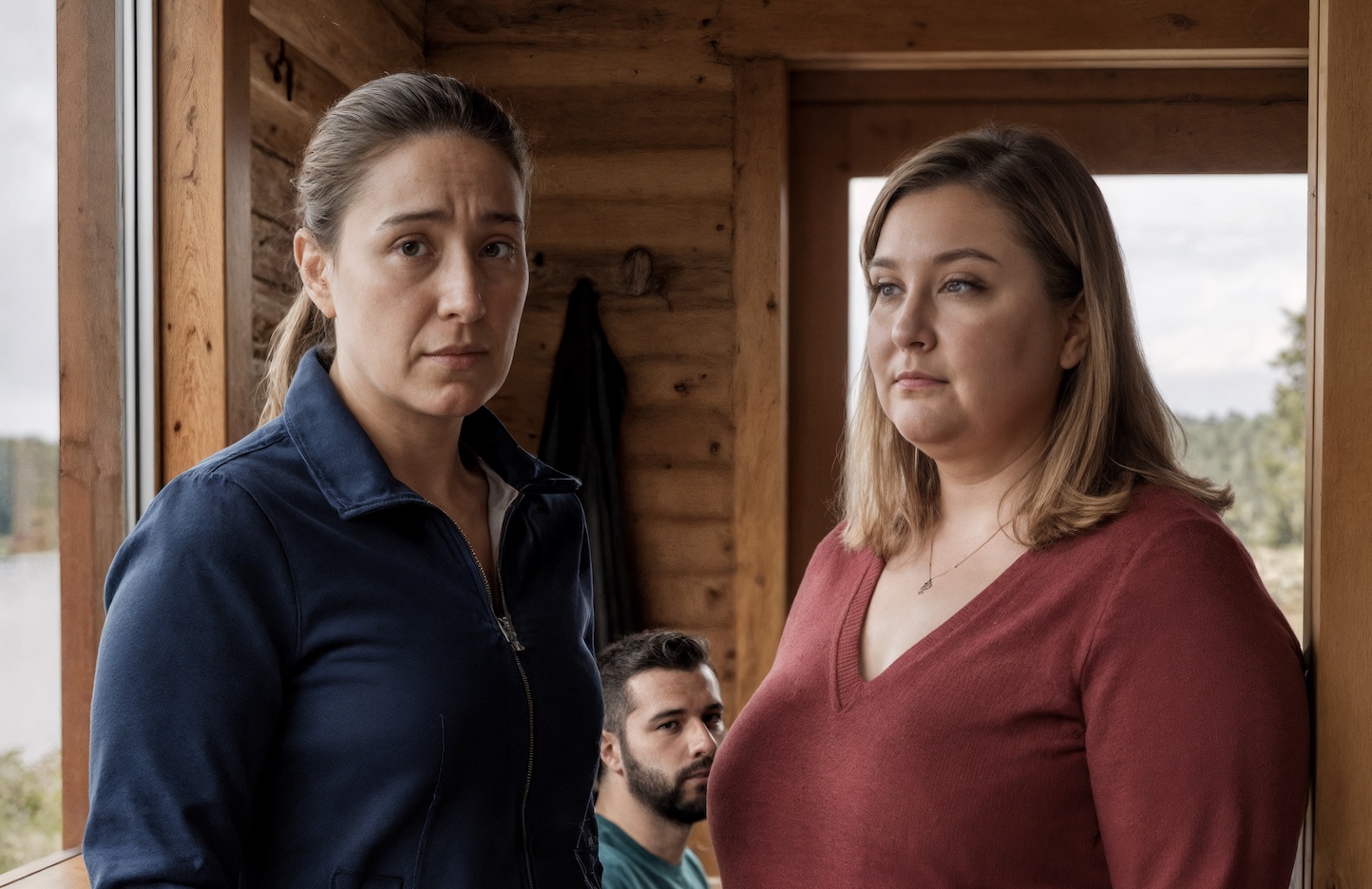
The key would not go into the lock.
Ekaterina tried again, but the door was locked from the inside. She stood on the porch of her own house with a suitcase in her hand, listening to the sound of someone opening the refrigerator inside. Then came a woman’s voice she knew all too well.
“Oleg, don’t forget the mayonnaise. I’m making a salad.”
Seven years. For seven long years, she had saved money from every paycheck, denied herself vacations, and worn the same coat through three winters in a row. She had bought this house by the river, registered it in her own name, and told no one except Aunt Nina. She had left her a spare set of keys for emergencies.
Ekaterina pressed the doorbell and kept her finger there.
The voices inside fell silent. Then she heard footsteps. The door flew open, and there stood Marina, her younger sister, wearing house slippers and carrying a dish towel over one shoulder.
“Oh, it’s you. Come in. Why are you standing there?”
Ekaterina stepped inside. The house smelled of fried onions and someone else’s life. Oleg’s jacket hung on the rack, his muddy shoes were by the door, and Marina’s bag sat in the corner with a glossy magazine sticking out of it.
“How did you get in here?”
Marina wiped her hands on the towel and did not even flinch.
“Aunt Nina gave us the keys. She said you wouldn’t mind. We’ve got renovations going on, you know that. I thought you already knew.”
Oleg came out of the big room—the one with the river view. He nodded at her the way a neighbor might in a stairwell.
“Hey, Katya. Staying long?”
She looked at them and understood one thing clearly: if she started yelling now, they would get exactly what they wanted. A reason to call her hysterical, greedy, selfish. A chance to run to their parents and complain: “Katya is so heartless, she would not even help her own sister.”
Ekaterina placed her suitcase by the wall.
“Not long,” she said calmly. “I’m leaving again tomorrow.”
The next morning, she did not sit down to breakfast with them. She waited until Marina announced that they were driving into town—“we need to pick up a few things”—and simply nodded. Of course. Go ahead.
The car disappeared around the bend. Ekaterina pulled out her phone and called a locksmith from the neighboring village. He arrived forty minutes later, worked quickly and in silence, changed the front door lock, replaced the gate lock, and mounted a sign that read:
Private Property. Video Surveillance.
Ekaterina paid him, walked him to the gate, and locked it behind him with the new key. Then she packed Marina and Oleg’s belongings into bags, carried them out to the porch, sat down in a chair by the window, and waited.
An hour and a half later, Marina called.
“Katya, we can’t get in! Did you seriously change the locks?!”
“Yes.”
“But our things are in there!”
“They’re on the porch. Come and get them.”
“Have you lost your mind?! Is that even legal?!”
“The house is in my name. I never invited you,” Ekaterina said quietly, almost monotonously. “So yes, Marina, it is legal.”
The line went dead.
Five minutes later, her mother called. Then her father. The same accusations over and over: cruel, selfish, how could she be so stingy, they thought she would help.
“I help when people ask,” Ekaterina said. “Not when they use me.”
Her father changed his tone and spoke more gently.
“Aunt Nina wants us all to come over and talk this through properly, as a family. Tomorrow evening. Will you come?”
Ekaterina was silent. She knew it was a trap. But refusing would only hand them another advantage.
“I’ll come.”
Aunt Nina met her at the door, hugged her tightly, and whispered:
“I never gave them the keys. She took them out of my bag while I was in the bathroom.”
Ekaterina nodded. That was exactly what she had expected.
Inside the room sat her parents, Marina, and Oleg. Ekaterina took a seat across from them and placed her phone on the table, screen facing up.
“Let’s settle this peacefully,” her father began. “Katya, Marina is going through a difficult time. They need support. And your house is just standing there empty.”
“It is not empty. I go there.”
“What personal space?” her mother burst out, throwing up her hands. “Family comes first! Marina is younger, she needs help!”
“Helping is when someone asks,” Ekaterina replied without raising her voice. “Not when they break in.”
Marina let out a trembling sob.
“I thought you wouldn’t mind. We’re family.”
“Family does not steal keys from an eighty-year-old woman.”
Aunt Nina straightened in her chair. Marina turned pale. Oleg tensed but said nothing.
“The house is mine,” Ekaterina said, looking directly at her sister. “You will never set foot in it again.”
Her father stood up and let out a heavy sigh.
“Then there is nothing more to do here. Marina, let’s go.”
They began gathering their things. Ekaterina sat motionless. Then suddenly the phone on the table lit up with a notification.
She glanced at the screen—and froze.
The video doorbell. Motion detected at the front door.
On the screen was Oleg, holding a screwdriver and working at the lock.
Ekaterina slowly lifted her eyes. Oleg’s chair was empty.
She turned the phone so everyone could see. Aunt Nina gasped. Her mother’s mouth fell open. Her father stood still with his coat in his hands.
“Where is Oleg?” Ekaterina asked.
Marina twitched.
“He just stepped outside… for some air.”
“For some air. With a screwdriver. At my house.”
On the screen, Oleg was now openly trying to force the lock, glancing around nervously. Aunt Nina rose from her chair. Her face turned hard as stone.
“You brought Katya here to distract her,” she said slowly, each word sharp and clear. “So that this thief could break into her house again.”
Her mother tried to object, but Aunt Nina cut her off with one sharp gesture.
“Quiet! Get out of my house! All of you! Right now!”
“Aunt Nina, but—”
“Out, I said!” the old woman snapped, stepping toward the door and throwing it open. “I thought you were decent people. But you are nothing but intruders. Taking advantage of me because I’m old.”
Her father tried to speak, but Aunt Nina jabbed a finger at his chest.
“You, Viktor, are a disgrace. You are betraying your own daughter for the sake of the younger one. Katya worked seven years to buy herself a place of her own, and you want her to hand it over just like that. Get out!”
They left in silence. Marina was sniffling in the hallway. Ekaterina kept staring at the phone screen—Oleg had already stepped away from the door. Someone had clearly warned him.
Aunt Nina lowered herself into a chair, breathing heavily.
“I’m sorry, my girl.”
Ekaterina took her hand.
“I knew from the start, Auntie. I knew.”
Three days later, Ekaterina had a full security system installed. Cameras around the perimeter, an alarm, sensors on the windows. The technician looked surprised, but asked no questions.
Marina kept calling for another week. She sent messages too—some pleading, some angry. Ekaterina did not respond. Their parents tried to pressure her into another conversation, but she refused.
Eight months passed. Then Aunt Nina called and said Marina had given birth. A girl.
Ekaterina hung up, sat by the window for a while looking at the river, then ordered a handmade baby blanket and had it sent to her parents’ address. No note. No explanation.
A week later Marina sent a text: “Thank you.”
Ekaterina read it and did not reply.
She was no longer carrying anger. She simply no longer allowed anyone into the boundaries of her life without permission.
One day she ran into Marina at a grocery store. Her sister was pushing a stroller and looked exhausted. They crossed paths near the checkout. Marina nodded. Ekaterina nodded back. Neither spoke. They went their separate ways.
Ekaterina no longer felt resentment. Only clarity. She had spent far too long allowing other people to decide what happened in her life.
Half a year later, a message came from Aunt Nina:
“Marina asked if she could come see you. To talk. It’s your decision.”
Ekaterina read it twice, then slipped the phone back into her pocket.
Not today. Maybe not tomorrow.
Or maybe someday. When her sister learned how to ask instead of demand. When their parents understood that children owe them nothing simply for being born.
But she did not try to predict the future. The house was hers. So was her life.
Ekaterina sat on the veranda, looking out at the river. The water moved slowly around the stones. Autumn was taking hold, and the air had turned sharp. She held a mug of something hot in her hands and thought: she had spent seven years saving for this piece of freedom. And when the moment came to choose between what was “right for everyone else” and what was right for herself, she chose herself.
Not everyone would understand. Not everyone would forgive her. But the people who truly loved her would accept it.
Aunt Nina came every Sunday. They drank tea on the veranda and talked about books, the weather, and the neighbor’s dog. The old woman never once asked whether Ekaterina had forgiven the family. She understood something important: forgiveness is not always necessary. Sometimes it is enough simply to let go.
Ekaterina stood up, took her mug, and went back inside. She locked the door—the same lock that had been changed that day—and walked into the large room overlooking the river.
There were no чужие voices there now, no чужие demands, no чужие expectations. Only her, her house, and her rules.
And that was the only thing that mattered.
If you want, I can also make it sound even more like a published English short story, with smoother literary phrasing.