“Yelena Dmitrievna Vlasova? This has to be placed in your hands personally.”
I signed for it. Then I locked the door—both deadbolts. My heart was pounding somewhere up in my throat.
My son.
Sergey hadn’t called in six months, ever since I refused to swap my modest two-bedroom place just to add to his down payment.
I tore open the envelope. Inside was a card with gold embossing and the lingering scent of expensive perfume.
“Sergey & Kristina. The birthday of our family. Onegin Restaurant. Dress code: Black & Gold. Formal evening wear only.”
I went to the mirror. A fifty-five-year-old woman looked back at me—exhausted, wearing a robe covered in little pills of lint. My “formal wardrobe” was basically a pair of black pants from five years ago and a blouse I wore to coworkers’ anniversaries. No gold. No sparkle. In my wallet—what was left of my paycheck advance and a little stash I’d been saving for winter boots.
That evening Sergey called himself.
“Did you get it?”
“I did, sweetheart. It’s very beautiful. Must be expensive, I guess?”
“Mom, don’t start,” he said, his voice dry. “This is a status event. Kristina’s father’s partners will be there. My bosses too. Please, look presentable. Don’t wear that market dress you wear to the dacha.”
“I don’t have anything else, Sergey. And I don’t have money right now…”
“I knew it. Fine. I’ll send you five thousand. Buy something black and floor-length. And get your hair done at a salon—don’t set it on curlers yourself.”
He hung up.
I stared at my phone. Five thousand—for a gown and a salon.
That month I didn’t buy winter boots. I didn’t pay utilities. I borrowed money from my neighbor—something I had never done in my life. But I bought a dress. Simple black, yet made from decent fabric. The shoes had to come from a consignment shop—they pinched, but they looked almost new.
On the wedding day I arrived early.
Onegin was glowing with lights. The parking lot was packed with foreign cars that cost more than my apartment.
Guests stepped out—unhurried men, women wrapped in fur and silk. I felt like a trespasser who’d snuck into someone else’s celebration.
Sergey was greeting people at the entrance. In a pricey light-blue suit he looked like a stranger—grown up, hard, polished. Beside him stood Kristina, a porcelain doll with ice-cold eyes.
I walked up and held out an envelope with cash—everything I’d managed to scrape together.
“Congratulations, my dears.”
Sergey glanced at me, slid the envelope into his inside pocket without even checking what was in it.
“Hi, Mom. You look… fine. Good enough. Go in—they’ll show you. Table eight.”
He immediately turned to a heavyset man climbing out of a SUV.
“Viktor Petrovich! What an honor!”
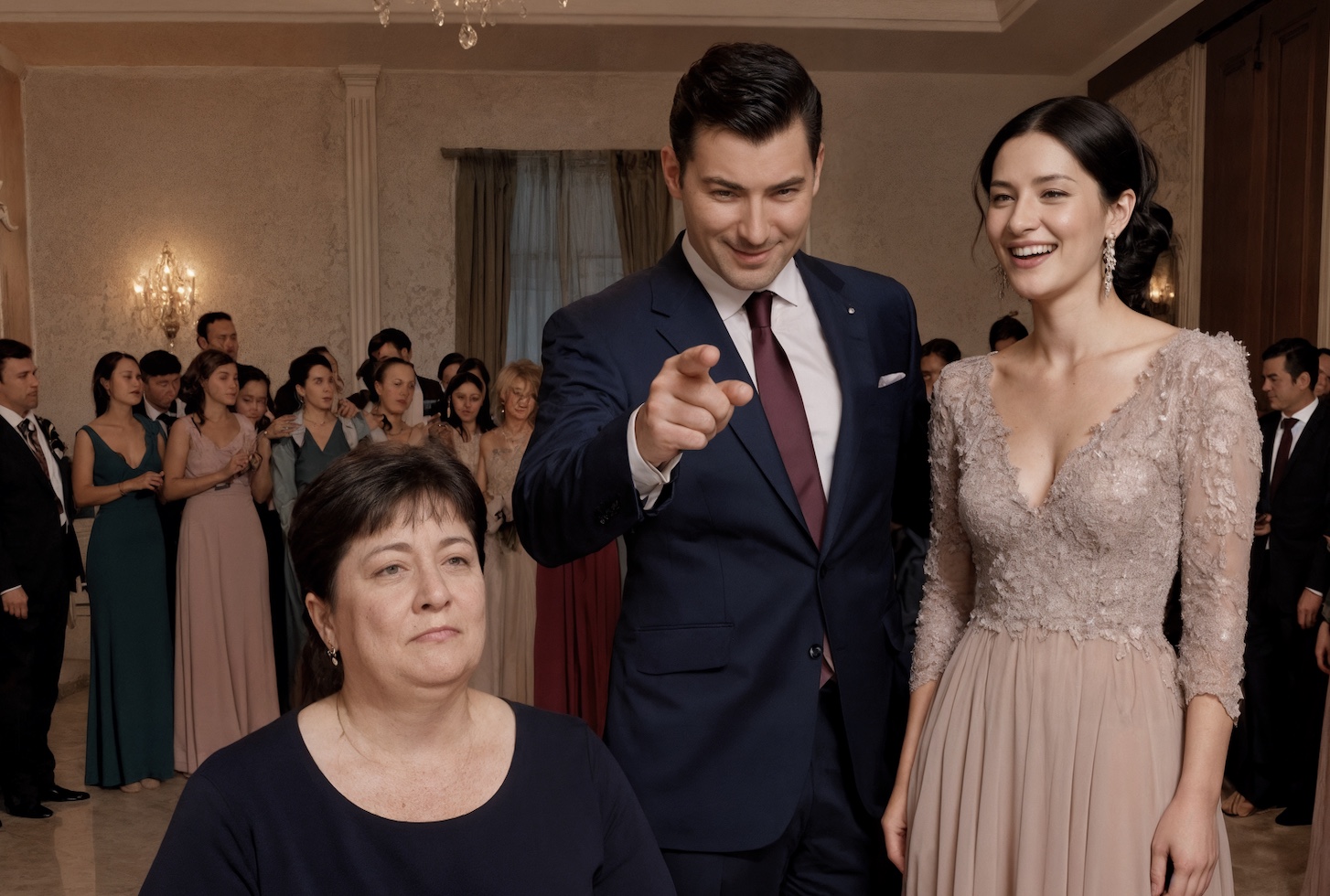
The banquet hall was enormous: crystal chandeliers, living orchids, live music. They guided me past the central tables where Kristina’s parents, their relatives, and the important guests sat. Table eight was in the far corner, half-hidden behind a column. A kitchen door was right next to it, slamming constantly as waiters rushed out with trays.
At my table sat a hard-of-hearing grandmother—some distant relation from the bride’s side—and two teenagers glued to their phones.
“Exile,” the grandmother announced loudly, adjusting her hearing aid. “That’s what this is—exile. Away from the gentry’s eyes.”
I didn’t answer. I kept my back straight.
I was the groom’s mother. I had a right to be there.
Toasts flowed nonstop. Kristina’s father gave the newlyweds a set of apartment keys in a brand-new building. The room erupted in applause. Sergey’s friends presented vouchers for the Maldives.
No one mentioned me. The MC never called my name—apparently I hadn’t made it onto the speaking list. I sat there squeezing a napkin in my hands and smiling whenever everyone clapped.
Then the main course began.
Waiters—fast, disciplined—carried out platters piled with steaming meat. First the couple’s table. Then the bride’s parents. Then the VIPs. Then the friends.
Forty minutes passed. On our table there were only empty salad bowls. The teenagers started tearing bread from the basket.
Finally a breathless waiter approached us. There were just two plates on his tray. He set a steak in front of me. The meat was gray, no sear. The side was cold, stuck-together asparagus. The little sauce dish was empty.
“I’m sorry,” he muttered without meeting my eyes. “We miscalculated a bit. This was the last portion—it cooled off. But the doneness is right.”
I looked at the nearby tables. People there were eating juicy pieces still sending up steam.
“Thank you,” I said quietly.
I didn’t eat.
A lump in my throat wouldn’t let anything pass. I needed to step outside, breathe.
My shoes were rubbing my feet raw, but I walked straight, refusing to limp.
On the terrace it was dark and chilly. I stood behind a decorative arborvitae and pressed my forehead to the cold glass.
From the far side of the terrace—where the smoking couches were—I heard voices.
“…Serge, that was kind of ugly,” Kristina said lazily, with no real emotion. “Your mother got served scraps. Aunt Lyuba noticed. People whispered.”
“Forget it,” my son replied, cheerful, relaxed. “Nobody noticed anything.”
“She’s sitting there in the corner like some poor relation. Maybe move her?”
“Kristina, don’t start. Where would I move her? Next to your father? What would they talk about—buckwheat prices? Let her sit. Mom’s not proud. She’ll finish it—she won’t fall apart. She’s used to it. Her whole life it’s been, ‘As long as little Seryozhenka is happy.’ She’s fine. She enjoys suffering.”
Kristina let out a soft laugh.
“You’re mean.”
“I’m practical. Come on—time to cut the cake.”
They walked away.
I stood behind the tree.
Inside me, everything went very, very quiet—like a winter forest when the cold freezes sound itself.
“She’ll finish it.”
“She’s fine.”
I remembered selling my grandmother’s earrings to pay for his English tutor. I remembered wearing patched tights under my pants so I could buy him trendy sneakers. I remembered scrubbing stairwell floors at night so he wouldn’t feel poorer than the other kids at college.
He had seen it all.
And he decided it wasn’t love. It was my nature.
To him I wasn’t a person. I was a function—staff. A service unit meant to be invisible and convenient.
I went back inside, picked up my purse. From the table I took the untouched plate of cold meat and carefully set it on the floor by the table leg.
Like a bowl for a dog.
No one noticed me leave.
At home, I didn’t cry.
I took off the expensive dress and hung it neatly in the closet. Then I pulled out a folder of documents. Inside was the deed to my dacha—land inside the city limits, a sturdy year-round house, gas, running water.
Sergey had been counting on that property.
“When the baby’s born, we’ll live there—fresh air,” he used to say.
In his mind, it already belonged to him.
The next morning I didn’t call my son.
I called a realtor I’d worked with years ago.
“Anya, hi. Do you still have that buyer for my dacha? The one with cash?”
“Yelena Dmitrievna?” Anya sounded shocked. “I do. But you said it was for your son—no amount of money—”
“Things have changed. If he closes today, I’ll drop the price by a hundred thousand.”
“I’m calling him.”
The deal happened in a single day. The buyer could hardly believe his luck. By evening I was holding a sum of money I’d only ever seen in movies.
I repaid my neighbor. Paid the utilities.
Then I walked into a phone shop.
“Hi. I need a new SIM—so my number can’t be known to anyone. Block the old one.”
After that I went to the Russian Railways website.
I didn’t even know where I wanted to go. I simply tapped at the map. A small town on the Volga—quiet, pretty.
I’d always wanted to paint. I just never had time.
I rented a tiny house there for the entire summer. Bought an easel, paints, canvases. I left my apartment keys with my neighbor and asked her to water the plants and check the mail.
Three months passed.
I sat on the Volga’s bank painting a quick study. The sun was setting, the water glittered—like that dress I never bought. My new phone stayed silent. Only Anya the realtor and my neighbor had the number.
I returned to the little house after dark.
A familiar car stood by the gate.
Sergey.
He was smoking nervously, pacing back and forth. When he saw me, he flicked the cigarette away and strode over. He looked rumpled and furious.
“Well. Hello, Mom.”
“Hello, Sergey. How did you find me?”
“Through the neighbor. Had to knock forever.” His voice turned sharp. “What are you doing? Have you lost your mind in your old age?”
“What is it?” I opened the gate but didn’t invite him in.
“What is it?!” he exploded. “You sold the dacha! My dacha!”
“My dacha,” I corrected calmly.
“We already started packing! Kristina’s five months pregnant—she needs fresh air! We were counting on that house! I already found a crew to redo the heating! Where’s the money?”
He held out his hand as if expecting me to pull out a wad of bills from a kitchen apron pocket.
“There is no money,” I said evenly.
“What do you mean, no money? There were millions!”
“I spent it.”
“On what?!” He scanned me—the simple linen sundress, the paint on my hands. “What could you possibly spend that kind of money on?”
“On living, Sergey. On my life. I bought myself freedom from having to swallow cold leftovers. I put money in a deposit account, and now I’ll travel. I enrolled in painting classes.”
He stared at me as if I’d turned into a stranger.
“You… how could you? You robbed us. For your little whims you took a decent home away from your grandchild!”
“Your child has a father,” I said. “Healthy, strong, successful. A man who thinks his mother is fine eating scraps. So feed your own family yourself. I’ve done my time.”
“I’ll never forgive you,” he hissed. “You’ll never see me again. You’re not my mother.”
“Alright,” I nodded. “If that’s what you want.”
He drove off, throwing up a cloud of dust. I watched him go and thought I should be in pain.
But there was no pain.
Only relief—like I’d finally taken off a backpack full of stones I’d carried for thirty years.
Five years passed.
I stayed in that same little town. I bought the cottage outright. Tourists began purchasing my paintings—simple, warm ones. I got a dog, a ridiculous terrier named Bublik.
I heard nothing about my son.
Then one day a notification popped up on social media. I’d made an account just to post my work. A message from a user named “Sofia S.”
“Hello! Are you Yelena Vlasova? The artist?”
I opened the profile. The avatar showed a little girl, maybe four years old, with serious gray eyes.
My eyes.
“Yes, that’s me. How can I help?”
“My mom says you’re my grandma, but you’re mean and you ran away. And my dad said you died. But I found your painting online, and the signature is the same as the one my dad has in an old notebook. Are you really my grandma?”
My breath caught.
Kristina. So they did talk about me.
And Sergey…
“Died.”
Well. For him, maybe I had.
I typed my reply slowly, choosing every word:
“Hi, Sofia. I’m alive. And I’m not mean. Sometimes grown-ups get tangled up and hurt each other. But grandmothers don’t stop being grandmothers just because they live far away.”
“Can I write to you? Dad gets mad when I ask about you. But I want to learn to draw. Mom says I have talent, like… like someone.”
I smiled.
“Of course you can. I’ll teach you. Draw what you see from your window and show me.”
A minute later a photo arrived: a crooked child’s drawing in markers—a house, a tree, and a big yellow dog.
I picked up my brush.
On a small canvas, I quickly painted an answer: a serious-eyed little girl and a funny terrier sitting on the shore of an enormous river.
I don’t know if my son will ever forgive me.
I don’t know if I’ll meet my granddaughter in real life.
But I know one thing: I will never again sit quietly and wait for handouts. I’m building my life with my own hands, and in that life there’s room only for people who can respect me—not my usefulness.
That evening I took Bublik for a walk. The river was calm and vast.
Just like my soul now.