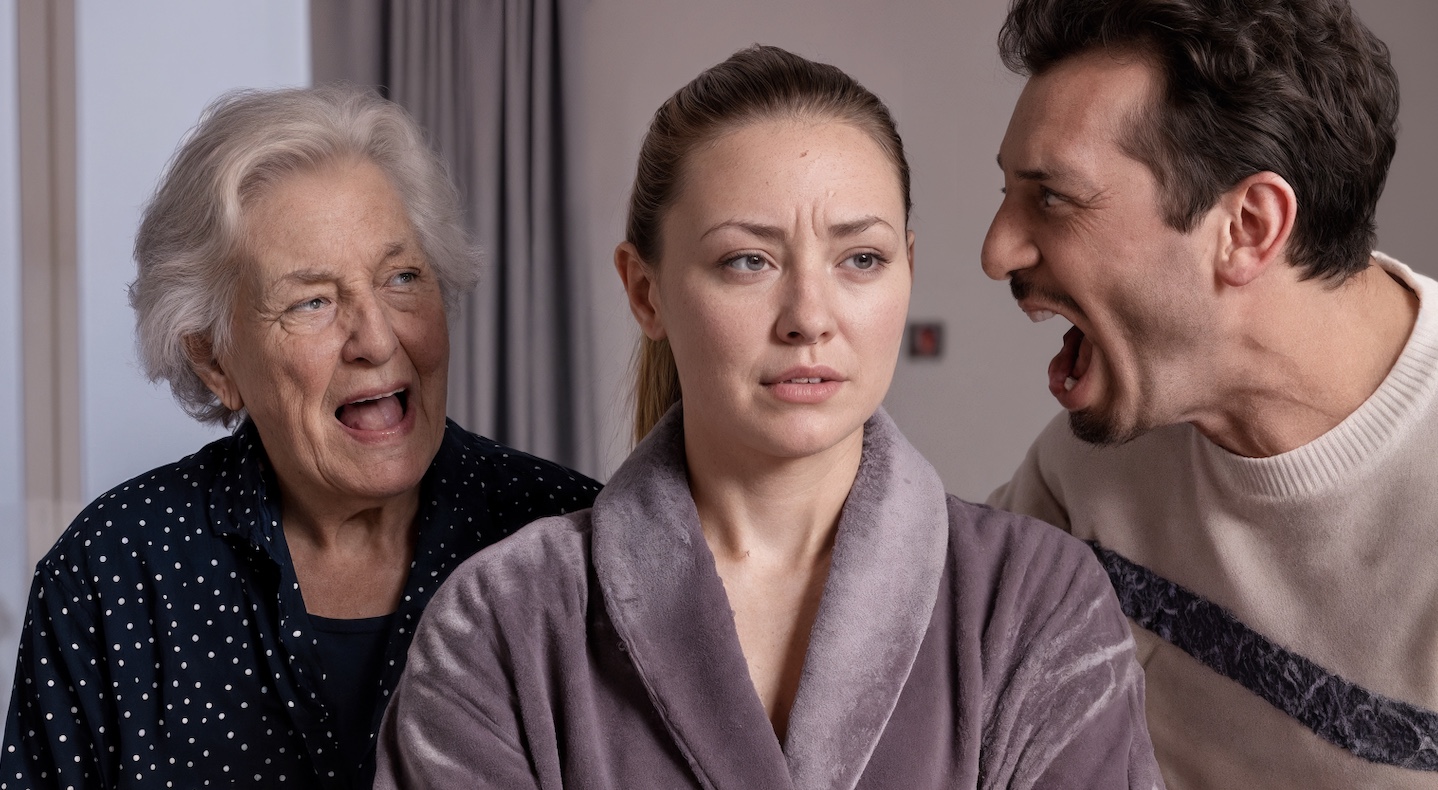
“Shut your mouth already! I’m tired of your whining!” Egor snarled, flinging his phone onto the sofa so hard it bounced once and thudded onto the floor.
Outside, snow was coming down in thick, lazy clumps, sticking to the windowpanes and turning the city into a smeared white blur. The apartment reeked of burnt oil and something else—something stale and sharp, like resentment that had been living here for years. Marina stood at the stove, gripping its edge as if it were the only solid piece of ground left above a yawning drop.
How did we end up like this? The thought flashed through her, but it never fully formed—her husband was already charging ahead, past the point of reason.
“Stop side-eyeing me or I’ll smack you! And then you’ll be the one watching my mother and cleaning the house!” he barked, his face turning blotchy with anger.
Marina turned around—slowly. Her wooden spoon kept moving in the pot even though the burner should’ve been turned off ages ago. She looked at him, at the man she’d spent twelve years with. Once, he’d carried her over puddles, laughed easily, kissed the top of her head while they waited at bus stops. And now… now he stood in the middle of their cramped kitchen, wound tight like a spring, ready to snap—and he was threatening her. Her, Marina—the woman who washed his socks, ironed his shirts, swallowed her irritation and endured his mother’s constant jabs.
“What are you even talking about?” Her voice came out softer than she intended.
“What am I talking about?” Egor mocked, stomping to the fridge and yanking out a beer. “I’m talking about my mother sitting all alone in that apartment, barely able to walk, while you’re sprawled here like some spoiled lady! Her blood pressure’s high, her heart’s acting up—and you couldn’t care less!”
Marina shut off the gas and turned to face him completely. Something inside her dropped away—maybe the last thread of patience, maybe the last hope that this could still be fixed.
“Sprawled?” she repeated, a harsh bite slipping into her tone. “I’ve been on my feet since six this morning. I did laundry, hung it up, cooked, ran to the store twice. And at lunch your mother called and spent thirty minutes explaining what a worthless housewife I am. Thirty minutes, Egor. I listened and didn’t say a word!”
He snorted as he popped the cap against the table edge.
“So what? She’s right. Look at you—seriously, look. The way you walk around the house. That shabby robe, your hair a mess…”
Marina glanced down at her lilac velour robe—old, sure, but comfortable. Her hair was tied back because you can’t stand over boiling pots with it hanging in your face. And he used to tell her she was beautiful like this—at home, natural. He used to say he loved her morning bedhead, her sleepy face, the smile she’d give him from under the blanket.
“Are you actually making fun of me right now?”
“I’m telling the truth,” he cut in and took a long gulp. “You’ve completely let yourself go. You used to take care of yourself, and now… Mom’s right. You need to shake yourself up.”
There it was. Heat climbed from Marina’s neck to her temples. So they’d talked about it—Egor and his mother. Talked about her, behind her back, more than once. Weighed her up, criticized her, passed judgment like she was some object.
Stay calm, she ordered herself. Don’t explode. Don’t scream.
But her hands were already trembling.
“So what exactly do you and your mother say about me?” she asked, forcing her voice to stay even.
Egor shrugged without looking at her.
“What’s there to say? The facts speak for themselves. You sit at home, you don’t bring in money…”
“We agreed to this!” Marina snapped, unable to hold it back. “Two years ago we decided I’d quit because you wanted hot dinner on the table, a clean home, and someone to handle everything day-to-day! That was your idea!”
“So what?” He set the bottle down with a dull thud. “Things change. Now my mother needs help. She can’t manage on her own. She’s sixty-seven—her legs hurt, her back… You’re young, you’re healthy. You’ll move in with her for a couple of months and take care of her.”
Marina froze. Had she heard him right? Was he serious?
“Move in… with her?”
“Yeah, it’s simple.” Egor slumped back into his chair, crossing one leg over the other, like he was discussing something as ordinary as taking out the trash. “Pack your stuff and stay there. Keep an eye on her, clean up, cook. I can handle things here. There’s not much to do, really.”
Somewhere far off, the wind began to howl; a neighbor’s window banged. Even through the sealed glass, the cold seemed to seep in, and Marina suddenly felt as if she were standing outside in the very blizzard raging beyond the window.
She stared at her husband—at his flat, indifferent face, at the way he lounged there sipping beer, eyes empty. Empty. As if she weren’t his wife, only a household inconvenience that needed a practical solution.
“You want me to go live at your mother’s place?” she said slowly.
“Yeah. And what’s the big deal? Two or three weeks, maybe a month. Until she feels better.”
“And you?” Marina asked.
“I’ll be here. Work, errands, things to do. I’ll visit, of course.”
Marina slowly untied her apron and hung it on the hook. Then she sat down on the stool opposite him. She studied him for a long time, as if she were seeing him for the first time.
When did this happen? her mind raced. When did I become the help?
Egor kept going, warming up to his own speech.
“Honestly, it would be the right thing. Mom always said a daughter-in-law is supposed to look after her mother-in-law. That’s normal. Tradition. And you’ve always wriggled out of it—always some excuse. Work, tired, headache…”
Marina listened, and with every word something inside her hardened into a clean, sharp shape. Not pain, not even hurt. Something else—cold and clear, like the January air outside.
“I’m not going,” she said.
Egor paused mid-sip and stared at her.
“What?”
“I’m not moving in with your mother.”
Silence—three seconds, no more. Then he shot up so fast the chair crashed backward.
“Who do you think you are?! I’m telling you—you will go! That’s my mother!”
“And this is my life.”
Egor grabbed his jacket off the hook, barely getting one arm into it.
“Fine. Since you want to be stubborn, we’re going right now. Mom will explain it to you herself!”
Marina didn’t even have time to argue. He was already shoving her into the hallway, pressing her coat into her hands. Ten minutes later they were in his car, forcing their way through the snow-choked streets. The wipers scraped helplessly—snow fell like a solid wall.
His mother’s apartment was in an old building on the outskirts. The entryway smelled damp and of cats. The elevator, as usual, was broken. Marina climbed the stairs, her heart hammering. Why did I come? I should’ve stayed home.
The door swung open before they even rang.
“Well, look who finally showed up!” Tamara Fyodorovna stood in the doorway in a greasy robe, leaning on a cane. Puffy face, small furious eyes. “Come in, son. Come in. And bring that one with you.”
That one, Marina noted silently.
Inside it was stuffy and smoky, even though Tamara Fyodorovna didn’t smoke. Egor did—immediately, without asking his wife or anyone else. He dropped onto the couch next to his mother, and Marina suddenly saw how similar they were: the same heavy lines around the mouth, the same smug sense of superiority.
“Listen here, Marina,” the mother-in-law began, not even offering her a chance to take off her coat. “Egor told me everything. You’re refusing to help me when I’m struggling. How am I supposed to understand that?”
“Tamara Fyodorovna, I’m not refusing to help, but moving in with you—”
“I didn’t ask for your opinion!” she cut in, slamming her cane against the floor. “I’m the mother. I raised my son, educated him, got him on his feet—alone, by the way! His father left us when Egor was ten. I worked two jobs! And now that I’m unwell, now that I need help, the daughter-in-law turns up her nose!”
Egor nodded along, dragging on his cigarette.
“Mom, I told her. I told her again and again. She won’t listen.”
“Of course she won’t!” Tamara Fyodorovna’s voice rose. “She’s modern! All they do is think about themselves! Selfish! In our day a woman knew her place, respected her family, honored her elders. And now what? They start making demands!”
Marina stood in the middle of the room, her cheeks burning. She wanted to talk back, to shout, to slam the door and leave. But her tongue felt glued to the roof of her mouth.
“Do you even understand what you owe?” the mother-in-law went on, leaning forward. “My son married you when you were nobody! A secretary earning pennies! And now you sit at home, living easy, and you still have complaints!”
“I’m not living easy,” Marina managed. “I run the household.”
“The household!” Tamara Fyodorovna scoffed. “What household, if there’s no order? Egor told me—dust everywhere, wallpaper peeling, and your cooking is awful…”
“That’s not true!”
“It is true,” Egor chimed in, tapping ash into a saucer. “Mom’s right. You’ve let the place go. And you’ve let yourself go too, if we’re being honest.”
Marina looked at him—the man she’d given twelve years to—sitting beside his mother like a boy of fifteen instead of a grown man pushing forty.
“Enough talking,” Tamara Fyodorovna said, levering herself up with her cane. “Tomorrow you come with your things. There’s a free room. I’ll put clean sheets on the bed. You’ll cook, clean, shop. In the evenings you’ll give me my pills on time, check my blood pressure. Nothing complicated.”
“I’m not coming,” Marina said quietly, but firmly.
Tamara Fyodorovna froze and turned slowly. Her eyes narrowed.
“What did you say?”
“I said I’m not coming.”
The mother-in-law’s face turned purple. She clutched her chest.
“You… you… Egor! Did you hear her?! That’s disrespect! That’s… that’s cruelty to a sick person!”
And then she started wailing—loud enough for the whole stairwell to hear.
“Neighbors! Good people! Look what’s happening! The daughter-in-law is leaving her mother-in-law to die! Heartless! Soulless!”
She flung the door open herself and spilled into the hallway, still screeching. Curious faces appeared on the landing. Marina rushed out after her, trying to stop the nightmare from growing.
“There she is!” Tamara Fyodorovna jabbed a finger at her. “See? Young, healthy—and she’s abandoning an old woman!”
“Oh my goodness, Tamara Fyodorovna!” gasped Valentina Petrovna from the third floor.
“That’s what the youth are like these days!” muttered Grandpa Vasily from downstairs.
Marina stood under a dozen condemning stares. Faces blurred, voices blended into one buzzing roar. She wanted the floor to open and swallow her.
“It’s not like that,” she tried. “I’m not refusing to help, it’s just—”
“Just what?” the mother-in-law pounced. “Just that you don’t care about family! About your husband, his mother! Selfish!”
Egor stood in the doorway, silent. Smoking, looking away. He didn’t defend her. Didn’t even try.
And that was the moment something inside Marina finally, completely broke.
“You know what?” she said loudly enough for everyone to hear. “Enough. I’m done. Done with this circus, the accusations, being treated like hired help!”
She turned and headed for the stairs. Tamara Fyodorovna wailed even louder, but Marina didn’t listen anymore. She went down faster with every flight. Outside, the frost hit her face, and she filled her lungs with cold air.
Snow kept falling. Marina walked across the city on foot, barely feeling the cold. She walked and thought about what came next. What would happen now.
She didn’t get home until an hour later—shivering, cheeks red, hair wet with snow. The lights were on. Egor was already there, sprawled on the couch with his phone.
“Where the hell did you disappear to?” he grunted without looking up. “You upset my mother, her blood pressure shot up. Happy now?”
Marina walked past him into the kitchen, poured herself water, and drank it in one go. Her hands shook—whether from the cold or rage, she couldn’t tell anymore.
“I’m leaving,” she said simply.
That got his attention. He looked up.
“Leaving where?”
“I don’t know. A friend’s place, a hotel—doesn’t matter. But I’m not staying here anymore.”
Egor jumped up; his phone flew onto the carpet.
“Are you out of your mind? What are you throwing a tantrum over? My mother asked for help—what’s wrong with that?”
“Wrong?” Marina turned. Tears burned in her throat, but she refused to let them fall. “Is it normal to scream at me? Humiliate me in front of neighbors? Tell people I’m nobody? And you just stood there. Silent. Like a statue!”
“She’s my mother!” Egor waved it off. “What was I supposed to do? She got upset and said too much. It happens.”
“So it’s okay to do that to me?” Marina’s voice dropped lower, harder. “To order me around, humiliate me, decide my life for me?”
“Stop being dramatic!” He stepped toward her. “It’s just a couple of weeks at my mom’s. You’re acting like it’s prison labor!”
Marina went into the bedroom, pulled an old sports bag from the closet, and began packing—jeans, sweaters, underwear. Her hands moved on their own, automatic.
“Where do you think you’re going?!” Egor stormed in after her. “Stop it right now!”
“Don’t touch me.”
He froze. Something in her tone made him back off.
In ten minutes she had what she needed: passport, cash, phone, charger, warm jacket. Nothing else mattered. The rest—those twelve years, the apartment, that whole life—could stay behind.
“Marina, wait!” Egor grabbed her wrist at the door. “You can’t just walk out! We’re a family!”
She looked at him for a long time, unwavering. She saw fear in his eyes—not fear of losing her, but fear of being left alone without the one who cooked, cleaned, endured.
“What family, Egor?” she asked, exhausted. “The kind where a wife can be degraded? Where your mother matters more than your wife? Where a woman is just free labor?”
“Don’t talk nonsense…”
“I tried for twelve years,” Marina said, pulling her hand free. “I tolerated your mother—her remarks, her advice, her interference. I quit my job when you asked. I did everything you wanted. And today you didn’t defend me. You let her turn me into a spectacle for strangers.”
She opened the door. Outside, snow continued to fall, blanketing the city in white. Somewhere out there, in that winter night, a new life was waiting—scary, unknown, but finally her own.
“Marina!” he shouted after her.
She didn’t turn around. She stepped out and closed the door behind her—quietly, without a slam. Down the stairs, out into the street. Snow crunched under her boots, frost burned her lungs, but inside she felt strangely calm.
Marina took out her phone and called her friend Olga.
“Ol? It’s me. Can I stay over tonight? Yeah… for longer. I’ll explain when I see you. I’m on my way.”
And she kept walking—along the snow-covered sidewalk, without looking back at the lit windows of the home where she’d spent so many years. The future was uncertain, but for the first time in a long time, Marina wasn’t afraid. With every step, she felt lighter.