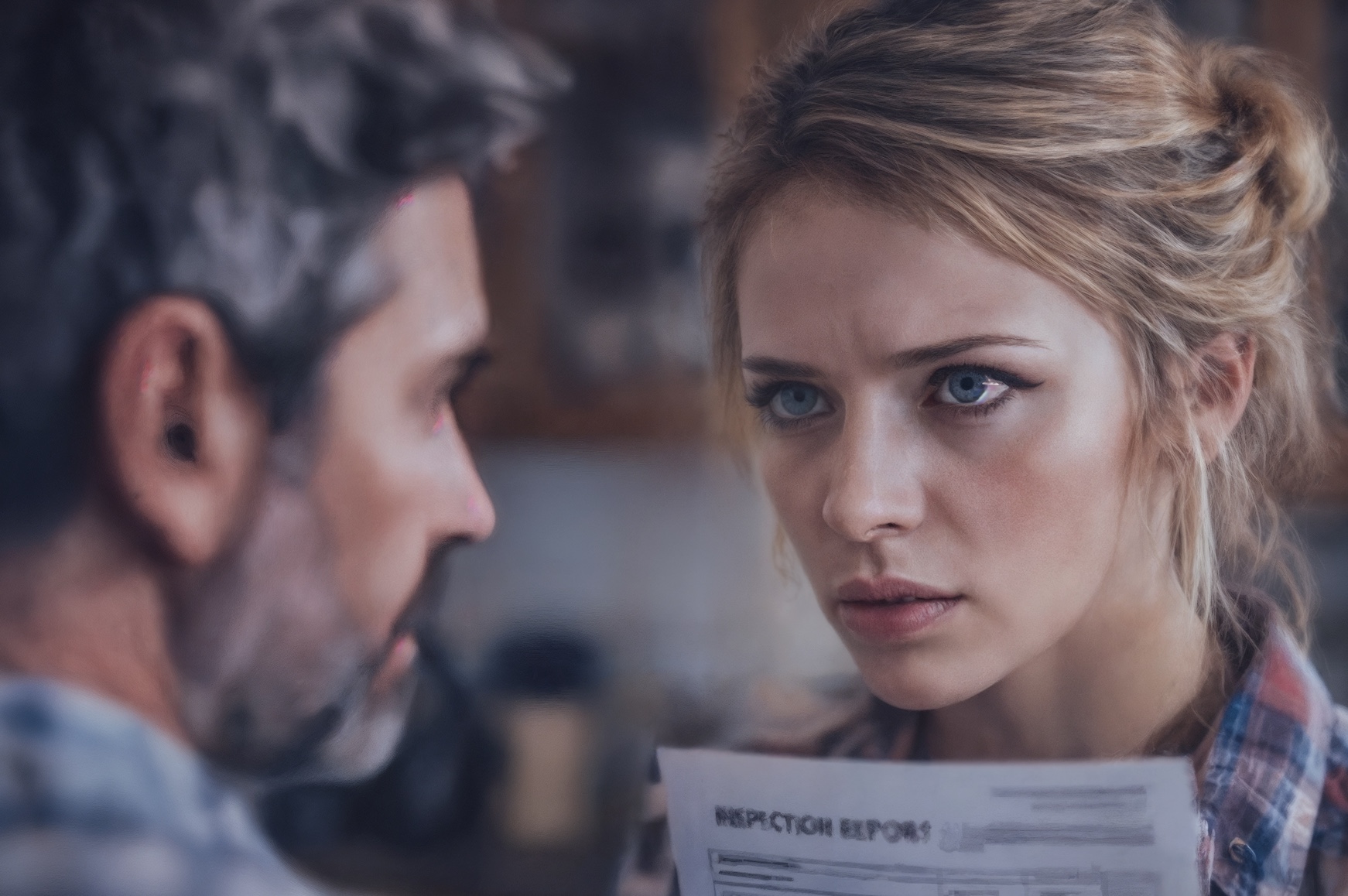
— You didn’t fix the brakes on my car, even though you took the money for the service… and instead you bought yourself new fishing rods? You sent me out in a car without proper brakes on black ice? — the wife asked quietly, holding the inspection report from an independent mechanic.
The sheet in her hands didn’t shake. It was thick, slightly rough, with a greasy fingerprint in the lower corner and a blue stamp that, to Olga, now felt like the most important document she had ever held. She stood in the kitchen doorway, her whole body drawn tight like a string pulled to its limit, humming with restrained fury instead of snapping.
Sergey sat at the table, leaning back comfortably. In front of him was a half-empty plate of fried potatoes and an open can of beer. On the muted TV mounted in the corner, someone ran across a field chasing a ball. At her question, he didn’t even choke. He gave the paper a lazy sideways glance and returned his attention to the screen, spearing a piece of bacon with his fork.
— Olya, here we go again? — he drawled, his voice heavy with the lazy satisfaction of someone who had spent the whole day on the couch. — What report? What mechanic? They saw you coming and ripped you off. I checked those pads last week. They had plenty of life left.
He popped a potato into his mouth and chewed loudly. The sound — the wet chewing mixed with a gulp of beer — grated on her nerves worse than the screech of tires half an hour earlier. She stepped forward and laid the paper on the table, right over the crumbs.
— Read it.
It wasn’t a request. There was iron in her voice, and Sergey twitched.
— “Remaining friction material thickness: zero millimeters,” — she read aloud without waiting for him. — “Metal against metal. Deep grooves on the brake discs. Vehicle operation prohibited.”
He finally looked up. Holding the paper between two fingers as if it were contaminated, he scanned it, snorted, and tossed it back.
— What nonsense. Your “independent” expert — what, some guy in a garage? Or those official dealers who charge a fortune to change a light bulb? Olya, use your head. I’ve been driving twenty years. I know what worn pads look like. There were at least three millimeters left. That’s months of driving unless you stomp the brake at every light. They just sold you new discs to inflate the bill.
She stared at him and barely recognized the man she had lived with for seven years. It was as if someone else sat in his place — someone from a world where physics didn’t apply and human life was cheaper than a set of brake pads.
— Three millimeters? — she repeated, cold rage rising inside her. — Sergey, today I almost slid under a KamAZ truck. At the overpass. Pure ice, barely covered with snow. I started braking early, like you taught me. The pedal just sank. It felt spongy. The car didn’t slow down — it sped up. Do you know what that feels like? Pressing the pedal and nothing happens?
The image still flashed before her eyes: the filthy rear of the truck looming closer to her windshield, the desperate chatter of the ABS trying to save a situation that couldn’t be saved.
— I jerked the wheel, — she continued, staring straight at him. — The car spun into a snowbank. Inches from the guardrail. If someone had been standing there… if there had been traffic coming the other way…
— But there wasn’t, — Sergey interrupted irritably. — Why are you dramatizing? “If this, if that.” It’s winter. Ice happens. Maybe the ABS glitched. That’s not on me. You need to drive more carefully instead of blaming your husband. The pads were fine.
His impenetrable certainty was terrifying. He either believed himself or desperately wanted to — because admitting he’d wasted the money and risked her life would have ruined his comfortable evening.
Olga slowly unzipped her coat. The kitchen walls, covered in cheerful floral wallpaper, suddenly felt like they were closing in.
— I drove straight to the nearest service station after they pulled me out of the snow, — she said clearly, enunciating each word. — The mechanic removed the wheel in front of me. I saw it with my own eyes, Sergey. There are no pads left. Just bare metal, worn blue from heat. And he asked me, “Are you immortal? Or did your husband take out a big life insurance policy on you?”
Sergey winced.
— Oh please. Some clown trying to scare you. You were looking for a reason to nag me. I’m tired. I came home to eat in peace, and here you are with hysterics.
— Where’s the money? — Olga ignored him. — I gave you twenty-five thousand two weeks ago. For full maintenance. Oil, filters, brakes all around. You said it was done. You said, “The car’s ready, drive.”
She stepped closer. Her shadow fell across his plate.
— Where did the money go if the pads are old and the oil on the dipstick is black as tar? I checked that too.
He froze. The fork hung in midair. For the first time, something flickered in his eyes — not guilt, but the realization that his convenient lie was unraveling. He set the fork down, wiped his lips, and leaned back, crossing his arms defensively.
— What, you’re auditing me now? Spying on me? I’m the head of this family. I decide what to fix and when. The oil could’ve gone another five thousand. And the pads… I figured we’d wait. Times are tough.
— Wait, — she echoed. The word stuck in her throat. — You decided to “wait” on brakes. On my safety. To buy what?
Her gaze darted toward the hallway, where a long rod case in expensive fabric leaned against the wall. It had appeared days ago. He’d said it was borrowed. Now the pieces snapped together.
— You bought them, didn’t you? The Graphiteleader rods you wouldn’t shut up about? “Japanese quality.” “Unbelievable sensitivity.” “Every angler’s dream.”
His face brightened despite himself.
— Olya, you don’t understand, — he said eagerly. — They were fifty percent off! A deal like that doesn’t come twice. I couldn’t pass it up. I would’ve changed the pads next week with my salary. Nothing would’ve happened in a week! You were driving fine. Today was just bad luck. And now I’ve got a proper setup. I won’t look ridiculous on the Volga.
She felt the ground sway — not from dizziness, but from the gulf opening between them. In his mind, graphite outweighed her life.
— Show me, — she said quietly.
— What?
— The rods. I want to see what I almost died for.
He took it as surrender. He jumped up, fetched the case, and laid it on the table with reverence.
— These aren’t just rods, Olya. They’re art. Japanese carbon, Torzite guides. You have no idea how they bend.
He unzipped the case with a rich, satisfying sound and pulled out velvet sleeves. Carefully, ceremoniously, he assembled the first rod. The slim blank shimmered under the kitchen light, fading from deep violet to black. The cork and EVA handle looked crafted for a surgeon’s hand.
— Vivo Prototype, — he breathed, stroking it. — Light as air. So sensitive I’ll feel a perch breathe on the lure. Hold it.
She took it automatically. It was weightless. Cold. Beautiful. Expensive. She didn’t see a fishing rod. She saw brake pads that hadn’t been replaced. Discs that hadn’t been bought. A mechanic shaking his head.
— Twenty-two thousand, — he said proudly, snapping the second section into place. — And that’s a steal. Retail’s nearly forty. It’s basically an investment.
— An investment, — she repeated dully. — You invested in carbon by pulling money out of your wife’s safety.
He waved her off and flexed the rod through the air.
— The car ran. The brakes worked. Maybe not perfect, but they worked. I’d have taken it to the guys next weekend. Why overpay?
He leaned the first rod against the fridge and assembled the second.
— This one’s for jigging. Heavier. Two years I dreamed of it. Don’t I deserve something for myself? I work like an ox.
She looked at him and the blindfold finally fell away. Seven years of marriage. An early-paid mortgage because they skipped vacations. Her old coat worn for a third winter because they needed to “save.” And here he stood, glowing with pride, unable to see the problem.
— You don’t work like an ox, Sergey, — she said calmly. — You’re a middle manager barely covering food and mortgage. The rest I carry. My overtime. My freelance nights. I bought that car. I trusted you to handle it because you said, “I’ll take care of it.”
— There you go again, throwing it in my face, — he sneered. — “I bought,” “I earned.” What about me driving you everywhere? Fixing things at home?
— What things? The crooked shelf? The leaking faucet? The brakes you “fixed”?
He exploded.
— Nothing happened! You’re alive! So it’s fine! These rods won’t wait. You’re not a fisherman — you don’t get it. It’s for my soul. I need this or I’ll die in that office.
He admired the two sleek rods by the fridge with more tenderness than she’d seen directed at her in years.
— Beauties, — he whispered. — Next weekend we’re heading to Ruza.
— Next weekend, — she echoed.
She looked at the report. At the rods. At him. Something clicked into place. He didn’t just make a mistake. He didn’t care. Her life was worth less than his hobby.
— For your soul? — she asked, stepping toward the fridge.
— Of course! Every man needs an outlet. Some drink. Some chase women. I fish. You should be grateful.
— I am, Sergey. I’m thrilled.
She picked up the first rod.
— Careful, don’t bend the tip too much, it’s fragile, — he warned, sitting back down.
Fragile.
She stared at him with empty eyes.
— Fragile, you say? Let’s test that.
— Careful! You’re overloading it! The angle’s critical!
He still didn’t understand. He thought she was testing the bend like in a shop. It never crossed his mind she would destroy it.
She grabbed the rod with both hands, pulled it apart, and with a sharp exhale snapped it over her knee.
The crack shattered the kitchen silence — dry and sharp, like breaking bone. The expensive Japanese graphite splintered into jagged pieces. One shard scratched the fridge. The top guide rolled across the tile.
Sergey gasped. His chair fell as he jumped up.
— What did you do?! Are you insane?! That was twenty thousand!
He lunged toward the pieces, trying to gather them.
— Twenty thousand? — she asked calmly. — And what are my legs worth? My spine? A wheelchair costs more than a rod, doesn’t it?
Before he could react, she grabbed the second rod. He tried to block her.
— Don’t you dare! I’ll kill you!
But adrenaline made her faster. She shoved him aside and slammed the rod against the edge of the table.
The heavier carbon resisted for a split second, then split with a dull pop. The guides twisted, the fibers frayed.
Sergey dropped to his knees, clutching the broken handle, tears filling his eyes.
— Why?! You destroyed money! I could’ve sold them! I put my soul into them!
— You didn’t put your soul in them, — she said. — You put my safety in them. Now we have neither brakes nor toys.
He roared, calling her names, threatening, stepping toward her. For a moment she thought he would hit her.
She picked up a heavy ceramic mug.
— Try it, — she said quietly. — Just try.
He stopped. His bravado deflated.
— You’re crazy, — he muttered.
— You already made your choice. Now I’ve made mine.
She dropped the last fragments.
He whispered the brand name like mourning a pet. He grieved carbon, not trust.
She walked to the hallway, returned with her keys, and threw them at his chest.
— Tomorrow the money for repairs and damages is on the table. Or I sell your boat motor.
His face went pale.
He grabbed his things, shouting threats about lawsuits. She told him to bring a psychiatric certificate with it.
He left barefoot, slamming the door.
Silence fell. Black shards lay in a puddle of flat beer — a monument to a marriage polished on the outside and hollow within.
She slid down the wall, exhausted. No tears left.
A bank notification lit her phone: the mortgage payment had gone through. Life continued.
Tomorrow she’d deal with the tow truck, the repairs, the finances.
Tonight, the door was locked. For the first time in years, she felt safe.
She stood, stepped over the wreckage, and took a broom.
— Japanese carbon, — she muttered. — Probably burns well.
She swept the shards into a dustpan, tied the trash bag tight, and set it outside the door.
Right next to the life she had just thrown away.