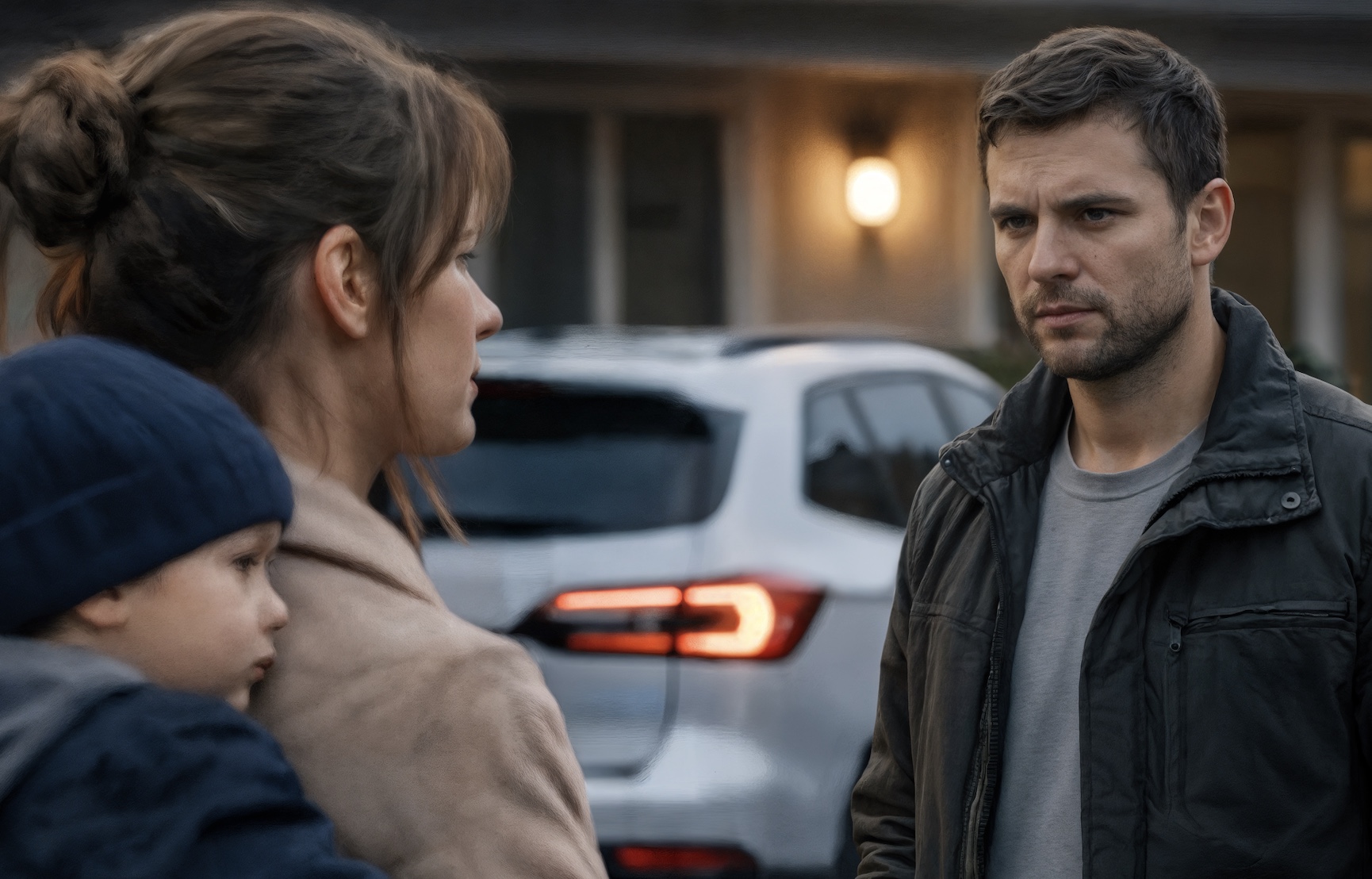
“I’ve forgiven you for everything. Come back,” Viktor said, standing beside my new Mazda and stroking the hood as if it were a purebred horse. “Alyosha needs his father. And it’s hard for you alone.”
“Hard?” I hitched my bag higher on my shoulder. “It was hard when you threw us out in January. Now? Now it’s exactly right.”
“Marin, why are you acting like a child? We’re adults. That whole situation… it was a misunderstanding.”
“A misunderstanding?” I shot back. “You brought your Alyona into our apartment while I was in the hospital with Alyosha’s pneumonia—and you changed the locks!”
I remember that night in microscopic detail. Fifteen below zero. Alyosha had just been discharged and still had a fever. I stood there holding him at my own front door—only the key wouldn’t work.
Our neighbor, Valentina, cracked her door open and looked at us with pity. “Oh, Marinochka… he was changing the locks yesterday with some young girl. Said it was ‘because of thieves,’ that some neighbors got robbed.”
I called Viktor—he didn’t pick up. Then came a text: Go live with your mother. The apartment is mine now. I paid the mortgage.
Paid it… I worked three years without a vacation to scrape together the down payment! And he paid two years out of five—and suddenly he’s some kind of champion.
I arrived at my mom’s place in slippers. I can still see how she opened the door, took one look at us, and silently went to make up the sofa. Not a word of “I told you so,” even though she had warned me: “He won’t be a husband, Marina. He’s handsome, but hollow—like a drum.”
The first month was hell. Alyosha cried at night: “I want to go home. I want Dad.” And “Dad” was posting vacation stories from Turkey with Alyona.
On my money, by the way—I’d received my annual bonus right before New Year’s and handed it to him for his “business.”
“Vitya, step aside. I have to get to work.”
“To work?” he sneered. “To your little beauty salon? Marina, what are you going to make there—pocket change? Come back. I earn well now. Alyona was a mistake, a fling. She doesn’t live with me anymore.”
A little beauty salon… When I left my office job, everyone acted like I’d lost my mind. Stable work, good salary—why would I give it up? “Are you serious?” my boss begged. But I’d already made up my mind.
I took out a loan and rented a small space in a sleepy residential district. Mom handed me her last savings. “Here, sweetheart. At least you’ll have your own business.”
At first I had three clients a day. I slept four hours a night and did the repairs myself after hours. Alyosha fell asleep right there on the client sofa, covered with my jacket.
Six months later, it finally started to take off. I found a great technician—Olya, another single mom. We worked like maniacs. By the end of the year I had four specialists and a waiting list booked two weeks ahead. I also launched training courses—teaching girls manicure skills. Later many of them wrote to me: “Marina Sergeyevna, you changed my life.”
“She doesn’t live with you?” I said, taking my car keys out. “Then why were her pink slippers in the hallway when I picked up documents yesterday?”
His eyes narrowed. “You’re stalking me?”
“No, Vitya. I needed a lawyer. I won the court case over the apartment. I’m selling my half and keeping the other half for Alyosha. And I’ll reimburse your share of the mortgage—don’t worry.”
His face stretched with shock. He had no idea about the trial. He thought I’d keep “squatting” at my mother’s place forever, waiting for him to graciously forgive me.
“Marina, you don’t understand… I’ll have nowhere to live!”
“And where were me and the kid supposed to live in January? On the street?”
“But I apologized! What else do you want—should I get on my knees?”
Three months ago, I met Pavel. He brought his daughter to my course—she’s fifteen and dreams of becoming a beauty professional. We started talking. Turned out he’s a widower; his wife died of cancer two years ago. Not a heartthrob, not a rich man—working hands, tired eyes. But he didn’t let his daughter go into the studio alone. He sat in the hallway all three hours and waited.
On the third lesson he brought a thermos of tea. “You work late. Thought you might need this.”
On the fifth he offered to fix the front steps. “It’s slippery here. A client could fall—you’ll have trouble.” He fixed them. Then adjusted the front door. Then hung a light fixture.
Alyosha warmed up to him immediately. Pavel taught him chess, took him fishing. Alyosha doesn’t call him “Dad”—he calls him “Uncle Pasha”—but his eyes shine when Pavel comes over.
“Vitya, move away from the car. I really have to go.”
He jerked his head toward the Mazda. “Did he buy that for you? Your new guy?”
“I bought it myself. I’m expanding the salon—I need a car for supplies.”
“You’re lying! Where did you get that kind of money?”
I got into the car and started the engine. In the rearview mirror I watched him standing in the yard—confused, furious, pathetic. He pulled out his phone and called someone. Alyona, probably—calling to complain.
That evening at dinner, Alyosha told me, chewing earnestly:
“Mom, Dad came to school. He wanted to take me, but Maria Ivanovna didn’t let him. He said you’re bad, that he’ll take me to live with him.”
“And what did you say?” I asked, my stomach tightening.
“I said I’m not going. His Aunt Alyona is mean—she hides candy. But Uncle Pasha is kind. He fixes my bike.”
Mom stroked her grandson’s hair and said softly, “Good answer, little Cossack.”
The next day Viktor sent a voice message. He was drunk—you could hear it in his slurred words: “You’ll regret this, Marina! I’ll ruin your life! I’ll take the kid from you! You work nights—what kind of mother are you?”
I forwarded it to my lawyer. He snorted. “Perfect. That’ll come in handy in court.”
A week later I ran into Alyona in a store. Her belly was already showing—four or five months, at least. Her eyes were swollen from crying, her whole face looked crumpled with exhaustion.
“Congratulations,” I said.
“For what?” she lifted her chin, defiant.
“For the baby. Viktor must be thrilled, right?”
She flinched like I’d hit her. “Thrilled… He told me to get rid of it. Says he doesn’t have money for a child. He wants to come back to you—because you’ve got a business, a car. And I’m an idiot… I sold my apartment when I moved in with him. Gave him the money for his ‘business.’”
I took out a business card and handed it to her. “Here. This is a good lawyer. And if you need work—come by. I’ll train you and hire you. A baby isn’t a problem; half my team have kids.”
She took the card with trembling fingers. “Why? I mean… I… back then I—”
“Because I know what it’s like to be left alone with a child,” I said. “And because it isn’t really your fault. He’s just like that. I was lucky enough to understand it in time.”
That evening Pavel arrived with a cake. “My daughter passed her entrance exam for college,” he said. “Thank you, Marina Sergeyevna.”
“You can just call me Marina,” I smiled.
“Really?”
Alyosha came racing into the kitchen. “Uncle Pasha! Are we going fishing tomorrow?”
“Of course, little Cossack. Did you dig up worms?”
“A whole jar!”
Mom put the kettle on and sliced the cake. An ordinary evening for an ordinary family—not perfect, not fairy-tale. But real.
And Viktor still lives in our former apartment. Alone. Alyona went back to her parents. Sometimes I see him by the entrance, waiting for me to pick Alyosha up. But my son runs out on his own, climbs into the car, and we drive away—into our new life, the one I built myself. Without him.