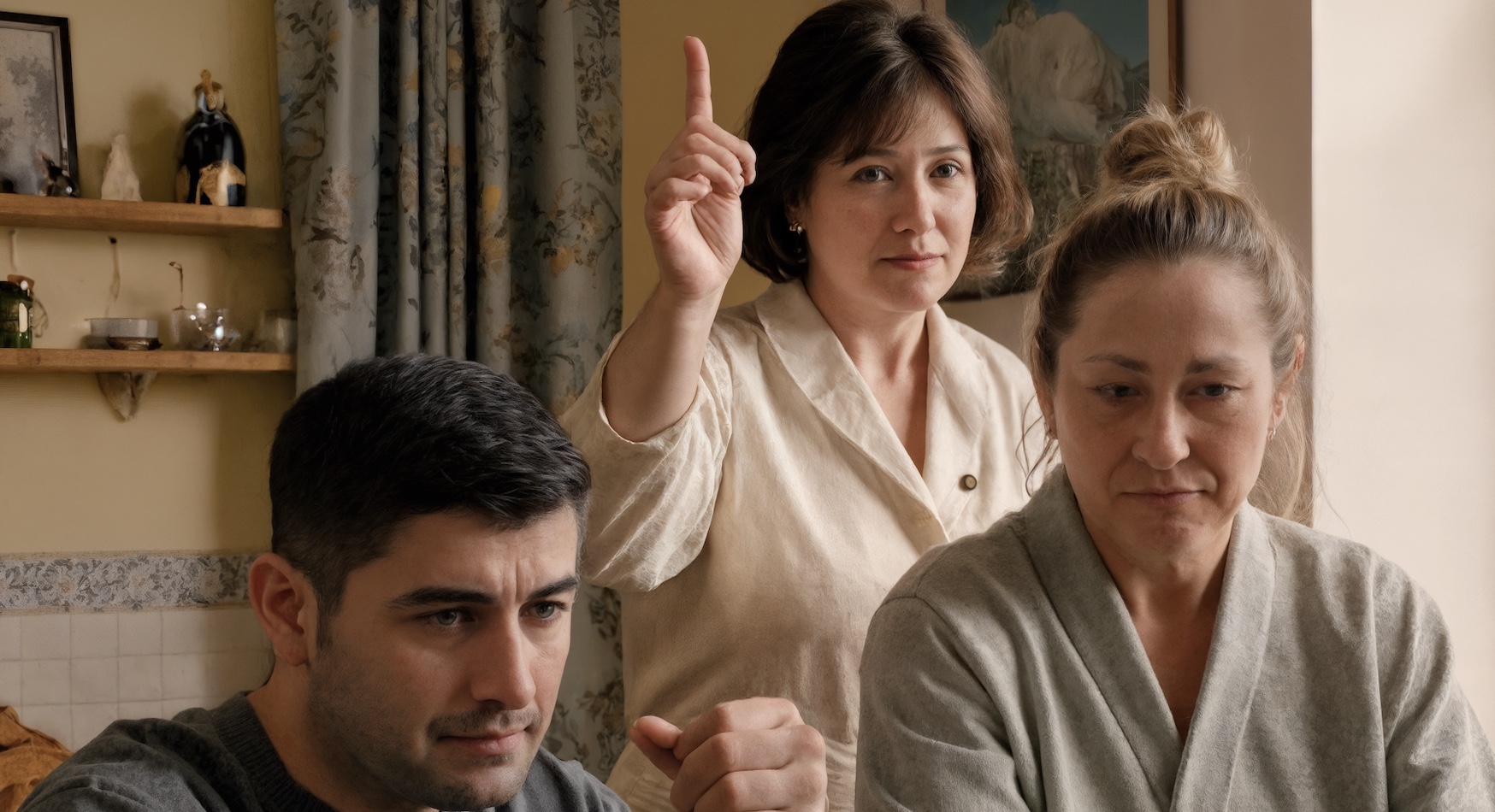
“So you’re refusing?” Dmitry’s voice wavered, but his eyes were ice. He stood across from her with his arms folded, as if he were waiting for her to give in.
“I am,” Marina answered firmly, holding his gaze.
The silence between them rang—so loud she could hear the hallway clock ticking off each second. For the first time in her life Marina felt it: a wall had risen between her and her husband. Not a quarrel—something larger.
“Then you’re not family,” Dmitry spat, and turned away sharply.
The words hit her like a stone in the chest. Not family—as if for four years she’d been a stranger, a temporary neighbor you keep around while it’s convenient and discard the moment she says “no.”
Marina sat at the table with a calculator, hemmed in by piles of papers. Every line of the statement mattered to her like a thread in a carpet she’d woven with her own hands.
812,000.
Every digit smelled of sleepless nights, self-denial, the tight ache in her neck and back.
She didn’t picture the sum as abstract “capital.” She saw an entire archive of sacrifices: twenty thousand—the Sochi vacation she canceled because she chose to take extra work. Five thousand—the dress she’d stared at in the shop window for weeks, then walked past. Another forty thousand—the laptop she truly needed, but she bought a second-hand one because it was cheaper.
And now her husband dismissed it as “money just sitting there.”
Meanwhile Dmitry was at his mother’s. Tamara Viktorovna poured him cinnamon coffee and, as always, spoke with a smile—though her eyes gave away impatience.
“You didn’t press hard enough, son,” she said, pulling her brows together. “Women like it when you explain they’re part of the family. Softer—but persistent. She’s not stupid.”
“Mom, I’m exhausted,” Dmitry muttered. “Marina’s like a wall.”
“Walls get broken too. Just don’t give up. It’s for Kristina.”
Right then Kristina burst in, eyes shining, swinging a brand-new handbag.
“Look! I got it for half price! There was a sale—how could I not?”
“Kristina!” Dmitry shouted. “Have you completely lost it? You’re in debt!”
“Oh, stop,” she waved him off. “We’ll sort it out. You’ve got a wife—she’s like a bank. Strict, sure, but she’ll pay.”
At that very moment Marina was at home, sipping water in tiny swallows, trying to push down the lump in her throat. More and more often she caught herself thinking that beside her husband she was just an “emergency cash register.”
That night she had a strange dream. She stood in her parents’ old apartment, the walls peeling and crumbling. In the corner a ten-year-old girl carefully placed coins into a box, one by one. And around her adults—Tamara, Kristina, Dmitry—ran back and forth snatching coins out of the box like it was a child’s piggy bank. The girl cried and covered the box with her hands, but the adults laughed and said, “Come on—we’re family.”
Marina woke with her heart hammering.
A couple of days later a neighbor knocked on her door—Anna Mikhailovna, a lonely retiree Marina had only ever exchanged polite hellos with.
“Marinochka,” the old woman hesitated, “this is a bit awkward, but… could you help me calculate my bills? I’m all mixed up with these numbers.”
Marina invited her into the kitchen. While they sorted through the payments together, Anna Mikhailovna said a sentence that went straight through Marina:
“Money is like blood, you know. If you give it away carelessly, without limits, it becomes hard to live. There has to be a purpose—otherwise it all gets washed away.”
Marina looked at the woman and suddenly understood this visit wasn’t random. The neighbor’s words were simple, but they cut deeper than any of her husband’s reproaches.
The next day, for the first time in ages, Marina walked home from work instead of rushing. The autumn air was golden; leaves stuck to her shoes. She kept thinking: what if this whole conflict is a test? A test of whether she’s ready to defend her boundaries—her life—her dreams.
When she came back, Dmitry was at the table on the phone. He didn’t notice her enter.
“Mom, I got it,” he was saying in a tired voice. “Yes, we’ll do it differently. Maybe through a credit card. Maybe we’ll make Marina put money in bit by bit. She’s not made of iron.”
Marina froze in the doorway. Cold spread through her chest.
That evening she placed a folder of statements in front of him.
“Here’s how it’s going to be,” she said. “This money is my life. And if anyone tries to take it without my consent, I’ll leave. Understood?”
Dmitry поднял his eyes and, for the first time in a long while, truly saw his wife—different. Not soft. Not quiet. Hard, like steel.
“You’re threatening me?”
“No. I’m warning you.”
He wanted to laugh, but couldn’t.
From that night on, a different silence settled in their home. It wasn’t a fight, and it wasn’t peace. It was the feeling of a storm brewing.
Marina knew: the struggle had only begun. And through the wall, in her mother-in-law’s apartment, a new scheme was already ripening—how to pull the money out of her.
The phone rang early in the morning, before Marina had even finished her coffee. Her mother-in-law’s name flashed on the screen. Marina exhaled and answered.
“Marinochka,” Tamara Viktorovna’s voice was sweet like jam, but sticky underneath, “I’ve been thinking… You’re an accountant, you’re a smart woman—you understand how things work. Why keep money idle? It needs to be put to work.”
“Put to work how?” Marina asked warily.
“My friend and I want to open a salon. Small, cozy—manicures, hair, massage. A women’s business. Three hundred thousand would be enough to start. Then income will come, and we’ll pay you back.”
Marina gripped her mug so hard her knuckles turned white.
“No,” she said. “That’s my money, and it has its own purpose.”
“Marinochka, you don’t understand!” her mother-in-law snapped. “You’re missing a chance! This is your family’s future!”
“My future is renovating my apartment,” Marina replied—and hung up.
For the first time in her life she didn’t apologize. She didn’t explain herself. She didn’t justify.
By lunchtime Dmitry called. His voice sounded tight.
“Why did you talk to my mom like that? She’s crying now.”
“Let her cry. I cried for four years from exhaustion, and nobody saw it.”
“You’re getting bitter, Marina,” Dmitry sighed. “Money is making you cruel.”
“Money is making me honest,” she answered. “Because without it, you’d tear me apart.”
That evening, on her way home, Marina noticed a strange man in the courtyard—about sixty, with a canvas bag and a bright green scarf. He sat on a bench feeding pigeons. A stack of old newspapers lay by his feet.
“Miss,” he said as Marina walked past, “do you know what money really likes? Not silence, like people say—respect.”
She stopped.
“Sorry?”
“Respect,” he repeated. “Respect for someone else’s labor. Respect for your own fatigue. Money leaves those who spend it mindlessly. I used to be a banker—I’ve seen hundreds like that. And you know what? Money always chooses an owner who values it.”
Marina smiled. A random stranger had said exactly what she couldn’t put into words.
At home Dmitry was waiting with a sour expression.
“Mom’s blood pressure spiked,” he announced like a prosecutor. “We need to go see her.”
“Go.”
“Together. You have to show you’re not the enemy.”
Marina agreed, though inside she was boiling.
Her mother-in-law’s apartment greeted them with perfume and the smell of fresh buns. Tamara Viktorovna lay on the sofa, propped up by pillows, theatrically clutching her chest. Kristina sat beside her scrolling on her phone and didn’t even pretend to be worried.
“Marinochka,” the mother-in-law groaned, “maybe I shouldn’t pressure you. But understand—family is sacred.”
“And who am I to you?” Marina asked quietly.
Silence fell. Dmitry coughed.
“You’re my son’s wife,” the mother-in-law said.
“So I’m not family,” Marina replied. “I’m a tool.”
Kristina snorted.
“Oh, drama queen. If you don’t want to help, just say so. Why ruin the show?”
Marina looked at her and realized—she wasn’t afraid anymore.
“I’m saying it plainly: I’m not giving you anything. Not a penny.”
After that visit Dmitry didn’t speak to her for three days. Silent at dinner, silent in the morning—only heavy sighs. And Marina felt a strange relief: his silence was more honest than all the pleading and manipulation.
But on the evening of the fourth day he placed a bank card on the table.
“I took out a loan,” he said. “Three hundred thousand.”
Marina went pale.
“You… what?”
“Mom and Kristina can’t wait. I decided to help.”
“And who’s going to pay it back?”
“We are,” he said. “The family.”
Marina stared at him as if he were a stranger.
That night she couldn’t sleep. She listened to her husband snoring in the bedroom and thought: So now my work will go toward interest? Toward their shopping? Toward someone else’s whims?
She got up, pulled her statements from the folder, and put them in her bag. The decision came on its own: the money had to be moved somewhere safe.
The next day Marina went to that same neighbor, Anna Mikhailovna.
“I want to leave something with you,” Marina said. “It’s safer than keeping it at home.”
The old woman looked surprised but didn’t refuse.
And for the first time in a long while Marina felt it: her money was truly protected.
But what awaited her next would be worse than requests and accusations—because her husband’s family decided that “stubborn Marina” could be broken another way. And that method was far harsher than any conversation.
“The autumn is long, and renting is expensive! So get ready—we’re staying with you until spring!” her mother-in-law blurted out, not even looking at Marina.
The kitchen went still. Dmitry coughed and stared at the floor. Kristina shook shiny boots out of a shopping bag and set them right on a stool.
“I even brought my toothbrush,” she said with a smug smile. “So we don’t waste time.”
Marina set down her spoon. Something inside her snapped.
“No,” she said.
Tamara Viktorovna’s eyes widened.
“What do you mean, ‘no’? Are you against family?”
“I’m against the takeover of my life,” Marina answered calmly.
“Selfish!” her mother-in-law shrieked. “We married you off, we accepted you—and now you’re slamming the door in our faces?”
For the first time Marina looked at all of them at once: the mother with the hard face, the sister with the smirk, the husband with the guilty eyes. And she understood—they were strangers.
That evening Dmitry said:
“Marina, just endure it. It’s not forever.”
“I’ve endured four years,” she replied. “And that’s enough.”
She started the renovation out of spite—immediately, without waiting for spring. The drill noise drowned out the ringing of accusations. With every new layer of white paint, the apartment walls turned into her personal armor.
“You chose money,” Dmitry said once.
“I chose myself,” Marina answered.
A month later he packed his things and moved in with his mother. Her mother-in-law gloated, Kristina snickered, neighbors whispered. And Marina stood in her refreshed, newly painted apartment and—for the first time in years—felt light.
She finally understood: her real family was her work, her future, and her freedom.
And she would defend it to the end.
The End.