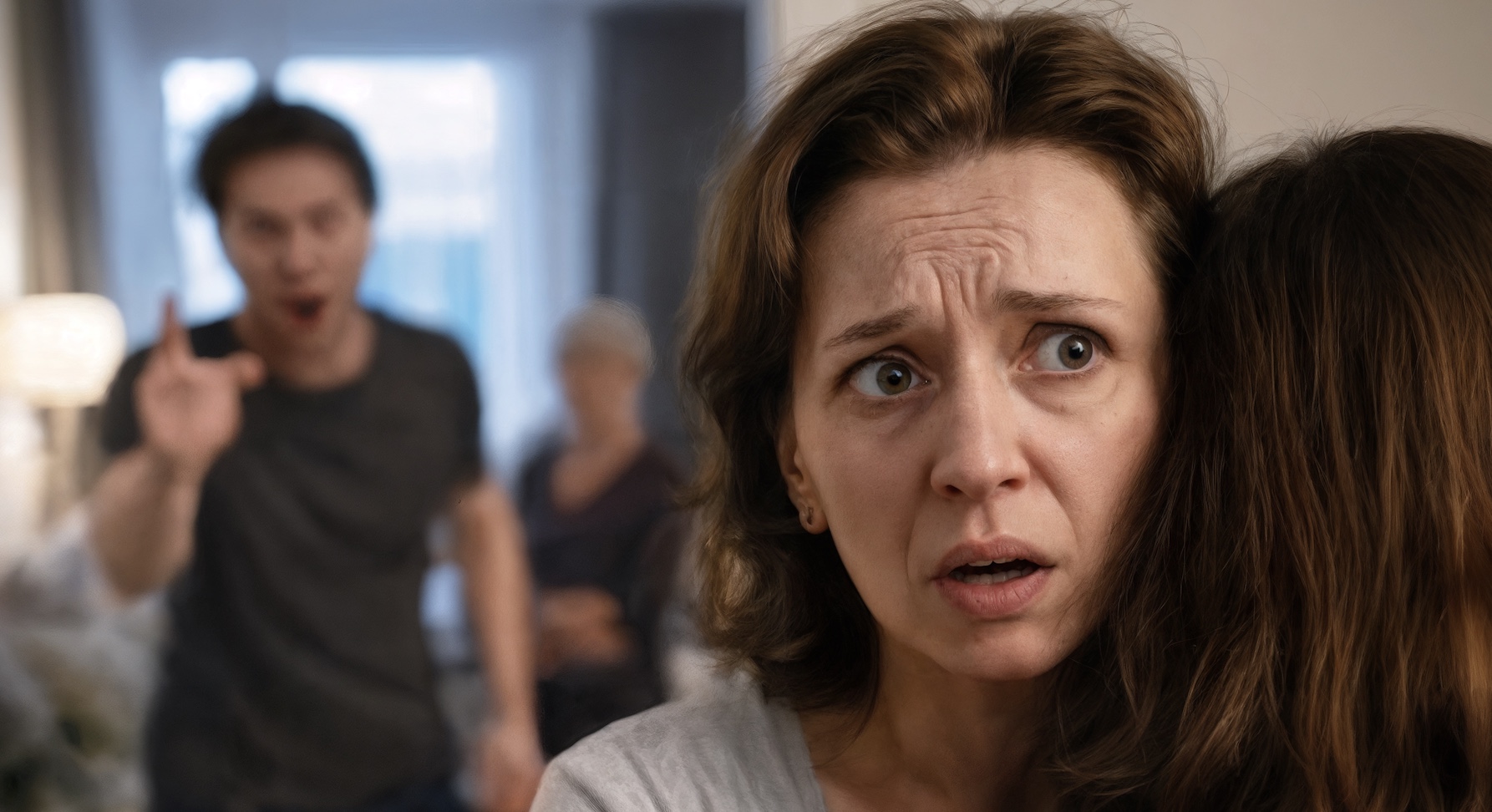
The text message came through at 10:30 a.m., just as I stood at the stove stirring béchamel for lasagna. December 30th—my last workday was finally behind me, and ten whole days off were ahead. I’d imagined spending them in a robe with books and old movies. Maybe Dima and I would go ice skating. Maybe I’d make something elaborate and beautiful—something I never have time for on ordinary days.
“Mom, have you left yet? Text me when you’re at the station—I’ll pick you up.”
I read it three times. The phone was Dima’s—he’d forgotten it on the nightstand when he went to shower. The notification had simply flashed across the screen.
The béchamel began to scorch. I turned off the burner without thinking, but I stayed where I was, staring at the phone.
Valentina Petrovna is coming. Today. And Dima is meeting her at the station, so he knew. More than that—he’d invited her himself.
Valentina Petrovna and I… how do I put this gently? We can’t stand each other. And we don’t even bother pretending otherwise. Our first meeting seven years ago—when Dima brought me to “meet his mom”—set the tone for everything that followed. She looked me over from head to toe and pursed her lips.
“Tall. And so skinny. Can you even cook?”
In seven years—four of them married—nothing changed. Valentina Petrovna found flaws in everything: my job (“sits in that office of hers all day, the house is a mess”), the fact that we didn’t have children (“you’ve been married four years and still nothing”), the way I cleaned, cooked, dressed. She was especially harsh about my looks: I was too thin, too tall, too pale. My hair was the wrong length. My eyebrows were the wrong shape.
Dima usually let her remarks slide.
“That’s just Mom—don’t take it to heart,” he’d say.
Easy to say—don’t take it to heart—when you’re being bullied in your own home and evaluated for every little thing you do.
Her last visit had been in March. She came for a week to “help with renovations,” even though we weren’t renovating anything. That week became a nightmare: Valentina Petrovna moved furniture around without asking, threw away my things (“it’s old junk, why keep it”), inserted herself into our relationship (“Dimочка, you give her too much money for groceries—I could feed a whole army on that”). By the end of the week, I had a migraine that wouldn’t go away for five more days after she left.
And now—again. For the New Year holidays.
I heard Dima come out of the bathroom and quickly put his phone back. He walked into the kitchen in jeans and a sweater, damp hair sticking up in every direction.
“Smells good,” he said, peeking into the pot. “Lasagna?”
“Dima,” I turned to him. “Is your mom coming?”
He went still. His face made it obvious he hadn’t expected the question. Then he forced a smile.
“Oh—yeah. I was going to tell you. She’s arriving tonight.”
“For how long?”
The pause dragged on.
“For the holidays,” he said, looking away. “Until January 8th.”
Ten days. Ten days under the same roof as Valentina Petrovna.
“Why didn’t you tell me?”
“I’m telling you now.”
“Dima, she’ll be here in a few hours! You couldn’t have warned me yesterday? Or the day before—when you clearly invited her?”
“Listen, she’s my mother,” he snapped, raising his voice. “Do I really have to ask permission to invite my own mother into my own home?”
Our home, I wanted to correct him, but I stayed quiet. The apartment was in Dima’s name—a wedding gift from Valentina Petrovna. She loved reminding me of it.
“It’s not about permission,” I said, trying to keep my voice level. “It’s about the fact that I’m your wife. We live together. This is something you talk about. I had plans for the holidays.”
“What plans? Lying on the couch?”
It was a perfect, painful strike. Yes, I wanted to lie on the couch. After a year of constant deadlines, endless overtime, and stress, I wanted to sleep, to rest, to stop thinking for once. Was that really so wrong?
“You know what,” I said, taking off my apron. “Fine. Go meet your mom. I won’t get in your way.”
“What’s that supposed to mean?”
“It means that when your mother arrived, I moved in with my friend.”
I went to the bedroom and pulled a duffel bag from the closet. Dima stood in the doorway, staring at me like I’d lost my mind.
“Are you serious? You’re going to move out because my mom is coming?”
“I’m going to spend the holidays the way I planned. Without fights, and without nonstop comments about what a terrible housekeeper I am, what a terrible wife I am—what a terrible person I am.”
“You’re exaggerating. Mom doesn’t—”
“Dima,” I turned to face him, “last time she called me a useless housewife eight times. I counted. Eight times in seven days. She rearranged every piece of furniture in the living room without asking. She threw out my favorite sweater and said it was ‘for poor people.’ And every single night she told you how your former classmate Olya—that’s a real wife, with kids and a perfect home.”
“Oh, that’s just her. She likes to talk.”
“I don’t want to listen to that ‘talk’ over New Year’s. Sorry.”
I packed jeans, sweaters, underwear. My toiletries bag. My laptop charger. I moved like a machine, trying not to think—because if I started thinking, I might back down. And I couldn’t afford to back down.
“Lena, this is stupid,” Dima tried a different tone, softer. “Mom will come, we’ll sit together, celebrate New Year’s… It’s a family holiday.”
“That’s your family,” I said, zipping the bag. “I don’t feel like part of it when Valentina Petrovna is here.”
“And what do you think this looks like? My wife runs away the second my mother shows up?”
“And what does it look like when a husband invites his mother for ten days without even telling his wife?”
We stood on opposite sides of the bed, and it suddenly felt like a symbol. Opposite sides. And we’d been that way for a long time.
“Lena, don’t be a child,” his voice hardened. “Stay. This matters to me.”
“And it matters to me to keep what’s left of my sanity,” I said, grabbing my bag. “Sorry.”
“You’ll regret it,” he threw after me as I left the bedroom.
I turned around. “What?”
“I said you’ll regret it. If you walk out now, don’t expect things to go back to how they were.”
Something inside me snapped—just like that. One sentence, and seven years crumbled like a house of cards.
“Fine,” I nodded. “I’ll take that risk.”
I rushed out without looking back, got into my car, started the engine, and only then allowed myself to exhale. My hands were shaking.
Masha opened the door in reindeer pajamas, holding a mug of coffee.
“Lena? What happened?”
“Can I stay with you for the holidays?”
“Are you serious?” She stepped aside immediately. “Of course. Come in. What’s going on?”
Over coffee and sandwiches, I told her everything. Masha listened, shaking her head now and then.
“Unreal,” she said at last. “So he didn’t even warn you?”
“He was going to tell me at the last second. Like—Mom’s already at the door, so now you have no choice.”
“And he doesn’t care that you might have plans?”
“Apparently not.”
My phone buzzed. Dima. I declined the call. A minute later—again. I silenced the ringer.
“Don’t answer,” Masha advised. “Let him cool off. And you too.”
But Dima didn’t cool off. By evening I had twenty-three missed calls. I opened the messages—and instantly wished I hadn’t.
“Do you understand how this looks? Mom arrived and you’re not here.”
“I lied and told her you got stuck at work. Be home tomorrow morning.”
“Lena, this isn’t funny anymore. Mom’s upset.”
“Do you realize you’re humiliating me?”
“If you’re not back by lunch tomorrow, don’t say I didn’t warn you.”
I reread them and couldn’t recognize the man who wrote them. Where was my Dima? The one who, seven years ago, read me poems on the dorm rooftop and said I was the most important thing in his life? The one who swore we were a team, that it was us against the world?
When did he become someone who threatens his own wife?
“Lena,” Masha peeked into the guest room where I sat staring at my phone. “How are you holding up?”
“I don’t know,” I said, showing her the texts.
She read them, and her face changed.
“Wow. He’s completely lost it.”
“Looks like it.”
“Text him that you’re not coming back—so he stops expecting it.”
I typed: “Dima, I’m spending the holidays at Masha’s. I need time to think. Please don’t call or text.” I sent it and blocked the chat.
On December 31st, Masha and I made Olivier salad, watched The Irony of Fate, and drank mulled wine. It was warm and quiet. And still, heartbreakingly sad.
“You know what I’ve been thinking?” I said as I sliced sausage. “That I’m not even surprised.”
“By what?”
“By the way he’s acting. Like somewhere inside, I always knew that when it really mattered, he’d choose her—not me.”
Masha stirred the mulled wine without saying anything.
“He always chose her,” I went on. “All these years. Every time she said something cruel about me, he stayed silent. ‘Don’t pay attention—she doesn’t mean it.’ When she interfered in our life, he just shrugged. ‘That’s Mom, what can you do.’”
“Mama’s boy,” Masha concluded.
“The scariest part is I didn’t see it,” I said. “Or I didn’t want to. I told myself he was just gentle, that he hated conflict. But really, he’s just a coward.”
The word hung in the air. Coward. I’d called my husband a coward.
And I realized it was true.
On January 1st at ten in the morning, the doorbell rang. Masha was in the shower, so I went to open it.
Dima stood there—unshaven, in a wrinkled jacket, eyes red.
“Hi,” he said.
“Hi,” I answered, staying in the doorway, not inviting him in.
“Can we talk?”
I glanced past him, half-expecting Valentina Petrovna to appear behind his shoulder. But he was alone.
“Out here,” I said, nodding toward the landing.
We stood in silence. He fidgeted, searching for words. Finally he forced out:
“You’re embarrassing me.”
There it was. Not “I missed you,” not “let’s work this out.” Just: “You’re embarrassing me.”
“I’m embarrassing you,” I repeated. “Seriously?”
“Mom cried all evening yesterday. She kept saying you hate her, that because of you we don’t see each other.”
“Dima, you saw each other in March. She lived at our place for a week.”
“That’s not enough! She’s my mother—she’s lonely—she’s sixty!”
“And that means I’m supposed to tolerate insults in my own home?”
“What insults?! She’s just giving advice!”
“She says I’m a bad wife and a bad housekeeper. Every. Single. Day.”
“Because she cares about us! She wants us to have a good life!”
I stared at him, not believing what I was hearing. Did he truly not see it? Or did he see it and find it easier to pretend he didn’t?
“Dima,” I said slowly, clearly. “Your mother came for ten days. You didn’t warn me. And now you’re demanding that I come back and spend the entire holiday catering to her—giving up my rest and my plans. Is that correct?”
“Well… basically, yes. She’s my mother.”
“And who am I?”
He looked confused.
“My wife.”
“So my wants and needs don’t matter?”
“Lena, why are you turning it into drama? Just come home, we’ll celebrate together, everything will be fine.”
“No, it won’t. Valentina Petrovna will criticize me at breakfast, lunch, and dinner. You’ll stay silent and pretend nothing is happening. And I’ll feel like the hired help in my own home.”
“You know what?” His voice turned sharp. “You’re just selfish. All you ever think about is yourself. And I’m having a great time, am I? Mom keeps asking where you are and why you’re gone. I’m lying, twisting myself in knots—and it’s all because of your little tantrum!”
Tantrum. My refusal to sit there and be insulted was a “tantrum.”
“Leave,” I said quietly.
“What?”
“I said leave. And don’t come back.”
“Lena—”
“I’m filing for divorce,” the words came out on their own, and I didn’t regret them. “I don’t want to live with someone who calls me selfish for protecting my boundaries. Who invites his mother for ten days without warning me and then expects me to drop everything and run around serving her. Who sends me threats when I don’t obey.”
He went pale.
“You can’t just—”
“I can. And I will. I don’t recognize you, Dima. You’re not the man I married.”
“It’s you who changed!” he raised his voice. “You used to be normal, and now you—”
“And now I have self-respect?” I cut in. “Sorry to disappoint you.”
I turned and went back inside. I closed the door, leaned against it, and slowly slid down to the floor.
That was it. Over.
Masha found me sitting on the hallway floor.
“Lena? What happened?”
“I said I’m divorcing him.”
“And?”
“And he left.”
Without a word, she sat down beside me and put her arm around my shoulders. We stayed like that for ten minutes, not speaking.
“Are you sure?” she asked finally.
“Yes,” I wiped my tears. “I understood it today. He won’t change. His mother will always come first. Always. And if I stay, I’ll spend my whole life fighting for second place—swallowing insults, swallowing hurt, enduring. I don’t want that.”
“And you’re right,” Masha hugged me tighter. “You know, I always thought you were the perfect couple. But the last couple of years… I could see it was hard on you. You became different. Like you were unhappy—really unhappy.”
“I felt invisible,” I admitted. “Especially when Valentina Petrovna came. Like I didn’t exist. My opinion didn’t matter. My feelings didn’t matter. Only she mattered.”
We rang in the New Year together—just the two of us—with champagne and a holiday variety show on TV. At midnight, I made a wish:
“I want to be happy. I want to live for myself. I want to stop being afraid.”
Valentina Petrovna left on the eighth, exactly as planned. After that, Dima called and texted. He begged me to come back, promised everything would change. But I knew it wouldn’t. It couldn’t—because to change, you have to admit there’s a problem. And he didn’t see one.
To him, the problem was me. The woman who dared to have needs. Who refused to bend under someone else’s expectations.
Three months have passed now. The divorce is almost finalized. I rented a small apartment on the edge of town and furnished it the way I like—without Dima’s hints, and without Valentina Petrovna’s commentary about how “that’s not proper” and “what will people say.”
Sometimes I feel sad. Seven years is a lot—habits, shared memories, a life built together. But the sadness passes quickly when I remember:
I’m free.
Free from constant tension, from waiting for the next jab, from having to justify every step I take.
Masha says I’ve changed. I’m more open, more alive. I’m smiling again. Making plans again. Believing again that everything will be okay.
And I don’t regret a single thing—because for the first time in all those years, I chose myself.