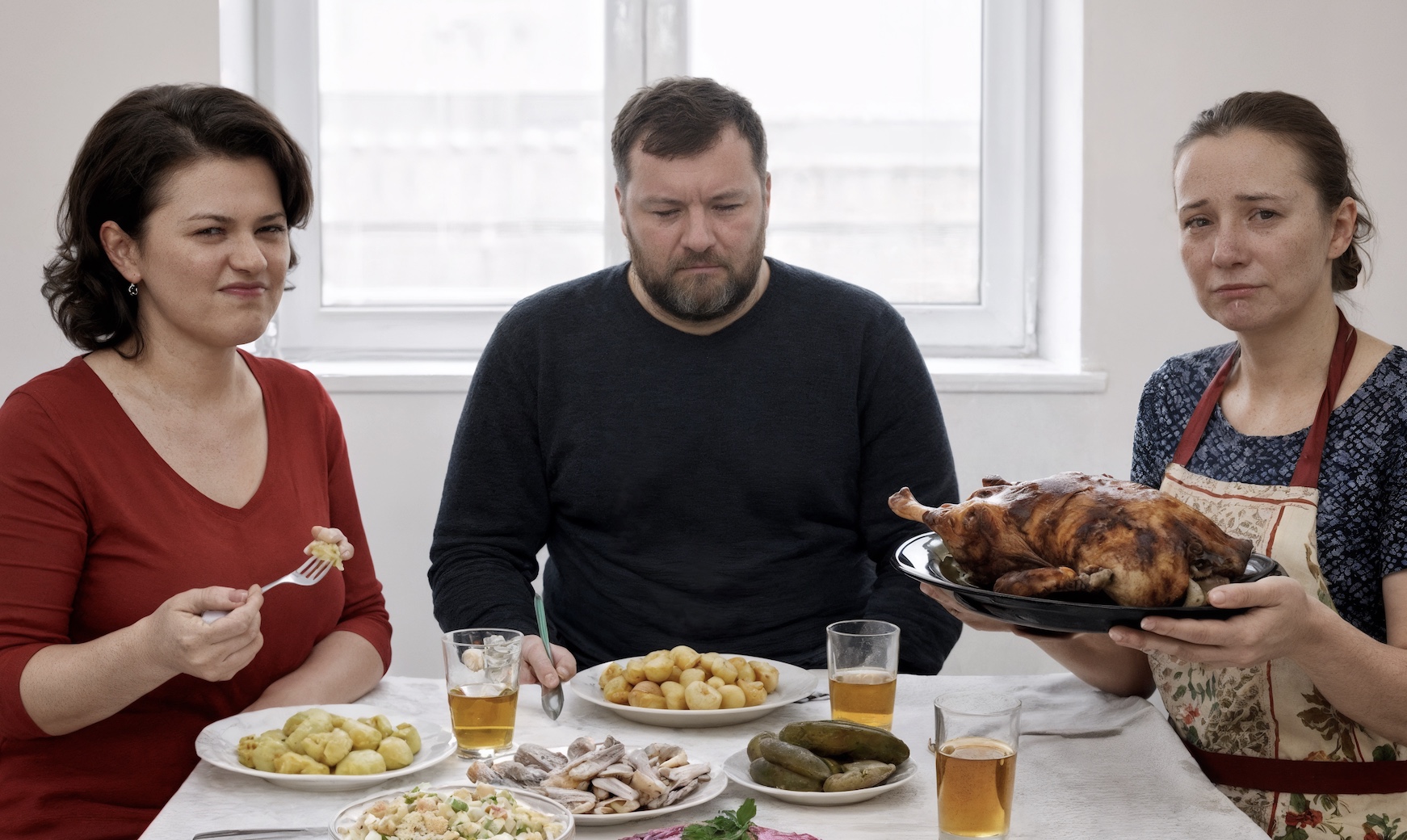
My husband’s sister trashed my cooking at the holiday table—until I suggested she eat at home
“Oh, come on—how much mayonnaise do you have to use?” Larisa sighed. “It’s nothing but cholesterol, Lena. Do you feel any sympathy for Andrey? He’s been getting wider around the waist lately. It’s honestly painful to watch you two clog up your arteries.”
With open disgust, Larisa prodded the edge of the dressed-up “Herring Under a Fur Coat” salad, as if she expected to uncover not boiled beetroot, but a ticking time bomb. She was seated at the head of the table, to the birthday man’s right, and she looked exactly like a restaurant critic who’d accidentally wandered into a grimy train-station cafeteria and was now forced to endure culinary humiliation.
Elena, standing by the sideboard with clean plates, froze. Everything inside her tightened like a spring. It was her husband Andrey’s milestone birthday—forty years old. She’d been preparing for two weeks: planning the menu, buying groceries at the market and picking only the freshest ingredients, marinating the meat using a special recipe she’d begged from a chef at a corporate party. Yesterday she’d spent seven hours at the stove without sitting down once—because everything had to be perfect. And now, the guests had barely sat down, no one had even made a toast yet, and Larisa was already starting her usual performance.
“The mayonnaise is homemade, Larisa,” Elena replied tightly, placing the plates on the table. “I whisked it myself—quail eggs and olive oil. Not a gram of chemicals.”
“Oil is fat,” her sister-in-law cut in, pushing the salad away as decisively as if it were poisoned. “Calories are calories, even if you sprinkle them with gold. Andrey, look at what you’re eating. You should be having steamed broccoli and dry chicken breast right now—but your wife keeps sliding these greasy salads onto your plate. And she calls it love. Feeding you straight into a heart attack.”
Andrey—who’d already served himself a generous mound of his favorite salad—looked guiltily at his sister, then at his wife. He hated moments like this. Larisa was his older sister, his childhood authority figure, and he’d grown up treating her opinion like the final verdict. On top of that, she worked as an administrator at a fitness club and considered herself a health guru—though she secretly loved sneaking a chocolate bar or two when no one was watching.
“Lar, it’s a celebration,” Andrey tried to soften things, spearing a piece of herring. “It’s fine just this once. It tastes great. Lena put in a lot of effort.”
“Effort,” Larisa snorted. “Real effort would be keeping your husband healthy, not stuffing his belly. But whatever—your choice. I’m not eating that. Do you at least have plain sliced cucumbers? Without… all of this?”
“Yes,” Elena nodded. “In the kitchen. I’ll bring them.”
She stepped out of the room, feeling the sting of hurt rise in her throat. Her eyes burned, but crying was not an option. Not today. She wouldn’t ruin her husband’s celebration. From the living room she heard the hum of voices—Andrey’s coworkers had come, along with his school friend Sergey and Sergey’s wife, and Andrey’s mother, Galina Ivanovna. Everyone seemed to sense the tension radiating from Larisa and tried to drown it out with louder jokes.
Elena quickly sliced cucumbers, arranged them on a plate, and didn’t even salt them—who knew, maybe salt was “white poison” in Larisa’s world too. When she returned, she set the plate in front of Larisa.
“Thanks,” Larisa muttered without even looking at her. “At least there’s something safe on this table.”
The evening continued. Guests raised toasts, wished Andrey success, health, happiness. Elena moved back and forth between the kitchen and living room, switching dishes, refilling drinks, making sure everyone had what they needed. She tried to be a warm hostess—smiling, joking—but every time she passed Larisa, she felt that sharp, appraising gaze like a thorn on her skin.
“And what is this?” Larisa asked loudly when Elena carried in the main dish: duck baked with apples and prunes. It looked spectacular—golden, crisp skin, an aroma so rich it made mouths water.
“It’s duck, Larochka,” said Galina Ivanovna, who had been quietly eating everything and praising Elena. “Your favorite when you were little, remember?”
“As a child I didn’t know how much hidden fat duck contains,” Larisa announced, inspecting the platter with distaste. “And anyway, Lena, you dried it out. You can tell. The skin’s all shriveled, and the color is… way too brown. Did you roast it for three hours? There are zero vitamins left—just carcinogens from frying.”
A silence fell over the table. Sergey—Andrey’s school friend—had been reaching for the best-looking piece, but froze.
“It looks fine, Lar,” he said. “It smells incredible. Lena’s got talent.”
“Talent for ruining ingredients,” Larisa muttered—quietly, but loud enough for everyone to hear. “Duck should be cooked low and slow in sous-vide, then finished with a torch. This is a grandma method. Last century. Andrey, you don’t feel sorry for your liver?”
Elena set the platter down. Her hands were shaking. The dish tapped the table a little louder than it should have.
“Larisa,” Elena said, forcing her voice to stay even, “if you don’t like it, you don’t have to eat it. No one is forcing you. There’s plenty of other food.”
“I’m not eating it,” Larisa shrugged. “I’m simply stating facts. I care about my brother. Who else will tell him the truth? You’ll just smile and feed him this… charcoal, as long as he’s happy. And then it’ll be gastritis, ulcers, gallbladder trouble. You’re not a doctor—you don’t understand.”
“I’m not a doctor. I’m an accountant,” Elena agreed. “But I can read recipes, and I can cook food people enjoy. And no one has complained—except you.”
“Oh please, who’s going to complain?” Larisa laughed. “They’re polite. They eat, choke, and smile. Manners won’t let them tell the hostess the meat is tough and the salad is salty. But I’m his sister—I’m allowed. We’re family. Right, Mom?”
Galina Ivanovna shifted uneasily. She clearly hated what the dinner was turning into, but she was afraid to argue with her daughter. Larisa had a sharp tongue and could scold her own mother so hard it left bruises.
“Well, sweetheart… the duck is actually tender,” the mother-in-law mumbled. “I tried a piece. And the apples are tasty…”
“Mom, your taste buds have faded with age,” Larisa waved her off. “You’ll say anything is delicious as long as you don’t have to cook.”
Andrey poured himself wine and drank it in one gulp. His face broke out in red patches. He could see Lena hanging on by a thread. He loved his wife. He loved his sister. And he was being torn in half.
“Lar, enough,” he said hoarsely. “Stop. The food is fine. The food is great. Don’t ruin the evening.”
“I’m ruining it?!” Larisa clutched her chest dramatically. “I’m sitting here minding my own business, chewing a cucumber, offering helpful advice—and I’m the villain? Thanks a lot, dear brother. So that’s how you value concern. Is your wife more important to you than your health now? Fine. Just don’t come begging me for a discount gym membership when you can’t squeeze through doors anymore.”
She turned away theatrically and started scrolling on her phone, making it clear how bored and disgusted she was by everyone.
Elena silently began serving duck to the guests. Sergey and his wife praised it, asked for seconds, requested the marinade recipe. Andrey’s coworkers ate with enthusiasm too, clinking glasses and cracking jokes. Slowly, the tension eased. It seemed like the storm had passed.
But dessert was still ahead.
Elena was proud of her cake. A real homemade Napoleon—made with butter and custard infused with a whole vanilla bean. She’d baked the layers until late at night, rolling the dough so thin you could practically read a newspaper through it. Then she layered it, let it rest. It was Andrey’s favorite.
When she carried in the cake—decorated with fresh berries—the guests actually gasped.
“Lenochka, this is a masterpiece!” Sergey’s wife, Sveta, exclaimed. “Like the best pastry shop—no, even better!”
“We’ll see what kind of masterpiece it is,” Larisa commented without lifting her eyes from her phone.
Elena began slicing. The knife slipped through with a satisfying crunch of flaky layers. She plated the pieces, poured tea.
Larisa set her phone aside and eyed her slice suspiciously.
“The cream is kind of yellow,” she announced. “Did you use farm eggs?”
“Yes,” Elena nodded. “Farm eggs.”
“Hello, salmonella,” Larisa declared. “Store eggs at least have inspections. Private farmers’ chickens walk through manure. Did you heat the custard properly, or did you just… throw it together?”
“Larisa,” Elena hissed through her teeth, “it’s custard. It’s cooked.” Larisa scooped a tiny bite, sniffed it, then tried it with just the very edge of her lips—and immediately grimaced.
“Ugh, it’s sickly sweet! How much sugar did you dump in here? Everything sticks together. And the butter—ugh, you can taste that greasy butter coating your mouth. Gross. Like I just ate a chunk of margarine. Lena, there are so many light desserts now: mousses, jellies, yogurt cakes. Why bake this heavy Soviet nightmare? It takes three days to digest. Andrey, don’t eat too much—you’ll feel awful.”
That was the last straw. The cup of patience—drip-fed with poison all evening—finally overflowed and cracked.
Elena carefully set the cake server back on the platter. The metal clink against porcelain sounded like a bell before a fight. The room went dead silent. Everyone stopped chewing. Andrey hunched his shoulders.
Elena walked over to Larisa. She didn’t shout. She didn’t wave her arms. Her voice was quiet, calm, and cold as Arctic ice.
“Larisa, please stand up.”
Larisa lifted an eyebrow.
“Why? Want to make a toast?”
“I want you to stand up and leave the table.”
“And why would I?” Larisa smirked, but something like unease flickered in her eyes. She wasn’t used to soft, accommodating Lena speaking to her like this.
“Because you don’t like it here,” Elena said, looking straight into her eyes. “You didn’t like the salad. You didn’t like the duck. You didn’t like the cake. Everything is tasteless, fatty, unhealthy, dangerous, and disgusting to you. You’ve been suffering all evening. As the hostess, I can’t allow a guest to suffer like this in my home.”
“Lena, what are you—” Andrey started, but Elena stopped him with a raised hand.
“Quiet, Andrey. I’m speaking to your sister. Larisa, you criticized every dish I poured my time and heart into. You ruined my mood, made the guests nervous, and you insulted your own mother by telling her she has no taste. You’re not acting like a sister—you’re acting like a rude market woman who thinks she’s a queen.”
Larisa’s face bloomed with red blotches.
“How dare you?! I’m telling the truth! I mean well!”
“This is not how you ‘mean well,’” Elena cut in. “Good intentions aren’t an excuse to shove the hostess’s face into what you think is wrong. That’s not ‘care’—that’s rudeness and arrogance. If you’re such an expert on nutrition, eat at home. There you can have your perfect steamed broccoli, dry chicken breast, and low-fat cottage cheese. But here, normal people eat normal food—and they enjoy it.”
“You’re throwing me out?” Larisa hissed, standing up so fast the chair scraped back loudly. “Mom, did you hear that? She’s kicking me out! Out of my own brother’s home! Andrey, are you going to let her talk to me like that?”
Andrey rose slowly. He looked at his wife—Elena stood straight, chin raised, pale but resolute. There was no fear in her eyes, only certainty. Then he looked at his sister, whose face was twisted with rage and wounded pride.
“Lar,” Andrey said softly, “Lena is right. You went too far. All night you’ve done nothing but spit venom. It’s unpleasant. It’s my birthday—not a lecture about cholesterol.”
“Oh, so that’s how it is!” Larisa grabbed her purse. “Fine! Poison yourselves with your mayonnaise! Get fat, get sick, die young! You’ll never see me here again! Mom, come on! We’re not wanted here!”
Galina Ivanovna blinked in panic, clutching her half-eaten cake.
“Larochka… but the cake is tasty… and I haven’t finished my tea…”
“Mom!” Larisa barked. “Have some pride!”
“Galina Ivanovna, please stay,” Elena said gently. “You haven’t done anything wrong. We’re having tea now—and I’ll wrap you a piece to take to your neighbor.”
The mother-in-law looked from her furious daughter to the calm daughter-in-law—and the beautiful cake. The choice was obvious.
“I… I’ll stay, Larochka,” she said quietly. “I’ll take a taxi later. You go, if you’re feeling so unwell.”
Larisa went speechless with outrage. Her own mother’s “betrayal” hit like a punch. She swept the room with a hateful stare.
“Animals,” she spat. “A whole herd that doesn’t want to hear the truth!”
She spun around and stormed out, slamming the door so hard the glasses in the cabinet jingled.
Silence hung in the room. You could hear the clock ticking and the city noise outside.
“Well,” Sergey sighed, breaking the quiet, “the air got cleaner instantly, didn’t it?”
The guests laughed cautiously. The tension that had hovered all evening popped like a soap bubble.
“Len,” Andrey came to his wife and took her hand. “I’m sorry. I’m an idiot. I should’ve shut her down immediately. I just… I’m used to her being like that. I thought it would pass.”
“It wouldn’t have, Andrey,” Elena said with a tired smile. “With people like that, you can’t stay silent. They take silence as weakness and climb right onto your back.”
“You were so brave,” Andrey said, admiring her. “I was even a little scared. You looked like a valkyrie.”
“I just love you—and I love my home,” Elena replied. “And I won’t let anyone pour mud on my table. Sit down, dear guests. The tea is getting cold. The cake really is good, isn’t it?”
“Absolutely incredible!” the guests answered in chorus.
The rest of the evening was wonderful. They laughed, shared funny stories, sang songs to a guitar. Freed from her daughter’s pressure, Galina Ivanovna turned out to be the sweetest woman—telling jokes and happily taking a second helping of the “unhealthy” duck.
When the guests left and Elena started clearing the table, Andrey volunteered to wash the dishes.
“Leave it—I’ll do it,” he said, taking the plates from her hands. “You already pulled off a heroic feat today. Culinary and… diplomatic.”
Elena sat, watching her husband clumsily but earnestly scrubbing a sponge.
“You know,” she said, “I think Larisa won’t come to our holiday dinners anymore.”
“Thank God,” Andrey replied without turning around. “We’ll go visit her twice a year, drink empty tea with no sugar, and listen to lectures. But at home, it’ll be tasty and peaceful.”
“You don’t regret it? She’s still your sister.”
“Sister is blood, sure—but that’s not a free pass to be rude. Today you showed her the boundaries. And you showed me, too. I’m proud of you.”
The next day, Elena’s phone stayed silent. Larisa didn’t call or send angry messages. Apparently she was digesting what happened. But Galina Ivanovna did call.
“Lenochka, hello,” her mother-in-law said brightly. “Thank you for yesterday. It was so warm and lovely. And Larisa… she called me this morning. Of course she’s offended. Says you humiliated her. But I told her: ‘Lara, don’t bring your rulebook into someone else’s monastery. Lena is a wonderful hostess—and if you want, chew your grass at home.’ She hung up on me. She’ll get over it. It’s good for her.”
Elena smiled. Things were settling into place. She’d learned one simple truth: your home is your fortress. And the rules in that fortress are set by the one who runs it. If someone doesn’t like your pies, they can bake their own—or eat cucumbers in proud solitude.
Half a year passed. Larisa really did stop coming to family gatherings, limiting herself to dry holiday phone calls. But Elena noticed something funny: whenever she and Andrey stopped by Larisa’s place for some reason, the table at the “health queen’s” house would occasionally feature a box of chocolates… or a stick of smoked sausage. Apparently, “clean eating” was much sadder when you did it alone. Elena kept quiet. She was a wise woman and didn’t gloat. In the end, everyone chooses their own menu.
Thanks for reading the story to the end! I’d be happy for your likes and subscriptions—tell me in the comments how you deal with criticism from relatives.