Lena woke at six in the morning even though her alarm was set for seven. Her heart was racing, as if she weren’t simply preparing for her husband’s birthday, but about to sit an exam that could decide her whole life. Dima was turning thirty. Twenty guests were coming. And among them—Alla Viktorovna, her mother-in-law.
Dima was snoring softly beside her, arms flung wide on top of the blanket. He had work the next day, but the night before he’d stayed up late fussing with the projector, setting up a slideshow of childhood photos. Lena gently slid out from under his hand and went to the kitchen. Marsik the cat rubbed against her legs and meowed demandingly.
“Yeah, yeah, I’ve got you,” Lena whispered as she poured him food.
She opened the refrigerator and began pulling things out: meat for the roast, vegetables for salads, cream for the cake. She’d bought everything ahead of time, from the best shops. It had cost half her bonus. Dima had offered to order catering, but Lena refused. She couldn’t give Alla Viktorovna even one extra reason to nitpick.
“She can’t even be bothered to cook for my son,” she would have heard for sure.
By eight, the kitchen already smelled of roasting meat, and platters of sliced appetizers were lined up on the counter. Lena was making her signature roast—her grandmother’s recipe—when Dima appeared in the doorway.
“Len, why are you up so early?” He yawned and stretched. “I could’ve helped.”
“Go back to sleep. It’s your birthday.”
“Ours,” he corrected, hugging her from behind. “Don’t worry so much. Everything will be fine.”
Lena leaned into him, feeling the tight knot inside her loosen a little. Dima always knew how to calm her down. That was exactly why she’d fallen in love with him four years ago—because beside him she felt safe. Even when the storm was his mother.
Alla Viktorovna hadn’t accepted their relationship from the very beginning. More precisely, she hadn’t accepted Lena. Before her, Dima had dated Oksana—quiet, domestic, the type who dreamed of children and a cozy family nest. Alla Viktorovna adored her and had already started talking about a wedding. Then Lena arrived—with a law degree, ambition, and workdays that stretched to nine at night. And Dima fell so hard he forgot the rest of the world.
“An upstart,” his mother had thrown out when she learned who he’d chosen. “A career climber. She’s turned my boy’s head.”
Three years had passed since then. They got married. First they rented, then they took a mortgage. Lena became a senior attorney at her company. And Alla Viktorovna still hadn’t made peace with it.
At every family gathering—her father-in-law’s birthday, New Year’s, Easter—she found a way to jab at her daughter-in-law. At first it was “harmless” hints: “Oksana baked a pie that was just incredible,” or “Dimochka used to come home earlier—now he’s always at work because nobody’s waiting for him at home.” Then it got harsher: “So when are you giving us grandchildren? The years go fast,” and “A career is a career, but you have to think about family.”
Lena endured it. She avoided her mother-in-law when she could. But family events were impossible to escape completely.
And now, today, all those people would be coming into their home. Their home. And Lena had to be the perfect hostess. She had to prove she was worthy of their son.
By four o’clock the apartment was spotless, the table was bursting with food, and Lena—changed into a new dress, strict but elegant, dark blue—was greeting the first guests. Dima’s coworkers arrived, his cousins with their wives, Aunt Masha and Uncle Seryozha. Everyone brought gifts, flowers, bottles. They laughed, they hugged the birthday boy.
Alla Viktorovna and her husband, Viktor Stepanovich, came last. She wore a severe suit, her lips pressed into a disapproving line. Dima hurried to hug them.
“Mom, Dad! Finally!”
“Good evening,” Alla Viktorovna said, scanning the entryway. “Oh, what a mess you have. Shoes all over the hall—so sloppy. And the cat is right here again. Dimochka, you know I’m allergic.”
Lena swallowed. The shoes were neatly on the rack—guests had simply set their pairs beside it. And Marsik was peacefully dozing on the windowsill, not even near the door.
“Mom, it’s fine,” Dima said, but the excitement in his voice had faded. “Come on, to the table.”
Viktor Stepanovich offered Lena an awkward smile.
“Good evening, Lenochka. How are you?”
“Good evening. I’m fine, thank you.”
They went into the living room where people were already taking their seats at the big table. Lena moved quickly from one end to the other, serving salads, pouring drinks. Dima turned on music and started telling some story from college. Everyone laughed.
Alla Viktorovna sat in the place of honor next to her son and didn’t touch a single dish.
“Is something wrong?” Lena finally asked, unable to hold it in as she watched her mother-in-law push her plate away.
“Oh no, no, everything is wonderful,” Alla Viktorovna smiled in a way that made it obvious: it wasn’t wonderful at all. “I’m just afraid I might feel sick. I have a delicate stomach, you know. I’m not used to… experiments.”
An uncomfortable silence hovered over the table. Aunt Masha almost choked on her fruit drink. One of Dima’s brothers stared stubbornly at his plate.
“Mom,” Dima said quietly. “Lena cooked all day.”
“I’m not saying anything like that!” Alla Viktorovna lifted her hands. “I’m just stating a fact. I need a diet. And there’s so much mayonnaise here, so many spices. Oksana always cooked light dishes, remember?”
Lena felt anger flare inside her. She remembered Oksana perfectly from the family photos Alla Viktorovna still kept on the sideboard—sweet, plump, kind-faced, with a strangely empty gaze.
“It’s really delicious,” Viktor Stepanovich said loudly. “Lena, you did great. The roast is amazing.”
“Thank you,” Lena managed, feeling a lump rise in her throat.
For about twenty minutes things stayed relatively calm. People ate, drank, toasted the birthday boy. Dima cut the cake—three layers, ganache, fresh berries—and everyone gasped with delight. Everyone except Alla Viktorovna.
“Dimochka, you know I can’t have sweets,” she drawled. “But it looks so pretty. What a pity.”
“Mom, come on, at least a tiny piece,” Dima said, clearly starting to lose his patience. Lena saw his eyebrow twitch—his sure sign he was close to the limit.
“I won’t risk it,” Alla Viktorovna stood up. “I’ll go wash my hands. You do have that… what’s it called… liquid soap in the bathroom, right?”
“Yes,” Lena answered.
“Oh.” Her mother-in-law sighed theatrically. “I’m allergic to it. I told you. Dimochka, did you forget to mention it?”
Lena remembered that conversation perfectly. Three months ago. Alla Viktorovna had demanded they keep only bar soap in their home—“like normal people.” Lena had stayed quiet then, but she hadn’t removed the liquid soap. It was their apartment, after all.
“Mom, there’s regular soap in there too,” Dima said wearily.
“Fine, fine.” She walked out into the hall, and everyone exhaled in relief.
“Forgive her,” Viktor Stepanovich muttered. “She’s nervous today for some reason.”
She’s always nervous, Lena thought, but she didn’t say it aloud.
When Alla Viktorovna returned, the atmosphere wasn’t the same. Guests exchanged glances, Dima sat with a face like stone, and Lena poured tea with shaking hands.
“You know,” her mother-in-law began, settling back into her chair, “I’ve been thinking why I feel so uncomfortable in your apartment. And I realized it! Unsanitary conditions. The cat walks everywhere, fur floating around. I went into the kitchen—he’s probably sitting right on the table where you cook. That’s disgusting!”
Aunt Masha cleared her throat.
“Alla, honestly. Lots of people have cats.”
“Lots of people do. But once there are children in the house, you’ll have to get rid of the cat,” Alla Viktorovna continued, ignoring her. “And children…” She turned to Lena. “When are you, dear, finally going to think about children? Dimochka is already thirty. The years are passing, and you’re still busy with your career.”
Lena’s hands went cold.
“Mom, please,” Dima said. “Not now.”
“And when, then?” Alla Viktorovna raised her voice. “Don’t I have the right to know if I’ll ever have grandchildren? Oksana dreamed of children, I remember. She said she wanted three. And you?” She jabbed a finger at Lena. “Do you even want kids, or are your court cases and meetings more important?”
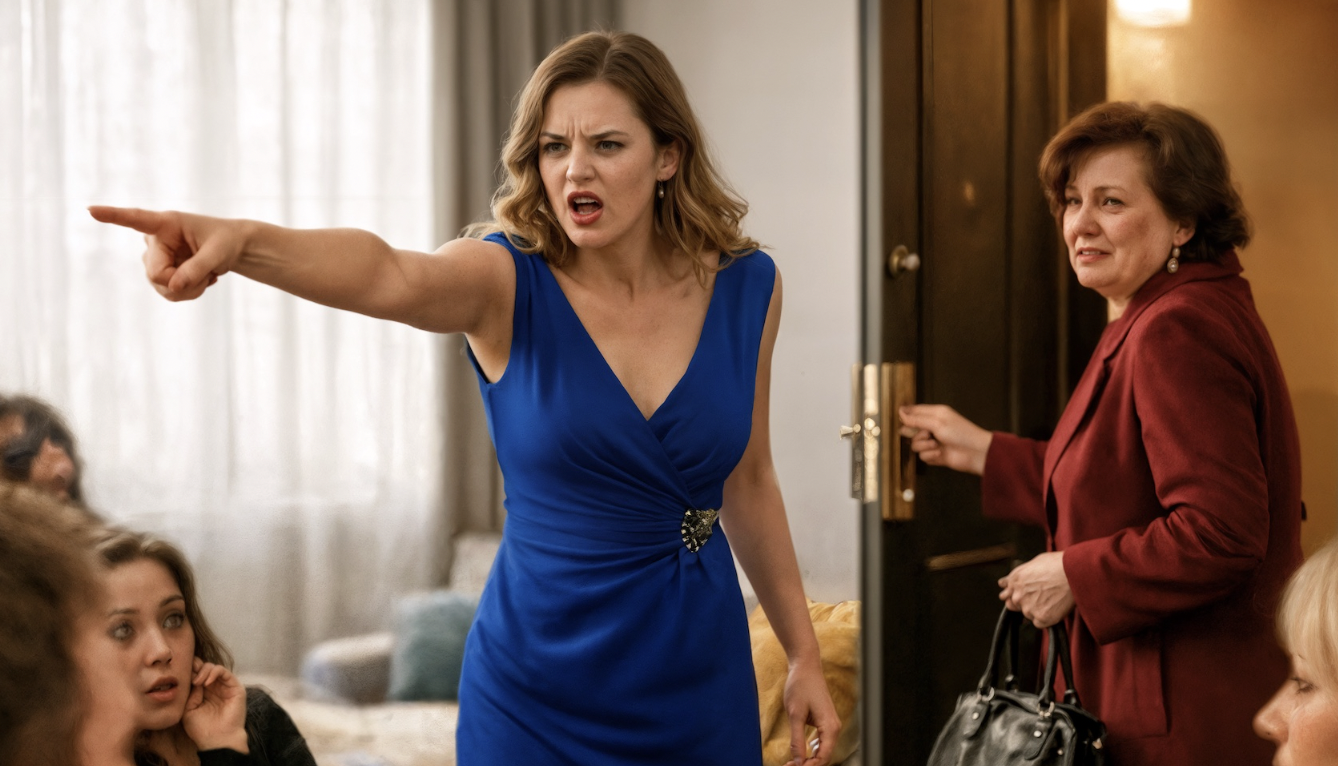
That was the moment something in Lena broke. She shot to her feet, and the chair scraped back with a crash. Marsik leapt down from the windowsill and ran into the bedroom. The room fell so quiet the ticking of the wall clock suddenly sounded loud.
“I’ve had enough,” Lena said. Her voice was calm, but there was steel in it. “Get out of my house.”
Alla Viktorovna froze, mouth slightly open.
“What did you say?”
“I said: get out of my house.” Lena could feel her lips trembling, but she kept going. “I cooked all day. I spent a lot of money to set this table. I tried to make tonight special for your son—whom, by the way, I love. And the moment you walked in, you started picking at everything. The shoes. The cat. The soap. The food. And now you’re digging into my personal life.”
“Dimochka!” Alla Viktorovna swung toward her son. “Did you hear how she’s talking to me?”
But Dima stayed silent, staring down at the table.
“I’m not refusing to have children because my career matters more,” Lena continued, and tears blurred her vision. “It’s because Dima and I aren’t ready yet. We want to wait until we’re stable. Is that a crime? And why do you keep comparing me to Oksana? Dima chose me. Me. Not her. Accept it already.”
“The nerve!” Alla Viktorovna sprang up. “Viktor, did you hear that?”
“I did,” Viktor Stepanovich said quietly. “And you know what, Alla? The girl is right.”
“What?!”
“You’re going too far.” He stood and put a hand on his wife’s shoulder. “We’re leaving. I’m sorry, Dima. I’m sorry, Lena.”
“How can you say that!” Alla Viktorovna protested, but her husband was already guiding her toward the door.
“You’re all against me!” she yelled as she pulled on her coat. “I’m his mother! I’m only taking care of him!”
“Mom… just go,” Dima said softly, without lifting his eyes.
The door slammed. Lena stood in the middle of the living room, shaking all over. Tears ran down her cheeks, smearing her mascara. The guests sat in silence, unsure what to do.
Aunt Masha was the first to come to her and hug her.
“Sweetheart, you did the right thing. She’s been crossing lines for a long time.”
“Exactly,” one of Dima’s brothers spoke up. “Lena, you’re a hero. We all understand what you’ve had to deal with.”
Dima finally looked up. His eyes were wet. He stood, walked to his wife, and wrapped her in a tight embrace. Lena pressed her face into his shoulder and cried the way she’d been holding back for years—everything from that day, from all those years, pouring out at once.
“Forgive me,” Dima whispered, stroking her hair. “Forgive me for not stopping her sooner. Forgive me for staying quiet.”
“I didn’t want to make a scene,” Lena sobbed. “I really tried. But she…”
“I know,” he said. “I know.”
Little by little the guests began to leave, awkwardly saying goodbye, promising to call. Aunt Masha stayed the longest, helping clear the table.
“You know,” she said as she stacked plates, “Alla has always been like this. Controlling. Even when Dima was little, she hovered over him every step. Then he grew up, and she didn’t know what to do with herself. She’s afraid he’ll leave her completely.”
“But I’m not taking her son away,” Lena said tiredly, wiping her eyes with a napkin.
“She doesn’t see it that way. To her, you’re a threat—because you’re strong. Independent. Not the kind of woman she imagined beside Dima.” Aunt Masha sighed. “But that’s her problem, not yours. You did well. Hang in there.”
When everyone was gone, Dima and Lena sat on the couch, holding each other. Marsik finally came out of the bedroom and hopped into their laps, purring.
“Do you think she’ll ever forgive me?” Lena asked.
“I don’t know,” Dima answered honestly. “But maybe that’s not the point anymore. What matters is that you finally said what needed to be said. And I… I should’ve done it a long time ago. I let you down.”
“You didn’t,” Lena said, taking his hand. “Sometimes it’s just hard to go against your parents.”
“But you’re my wife,” Dima said quietly. “You come first.”
They sat in silence, listening to the cat purr and the occasional car passing outside. The half-eaten cake still sat on the table, candles burning low. The celebration hadn’t gone the way they’d planned.
But something had shifted. Something important.
“You know,” Dima said after a while, “next time let’s just celebrate the two of us. No crowd. No… drama.”
Through her tears, Lena managed a small smile.
“Deal.”
A message popped up on Lena’s phone from Viktor Stepanovich: “Lenochka, I’m sorry for Alla. I’ll talk to her. You were right. Hang in there.” Lena showed Dima the screen.
“Your dad’s a good man,” she said.
“Yeah,” Dima nodded. “He is.”
They stayed that way until the last candle went out, until the sky outside turned completely dark. Ahead of them were difficult conversations, strained relationships, maybe a long stretch of silence. But for the first time in all those years, Lena felt she had defended her right to be herself—in her own home, beside her husband.
And maybe, just maybe, that was enough.