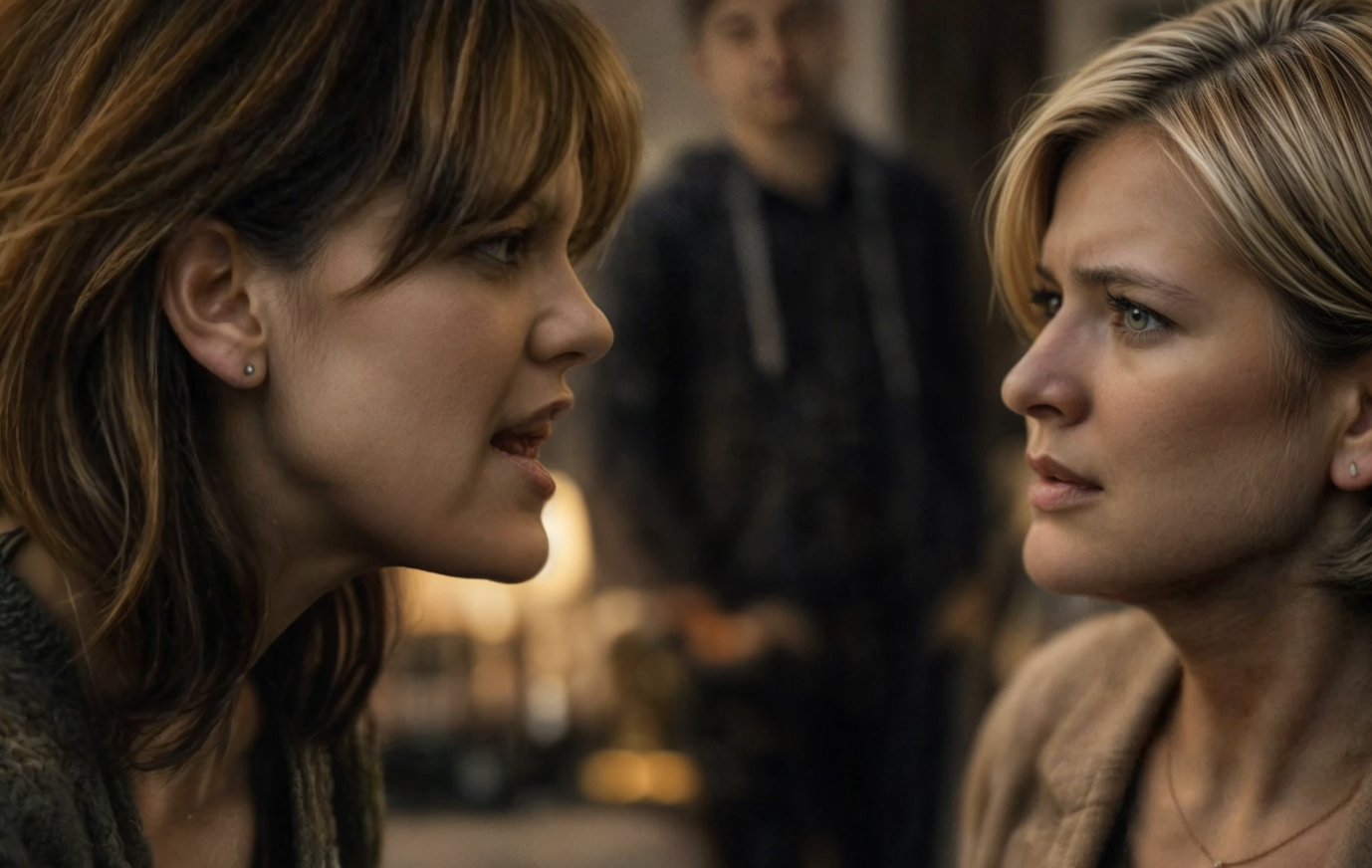
— “Anya, Dima needs help. You understand—I can’t manage it on my own.”
Larisa Mikhailovna’s voice was soft and wrapping, like warm honey they used to give for a cough in childhood—cloyingly sweet, and nauseating. With carefully practiced nonchalance, she slid a glossy brochure across the lacquered kitchen table. Expensive, with embossed gold lettering and photos of smiling, successful young people against the backdrop of an imposing building with columns. A private commercial college—one of those that sold diplomas on installment plans while disguising it as “elite education.”
Anna didn’t touch the brochure. She looked at it the way you’d look at a dead rat your mother had dragged into the house and was now offering you for dinner. She slowly finished her cold tea, set the cup down on the saucer with a barely audible tap, and only then raised her eyes to her mother. Her gaze was calm, cold, and completely unreadable.
“No, Mom.”
Two words. Simple, short, with not a hint of doubt or room for bargaining. They fell into the cozy kitchen silence—where it smelled of apple pie and motherly comfort—like two shards of ice. Larisa Mikhailovna flinched as if she’d been struck. The honey mask on her face cracked, revealing a hard, displeased grimace.
“What do you mean, ‘no’?” Her voice gained those pressing, shrill notes Anna had known since childhood—the exact timbre that switched on whenever something went off-script. “I don’t understand. What kind of answer is that?”
“It means no. I’m not paying for his education.”
Anna nudged the brochure toward the edge of the table with her fingertips, as if it were something dirty. She looked straight at her mother, and that direct, grown-up stare made Larisa Mikhailovna uncomfortable. She was used to seeing guilt in her daughter’s eyes, the desire to please, the fear of disappointing. But now there was nothing there except tired determination.
“But he’s your brother!” her mother cried, raising her voice. She threw up her hands, her manicured nails flashing with fresh red polish. “Your only brother, Anya! You have to help him. You’re obligated!”
Anna gave a small, joyless smirk. It sounded like rusty metal being forced to bend.
“I’ve been hearing the word ‘obligated’ from you my whole life. I was obligated to do his homework because he was ‘a boy and it’s hard for him to focus.’ I was obligated to clean his room because he had ‘creative mess.’ I was obligated to give him my new music player because he ‘really wanted it—what, are you sorry for him?’”
She spoke evenly, almost without emotion, listing facts like an accountant reading out a report of losses. Every word was precise, measured—and that precision made Larisa Mikhailovna start to tremble. She hadn’t been ready for this kind of pushback. She’d been counting on tears, on pleading, on the familiar game of “a good, loving family.”
“You’re twisting everything! Those were little things! Childhood nonsense!” her mother fought desperately to take control back. “And now it’s about his future! Your brother’s future! Do you really have no heart? He’ll be ruined! Do you want him to end up in the army? Or hauling boxes as a laborer?”
“Mom, spare me the theatrics. He’s twenty. At that age men don’t ‘get ruined’—they start taking responsibility for their lives. Or they don’t. That’s their choice.” Anna paused, watching her mother closely. “Besides, he doesn’t even plan to study. He told me so himself.”
Larisa Mikhailovna froze for a second. Her face stretched.
“He’s lying—just boyish nonsense! That’s just him showing off in front of you,” she recovered quickly. “Of course he wants to study! Everyone does! He just needs support. Our support—yours, first and foremost. You’re the oldest, you’re smarter, more successful. You have to set an example. Help him get on his feet.”
Anna slowly shook her head. The performance was flawless, but she was no longer the audience. She knew this script by heart.
“No. My role in this production is over. No more help. No more support. And no money. That’s my final decision.”
“You’re just selfish,” Larisa Mikhailovna spat, and her face—so recently arranged into motherly concern—hardened into an ugly mask. The softness vanished without a trace, replaced by cold, prickling contempt. “I always knew you had no soul. The moment you jumped into marriage, you forgot your family. Your husband taught you that, didn’t he? That relatives are nothing? That you don’t have to help them?”
She spoke fast, viciously, each word a small stone she hurled at her daughter. She aimed for the tenderest spots, trying to break through Anna’s calm armor and summon the familiar guilt their whole family world was built on.
“My husband has nothing to do with it. This is my decision, based on years of experience,” Anna’s voice stayed even, but steel threaded through it. “And since we’re talking about obligations, let me remind you. I was obligated to keep quiet when he stole my money—the money I’d saved for an English tutor. Remember? You found the empty envelope under his mattress, then came into my room and begged me not to tell anyone. You said he was ‘going through a difficult period.’ He was sixteen then, Mom. Not six.”
Larisa Mikhailovna jerked as if slapped. Her cheeks flushed a dark crimson.
“Stop it! That was a hundred years ago! He was a child! Children do stupid things—he understood everything long ago and repented!”
“Repented?” Anna’s smile twisted. “He repented so much that two years later, when I stayed up all night writing his economics term paper because you were crying and saying he’d be expelled, he was out drinking with friends on the money you gave him for ‘study materials.’ And I kept quiet about that too. Because you asked me to. Because ‘Dima needs a chance.’ How many chances was I supposed to pay for with my life, Mom? How many more?”
Each memory was a scar Anna seemed to reopen right there, on that sunlit kitchen. She wasn’t defending herself anymore. She was attacking—methodically, mercilessly—using the truth as a weapon, the truth they had both spent so long and so carefully silencing.
At that moment, the kitchen door swung open lazily, and the subject of the argument appeared in the doorway. Dmitry—tall, hunched, with a permanently dissatisfied face and sleepy eyes—scratched his stomach under a stretched-out T-shirt.
“Mom, is there anything to eat?” he asked, ignoring the thick, electrified tension in the air.
At the sight of her son, Larisa Mikhailovna transformed instantly. The fury aimed at her daughter switched to syrupy, suffocating tenderness.
“Dimmy, sweetheart, of course there is. I baked a pie—your favorite, apple. Sit down, I’ll pour you some tea.”
She fussed around him, her movements suddenly smooth and caring. The abrupt shift was so grotesque it made Anna feel sick. She watched this ugly symbiosis of mother and son and, for the first time in her life, felt nothing but disgust.
Dmitry flopped into a chair, grabbed the biggest piece of pie, and stuffed it into his mouth. Chewing, he finally noticed the brochure on the table and his sister’s sour expression.
“Oh, so this is about college?” he mumbled through a mouthful. “Anya, come on. What, you feel sorry or something? Didn’t you get a bonus? I heard. You’ll chip in for the first year, and then we’ll figure it out.”
That casually arrogant line was the last drop. He didn’t ask. He didn’t persuade. He simply stated it like a fact—as if her money were a shared family resource he had an unquestionable right to by birth.
Hearing that, Larisa Mikhailovna immediately rushed into battle to defend her hopeless offspring.
“See! The child understands everything!” She turned to Anna, her eyes shooting lightning again. “He’s not asking for a car, not for partying—he’s asking for an education! And you… You’ve always been jealous of him! Of his talents, of how everyone loves him! Even when you helped, you did it with a face like you were doing him a favor! You just liked feeling better than him! That’s all your ‘help’ ever was!”
Jealous? Anna listened to the accusation, and a shadow of a smile slid over her lips. It was so absurd, so far from the truth, it didn’t even spark anger—only the cold, detached curiosity of a pathologist studying a long-dead organism. She slowly lifted her gaze from the tablecloth to her mother, then shifted it to her brother, who had finished his pie and was now watching the quarrel with interest, like it was an entertaining TV show.
“Jealous?” she repeated quietly—and that quiet question sounded louder in the kitchen than any scream. “Of what, Mom? Tell me—what exactly was I supposed to be jealous of? His talent for lying to your face knowing you’ll believe him anyway? His ability to live off other people and think it’s normal? Or maybe his knack for turning every opportunity into a failure? Those are rare talents, I agree. But for some reason they don’t inspire envy in me.”
Larisa Mikhailovna opened her mouth to object, but couldn’t find words. Her daughter’s arguments weren’t emotional jabs—they were precise surgical cuts, exposing the infected abscess of their family relationships.
Anna slowly, with pointed calm, pushed her chair back. The scrape of the legs against the linoleum was the only sound in the silence that followed. She stood up—not to leave, but to rise above them as they sat at the table. She looked down at her mother, and there was no anger in her eyes, no hurt. Only an irreversible decision.
“No, Mom. I’m not paying for his education. He may be my brother, but I’m not going into debt so he can have some kind of diploma—especially when he isn’t even going to study. He told me that himself.”
Dmitry choked on his tea. He stared at his sister with open hatred.
“What are you saying? I never told you that!” he blurted, spitting droplets.
“You didn’t?” Anna didn’t even turn her head toward him; her eyes stayed locked on their mother. “You didn’t tell me two weeks ago by the entrance, laughing, that you ‘just need a diploma for show so the parents get off your back’? Wasn’t it you bragging that every exam can be ‘bought off a price list’ and only ‘nerds and losers’ go to lectures? Were those not your words, Dima? Or is my hearing failing?”
Confusion flickered across Larisa Mikhailovna’s face. She looked at her son, searching his eyes for denial, but found only cowardly anger and a darting gaze. He’d been caught—caught by his own stupidity and boasting.
“It’s all lies! She’s making it up!” he shouted, jumping up from the chair. “She just doesn’t want to give money, so she’s inventing this nonsense!”
But his yelling convinced no one anymore. The truth was too obvious. Anna ignored his tantrum. She addressed her mother again, her voice turning very quiet—yet even heavier for it.
“Do you hear him? He’s lying even now. Clumsily, stupidly. You raised a liar and a parasite, Mom. And now you want me to pay for the next season of this show—to buy him a diploma he neither deserves nor needs. Well, I won’t. Want to buy him a ‘checkbox’? Great idea. Sell your car. Or the summer house. The very summer house I broke my back on every year while Dimmy ‘rested from hard studying’ in the city. That would be fair. Invest your own resources in your own project. My money is done in this cesspool.”
She turned and walked toward the kitchen exit. She didn’t look back. She knew she’d see her mother’s face twisted with rage and her brother’s helplessly clenched fists. She left them alone with the glossy brochure, the half-eaten pie, and the ugly truth she had just dumped onto their cozy kitchen table.
“Ungrateful!”
It wasn’t a word so much as a hiss torn from Larisa Mikhailovna’s mouth, warped by spite. She sprang from her place and lunged after her daughter into the hallway, her cozy house slippers scraping angrily on the floor. Dmitry—awkward and furious—followed, looming like a dark shadow. The kitchen coziness evaporated, dissolved as if it had never existed. Only bare, animal rage remained—the rage of cheated predators having prey snatched away.
“You’ve used my kindness, my love, your whole life! I did everything for you—everything! And you? You grew up and decided you can wipe your feet on us? Decided your little husband is your family now, and we’re just trash by the roadside?”
Anna walked to the front door in silence. She didn’t turn around. She listened with her back as they screamed, and the words seemed to bounce off her without doing any harm—as if she were wearing invisible armor forged from years of humiliation and swallowed resentment. She stopped by the small console table where they usually left keys and mail.
“You’re just fat and spoiled!” Dmitry chimed in, his voice rough with dull, teenage malice. “Started earning more than us and now you think you’re something special! Queen of the world! You think we need your handouts? We’ll manage without you!”
He was lying, and all three of them knew it. His words were a pathetic attempt to save face where face had long since been gone. He was as dependent on his mother’s coddling and other people’s money as a newborn is on milk.
Anna said nothing. She slipped her bag off her shoulder and took out her keyring. There weren’t many: her apartment, her car, her office. And among them—one old brass key to her mother’s apartment. The most worn of all, nicked along the teeth, familiar down to every scratch. She held the ring in her hand, and its quiet metallic jingle was the only answer to their furious tirades.
“What are you doing?” Larisa Mikhailovna’s voice wavered—not with tears, but with a sick premonition. She saw that slow, deliberate motion and understood that something irreversible was about to happen.
Anna didn’t reply. Her fingers calmly, methodically pried open the tight metal ring. It wasn’t easy—she nearly broke a nail—but her face showed no emotion. She was fully focused on this simple mechanical act, as if her life depended on it. And in a way, it did. She wasn’t just removing a key. She was performing surgery—amputating a poisoned, gangrenous piece of her past.
“Anya, stop! What are you thinking?” Now her mother’s voice held genuine fear—not fear for her daughter, but fear for herself. Fear of losing access, leverage, a backup airfield.
Finally, with a soft click, the key came free. Anna closed her fist around it, feeling the cold metal against her skin. Then she opened her palm and carefully, without a clatter, set it down on the dark polished surface of the console table. The brass key flashed helplessly under the hallway lamp.
The shouting died. Both mother and son stared at the key as if it were a snake. It lay between them and Anna like a border that could no longer be crossed. A symbol of her final departure.
Anna slipped the rest of her keys back into her bag, zipped it, and only then looked at them. Her gaze was empty and calm—the gaze of someone who has made a decision and will never doubt it again.
“The family bank, Mom,” she said quietly, each word slicing the air, “is finally closed. The account is empty.”
She turned the lock, opened the door, and stepped out onto the landing. She didn’t look back. She didn’t hear what they shouted after her, because another music was already playing in her ears—the music of silence and freedom.
And in the hallway, in front of that mute brass key, two people stood frozen: Larisa Mikhailovna and Dmitry. Their rage had burned out, leaving only the bitter taste of ash and an icy, all-consuming realization: the source of easy money, unconditional help, and everlasting guilt they had fed on all their lives had just dried up.
Forever