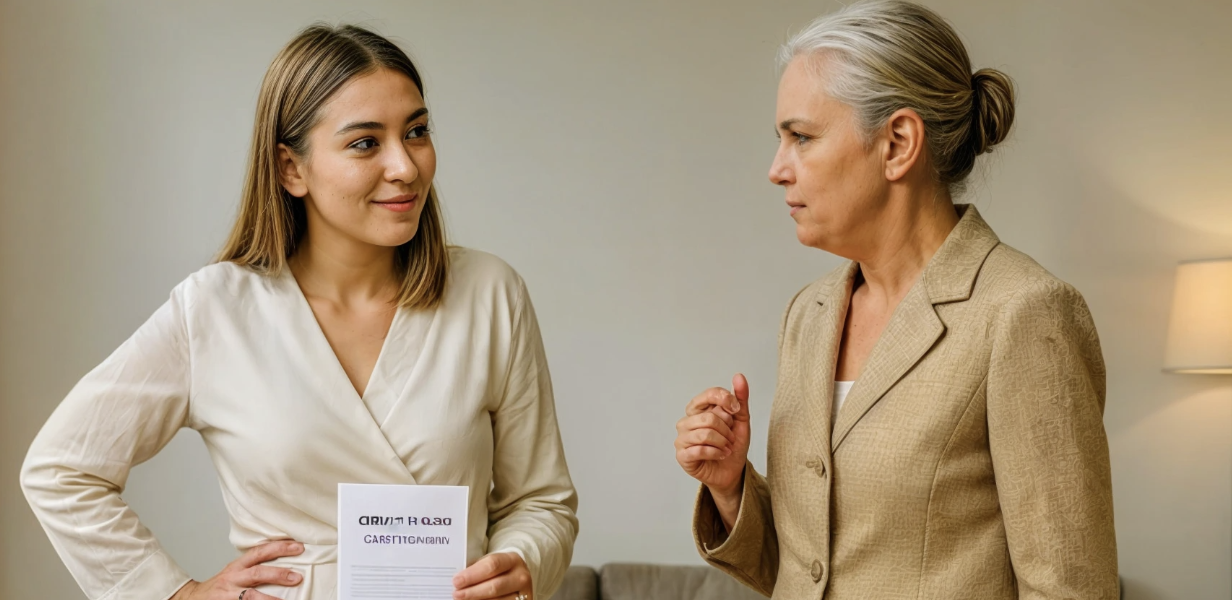
Vera was folding the clean laundry into the wardrobe when she heard the familiar cough behind her. Maria Nikitichna stood in the bedroom doorway, surveying the room with a critical eye. Her mother-in-law came to “visit” three times a week, but every visit turned into an inspection.
“Verочка, you’re hanging the towels wrong,” Maria Nikitichna announced, walking in without knocking. “Colored ones should be separate from white ones. And you should iron them on both sides—otherwise bacteria multiply.”
Vera silently nodded and kept working. Arguing was pointless. Her mother-in-law considered herself an expert in everything related to housekeeping—and her “expert opinion” extended to absolutely every aspect of the young couple’s life.
“And did you make soup today?” Maria Nikitichna continued, heading for the kitchen. “Maxim needs something hot every day. A man without soup isn’t a man—he’s a misunderstanding. I’ve told you that more than once.”
Vera let out a tired breath. Every day began and ended with her mother-in-law’s instructions: how to cook, how to clean, how to dress, who to talk to. Living under that total control was becoming unbearable.
“And here’s something else,” Maria Nikitichna sat down at the kitchen table, clearly settling in for a long talk. “You talk too loudly on the phone. The neighbors might think you’re a troublemaker. You need to speak more quietly, more properly. And why do you call your mother so often? Maxim doesn’t like it.”
“Maxim never told me anything like that,” Vera objected carefully as she poured tea.
“He didn’t tell you because he’s tactful. A well-brought-up boy—unlike some people. But I can see how tense he gets when you hang on the phone for an hour. Your husband needs attention, not girlfriends on the phone.”
Vera gripped her mug with both hands. Her patience was slowly but surely running out. Her mother-in-law controlled literally every step, every word, every breath. It felt like she even had to relearn how to breathe—according to instructions.
“Maria Nikitichna, maybe it’s time for you to go home?” Vera hinted politely. “You must have things to do.”
“What things? I’m retired. My main job is helping my son and his family. Tomorrow I’ll come in the morning—we’ll do a deep cleaning together. I’ll show you how to wash floors properly. You leave streaks.”
Vera closed her eyes and silently counted to ten. Every day had become a trial. Living under her mother-in-law’s microscope was torture.
That evening, when Maria Nikitichna finally left, Vera waited for her husband to come home from work. Maxim arrived tired, tossed his briefcase in the entryway, and went into the kitchen.
“Max, we need to talk seriously,” Vera began as she set the table. “Your mom… she won’t let me breathe. She’s here all the time—ordering me around, criticizing, sticking her nose into everything.”
“Mom helps us,” Maxim replied calmly, pulling out his phone. “She’s an experienced woman—she knows how to run a household properly. Honestly, you could learn from her.”
“Learn?” Vera froze with a plate in her hands. “Maxim, I’m an adult. I don’t need instructions on how to hang towels or who I can talk to on the phone.”
“There’s nothing wrong with Mom’s advice,” her husband shrugged, eyes still on the screen. “She wants what’s best for us. She wants everything to be good. You’re taking little things way too personally.”
“Little things? She controls my every step!”
“Vera, don’t exaggerate. Mom’s just caring. Lots of people dream of a mother-in-law like that. And you’re unhappy. You never like anything.”
Vera sank into a chair. Maxim didn’t see any problem at all. To him, his mother’s behavior was normal. He’d grown up in an atmosphere of total control and called it “care.”
A week later, Vera’s mom called with unexpected news. Vera’s grandmother, Elena Pavlovna, had decided to move in with her daughter permanently.
“She wants to be close,” her mother explained over the phone. “She says it’s hard alone. And I’ll feel calmer if she’s nearby. Vera, you don’t mind, do you?”
“Of course I don’t,” Vera said, genuinely happy. “I’m completely for it. Grandma’s wonderful—you’ll get along great.”
Her grandmother had always been wise and tactful. She never meddled in other people’s lives, never gave unsolicited advice, respected boundaries—her total opposite of Maria Nikitichna.
“You know, I just had an idea,” her mother continued thoughtfully. “If Grandma’s moving in with me, her apartment will be empty. A two-room place on the third floor—nice and bright. Maybe she could give it to you? Or at least make a will? Either way, it’ll be yours eventually.”
Vera went still. Her own apartment. Freedom from renting, from paying monthly rent, from dependence. A dream.
“Mom… are you serious?”
“I’ll talk to Grandma. I think she’ll agree. You’re her only granddaughter—her favorite. Who else would she leave it to?”
Her grandmother agreed without hesitation. A month later, all the documents were finalized. Elena Pavlovna moved in with Vera’s mother, and officially gifted the two-room apartment on the third floor to Vera. The deed of gift was registered on time, exactly as required.
“Live there, sweetheart, and be happy,” her grandmother hugged her on the day she handed over the keys. “This is your personal property. You won’t have to share it with anyone. Just remember: the apartment is yours—and only yours. Because it’s a gift, it isn’t divided in a divorce. Remember that well.”
Vera kissed her grandmother, thanking her for the priceless gift. The apartment was modest but cozy: two small rooms, a kitchen, and a combined bathroom. But it was hers—no rent, no landlord who could throw them out at any moment.
“Thank you so much,” Vera whispered, hugging the elderly woman. “You have no idea how important this is for me.”
“I do, dear. I was young once too—I know what it’s like to live in a rented place. Now you have your own corner. Take care of it with Maxim.”
Vera smiled, but privately she thought: the apartment belonged only to her. And that was right. It was her protection, her support, her independence.
The move took just two days. The couple didn’t own much—clothes, dishes, a minimum of furniture. Maxim carried boxes, grumbled, but overall he was pleased.
“At least we won’t have to pay rent anymore,” he said, setting up the couch. “Thirty thousand a month saved. That’s huge.”
Vera nodded as she put dishes away in the kitchen. She was happy not only about the savings, but about the independence. No one could put them out on the street now. No landlord could suddenly raise the rent. This was their fortress.
“We can start saving for a car,” Maxim went on dreamily. “Or finally take a real vacation. Turkey, maybe. Everyone at work goes—we never do.”
“Yeah, we can do a lot now,” Vera agreed, wiping the windows. “The main thing is to manage the money wisely.”
Together they made a new family budget. Without the rent expense, everything looked far more optimistic: better groceries, new clothes, small развлечения.
“Your grandma basically saved us,” Maxim admitted that evening as they sat on the balcony with tea. “Good thing you’ve got relatives like that.”
Vera smiled but didn’t answer. She remembered her grandmother’s words: the apartment was hers alone.
The first month in their new place flew by. They actively saved the money that used to go to rent. Thirty thousand rubles a month was a significant sum for their budget.
“Can you imagine? In a year we’ll save three hundred sixty thousand,” Maxim calculated over dinner. “We could buy a used car. Or do a good renovation. So many options.”
Vera felt immense relief that the financial pressure had eased. Now they could afford quality food and stop pinching pennies. Life was becoming comfortable.
“Maybe we should save for new furniture?” she suggested. “This couch squeaks, and the wardrobe has seen better days.”
“Let’s do the car first, then furniture,” Maxim objected. “The car matters more. In winter you’ll suffer getting to work on buses.”
They talked about plans, built a future. Maxim liked the new living situation too. The apartment was small but cozy—and most importantly, free.
“By the way, I haven’t told Mom about the apartment yet,” Maxim remembered. “We should invite her over, show her. She’ll be happy we finally have our own place.”
Maria Nikitichna found out the very next day. Maxim called her in the morning and shared the good news. His mother immediately came to inspect.
“Well, look at you—good job,” she said, walking through the rooms. “It’s a nice apartment, even if it’s small. But it’s central, near bus stops—very convenient.”
Vera noticed her mother-in-law’s eyes light up with a particular glint. Maria Nikitichna was clearly plotting something. She studied the layout too carefully, peered into every corner.
“And who will live in the second room?” she asked casually, stopping by the smaller room.
“No one for now,” Vera answered warily. “It’ll be a guest room. Or a study for Maxim—we haven’t decided.”
“A guest room?” Maria Nikitichna sounded shocked. “What a waste. The room just sits there. And it could be used properly.”
Vera’s caution sharpened. Her mother-in-law’s tone promised nothing good. Maria Nikitichna was making plans—and those plans clearly involved their apartment.
“Used how?” Vera asked carefully.
“How else? Igor could live here for a while. My younger son desperately needs housing. He’s renting a room in a dorm—terrible conditions. And you’ve got an empty room.”
Vera felt the blood rush to her face. Igor was Maxim’s younger brother—a thirty-year-old man who couldn’t get his life together. He kept changing jobs, blamed circumstances, lived large at his mother’s expense.
“Maria Nikitichna, that’s impossible,” Vera said firmly. “We have a small apartment, we’ve only just settled in. We need our personal space.”
“What personal space?” her mother-in-law flared up. “The room is empty! Wasted! And Igor has nowhere to lay his head. He’s Maxim’s brother—blood. How can you refuse family?”
Maxim stayed silent, shifting from foot to foot. Vera shot him a pleading look, but her husband looked away.
“Mom’s right,” he said quietly at last. “Igor really needs help. We can’t refuse my brother. It’s family.”
“Maxim!” Vera couldn’t believe her ears. “What are you talking about? This is our home, our space!”
“Our home is a family home,” Maria Nikitichna cut in, instructive as ever. “And in a family home, there’s always room for relatives. Igor will stay temporarily, get back on his feet, and move out. Just a couple months.”
“I’m absolutely against it,” Vera said flatly. “And I’m not discussing this any further.”
The atmosphere in the family turned white-hot. Maxim supported his mother’s idea and kept pressuring Vera to agree. Every evening became endless arguments.
“Ver, think logically,” her husband insisted, pacing the room. “Igor is my brother. My own. We can’t abandon him. He has no money for normal housing—he lives in a dorm like a bum. And we’ve got an empty room.”
“It’s empty because it’s our personal space!” Vera shot back. “Maxim, we’ve only just started living normally—without strangers. And you want to move your brother in here?”
“Temporarily. Two months, max.”
“Two months will turn into years! I know these ‘temporary’ tenants. He’ll settle in and never leave.”
“You’re selfish,” Maxim said, offended. “You only think about yourself. Family means nothing to you.”
“Family is you and me!” Vera tried to reach him. “Not every relative who wants to move into our apartment!”
But Maxim wouldn’t budge. His mother had convinced him that refusing his brother was betrayal—that real family always helps each other, and that Vera was selfish for wanting comfort.
“Igor’s moving in on Saturday,” Maxim announced at last. “I already promised Mom. The decision is made.”
On Saturday morning, Vera heard the doorbell. On the threshold stood Maria Nikitichna with huge bags and a satisfied smile. Maxim let her in and began hauling things inside.
“What is that?” Vera asked, staring at the bags.
“Igor’s moving today—I brought his things in advance,” her mother-in-law replied cheerfully. “Maxim, carry it all into the second room. It’ll be comfortable for my son.”
Vera felt everything inside her tighten into a hard knot. They hadn’t even asked her. They’d simply informed her. Maxim avoided her eyes, fussing as he carried the bags.
When his mother went to the kitchen to put the kettle on, Vera couldn’t take it anymore. She caught up with Maria Nikitichna and stepped in front of her, blocking her path.
“Why do you think my apartment is a family house?” Vera asked, staring her down.
Maria Nikitichna raised her brows in surprise, as if she’d heard something absurd. She even laughed and shook her head.
“Your apartment? Sweetheart, how naive. Everything acquired during marriage is joint property. That’s the law. The apartment belongs to you and Maxim equally. Which means Maxim has every right to decide who lives here.”
“All property acquired during marriage is considered jointly owned,” Maria Nikitichna went on, lecturing as she poured tea into cups. “I consulted a lawyer specifically. Even if it’s registered in your name, Maxim has equal rights. So don’t act like you’re the only owner.”
“Maria Nikitichna, you consulted a bad lawyer,” Vera said coldly. “Because this apartment is not joint property.”
“Oh yes it is!” her mother-in-law snapped. “You got it during the marriage—so it’s shared!”
“No. I received this apartment as a gift from my grandmother. It wasn’t bought during the marriage, it wasn’t purchased with shared money. It’s my personal property.”
“What does inheritance have to do with it?” Maria Nikitichna faltered.
“It matters because by law, property received as a gift or inheritance by one spouse is not divided,” Vera said evenly. “It’s in the Family Code. Even in a divorce, this apartment stays mine—only mine.”
Her mother-in-law’s face fell. She hadn’t expected Vera to know the law. Maria Nikitichna was used to manipulating, to crushing people with authority—but this weapon didn’t work.
“Maxim!” she shrieked. “Come here right now! Your wife has gotten completely out of hand!”
Maxim came into the kitchen, looking between them. Maria Nikitichna still held her cup, but her face was red with outrage.
“Explain to your wife that the apartment is shared!” she demanded. “She’s making a scene, quoting laws!”
“Vera, let’s not start,” Maxim said, trying to soothe. “Mom’s right—the apartment is ours.”
“No, Maxim,” Vera replied calmly. “It’s mine. Personal. Gifted to me. It isn’t marital property. Even if we divorce, this apartment won’t be divided. It will remain mine.”
“Divorce?” Maxim looked stunned. “What are you even talking about?”
“I’m saying you can’t call this apartment ‘ours.’ Legally it belongs only to me. Grandma signed the deed in my name, not in both our names. On purpose.”
“On purpose?” Maxim repeated, disbelieving. “So you planned from the start not to share?”
“I received it from the start as a personal gift. And yes, Grandma warned me it was mine. She made sure I had a reliable support—a roof over my head that no one could take away.”
Maria Nikitichna slammed her cup on the table so hard tea splashed.
“There it is—her true nature!” she screamed. “Greedy! Calculating! Married my son and won’t share the apartment! Only for herself—her precious self!”
Maria Nikitichna threw a full-blown tantrum right there in the kitchen—shouting, waving her arms, accusing Vera of every mortal sin. The neighbors probably heard every word.
“Ungrateful!” she howled. “We accepted you into the family, and now you’re kicking us out of your apartment! You won’t even let Igor stay! Selfish!”
“No one is kicking anyone out,” Vera replied evenly, arms crossed. “You and Maxim live here. But Igor does not belong here. This is our space.”
“What space? What right do you have to decide? Maxim is the master of this home!”
“Maxim is not the master,” Vera said sharply. “This is my apartment by documents. And I have the full right to decide who lives here—and who doesn’t.”
“You don’t respect family!” Maria Nikitichna kept shrieking. “You don’t respect your husband! You don’t respect me! Maxim, do you hear her?”
“I hear her,” Maxim said darkly.
“And what are you going to do?” his mother demanded. “Are you going to let your wife talk to your mother like that?”
Vera didn’t stop. She had been silent too long—enduring humiliation, control, manipulation. Now it was time to say everything she’d held inside.
“Maria Nikitichna, you’ve been meddling in our life for years,” Vera said, each word clipped and clear. “Telling us how to live, how to breathe, how to talk. Controlling every step. And I kept quiet, I endured. But that’s enough.”
Maxim stood silent, processing. His face grew darker with each second. His mother kept sobbing theatrically, calling on her son to defend her from his “impudent” wife.
“Maxim, can’t you see how she treats me?” Maria Nikitichna sniffled. “I’m your mother! I gave birth to you, raised you, gave you my whole life! And she insults me!”
Maxim slowly lifted his head and looked at Vera. His gaze was cold, distant. Vera realized something irreversible was about to happen.
“You know what, Vera,” he said quietly, clearly. “I can’t live with a woman who talks to my mother like that. I can’t and I won’t.”
“Maxim, your mother turned my life into hell,” Vera tried to explain. “Can’t you see it?”
“I see one thing,” he said. “You’re selfish. You won’t share the apartment, you won’t help my brother, you insult my mom. I don’t need a wife like that.”
“Right, my son!” Maria Nikitichna encouraged him, wiping her tears. “You don’t need a wife like that!”
“I’m filing for divorce,” Maxim said, enunciating. “And let this apartment stay yours. I don’t need it. And I don’t need you either.”
Vera felt a strange relief. At last everything was clear. At last the masks were off.
“File,” she answered calmly. “I’m not against it.”
Maxim stared at her, stunned. He’d clearly expected tears, begging, attempts to stop him. But Vera stood perfectly calm—almost relaxed.
“You… you agree to divorce?” he asked incredulously.
“More than agree,” Vera said. “I’m tired of enduring your mother and your indifference to my feelings. Tired of being a servant in my own home. Tired of living under pressure.”
“How dare you!” Maria Nikitichna screeched. “Maxim is a wonderful husband! You’re the ungrateful one!”
“A wonderful husband wouldn’t let his mother humiliate his wife,” Vera cut in. “A wonderful husband would protect his family—not hide behind his mother’s skirt.”
Maxim flushed with rage. He grabbed his jacket from the hook and pulled on his boots.
“I won’t tolerate this!” he shouted, zipping up. “I won’t tolerate my mother being insulted! We’re leaving! And we’re not coming back!”
“We’re leaving, son, leaving!” Maria Nikitichna echoed, hurriedly gathering her things. “Let her stay in her apartment alone! We’ll see how she lives without us!”
Vera watched them pack without a word. Inside, an unusual calm was spreading.
When Maxim and Maria Nikitichna were ready to go, they stood by the door, waiting for Vera to rush after them and stop them. Instead, she walked to the door and swung it wide open.
“Don’t let the door hit you on the way out,” she said evenly. “Good luck finding a more obedient daughter-in-law.”
“You’ll regret it!” Maria Nikitichna threatened from the threshold. “You’ll end up alone—no one will need you!”
“Better alone than with you,” Vera smiled.
Maxim wanted to say something, but his mother tugged his sleeve. They stomped out onto the landing. Vera firmly shut the door and turned the key in the lock.
Silence.
For the first time in a long while, the apartment was completely silent. No shouting. No orders. No criticism. Vera walked into the room and sank onto the couch.
She was divorced—or rather, she would be in a month, when the formal waiting period ended. But in reality, it had already happened. Maxim had left with his mother, and he was unlikely to return.
Vera leaned her head back against the couch and closed her eyes. A strange feeling. It should have been sad; there should have been tears. But there weren’t. There was only relief.
Alone in her apartment, Vera felt an extraordinary calm. For the first time in years, she could breathe freely. No one told her how to hang towels. No one criticized her cooking. No one pushed advice on how to live.
She got up and walked through the rooms. The apartment felt larger without Maxim and his mother. The air felt lighter. Vera opened the window and let in fresh air.
At last, the long-awaited quiet had come to her life—the quiet she had dreamed of all these years. Quiet without reproaches, without manipulation, without toxic relationships.
Vera brewed herself tea and sat by the window. Outside, ordinary life went on: people hurried about their business, children played in the yard, a dog barked somewhere. The world kept turning no matter what.
She realized she was free—free from a husband who never protected her, from a mother-in-law who made life a nightmare, from the constant need to justify herself and prove her right to have an opinion.
The phone rang. Her mother. Vera picked up.
“Verочка, how are you?” her mother asked gently.
“Great, Mom,” Vera smiled, looking out the window. “Just great. I’m fine. Finally—truly fine.”
And it was the pure truth. For the first time in a long while, Vera was completely happy—alone in her own apartment, with her own rules, with her own life. And it was wonderful.