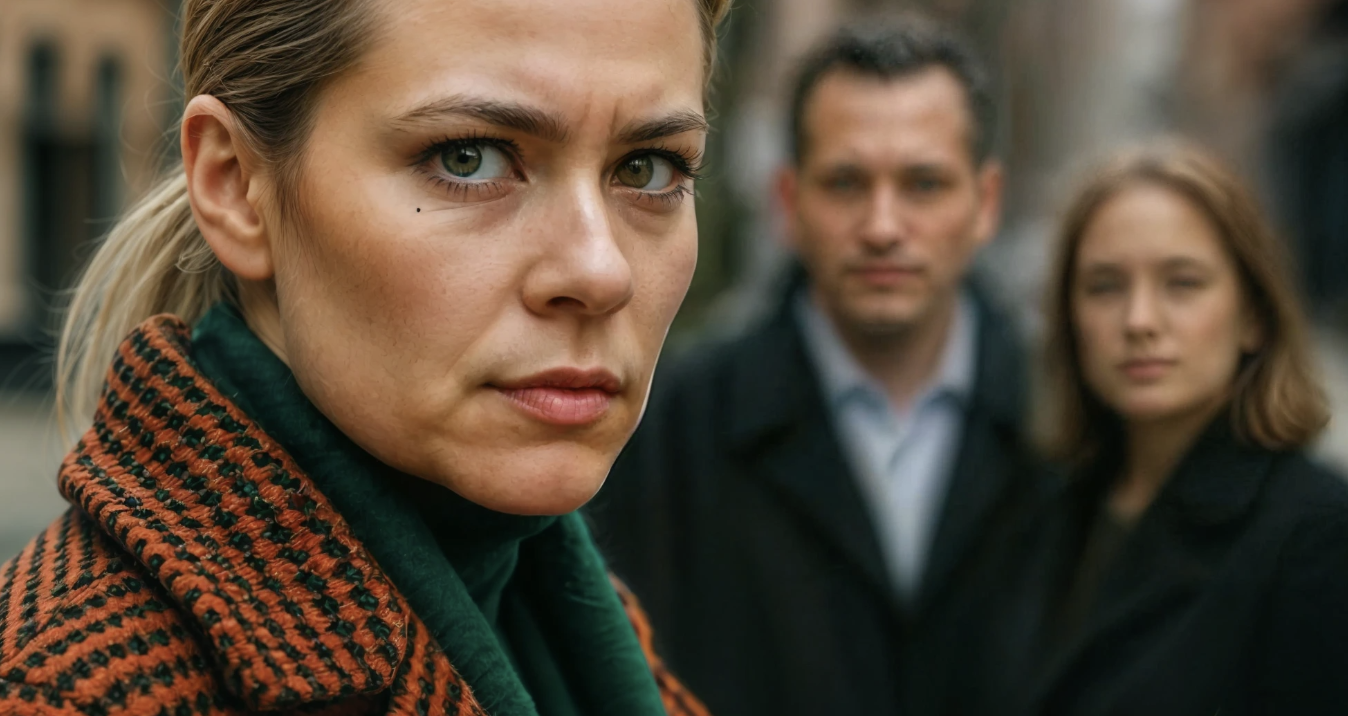
A resonant, authority-soaked voice—her mother-in-law, Alla Mikhailovna’s—cut through the stale air of the old two-room flat on the outskirts of Moscow.
“Olga, come on—you’re not a stranger. You understand: we’re family. And in a family, how is it? Everything’s shared. The joys are shared, and that means… well… the opportunities too.”
Olga, a literature teacher with twenty years of experience, silently stirred a long-cold tea in her favorite mug with a Vrubel print on it. She sat on the edge of the old sofa, instinctively drawing her head into her shoulders. Opposite her, sprawled in the only “master’s” armchair, was Alla Mikhailovna—a woman like a boulder, the warehouse manager at a sausage factory. She always smelled of smoked meat and power—the petty but absolute kind of power that comes from controlling scarce goods.
Next to her, on a hard chair, Angela—the sister-in-law—kept fidgeting. At thirty-two, she still hadn’t found a “decent” job.
“What ‘opportunities,’ Mom!” Angela whined, examining her garish manicure. “Money. That’s what it is—money! They turned me down again last week. Said I ‘don’t have enough experience.’ As if! I’d wipe the floor with those office rats from HR. They’re just jealous. I told them straight: ‘You don’t even understand who you’re losing.’ And they…”
“Then write your résumé properly,” Igor muttered—Olga’s husband—studying his reflection in the black screen of the switched-off TV. He adjusted the collar of his expensive (as he claimed) shirt and glanced at his watch. The watch was heavy, gold-glinting, and Igor wore it like a medal.
Igor worked as a personal driver for some banker. He drove a company Mercedes S-Class and acted as if that “Merc” were his private property. He loved to toss the key card with the three-pointed star onto the kitchen table and ramble about “traffic on Kutuzovsky” and “the quality of Nappa leather.” The family listened in reverent awe. Olga knew the suit was bought on credit, and at home Igor walked around in stretched-out sweatpants.
“What does a résumé have to do with it?!” Angela flared. “Igor, you of all people should get it! Status! I need starting status! And what status do I have if I live with Mom? I need my own apartment. For a fresh start.”
Alla Mikhailovna sighed theatrically, pressing a hand to her massive chest.
“That’s exactly what we’re talking about, dear. Exactly. Olechka,” she fixed her daughter-in-law with a sharp stare again, “we didn’t just gather for nothing. We’ve… done some figuring.”
Olga lifted her eyes. Her gray, usually warm, “teacher” eyes now looked like two chips of ice. She waited. She’d known this conversation was inevitable ever since her second cousin’s aunt, Aunt Katya, died six months earlier.
“So,” Alla Mikhailovna switched into Warehouse Boss mode, “your aunt’s apartment in Moscow. In Sokol. Good area—Stalin-era building. Igor and I checked prices. There’s…” she chewed her lips meaningfully, “there’s very good money there, Olya. Very.”
Olga was silent.
“And we decided,” Igor jumped in, standing and pacing the room like a businessman deciding the fate of nations, “for us to keep cramming in here… it’s ridiculous. I’m a man… in the public eye. I need to match my image. We sell that Stalin building.”
Olga didn’t speak.
Angela leaned forward, her eyes feverishly bright.
“Igor, you’ll start! You know I need it more!”
“Hush!” Alla Mikhailovna snapped. “There’s a plan. Approved by Igor. So: first—Angela gets a down payment for a mortgage. Enough sitting around single; time to build a life. Second—I get money for the dacha. Finish the second floor and build a bathhouse. I’ve worked myself to the bone for you my whole life; I’ve earned some rest.”
“And us?” Olga asked quietly, almost a whisper.
“And us—the main thing!” Igor stopped in front of her, legs wide. “I’m getting a new car.”
“But you already have—”
“Oh, Olya, don’t make me laugh. That one is a company car. You understand? COM-PA-NY. I could lose it tomorrow. I need my own transport. Real. So I’m not ashamed. I’ve already picked a—an SUV. For Mom’s dacha and for the city.”
“And whatever’s left,” Alla Mikhailovna continued, “goes to you—for your own down payment. For your apartment. A normal one. Not this… kennel.”
They ran out of steam. Silence hung in the room, broken only by the ticking of Igor’s “gold” watch. They stared at Olga, waiting. Waiting for gratitude, agreement, immediate delight at their generosity—after all, she would “get something too” for a down payment.
Olga slowly set her cup on the table. She remembered Aunt Katya: an old, dried-up woman with piercing eyes. Aunt Katya had worked in a library all her life, lived modestly, nearly ascetically. Igor and his family called her “a crazy poor beggar.”
Olga remembered how, three years ago, when Aunt Katya’s illness was first discovered, she came to visit.
“Money, Olyenka,” Aunt Katya whispered, holding her hand in her own bird-claw fingers, “is a scary beast. It either serves you, or it eats you. It doesn’t like noise—it likes quiet and counting. Do you understand?”
“I do, Aunt Katya.”
“Never spend on what shouts. All those cars, fur coats, trinkets… it’s dust. It’s for people with emptiness inside. Spend on what is silent and warm: books. Health. A quiet corner where no one will touch you. And never—hear me, Olyenka—never let grabbers decide for you. A grabber is like a weed: give it a finger and it will wrap its roots around your whole soul.”
Olga nodded then, thinking it was just old-people talk. But Aunt Katya, it turned out, was not only well-read—she was wise.
When she died, Olga went to the notary alone. She waited the legally required six months alone. Igor asked a couple of times, lazily: “So what, did your crazy aunt leave you her books?”—and lost interest. He was sure there was nothing worth taking.
Olga remembered the notary—a dignified woman—pushing up her glasses.
“You are the sole heir under the will. Ekaterina Lvovna set everything out very clearly. The apartment in Sokol and a bank account. You take possession.”
That day Olga saw the amount on the account for the first time. Aunt Katya—the “beggar”—had saved all her life. And the apartment…
That day Olga realized Aunt Katya hadn’t just given her money. She’d given her freedom.
“Well?” Alla Mikhailovna couldn’t stand it. “Olya, why are you sitting there like you’ve got water in your mouth? Do you agree? Tomorrow we go to the realtor.”
Olga slowly raised her head. Her back straightened. Twenty years in school had taught her one thing: when the class is noisy, you speak quietly—but so the kids in the last row can still hear.
“No.”
Three pairs of eyes locked onto her.
“What do you mean, ‘no’?” Igor blinked.
“I don’t agree,” Olga repeated calmly.
“You… you decided to grab it all for yourself?!” Angela choked. “We won’t let you! We’re family!”
“Angela,” Olga’s voice hardened like a ruler, “family is when you support each other. Not when you wait for one person to get an inheritance so you can solve everyone’s problems.”
“How dare you talk to me like that?! Teacher-woman!” Angela shrieked.
“Olya,” Alla Mikhailovna tried to claw back control, “don’t be stupid. Without Igor, who are you? He’s the man—he’s the head. What he says goes, and—”
“Alla Mikhailovna,” Olga cut her off. “And what, forgive me, do you have to do with my second cousin’s aunt’s property?”
Her mother-in-law went crimson.
“Oh you… you snake! We took you in! I raised Igor for you—I didn’t sleep nights!”
“Mom, calm down!” Igor stepped toward Olga. “Olya, what’s gotten into you? You’ve lost your mind? These are our shared money!”
“You’re mistaken, Igor.” Olga stood up. Suddenly she was the same height as him. “Under Article 36 of the Family Code of the Russian Federation, property received by one spouse during marriage by inheritance is that spouse’s personal property. It is not subject to division.”
Again the room fell silent—but now it wasn’t heavy. It rang.
“What?” Igor managed.
“Legally,” Olga dictated, as if grading a spelling test, “neither you, nor your mother, nor your sister have any rights to that inheritance. None.”
“You… you…” Alla Mikhailovna sucked in air. “We’ll sue! We’ll prove you deceived him!”
“Good luck,” Olga smirked faintly. “But there’s one problem.”
“What problem now?” Igor hissed, starting to understand the Mercedes was slipping away.
“There is no apartment.”
It was like a punch to the gut. Angela cried out. Alla Mikhailovna clutched the armrests.
“How… none?” Igor went pale. “Your aunt… what, she was homeless? She lied?!”
“No,” Olga said evenly. “There was an apartment. In Sokol. A beautiful one.”
“Then where—”
“I sold it.”
If a grenade had gone off in the room, it would’ve had less effect.
“HOW DID YOU SELL IT?!” all three screamed in unison.
“WHEN?! WITHOUT US?!” Igor grabbed her by the shoulder.
Olga shook his hand off with disgust.
“Hands off. I took possession of the inheritance exactly six months ago, Igor. As required by law. The same day I received the certificate of ownership, I started the sale process. The deal closed two months ago.”
“A-and… the money?” Angela stammered, already crying with rage. “Where’s the money?”
“The money?” Olga looked at the three of them: the greedy mother-in-law; the lazy, envious sister-in-law; and her husband—the man who’d built his whole life around a façade with nothing behind it but emptiness and loans.
“You wanted a plan?” Olga asked. “I had one too.”
She went to the wardrobe and pulled out a small wheeled suitcase.
“You… where are you going?” Igor couldn’t believe his eyes.
“I’m leaving you, Igor.”
“Where?! Who needs you?! At your age?!”
“You see… Aunt Katya was a very wise woman. She taught me that money loves silence. And that you should invest in what is ‘silent and warm.’”
She looked at Alla Mikhailovna.
“You wanted a dacha? I’m sorry—but I decided rural libraries in the Tver region need it more. I transferred a large sum to the ‘Revival of the Book’ foundation. Aunt Katya devoted her entire life to books. This is in her memory.”
Alla Mikhailovna made a gurgling sound.
“You… you… wasted it!”
“I invested it,” Olga corrected. “Now you, Angela. You wanted a ‘start’? You know what the best start is? Education. I paid for several courses for you: accounting, 1C, office administration.”
“WHAT?!” Angela howled. “I would never—”
“Yes, you,” Olga said. “The courses start Monday. Here’s the address.” She tossed a brochure onto the table. “If you don’t show up, the money is gone. This is your one chance to stop blaming everyone and start working.”
“I’ll—”
“And finally, Igor. You.” Olga looked him straight in the eyes. “You wanted a car so badly. But you know the driver’s problem? He’s always the one taking people places. And I’m tired of being your passenger. And your mechanic—patching holes in your budget and your ego.”
“You’ll regret this, Olya… You’ll come back…”
“No. You see, with what was left… I bought an apartment.”
Igor froze.
“For us?”
“For me. A small studio. In a new building in Khimki. But mine. With a fresh renovation. And you know—it’s very quiet there. I moved Aunt Katya’s books there last week.”
“You… you did this… a long time ago?! You lied to us?!”
“I fought, Igor!” Olga suddenly shouted, and in her voice rang the steel only guilty students had ever heard. “I fought for myself! I understood you were dragging me into your swamp—your swamp of constant dissatisfaction, laziness, showiness, and greed! Every day I teach children to be honest, and then I come home and lie! I lie that I admire your ‘Merc’! I lie that I believe in your sister’s ‘self-searching’! I lie that I respect your mother, who sneaks sausage out of the factory under her coat! I’m tired!”
She grabbed the suitcase handle.
“I thought I couldn’t do it. I was afraid of this day. I cried at night thinking I was alone. And then I understood: you can fight—and you must—always! Even when it’s scary. Especially when it’s scary! I’m fighting for my life. And I’m filing for divorce.”
Alla Mikhailovna slumped into the chair. Angela stared blankly at the course brochure.
Igor… Igor deflated. All his “status,” all his “Nappa leather” slid off him like husks. In front of her stood a tired forty-year-old driver in stretched-out sweatpants—exactly who he was.
“Olya…” he whispered. “How am I supposed to…”
“On your own, Igor. Grown boys do everything on their own. Goodbye.”
She turned and walked to the door.
“Rat!” Alla Mikhailovna rasped at her back. “You robbed the family!”
Olga stopped, but didn’t turn around.
“The family, Alla Mikhailovna, is exactly what I saved. From yourselves. But I’m afraid you won’t understand that.”
She opened the door and went out onto the stairwell. The lock clicked.
Behind the door, a wail began to rise—the wail of cheated hopes, collapsed schemes, and lost free handouts.
Olga called the elevator. The doors opened. She stepped inside and looked at her reflection in the dim mirror. A tired woman with reddened eyes looked back at her. But for the first time in many years, that woman was smiling.
She was free.
“Well then, sonny—so you jumped too far, didn’t you? Told you: you can’t trust women. Especially the quiet ones. Teachers.”
Alla Mikhailovna slammed an enamel kettle onto the kitchen table. In her own apartment, smelling of dust and Valocordin, she was no longer a “woman-boulder.” She was an angry, gaunt woman who’d lost her main purpose—control over her son, and through him, control over her daughter-in-law.
Igor, sitting at the table in those same stretched-out sweatpants, only shrugged. Three months had passed since Olga left. Three months of hell.
The divorce came quickly. Olga laid claim to nothing in the rented apartment, taking only her books and that same suitcase. Igor, meanwhile… Igor lost everything. The banker he worked for didn’t tolerate “personal problems.” Learning his driver was divorcing and generally “not in the resource,” as the boss liked to say, he told him to leave “amicably.” No severance. No references. The Mercedes S-Class went to the replacement.
Now Igor was living on his mother’s neck.
“I don’t get it, Mom—how could she do that?” he whined, poking his fork into a cold macaroni noodle. “Just took it all… for herself! And what about me?”
“And you stood there with your mouth open!” Alla Mikhailovna snapped. “I told you: a man has to be a man! You should’ve squeezed her from the start! But you—‘Olyenka,’ ‘Olyenka’… Well, that’s where your ‘Olyenka-ing’ got you!”
Angela drifted into the kitchen. Over the months she’d grown even more irritable. She attended the accounting courses Olga paid for exactly twice.
“Ugh, Mom, what’s there? It’s numbers! My head hurts. And anyway, it’s humiliating. Me—in accounting?”
“And where do you belong, then? On a throne?” Alla Mikhailovna shot back. “Both of you sitting on my neck! My warehouse isn’t rubber, I can’t feed you sausage forever!”
“That’s it!” Igor sprang up, seizing on the thought. “Her! She’s to blame! She… robbed us!”
“Legally she’s clean, son,” Alla sneered. “I went to a lawyer—ours from the factory. He said: ‘Inheritance is personal. No way around it.’”
“And if…” Angela narrowed her eyes slyly, “if you can’t get around the inheritance… maybe you get around her?”
Igor and Alla Mikhailovna stared at her.
“What do you mean?”
“She’s a teacher,” Angela drawled. “‘Teach-er,’” she mimicked Olga. “And you know what they’re like. Vulnerable.”
Igor slowly raised his head. In his dead eyes, a spiteful spark appeared for the first time.
“Reputation,” he whispered.
“Exactly!” Angela brightened. “They’re strict now. One little thing and you’re out of a job! And who needs her without work? She’ll crawl back! To you, Igor—she’ll crawl back!”
Alla Mikhailovna leaned her massive chest onto the table.
“Go on.”
“Write,” Angela snapped her fingers. “Everywhere. To their Department… to the Prosecutor’s Office… to child services. That she—”
“—takes bribes!” Igor cut in, coming alive. “Yes! Where did she get a new apartment? Where did she get money for ‘charity’? She stole it! Squeezed it out of parents!”
“Right, son!” Alla Mikhailovna’s lips stretched into a predatory smile. “That’s what we’ll write. That she abused her position to extort money. That she gives grades for gifts. And her ‘charity’—she’s laundering money!”
“And the apartment!” Angela clapped. “That she bought it with unearned income! Let them check!”
“We won’t just write,” Alla Mikhailovna rose to her full imposing height, turning back into the Warehouse Boss. “We’ll write… a collective complaint. From ‘outraged parents.’ Anonymous. No traces. Let her dance. She’ll be out of the school with a black mark!”
Olga Viktorovna was making her morning coffee in her small but sunlit studio in Khimki. She still couldn’t quite believe it was hers—her quiet corner, just as Aunt Katya had said.
It didn’t smell of smoked meats and dust here. It smelled of books and coffee. She’d lined Aunt Katya’s library along the walls. Old leather-bound volumes looked at her—wise and calm.
Life was settling. At school she was valued. The kids loved her. After classes she ran a literature club—for free, for the soul. They read Chekhov, and Olga tried to convey a simple idea to the teenagers:
“Do you understand? ‘The Man in a Case’ isn’t funny—it’s terrifying. It’s a person who voluntarily gave up life out of fear. He’s afraid ‘something might happen.’ He hides from life itself. And the worst part… he tries to shove everyone around him into that case.”
The children listened, holding their breath.
After class, the principal, Irina Petrovna, called her in—a strict gray-haired woman with very tired but intelligent eyes.
“Olga Viktorovna, sit down.” Her tone was unusually cold.
Olga sat on the edge of the chair.
“I have… an unpleasant conversation.” Irina Petrovna placed several sheets of paper in front of her. “We received a complaint. From the Department of Education. And a copy went to Rosobrnadzor.”
Olga took the pages. Her hands trembled slightly. “From a group of parents of students in Class 10-A…”
She read. Color drained from her face, leaving a deathly pallor.
They accused her of everything: taking bribes for grades; running paid exam prep “on a conveyor belt” for “under-the-table money”; “laundering” those funds through shady charitable foundations. As “proof,” they cited her recent apartment purchase—“where did a simple teacher get the money, one wonders?”
And the last line—bold, vile: “…also leads an immoral lifestyle, unworthy of the title of Russian educator.”
“This… this is a lie,” Olga whispered, raising terrified eyes to the principal. “Irina Petrovna, you know me…”
“I know you,” the principal sighed heavily. “But the complaint went ‘upstairs.’ You understand what that means.”
“What?”
“It means an inspection. A commission. I’ve already been notified. Tomorrow they’ll sit in on your lessons—people from the Department.”
Olga left the office on ватные—cotton—legs. The world she’d built so carefully over these months was collapsing. Her “quiet corner” was turning into a boxing ring. She felt as if everyone in the hallway was staring at her. Whispering. Pointing.
She reached her empty classroom, sat at the desk, and dropped her head into her hands. She didn’t cry. She had no strength. She remembered Alla Mikhailovna’s words: “Who needs you?”
Had they won? Had the “case” they’d tried to put her into finally snapped shut?
She sat like that for an hour, maybe more. Then she lifted her head. Wiped her dry eyes. Went to the board, took the rag, and erased yesterday’s topic. Picked up chalk. And in a firm, steady hand wrote:
“Topic: Moral choice in F. M. Dostoevsky’s Crime and Punishment.”
“No,” she said into the empty classroom. “I won’t be afraid. I’m not Belikov. Fight. Fight always.”
The next day the classroom was quieter than ever. On the back row sat an inspector from the Department—Svetlana Borisovna. A woman with an unreadable face and a notebook she wrote in constantly.
Olga was nervous. Her voice shook. But she looked at her tenth-graders and saw support in their eyes. News of “the commission” had already spread through the school.
“…and so,” Olga said, trying not to look at the inspector, “we come to the main thing: Raskolnikov’s theory—‘trembling creatures’ and ‘those who have the right.’ Why did he do it? Not because of money. Money was a pretext.”
She glanced at her best student, Vitya.
“Vitya, what do you think his main mistake was?”
“That he decided he was ‘one who has the right’?”
“Correct. But not only. He decided one person can judge another. That he can decide who lives and who doesn’t. That you can step over a human being for a ‘great’ goal. But Dostoevsky shows us: once you step over that line—you lose yourself. You become a ‘creature’ yourself.”
Svetlana Borisovna lifted her head from the notebook.
“And what about slander?” she suddenly asked quietly.
The class froze.
“I’m sorry?” Olga asked.
“I’m talking about Raskolnikov’s theory. What if… you don’t kill? What if you slander? Write an informant’s report. Destroy someone’s reputation. Is that… the same?”
Olga was silent for a second, gathering her thoughts.
“Sometimes,” she said firmly, “it’s worse than murder. If you kill the body, you may leave the person a good name. If you slander, you kill the soul. You take away everything the person lived for. And the worst thing about a denunciation… is that it’s almost always anonymous. It’s a knife in the back. It’s the act not of someone ‘who has the right’—but of the lowest coward.”
Svetlana Borisovna looked at her for a long moment, then… nodded. And returned to her notebook.
After the lesson she went to the teachers’ room and began questioning parents.
And then… something started that neither Alla Mikhailovna nor Igor could have predicted. They hadn’t accounted for one thing: twenty years of honest work.
The first to burst into the room was Maria Skvortsova, Vitya’s mother—a terror of the parent committee.
“Svetlana Borisovna? Hello. I’m here about Olga Viktorovna.”
“I’m listening,” the inspector replied coldly.
“Then listen!” Maria pulled a thick stack of handwritten pages from her bag. “Here. This is from our class. From everyone! Our children wrote what they think of Olga Viktorovna. And now I’ll tell you what I think. Bribes? Do you know what my son Vitya was like? A failing student! I came to Olga Viktorovna three years ago with an envelope. And do you know what she did?”
“What?” the inspector asked, interested despite herself.
“She shoved that envelope back into my hands so hard I was ashamed! She said: ‘You’re humiliating your son. And me.’ And then she started tutoring him—free. On Saturdays. Because she saw in him… a person. Now he’s going for a gold medal! He’s applying to Moscow State University! I…” Maria suddenly sobbed, “…I’m afraid to bring her a jar of jam on March 8, because she won’t take it. She’ll say, ‘not allowed.’ And you—an apartment… We’d have chipped in for her apartment ourselves!”
A father of another student, a grim man in a work uniform, poked his head in.
“I… heard… about Olga Viktorovna… My goofball is in her club. Before, he didn’t hold anything but a phone. Now he reads Chekhov. At home. By himself. What ‘immorality’?! What are you talking about?! She’s a saint!”
The inspector listened. She listened half the day. She read children’s letters full of love and admiration. She saw tears in mothers’ eyes.
In the evening she called Olga in.
“Olga Viktorovna,” her face was no longer cold but… sympathetic, “the commission found no confirmations. Not a single one. Your reputation is spotless. I’ll write the report.”
Olga sat down; her legs wouldn’t hold her.
“Thank you…”
“But I have a question for you. Personal.” Svetlana Borisovna looked her straight in the eyes. “Who? Who wrote it? They knew about your apartment. About the charity. This isn’t ‘parents.’”
Olga was silent.
“You don’t have to answer. But I’ve dealt with complaints for almost thirty years. Those… personal, venomous denunciations… are written only by the closest people. Former close people.”
Olga nodded slowly.
“My ex-husband. And my mother-in-law.”
“They were taking revenge because you didn’t give them the inheritance?”
“Yes.”
Svetlana Borisovna frowned.
“Slander—Article 128.1 of the Criminal Code. False report. You can file a counterstatement.”
“I don’t want to,” Olga said tiredly. “I just want them to leave me alone.”
“I understand.” The inspector closed the folder. “They won’t. People of that… ‘case-like’ type, as you put it today, don’t stop. They’ll hit again. But…” she smiled slyly, “…do you know the beauty of the system? It works both ways.”
“What do you mean?”
“An anonymous letter, sure. But the style—bureaucratic, the vocabulary… ‘unearned income,’ ‘set up on a conveyor belt’… That’s how people write who deal with reporting. With nomenklatura. Your mother-in-law, you said—what is her job?”
“Warehouse manager. At a sausage factory.”
“A-ah,” Svetlana Borisovna drawled. “That explains a lot. People who are themselves, shall we say, not clean-handed, shout the loudest about others’ ‘unearned income.’ You know, Olga Viktorovna… I think I’ll make one phone call. Informal. To colleagues. In another service.”
“Why?”
“For prevention. I don’t like it when good teachers get hurt. Go on—work. We need you.”
Alla Mikhailovna was on cloud nine. She sat in her little storeroom at the warehouse, hung with strings of salami, and waited. She was sure Olga would be fired any day now—and would come crawling.
Instead, the door burst open. And it wasn’t Igor and Angela who walked in. Two stern men in plain clothes came in, followed by the factory director, pale as a sheet.
“Alla Mikhailovna?” one of them said. “Economic security. We have a warrant to inspect your warehouse. We received a report of systematic theft on a particularly large scale.”
Alla Mikhailovna’s world swayed. The “sausage” she’d been “taking” for years… the “off-the-books” invoices… the ghost employees she used to write products off to… Everything she’d treated as a small, harmless privilege…
The inspection lasted three days. They weighed everything. They cracked her “black” accounting. They found it all. The system she’d built for decades collapsed.
She was fired the same day, for cause. A criminal case was opened for “theft and embezzlement”—Article 160 of the Criminal Code.
She sat at the same kitchen table where she’d planned revenge. Only now she didn’t shout. She stared at one point.
“Mom… what is this?” Igor babbled. “How… did they find out?”
“She…” Alla rasped. “It’s all her. That snake. She tipped them off.”
“But how?!”
“I don’t know… But it was her.”
He waited for Olga outside the school gates. Thin, in some gray jacket, with all his Mercedes shine gone.
“Olya!”
Olga flinched but didn’t stop.
“Olya, wait!” He ran up and grabbed her sleeve.
“Hands off, Igor.”
“Olya, forgive me! It wasn’t me—it was all Mom! I… I didn’t want this! I’m an idiot!”
Olga stopped and looked at him. There was no anger in her eyes, no hatred—only a cold, endless fatigue.
“You did want it, Igor. You stood there and listened while she planned. You were happy when you wrote that anonymous complaint. You hoped I’d come crawling.”
“No! Olya, I… I’m at the bottom!” He dropped to his knees right in the wet slush of the first snow. “Mom’s under investigation! No one will hire me! Angela… she…” he waved his hand.
“What about Angela?” Olga asked.
“She… went back to those courses. Said, ‘You two are idiots, and I want to live.’ She’s the only one…”
“Then she still has a chance,” Olga said quietly.
“And me? Do I have a chance, Olya? You’re kind—you help everyone! Help me!”
Olga looked at him—the man she’d once loved—now at her feet, humiliated, broken.
“I am kind, Igor. But I’m not stupid.” She repeated the words she’d once told him. “Do you know the difference between falling and rock bottom?”
He stared up at her silently.
“From rock bottom,” Olga said, “you can push off—if you have the strength. But you… you just lie there waiting for someone to lift you. You’re not even fighting.”
“What am I supposed to fight for?!” he howled. “I have nothing!”
“FOR YOURSELF!” Olga suddenly shouted, and her voice rang with that same steel. “To be honest! To get up off your knees—not in front of me, but in front of yourself! I fought when I left you. I fought when they wrote that filthy denunciation. I fought for my name, for my students! And you? You spent your whole life taking—from me, from your mother, from your boss… You gave up, Igor. And you can’t do that. Never!”
She stepped over him and walked toward the bus stop.
“WHAT DO I DO?!” he cried after her desperately.
Olga stopped, but didn’t turn.
“First—stand up. Find work. Any work. Car washer. Loader. And stop lying. At least to yourself. Goodbye, Igor.”
She left without looking back.
That evening, in her quiet studio, Olga was checking notebooks when her phone rang. It was Maria Skvortsova.
“Olga Viktorovna, hello! How are you?”
“Thank you, Maria—I’m okay.”
“We… talked it over. The parents. And we decided… we bought you tickets.”
“Tickets?” Olga didn’t understand.
“To the Bolshoi. The Nutcracker. Before New Year’s. You… you’re our best teacher. You’re our…” Maria hesitated, “…you’re our quiet corner.”
Olga ended the call and went to the window. Outside, thick, clean snow was falling. She watched it, tears running down her cheeks—but they were different tears now. Not tears of hurt, but of happiness.
She wasn’t alone.
She had won