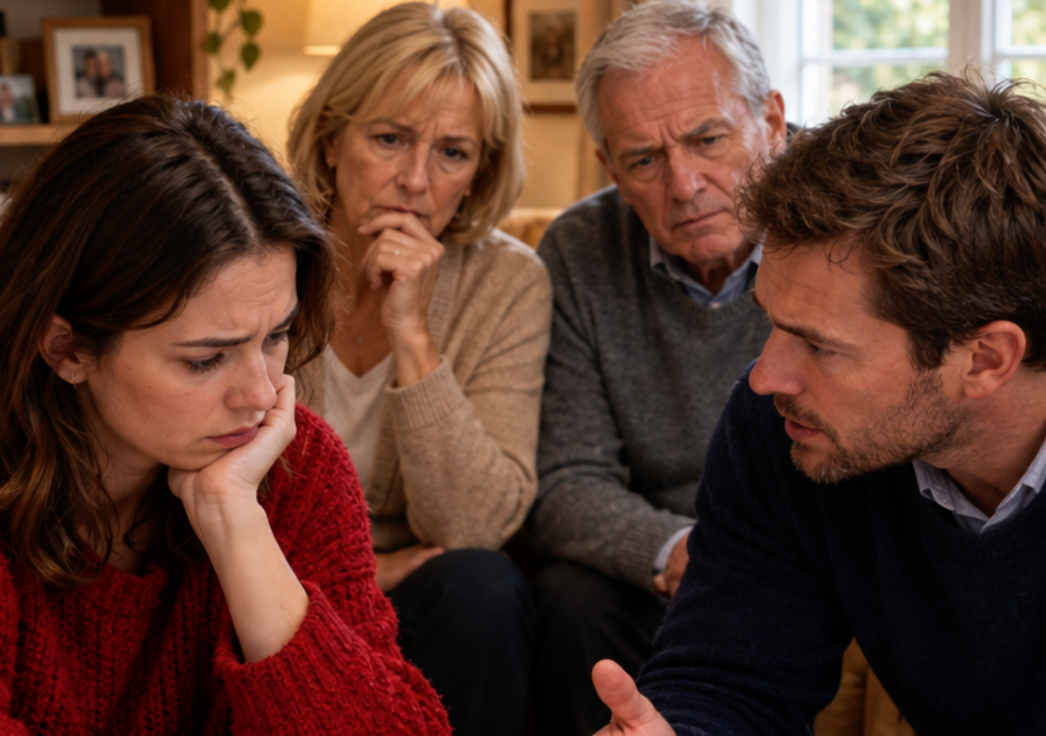
A few days before the meeting, my mother-in-law called me with a question that made me think I must have misheard her at first.
She wanted to know if I was planning to throw out the old workbench from the shed at the dacha this spring.
“Sergey Mikhailovich will keep it for himself,” Raisa Petrovna said casually, as if we were just discussing a jar of nails. “There’s plenty of space in the shed anyway. And don’t touch the room next to the kitchen—we’ll settle in there for the summer. Pavel doesn’t need the whole house to himself.”
I turned off the water above the sink and stared at my phone for a few seconds.
We hadn’t even made it to the divorce yet. The court hearing about the property hadn’t even started. But my husband’s parents had already divided up the rooms at my dacha and decided what they’d take from the shed.
“Raisa Petrovna,” I asked, “which dacha are you talking about right now?”
She didn’t catch the question.
“Well, yours. Ours, I mean. Don’t nitpick, Oksana. We were a family for eleven years.”
That was the first time I realized that Pavel hadn’t told his parents everything.
Or maybe he told them everything, but they only heard the part they liked.
The word “ours” slipped in so quietly.
Pavel and I got married when I was twenty-eight and he was thirty. I was working as an accountant at a small trading company, and he handled procurement at a construction firm. At first, we lived in my one-bedroom apartment, which I’d inherited before our marriage, but we only stayed there less than a year.
My father had always wanted to settle the property question while he was still alive and avoid any future family arguments. He had a two-room apartment that used to belong to my grandmother, and a small dacha with a plot of land. The house was ordinary: two rooms, a kitchen, a veranda, a shed, and six hundred square meters. Nothing fancy.
A few months after our wedding, my father gave both properties to me as a gift.
Pavel and I went together to take care of the paperwork. He waited for me, then we stopped for groceries, and that evening we joked that now I could finally move my huge wardrobe out of my old apartment.
So Pavel always knew exactly where the apartment and dacha came from.
For the first few years, it really didn’t matter to anyone. We lived our lives, went to the dacha, invited our parents over, planted greens, grilled meat in the yard, argued about typical things like an open fridge or scattered socks, and forgot about it all ten minutes later.
Then, little by little, Pavel started using the word “ours.”
At first, I actually liked it.
“Our apartment,” “our dacha,” “in our shed.”
How else is a husband supposed to talk after a few years of marriage?
The oddities started with his mother.
One day in May, Raisa Petrovna announced over Sunday lunch that her cousin Lyudmila and her husband would stay at the dacha for a week.
I happened to be setting down a plate with pie and thought I must have missed the beginning of the conversation.
“Which dacha?”
“Yours,” my mother-in-law replied. “You’ll be working in July anyway, so the house will be empty.”
“And why did you decide you could move someone in there?”
She frowned—not angrily, more puzzled.
“Oh come on, Oksana. What do you have against Lyudmila? She’ll make the bed herself, clean up everything.”
I glanced over at Pavel. He was sitting next to me, intently picking out a piece of pie.
“Pasha?”
He looked up at me.
“Well, Mom already promised. Why make a big deal out of it now?”
That was the first time no one asked me about my own property, and my refusal was made out to be a problem for the whole family.
In the end, Lyudmila didn’t come. I stood my ground and said a firm “no.” Raisa Petrovna barely spoke to me for a week, and Pavel called the whole situation “a circus over an empty house.”
Eventually, everything seemed to settle down.
But now I realize nothing really settled. They just learned: if they pushed harder, maybe I would give in. That time I didn’t—but it only meant they needed to find another way.
The renovation that, seven years later, turned out to be a “major investment”
Four years after our wedding, we did a major renovation in the apartment.
It wasn’t a reconstruction or redesign. We didn’t move any walls, increase the space, or attach the balcony to the room. The apartment just needed some updates after my grandmother—old linoleum, faded wallpaper, ‘90s plumbing.
We stripped off the old coverings, leveled the floor, replaced the doors and plumbing, hung new wallpaper, and ordered a new kitchen set. We even updated some of the wiring.
Most of the money came from my savings, plus Dad helped with the kitchen. Pavel’s job was a bit shaky that year—his company was being reorganized and bonuses hadn’t been paid in months.
But he also pitched in—he bought materials, ordered the doors, paid for two faucets, and made several trips to the home improvement store himself.
No one walked around the apartment with a calculator back then.
When the doors arrived, Pavel spent half the evening arguing about how one of the frames showed up damaged. I even sent him a picture of the order through messenger, because he was fighting with the store over the part number.
Seven years later, those same doors suddenly became one of the main pieces of “evidence” that the apartment supposedly belonged to him, too.
But before we got to court, there was another talk—this time about the summer house.
Pavel decided he wanted to buy a three-room apartment in a new building. He spent weeks browsing listings, crunching numbers, and showing me floor plans.
I liked the idea itself. I just didn’t like how he wanted to come up with the down payment.
One evening, he put his phone down on the table in front of me.
“Look. If we sell the summer house, we’ll almost cover it all. We can make up the rest with our savings.”
At first, I thought he was just throwing out an option.
“I’m not selling the summer house.”
“Why not?”
“Because I don’t want to. My dad gave it to me, I go there, I enjoy it.”
Pavel leaned back in his chair.
“How many times did we even go there last summer? Five?”
“Nine.”
“What’s the difference? Property should work for the family.”
The phrase sounded so businesslike, as if the summer house was supposed to clock in for a shift every morning.
I refused again.
The next day, Raisa Petrovna called.
The timing was so obvious it was almost funny.
“Oksana, you and Pavel are young,” she started. “Why hold on to an old house? Sell it and buy a decent apartment. There will be more summer houses later.”
“What kind?”
“You’ll buy another one.”
“With what money?”
She went silent for a moment, then said with irritation:
“You twist every word I say.”
I didn’t turn anything upside down. For the first time, I just started asking the following question.
His money was his own, but mine was considered family money.
The situation with the summer house alone didn’t destroy our marriage. If it had just been one argument, we’d probably have been picking out curtains together again the next week.
But then, similar decisions started to happen more often.
In the fall, Pavel transferred a large sum to his parents for a new fence. I found out about it when I opened the bank app and saw how much money was left in our joint account, where we both put money for daily expenses.
It wasn’t a catastrophic amount, but it was significant—almost a month’s worth of expenses for our family.
When Pavel came home that evening, I placed my phone in front of him with the transaction history open.
“Why didn’t you tell me anything?”
He took off his jacket, hung it in the hallway, and only then looked at the screen.
“What should I have said? My parents need a fence.”
“I’m not asking about the fence. Why did you take money from our joint account and make the decision by yourself?”
Pavel walked into the kitchen, opened the fridge, and took out the dinner container.
“Because they’re my parents. I’m not going to get approval every time I help them.”
“Then help them with money from your own account.”
He put the container on the table a bit more forcefully than usual.
“Funny how that works. When we were renovating your apartment, my money was considered our money. But helping my parents—that’s only from my personal funds.”
That’s when the topic of the apartment came up for the first time.
Not as the place we lived in, but as a bill he planned to present to me someday.
I reminded him that I paid for most of the renovations myself.
“Of course,” Pavel smirked. “You do everything yourself. I’ve just been passing through for eleven years.”
A month later, there was another similar conversation. Pavel’s father decided to replace the gate on his property, and Raisa Petrovna sent us a link to the contractor in the family chat with the message: “Then you’re paying for half.”
No question asked.
Pavel replied, “Okay.”
I responded, “No, let’s discuss it first.”
My mother-in-law called her son almost immediately.
He went to the hallway to talk, even though he used to openly discuss his parents in front of me. He came back about ten minutes later, clearly irritated.
“Did you really have to do this in the family chat?”
“Where else am I supposed to respond to a demand posted in the family chat?”
“Now Mom is worried.”
“And am I supposed to pay for the gate so she doesn’t worry?”
After that, we mostly only spoke about household things for almost a week.
There was no dramatic scene where one of us suddenly realized the love had ended. I just started to notice how Pavel would check with his parents about our money before even talking to me.
And then something happened after which it didn’t feel possible to go back to how things were before.
The summer house was divided before the divorce even happened
In January, I went to the summer house to check the heating and the roof after a snowfall. I saw Sergey Mikhailovich’s car parked by the gate.
This surprised me: only Pavel and I had keys.
My father-in-law was in the shed. Cans of fasteners that had been on the shelves were stacked by the wall, my gardening tools were moved to the corner, and Sergey Mikhailovich himself was measuring the space near the window with a tape measure.
“What are you doing here?”
He turned around quite calmly.
“I want to move the workbench over here. It’s uncomfortable near the door, too drafty.”
“Why move it at all?”
My father-in-law closed up the tape measure.
“Raisa and I decided we’d tidy up here in the spring. Pavel said we’ll all be sharing it anyway.”
I pulled out my phone and called my husband right from the shed.
Pavel didn’t answer right away.
“Did you give your dad the key?”
“Yeah, I did. Why?”
“Why didn’t you ask me?”
There was a pause on the other end of the line.
“Oksana, come on. How much has my dad done with his own hands here? He fixed the porch, helped put up the fence. Now he needs to ask for permission just to enter the shed?”
I looked over at Sergey Mikhailovich. He definitely heard the conversation but pretended to study a board.
“Pasha, the house belongs to me.”
“We’re married.”
“So?”
His reply was very calm:
“That means you won’t be making decisions here all by yourself.”
I asked my father-in-law to return the key. At first, he was offended, but eventually he pulled it out of his pocket and placed it in my palm.
That evening, Pavel made a scene at home. It wasn’t loud—no shouting, no broken dishes, no drama—which somehow made it even more unpleasant.
He spoke evenly, almost wearily.
“You humiliated my father.”
“I just asked for my key back.”
“Exactly. ‘My’ key. Everything’s yours with you.”
“So, now I should call everything I own ‘ours’ so that no one gets upset?”
Then he said,
“Let’s see what you say when we start dividing up the property.”
I didn’t reply.
Two weeks later, I suggested a divorce.
I stayed in the apartment.
At first, Pavel thought I was just trying to scare him.
Then he realized I had filed the papers and his entire tone changed.
He didn’t leave that same evening, and I wasn’t pushing him out the door with a suitcase either. While we were still married and living together, it was more complicated than simply saying, “This is my apartment, get out.”
I suggested we calmly decide when he would move out and which of the things we’d bought together he’d take.
Pavel replied,
“First, the court will decide whose apartment it is.”
“Alright then. Go through the court.”
He really did file property claims.
In addition to the car we bought while married—which I never considered mine alone—Pavel also declared the apartment as contested property. Later, the summer house was added to the case file.
His phrasing wasn’t domestic anymore. Not “I’ve been your husband for eleven years, so I get half,” but that joint contributions and his labor had supposedly significantly increased the value of the property.
Seems like someone explained to him how these kinds of claims should actually be worded.
After that, Raisa Petrovna became even more confident.
That’s when she called about the workbench and the room at the summer house.
I didn’t tell her what was in the documents.
I just said,
“Let’s wait for the court decision first.”
“Of course,” she replied. “The court will sort it out. Pavel invested so much there, it’s not like he’s claiming something for nothing.”
I hung up the phone and opened up old bank statements on my computer.
Unlike Raisa Petrovna, I actually wanted to figure out not who ‘lived there for how many years,’ but exactly how much money had really been spent and on what.
Some parts of the story were easy to piece together. Electronic orders were preserved. The bank transfers, too. My dad paid for the kitchen directly to the seller. I covered the flooring and most of the materials. Pavel bought the doors, plumbing, and a few smaller items.
Just your typical family expenses for a renovation.
There was never a second floor, an extension, a merger of apartments, or any major reconstruction of the house.
The situation at the dacha was even more modest: Sergey Mikhailovich helped repair the porch, once replaced a few boards on the veranda, Pavel bought some paint and ordered materials a couple of times.
I paid for most of the necessary things myself.
When I came to the hearing, I didn’t expect to produce some magic document that would awe everyone. On the contrary, I was nervous because I knew the court deals with evidence, not family fairness.
But I definitely underestimated Raisa Petrovna.
The hearing where apple trees suddenly became an investment
At the first hearing, my mother-in-law showed up with Pavel. He had a lawyer as his representative, while Raisa Petrovna sat in the hallway, persistently explaining something to her son before things began.
Sergey Mikhailovich also arrived.
I asked my own representative:
“Are they all coming as a family?”
She shrugged:
“Let them.”
At the actual hearing, there was nothing funny at first. Everything moved along straightforwardly: demands, documents, the origin of the property, information about the registration of rights.
When it came to the apartment, the main point was stated.
It had been gifted to me.
The contract existed from the beginning. Pavel knew about it, and of course, his signature wasn’t required. The ownership was registered in my name.
Then the matter of investments was raised.
Pavel’s representative listed the renovations: new flooring, doors, plumbing, the kitchen, and labor.
The court started to examine which expenses were actually confirmed and why Pavel believed that these supposedly increased the apartment’s value enough to change its ownership regime.
That’s when the first unpleasant fact for him surfaced.
Some of the renovations he mentioned hadn’t actually been paid for by him.
Second—most of the work was just basic updating of the apartment.
Third—the amounts he could confirm himself were nothing like the grand contributions his mother had been boasting about for months.
Pavel sat there tense but silent.
But the story with the dacha went to a whole different level.
After the hearing, in the hallway, Raisa Petrovna indignantly asked her son’s lawyer:
“Doesn’t anyone take labor into account at all?”
He replied that different circumstances could be considered, but they’d have to be proven and shown to have an impact on the property’s value.
Raisa Petrovna immediately brought up Sergey Mikhailovich.
“He worked on the porch. He pruned the apple trees every year. Fixed the shed.”
The lawyer looked at her with that expression people have when they’re trying to stay politely professional and not continue the conversation.
“Taking care of apple trees by itself doesn’t entitle someone to ownership of the dacha.”
Sergey Mikhailovich, who had been silent by the window, suddenly asked:
“What about the porch?”
“Sergey Mikhailovich,” my wife said tiredly, “please, don’t start.”
I turned to face the window.
That’s when I really found it funny.
Not because someone had lost the case—there was still a long way to go before any decision would be made.
What flashed before my eyes was our shed, the measuring tape, the workbench, and our family council, where the adults actually divided up someone else’s property based on who fixed a porch or trimmed a few apple trees.
The most unpleasant discovery didn’t happen in court.
After the first hearing, Pavel came back to our apartment looking more somber than usual.
We were hardly living as a family anymore. We slept in separate rooms, bought groceries for ourselves, and split household bills. Pavel was already looking for a place closer to his work, though he kept saying out loud that “nothing’s been decided yet.”
A few days later, he brought up the conversation himself.
“How are we going to divide the car?”
That was actually a reasonable question.
We bought the car together, with shared money during our marriage. I suggested either selling it and splitting the money, or he could keep the car if he paid me my half.
Pavel chose the second option.
Then he asked:
“So, you’re not willing to discuss anything about the apartment?”
“What exactly?”
“I lived here for eleven years.”
“You did.”
“I renovated it.”
“You did—with me. But that doesn’t mean the apartment is automatically half yours.”
He ran his hand across the table and sat there in silence for a while.
“You had everything prepared in advance.”
That comment hit me harder than the previous ones.
“Pasha, the gifting contract was signed eleven years ago. You went with me to take care of the paperwork. What exactly did I supposedly prepare in advance?”
He didn’t answer.
Probably because there was nothing left to argue about.
A week later, Pavel rented a new apartment. On Saturday, his father came, and together they moved his clothes, computer, some books, and the things we had agreed on.
I didn’t stand over them with an inventory list or count every dish.
Once Pavel finished, he left the set of keys on the hallway table.
“That’s it.”
“All the sets?”
“Yes.”
I counted them. I had already taken back the old set, the one that had belonged to Sergey Mikhailovich, back in winter.
The next day I had a locksmith change the lock cylinder.
Not as an act of revenge.
Family life was simply over, Pavel had moved out, returned the keys, and after everything with the summer house, I just wanted to be sure who could access the apartment.
Our parents stopped picking out rooms for themselves.
The property dispute didn’t end with a dramatic scene. Life just doesn’t work that way.
Documents were submitted, expenses were discussed, and both sides clarified their demands. Pavel didn’t end up getting the result his family had hoped for regarding the gifted properties.
But we really did split the car fairly. He kept it, and I got the agreed payment.
Some of the jointly purchased things were divided without drama, too. I kept the washing machine; he took the TV, since he had picked that model and wanted it. No one went to court over the stools or pots and pans.
After that conversation in the hallway, Raisa Petrovna never called me again.
This spring, I visited the dacha for the first time since all the meetings. The snow had already melted, last year’s branches were piled by the shed, and one of the floorboards on the porch had warped a bit over the winter.
I opened up the shed.
The workbench was right where it always was, standing by the wall.
Sergey Mikhailovich built it to last, and I wasn’t about to throw out a perfectly good piece just because we’re no longer related.
I put the tools back on the shelf, carried out the empty boxes, and then opened the windows in the house.
In the room off the kitchen—the one Raisa Petrovna had already mentally claimed for herself for the summer—there was an ironing board and two boxes filled with books.
A month later, I added a small couch to the room.
Pavel never came back for his things. His parents also didn’t return to the dacha.
And the old porch survived another spring without so much as a creak.