Zhenya, grab a pen. The realtor has been waiting downstairs for half an hour already.
“What realtor?” I asked.
“For the apartment,” Lidiya Petrovna answered calmly. “We need to sell before prices near the MCD drop.”
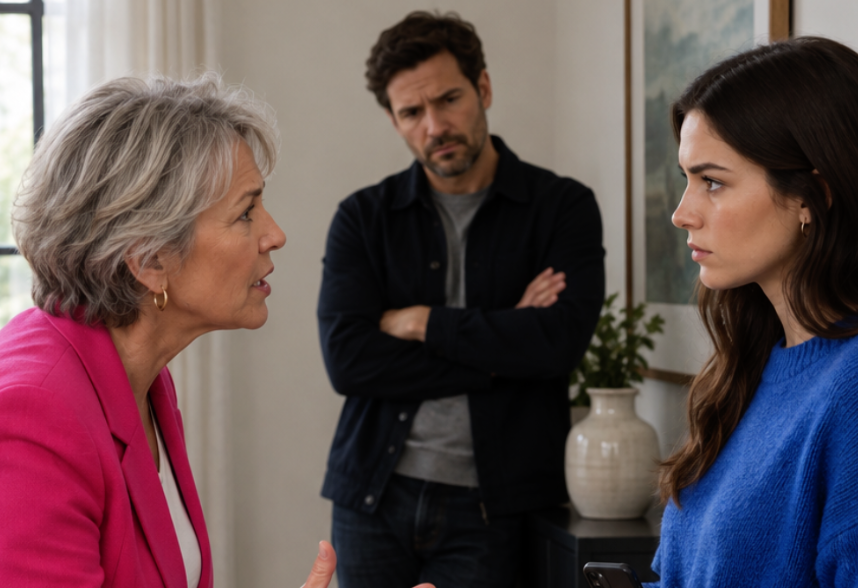
She was sitting in my kitchen in her coat, back straight, like I was the one called in for a talk, not the one coming home after a long shift. A folder lay on the table, Oleg was silent by the window. He smelled of cigarettes, my mother of sweet perfume and sausage. I had just taken off my boots and already knew—they hadn’t come to talk, they came to pressure me.
“So now you’re bringing realtors into someone else’s apartment without asking?” I questioned.
“It’s not someone else’s,” said Oleg. “We’re family.”
“Convenient word. Makes it easy to cover debts with it.”
“Zhenya, don’t get upset,” my mother-in-law nudged the folder toward me. “You have a three-room apartment from Aunt Alla. Old building, but it’s a good area. We sell it, pay off Oleg’s loan, and get a modern euro two-bedroom in a new complex. We put it in his name—the bank approves him more easily. You stay with your husband, and in a new place. What’s not to like?”
“Everything. Starting with the fact you decided this without me.”
“It’s impossible to do anything with you,” Oleg said irritably. “You always take a stand. I’m having a cash flow problem. If I don’t cover one loan now, everything will collapse.”
“So I’m supposed to save you with my aunt’s apartment?”
“What else? Moral support?” Lidiya Petrovna scoffed. “Banks don’t accept moral support as payment.”
“Funny. When Aunt Alla was bedridden after her stroke, you both said you couldn’t help. Oleg, you were always at meetings, stuck in traffic, out of reach. Showed up at the funeral smelling like booze. But now suddenly, we’re family.”
“Here we go again,” my mother-in-law grimaced. “Another round of ‘I did everything alone.’ Well, you did—good for you. But the apartment isn’t some memorial.”
“To you — maybe not. To me, it’s the home where I was loved, no strings attached.”
“Don’t dramatize,” Oleg cut in. “We’re married. Everything’s shared, that’s just normal.”
“Normal isn’t when you take forty-eight thousand from your wife’s card and then send a smiley face instead of an apology.”
“I returned some of it.”
“Nine thousand. The rest must have gone toward your manly pride.”
Lidiya Petrovna tapped her fingernail on the documents.
“Here’s the consent to sell and the power of attorney. Sign it now and tomorrow we go to the municipal office. You won’t even have to do any running around.”
“How touching. And what will I get? The stool in the hallway?”
“Don’t be sarcastic. You don’t need an apartment like that all to yourself. No kids, you’re at work all day, half the rooms are closed. A man needs a proper home.”
“Let the man learn to pay for his own place first.”
Oleg spun around to face me.
“For your information, I invested in this home too. Who replaced the windows? Who installed the kitchen? You think no one in court will care about that?”
“I replaced the windows. I paid for the kitchen. I have contracts, transfers, receipts. And on the day it was assembled, you slept until one.”
“So you kept track of everything, huh?”
“No. I just stopped trusting you a long time ago.”
Lidiya Petrovna smirked:
“Last chance—sign this the easy way. Or you’ll have to run around later.”
I looked at them and suddenly felt calm. It was almost upsetting how simple it all turned out to be.
“I’m not running anywhere. And you, Oleg, are packing your things and leaving today.”
“Are you serious?” he even laughed. “Me? Out of the apartment?”
— From my own apartment. Yes.
— Zhenya, this is just rude, — my mother-in-law hissed through her teeth.
— Rude is showing up with a folder in my kitchen to split up my walls. The door is over there.
He took his time packing, like he wasn’t pulling shirts out of the closet, but dragging out pieces of my conscience. His mother hovered around, muttering:
— So ungrateful. We just want to give her a good life, and she keeps showing off.
— Fix your own life, — I said. — For the first time, I finally have a chance to live without your so-called “help.”
An hour later, Oleg called.
— So what did you achieve? Mom’s popping pills, I’m sitting in the car.
— Don’t exaggerate. You’re a natural at living off other people, you’ll be just fine.
— Let’s cut the drama. You’re just having a tantrum. Tomorrow, after you cool off, we’ll talk.
— Tomorrow I’m changing the locks.
— Just try it.
— Is that a threat?
— It’s a warning. I lived here.
— Past tense. You lived here.
His tone instantly softened; suddenly he sounded familiar, almost gentle — the same voice he used when he wasn’t really trying to negotiate, only to get his way.
— Zhen, just think about it. How are you going to manage a three-bedroom all on your own? Utility bills, repairs, groceries, taxes. I’m at least offering a solution.
— Your solution is to sell what’s mine to cover your pit.
— The pit belongs to both of us.
— No. The only thing we ever truly shared were promises.
I really did change the locks. A locksmith from the next building put in a new cylinder and told me:
— Good decision. Nowadays, relatives are worse than thieves. At least thieves come at night and stay quiet.
I smirked, but a week later a lawsuit arrived. Oleg wanted compensation for “major improvements,” half the appliances, and access to the apartment. His paperwork read like he’d single-handedly renovated the entire building and built the one next door for good measure.
— Inheritance is your personal property, — said lawyer Markelov. — But he’ll fight you on the renovations. Do you have the receipts?
— I’ve got everything. After living with him, I keep even the user manuals for the kettle.
— Then let him fight. People like that love to make noise, but they rarely have proof.
On Saturday someone yanked the door handle. Through the peephole, I saw Oleg, Lidiya Petrovna, and a chubby man with a tablet.
— Open up, — Oleg shouted. — This is the appraiser.
— Tell him to assess the hallway, — I replied through the door. — He’s not coming into the apartment.
— My stuff is still in there!
— A box of cables and old sneakers isn’t an excuse to drag strangers in here.
— Don’t embarrass yourself, Zhenya, — my mother-in-law piped up. — People came all the way from Moscow.
— That’s even worse for them. They’ve been misled.
— Who do you think you are, keeping a husband out? — Oleg exploded.
— The owner. That’s all you need to know.
I called the police. While we waited, aunt Nina from next door poked her head out in her bathrobe:
— What’s going on now?
— Nothing new, — I said. — Some people confuse marriage with a license to seize property.
The officer kept it brief:
— If the owner doesn’t let you in, that’s final. No showings, no appraisers, no pressure — goodbye.
— I’m his mother! — Lidiya Petrovna raised her voice.
— And I’m not HR, — the officer replied. — Please leave the building.
In court Oleg sounded confident:
— I replaced the windows, doors, kitchen, bought new appliances.
— Do you have any proof of payment? — asked the judge.
— I paid in cash.
— To whom?
— The contractors.
— Which ones exactly?
He stumbled. Markelov placed my contracts, statements, and translations on the table. The judge flipped through the papers, and for the first time, I saw Oleg’s face cloud over with the chill of realization.
After the hearing, Lidia Petrovna caught up with me in the corridor.
“Think you’ve won? This is just the beginning.”
“Unlike you, I know how to play the long game,” I replied.
That evening, before the next hearing, she came alone. No makeup, an old jacket, and carrying a black folder.
“Don’t worry, I’m not here to barge in,” she said. “Can I have five minutes?”
I let her into the kitchen and put the kettle on.
“I’m not here to apologize,” she began. “It’s too late for that. I’m here to tell you that he did the same to me.”
“Be specific.”
“He sold my garage. I never saw the money. My pension card is empty. I have two microloans in my name — he took the SMS codes, lied that it was for refinancing. And none of it was for business or your new life. It was for gambling. And for a woman from Tula — he was renting her an apartment. Here are the transfers. Here’s the correspondence. She sent everything to me herself when collectors came after her too.”
I was silent. I didn’t feel pity. Just exhaustion, like after a long journey when all you see at the end is an ordinary fence, not your goal.
“You knew what he was like,” I said.
“I did. But I thought he was weak. Thought he needed protecting, a push, saving. But he’s not weak. He’s insatiable. He consumes everything he can reach—me, you.”
“So why bring this to me?”
“Because tomorrow he’ll lie again. And I’m tired of lying with him. Also, those receipts for the repairs are fake. He took a stamp from a neighbor, whose business closed long ago. At first I thought it would work. It didn’t.”
“You do realize you’re throwing your own son under the bus?”
“And what did he do with me? Leave me to dry?” she gave a tired smile. “Don’t make me out to be a repentant mother. I never loved you. I always judged you: convenient, inconvenient, useful. But if no one stops him, he’ll keep consuming everything and call it a hard life.”
Outside, a child was screaming, the smell of fried fish wafted from the neighbor’s apartment, and the kettle clicked as it finished boiling, making our conversation feel even more grim.
“You know what’s most disgusting?” I said. “I actually started thinking maybe I’m greedy. Maybe I really should have sold everything to ‘save the family.’”
“You can’t save a family with an apartment,” she shot back. “An apartment just delays the moment when it’s clear to everyone that there’s nothing left to save.”
At the next hearing, Oleg turned pale when he saw his mother sitting next to me.
“Mom, what are you doing?”
“Sitting. The law doesn’t forbid it.”
“Are you on my side or what?”
“For the first time, I’m not on your side.”
She spoke matter-of-factly, as if reading out a grocery list:
“Yes, my son asked me to pressure the defendant to speed up the apartment sale. Yes, he needed the money urgently. No, he didn’t pay for any repairs. Yes, the documents he submitted are backdated. Yes, he took money from my card and misled me.”
“Mom, what are you talking about?!” he snapped.
The judge looked up:
“One more outburst and I’ll have you removed from the courtroom.”
“She’s lost her mind!”
“No,” said Lidia Petrovna. “I’ve simply woken up—too late, but I have.”
After the hearing, Markelov quietly said:
— That settles the main issue. Now we can deal with the forgery separately.
I nodded. In the past, I probably would have felt sorry. But in our family, pity always worked like a credit card: it helps you out at first, then suffocates you with interest.
Oleg caught up with me on the stairs.
— Happy now? My mom’s against me, there’s a court case, the police… Do you even sleep well at night?
— For the first time, yes.
— You’ll fall apart without me.
— That’s where you were most wrong. You thought I was clinging to you. I was really holding onto the hope that eight years couldn’t have been just a cheap forgery. Turns out, they could.
I came home under wet March snow. The apartment was quiet, without that constant expectation of someone else’s key turning in the lock. I put the kettle on, took aunt Alla’s old clock off the wall, and suddenly realized: it’s time to stop living as if any peace has to be earned.
Lidiya Petrovna sent me a message: “Don’t throw away the folder. There are still copies inside.”
I didn’t reply. I just threw away Oleg’s cracked mug, opened the window, and for the first time in ages, I didn’t feel guilty about being at peace. Outside, neighbors were arguing over parking, someone upstairs was drilling, a dog was barking—just an ordinary evening, no beautiful music. And in that ordinariness, I found more truth than in my entire marriage.