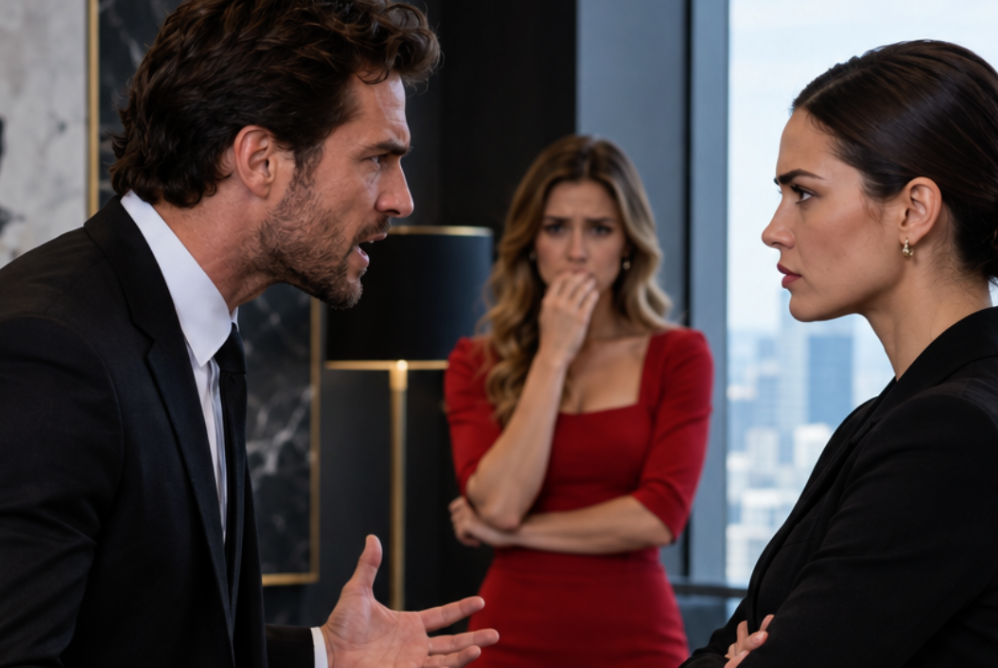
“That’s it, I’m finally done suffering. Today, I’m officially shaking off this endless poverty,” Igor announced loudly, as if he wasn’t talking to his lawyer but giving a press conference to the entire courthouse hallway. “For ten years I carried around a grown woman pretending to be a misunderstood artist with a camera. Enough. I want a real woman, not this never-ending creative loss.”
Inga sat by the window on a hard bench, staring at her knees. Her fingers were trembling. There was a lump in her throat—awful and dry. The people nearby pretended not to listen, but everyone was listening.
“Igor, keep your voice down,” mumbled the lawyer.
“Why should I? Am I not telling the truth? Did she ever pay the utility bills herself? Ever pay off the apartment? Buy a car? No. I worked. Me. And she—there were always courses, cheap photo gigs, then ‘I’m burnt out,’ then ‘I need creative inspiration.’ She’s had it easy.”
Inga lifted her head.
“Stop it.”
“Oh, now she speaks. And what are you going to do about it?” He even smirked. “Do you even realize who you are without me? Thirty-four years old, no real job, no apartment, no money. Just an old camera and a habit of getting offended.”
“Enough, Igor,” she said, sounding more composed. “Just shut up and wait for the hearing.”
“Actually, I feel relieved. At least I can say it out loud now. You’ve held me back my whole life. I told you: either become a decent person or don’t get in the way. You chose to live off me. Now that’s over. I’ll have a woman on my level. Vika, for example. She doesn’t freak out, doesn’t whine, works, makes money.”
Inga felt something snap coldly inside. That was it. It didn’t even hurt anymore. It was like looking at torn wallpaper in someone else’s apartment: unpleasant, but not surprising.
“Then go to your Vika,” she said. “Who’s stopping you?”
“I’m already going. And please, spare me your ‘I understand now, let’s try again’ speeches later. The train’s gone.”
She stood up.
“Don’t worry. I’m not about to run after the train.”
The hearing went quickly and without any drama. It was as if all the worst things had already happened in the hallway, and now all that was left in the courtroom was to put signatures on something that had died long ago. Igor cheerfully agreed to keep the apartment and the car, while Inga was left with her things—her laptop, clothes, and the old camera she had bought before they got married.
The judge looked up:
“Ms. Morozova, do you understand the consequences?”
“I understand perfectly.”
“No objections?”
“None.”
After the hearing, she went outside, sat on a bench at the bus stop, and stared at the dirty March snow by the curb for a long time. Her phone was in her hand, but there was no one to call. Sonya had invited her over, but right now, Inga just wanted one thing: for everyone to leave her alone for at least an hour.
The phone rang on its own. Unknown number.
“Hello.”
“Good afternoon. Is this Inga Sergeyevna Morozova?”
“Yes.”
“This is the notary office calling. You need to come in today. It’s regarding an inheritance case.”
“Sorry, regarding what?”
“An inheritance. Sergei Nikolaevich Morozov has passed away. You are named as the heir in his will. We’ll send you the address by text message.”
“You must be mistaken. I hardly know anybody with that last name.”
“There’s no mistake. Please come in. We’ll show you all the documents here.”
An hour and a half later, she was already sitting across from the notary—a smooth, tidy man with the expression of someone who has seen it all.
“Inga Sergeyevna,” he flipped through the folder, “the deceased was your father’s cousin. He had no children. His wife passed away long ago. The will was made two years ago. You are named in it.”
“But I hardly remember him.”
“That doesn’t affect the legal standing of the document. You inherit a three-room apartment in the city center, a house with land in the suburbs, and a bank deposit. Altogether, the estate is worth around sixteen million rubles, and that’s not counting future property reevaluation.”
Inga looked at him as if he were speaking a foreign language.
“Can you repeat that?”
“Sixteen million. And two pieces of property.”
“For me?”
“Yes, for you.”
“But why?”
The notary shrugged slightly.
“Sometimes people write their wills not based on closeness, but by personal choice. I have a letter from the deceased, if you’d like to read it later.”
She left the office not even stunned, but as if she hadn’t been put back together properly. Her legs carried her, but her head lagged behind. At the nearest coffee shop, she ordered the cheapest Americano, sat by the window, and called Sonya.
“Where are you?” Sonya immediately asked.
“Downtown. Sitting here trying to figure out if I’ve lost my mind.”
“What happened?”
“I was just told that I’m an heir. An apartment. A house. Money.”
“What kind of money?”
“A lot.”
“Inga, don’t drag this out.”
“Sixteen million.”
There was a pause on the other end.
“Okay. Either you’re raving from nerves, or the Universe has decided you’ve suffered enough.”
“Honestly, I’m thinking the exact same thing right now.”
“Don’t tell anybody yet, okay? Especially that peacock.”
“I wasn’t planning to.”
The following weeks were filled with paperwork, certificates, waiting in lines, trips, and signatures. Inga received the keys to her late relative’s apartment—spacious, old, with heavy doors, bookshelves, and the scent of medicine, wood, and tea. At the cottage stood a sturdy house, not luxurious but full of life: a stove, a veranda, apple trees, a rusty grill, and a shed with neatly arranged tools.
Sonya followed her around the rooms in awe:
“Do you even realize this isn’t a dream? You don’t just have to survive anymore. You can actually live.”
“I’m still just learning not to flinch at the thought.”
“So what now?”
“First, I’ll rent a decent apartment while the renovations are going on. Then I’ll buy a camera. After that, I’ll figure it out. No sudden moves.”
“My God, how can you be so calm about this?”
“I’m not calm. I’ve just spent so many years living in survival mode—saving money, words, wishes—that my body doesn’t know how to switch gears.”
She told no one except Sonya. But rumors, like cockroaches in an old house, pop up even where not a crumb has been left behind. Three weeks later, Igor called her.
“Hi,” his voice was syrupy and soft. “How are you?”
“Be more specific.”
“Why so tense right away? I was just asking. We’re not strangers, after all.”
“After the trial, I really wanted to ask—at what point exactly did we stop being strangers?”
“Inga, I was emotional. I said things I shouldn’t have. You know I go overboard sometimes.”
“I know. I spent ten years observing you in your natural habitat.”
— Don’t start. That’s not even what I wanted to talk about. Let’s meet. Calmly. No anger. Let’s talk like adults.
— There’s nothing left for us to discuss.
— Are you sure? Maybe we both acted too quickly.
— No, Igor. We were hasty ten years ago.
He kept calling. Texting. Sent flowers to the old address. Then he showed up outside Sonya’s place.
Sonya came outside to him in sweatpants and holding a trash bag.
— What are you doing here?
— I want to talk to Inga.
— And I want you to disappear. Let’s each stick to what we want.
— Sonya, this isn’t your business.
— It becomes my business when you start lying and pushing. Leave before I tell the neighbors that you’re an ex-husband with terrible manners and dirty sneakers.
A month later, a court summons arrived. Igor filed a lawsuit. He demanded that some of the property Inga received be recognized as jointly acquired, because, as the papers stated, ‘years of financial support for his wife and the plaintiff’s contribution to the family’s well-being indirectly helped maintain family ties and eventually led to the inheritance.’
Sonya reread the lawsuit twice.
— This isn’t a lawsuit. It’s a diagnosis.
Inga gave a joyless smirk.
— He found out.
— I can see that. Does he really think he can grab a piece?
— Judging by how it’s worded, yes. And it looks like someone smart gave him tips.
— Vika?
— Who else? She’s exactly his type.
Inga found a lawyer recommended by the notary. Olga turned out to be short, tough, and organized, with the voice of a teacher who’s immune to stories about forgotten notebooks.
— Legally, his position is weak, — she said, flipping through the documents. — An inheritance is your personal property. But people like him don’t care about law, they want to pressure you. They’ll play the ‘I supported her,’ ‘I gave the best years,’ ‘she owes me’ game. Your job is not to justify yourself. Mine is to show the judge that he’s here for money, not for justice.
— I have something, — Inga said quietly.
— What is it?
— A recording from the courthouse hallway. I turned on the recorder when he started yelling. Not for the court. Just… I wanted to be sure I wasn’t imagining it later.
Olga looked up and smiled for the first time.
— Now I really enjoy working with you.
On the day of the hearing, Igor showed up like it was a celebration: dark suit, new watch, that smug line on his lips. Vika sat beside him—polished, expensive, icy. Inga, in a simple gray dress and coat, looked not poorer—just quieter.
The judge started off dryly:
— Plaintiff, state your claims.
Igor stood up.
— Your honor, I’m not asking for anything extra. For ten years I supported the family. My ex-wife never had stable work, was involved in questionable creative projects, and lived at my expense. If not for my support, she wouldn’t have been able to maintain contacts with relatives or receive this inheritance. I think it’s only fair to compensate me at least a part of it.
Olga didn’t even pick up her pen. She just tilted her head a little.
— Defendant?
— I never had any relationship with this relative, — Inga said. — I barely knew him. I only found out about the will after the divorce. That’s it.
Igor’s lawyer stood up:
— But the marriage was a long one. The plaintiff fully supported his wife financially. She had the freedom to focus on herself without any concerns about money.
Olga stood up at once.
— That’s a wonderful way to put it. ‘She had the freedom to focus on herself.’ In that case, I’d like to submit an audio recording where, on the day of the divorce, the plaintiff publicly said, and I quote, ‘I dragged a pauper on my back,’ along with messages proving that by the time of the separation, he was already in a relationship with another woman and was planning further financial pressure on the defendant.
Vika swung around to face Igor.
— What messages are you talking about?
Inga looked at her calmly.
— The same ones. You left your tablet at our place last fall. Your password was your birthday. Don’t be upset, it wasn’t even hacking, just carelessness.
The judge tapped her pen.
— Silence. Play the audio recording.
Igor’s voice echoed through the courtroom—confident, harsh, loud:
‘Finally, I’ll be free from this endless poverty… ten years I’ve carried her… she’s nothing without me…’
He turned pale so quickly, it was as if someone had switched off his light.
Olga took her time.
— Also, in his conversations with Ms. Sokolova, the plaintiff discusses that after the divorce ‘the ex has nothing anyway, she’ll sit around and come crawling back,’ and later, after learning about the inheritance, writes: ‘I need to think how to approach this through the court, maybe she’ll get scared and agree to share.’
Vika stood up.
— That’s a lie.
— Want me to read it out loud? — Olga asked. — The writing style is very recognizable. Especially the part about ‘approaching through the court.’
The judge turned her gaze to Igor.
— Plaintiff, do you maintain your claims?
He swallowed hard.
— I… thought I had the right.
— That’s not an answer.
— Then… no. I withdraw my claim. Please leave it without consideration.
Olga immediately said:
— We object. We ask for a dismissal on the merits, with evaluation of the evidence presented.
The judge nodded.
— Reasonable. The court is recessing to make a decision.
When the decision was announced, it was short and to the point: the claim was completely denied. The court specifically stated that inherited property is not subject to division, and that the plaintiff’s arguments were unfounded.
By the exit, Igor caught up with Inga.
— Happy now? Did you enjoy making a scene?
— No, she said. — You made a scene yourself. I just didn’t save you this time.
— You waited for the perfect moment on purpose.
— No. For the first time, I just stopped making things easy for you.
— I actually loved you, you know.
She looked at him the way you’d look at a cracked mug: once useful, but now just something you might get cut by.
— You loved a person who put up with things, cut back on herself, and made excuses for your exhaustion. And the moment she stopped being weak, suddenly you had to fight for ‘justice.’
Vika stood silently aside. Then suddenly said:
— Igor, you told me she was hysterical and lazy. But honestly, she seems to be the only adult here.
He flinched:
— Vika, don’t start.
— No, actually, I’m finishing.
She turned and left. Her heels struck the marble sharply and angrily, like a period at the end of a long, ugly sentence.
A few months later, Inga opened a small studio. No flashy signs, no golden letters on the facade. Just a bright room on the ground floor, white walls, a gray sofa, a kettle, a rack of backdrops, good lighting, and a sign that read “Point.” When Sonya saw the name, she snorted:
“Very symbolic. A point at the end of marriage, a point at the end of humiliation, a point at the end of poverty.”
“No,” said Inga. “Not ‘point’ as in ‘the end.’ A point from which you can draw anything you want from now on.”
One day, the notary handed her that very letter from Sergey Nikolaevich. Just one page.
“Inga, we hardly knew each other. But many years ago, I saw your photos on your father’s page. You photographed ordinary people as if they had dignity, even when they had no money. That’s a rare talent. My relatives only came to see me when they needed something. You never did. That’s why I’m leaving this to you. Someone who can see value beyond price usually won’t get lost.”
She sat in the studio, holding that paper, laughing through her tears.
“Sonya, do you hear me?” she called. “For the first time in my life, I’ve been chosen not for convenience, not out of pity, and not as a last resort.”
“Finally,” replied Sonya. “Welcome to normal reality.”
And at that moment, Inga suddenly realized: all this inheritance wasn’t really about money. The money just opened the door. And the woman who walked out through it was no longer someone who could be called poor in front of everyone and expected to quietly accept it. Now she knew the value not of an apartment, not of a bank account, not of a camera. She knew her own worth. And that, as it turned out, was the most valuable asset of all.