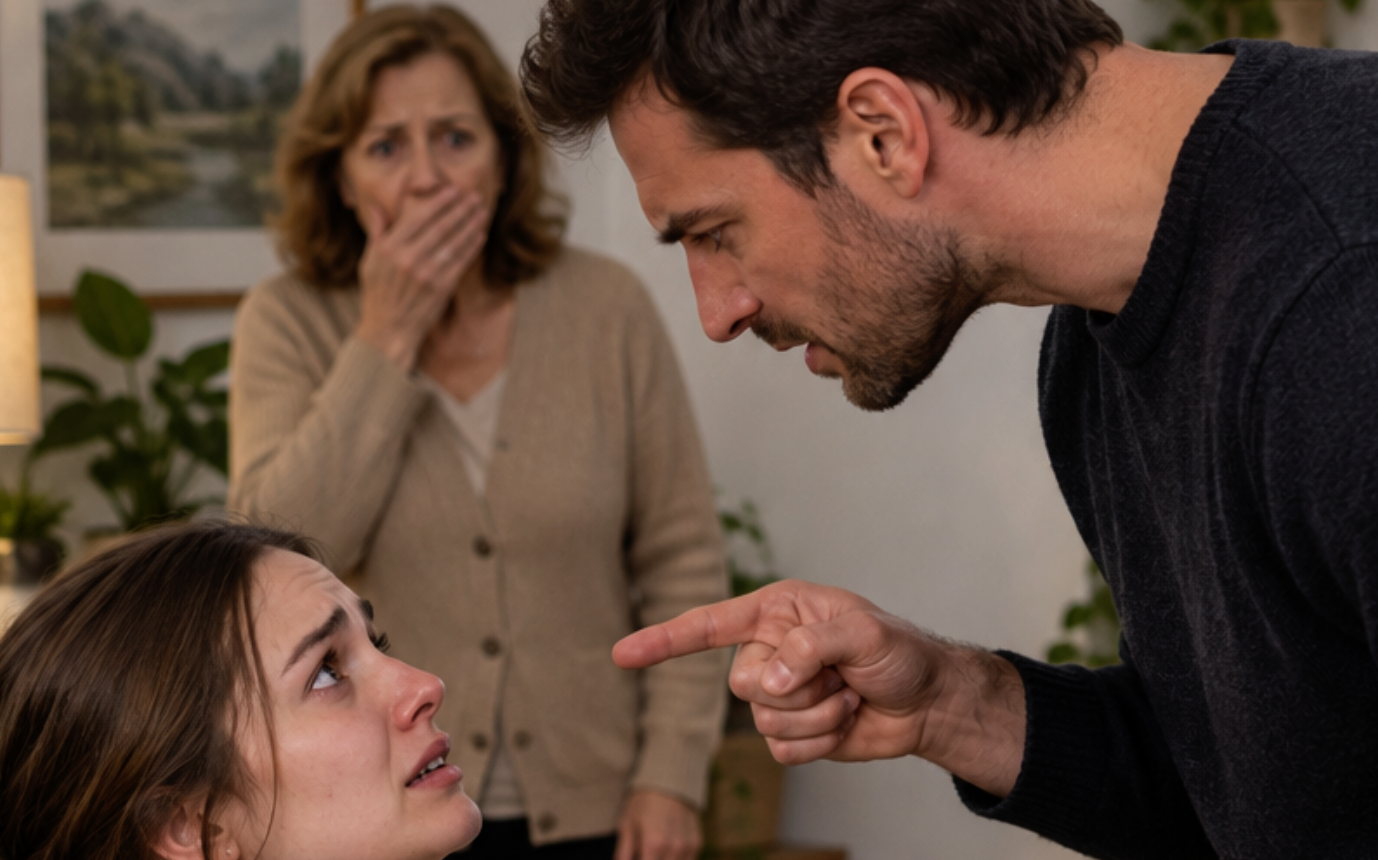
Ksenia parked her car by the curb in her usual spot and decided not to turn off the engine. Her mood had been ruined exactly forty minutes ago by one phone call, and it just kept getting worse—slowly, like rust. She gripped the steering wheel with both hands and stared straight ahead. In front of her was their apartment entrance, and standing outside were three people.
Roman stood there, his jacket undone and phone in hand, already turning around at the sound of her engine. Next to him was Lyudmila Arkadyevna, her mother-in-law, in a burgundy coat and looking like someone who’d just had their last hope stolen. A bit off to the side was Vłada, her sister-in-law, with a bag slung across her shoulder and a face as if she’d just tasted a lemon.
“Wonderful,” Ksenia said aloud. “Episode two. The whole cast is here.”
She turned off the engine but stayed sitting. She had absolutely no desire to walk into that scene. Her phone vibrated in the cupholder, and ‘Regina’ appeared on the screen. Ksenia grabbed it like a drowning person grabs a lifeline.
“Regina, hey. You have the best timing. You have no idea just how perfect your timing is.”
“I can hear it in your voice. You’ve got the tone of someone counting to ten and losing track at eight.”
“I lost track at four. There’s a welcoming party waiting at my building—my mother-in-law, my sister-in-law, and my dear lawful husband.”
“Yikes. What’s the reason for this little shareholder meeting?”
“The seedlings, Regina. The boxes of petunias that didn’t make it to the dacha today.”
“Wait. You were out on a job today, in Lyubertsy, checking that collection, right?”
“Yeah, since nine in the morning. Spent three hours poring over the old furniture set from my late mother-in-law’s friend, figuring out which stones were real emeralds and which were just green glass. You know what’s funny? It was glass. As always.”
Regina let out a little chuckle on the other end.
“And now they’re going to make you pay the price for that glass?”
“They’re going to make me pay for the taxi,” Ksenia replied. “Okay, he’s coming over. Roman’s heading my way. Ready, aim, fire.”
“Hang in there, gemologist. You can see right through stones—these are just people.”
“People are worse, Regina. At least stones have an honest hardness scale.”
She hung up, pulled out the key, got out, and locked the car. Roman was already heading over—quick and angry, the way men walk when they’ve rehearsed a line and are nervous they’ll forget it.
“How long were you planning to sit out in the car?” he asked.
“Exactly as long as I found it pleasant.”
“Mom’s waiting.”
“She’s your mom,” said Ksenia. “So she can wait for you.”
They walked to the entrance in silence. Lyudmila Arkadyevna straightened up like a guard on duty. Vłada turned away dramatically, staring at the awning.
“Good evening,” Ksenia said evenly. “Nice night.”
“Nice? Maybe for you,” her mother-in-law shook her head. “Do you have anything to say to me?”
“No, I don’t.”
“An apology, for example.”
Ksenia put on a surprised face. She was good at it—years of dealing with customers who brought in brass and called it gold.
“For what exactly, Lyudmila Arkadyevna?”
Roman stepped in between them like an umpire who already knows who he’s going to blow the whistle on.
“What do you mean, ‘for what’? I asked you this morning. I asked you to take my mother to the dacha, she has those seedlings, she’s on a schedule, the tomatoes are overgrowing. Did you hear me?”
“I heard you.”
“And?”
“And I told her ‘no,'” Ksenia shrugged. “Clear, direct, no room for misunderstanding. I had my own things to do. My own. Not just ‘chit-chat’—I mean actual work, the kind I get paid for.”
“So brazen,” her mother-in-law gasped. “Can you believe how brazen she is? I even had to take a taxi! A taxi! With all the seedlings and boxes, and the driver was scowling because dirt was spilling everywhere.”
“I feel bad for the driver.”
“What’s with you?” Roman raised his voice. “Don’t get heated. My mother had to spend money because of you. Apologize and transfer her the taxi fare.”
Ksenia looked at him intently—the way she’d look at a stone under a magnifying glass, searching for the crack that explains everything.
“Romochka,” she said sweetly. “Look here.”
And she showed him a fig—her hand gesture neat, well-manicured, with a perfectly shaped thumbnail.
“You…” he started.
“Now look here,” Ksenia turned the same gesture toward Lyudmila Arkadyevna and held it for a couple of seconds to make sure it was understood. “And let me explain. Your mother—your expenses. So, darling, grab your phone and transfer this woman her money. From your card. The very same card you used last month to buy yourself a new camping stove.”
Lyudmila Arkadyevna swayed a bit. Not from weakness—but from the shock that her daughter-in-law said all this right in front of her, spoke aloud, looked her in the eyes, and clearly had no intention of blushing.
“Do you hear how she talks to me?” the mother-in-law gasped. “Can you hear that, Roma? Right in front of me! About me! Like I’m not even here!”
“I hear,” Roman replied dully.
“I’ll show her…”
“I’m not a taxi service,” Ksenia cut in. “I’m not a tow truck, not a cargo van, and definitely not a petunia delivery company. I have my own plans and my own business. If you need a car, call your son or daughter—let them take your seedlings. Vlada has a Hyundai Solaris sitting across the street, bumper kissing the curb for two years now. All the best.”
And she headed into the building. She held the door instead of slamming it—slamming would’ve been too generous.
The drama started behind her. Ksenia caught the opening notes until the elevator carried her away.
“Roman!” her mother-in-law’s voice shot up two octaves. “You’re the one who dragged me here! You said, ‘Come, she’ll apologize!’ Now I’m just standing here like some beggar outside a shop!”
“Mom…”
“What do you mean ‘mom’?! I warned you—don’t get involved! But you did, and now you dragged me into it!”
The elevator doors closed.
***
Roman came home about ten minutes later. He walked in angry, but his anger was unfocused—a stray emotion still searching for a target.
Ksenia stepped out into the hall, arms crossed—and struck first.
“So what was that all about?”
“You’re really asking me?”
“Yes, you. Who else? Everyone else is gone. You know I’m working. You know I had a job outside this morning, that I need the car for work, that I haul around equipment worth as much as your camping stove along with its basket. And yet you still demanded I drop everything and drive your mother and her boxes to the dacha.”
“I didn’t demand. I asked.”
“You ‘asked’ in the tone of someone who’d already decided I’d do it,” Ksenia scoffed. “What, are you immortal? You make a scene like that in front of the whole building.”
Roman took off his jacket and hung it so the hanger banged against the wall.
“Do you get how I looked?” he said. “I’m standing there between you two. My mother is yelling, and you’re making a rude gesture—at me! At my mother! Then you lecture her like she’s a first grader. You could’ve been nicer.”
“Nicer? What does that even mean?”
“You could’ve just said, ‘Sorry, not going to happen.’ Maybe even smiled a little.”
“I said ‘no’ at eight in the morning. Nicely, by the way. You pretended you didn’t hear me and went looking for backup.”
“You could at least say ‘thank you’ for me trying to fix everything!”
“Fix what, Rom?” Ksenia even laughed, short and joyless. “You didn’t fix a thing. You staged a public flogging and sold tickets. And the most annoying part? You didn’t even think of taking her yourself. You had the day off.”
“I’m prepping for the season!”
“You’ve got cylinders, a basket, and your weather report. I know. In ten years you’ve never missed a single flight, but your mother has to take a taxi with her seedlings because your wife is supposedly free.”
Roman rubbed his neck.
“Now she’ll remember that gesture until retirement.”
“Let her remember,” Ksenia replied. “It was a good one. Very expressive.”
Her phone rang. ‘Tamara Nikolaevna’ appeared on the screen. Ksenia picked up, and her face instantly changed.
“Yes, Mom. What?… How is she wheezing? Since when?… All morning? Why didn’t you say anything until now?”
Roman rolled his eyes so she could see.
“Don’t panic. Listen to me. Don’t feed her, put some water nearby. I’m coming. Yes. Forty minutes if the roads are clear. Okay, I’m getting in the car.”
She hung up, grabbed her keys and her bag. No packing—she hadn’t even taken her jacket off.
“Are you serious?” Roman stood in the doorway. “You’re going now?”
“I’m going now.”
“Because of the cat?”
“Because of Marta. I brought Marta home in a hat when she was a kitten, I was fourteen. She’s seventeen now and has been wheezing all morning.”
“But you wouldn’t drive my mother to the dacha.”
“Your mother is healthy, walks faster than I do, and demands attention like a majority shareholder,” Ksenia said, stepping around him. “The cat can’t breathe. You figure out the difference; you’re an adult.”
The door closed. Roman stood there, glaring at it like it was somehow to blame.
The phone rang. It was Vlada.
“Well, thanks a lot, little brother,” his sister started, not bothering with pleasantries. “I did not expect that. You just stood there in silence. Just stood there while your wife humiliated our mother in front of everyone!”
“And what were you doing?” Roman snapped back. “You stood there quietly, too. You’re a groomer, you can open a Rottweiler’s mouth, but right then you couldn’t find your tongue?”
“I was being diplomatic!”
“You were hiding, that’s what. Spare me.”
“She gave you the finger!”
“I saw it, thanks.”
Vlada paused, gathering air for her next tirade.
“Where is she now? ‘At work’ again?”
“In the car,” Roman said through gritted teeth. “She’s going to her mother-in-law’s. Her cat is old and wheezing, seventeen years old, the thing. And my wife just dropped everything and left.”
“Where did she go? To Severnaya?”
“To Severnaya.”
“That’s forty minutes one way!” Vlada’s voice rang out with revelation. “So she can’t spend fifteen minutes to drive my mother with her plants, but she’ll cross the whole city for a cat? Unbelievable.”
“Vlad, just drop it.”
She dropped it—exactly for one minute, the time it took her to call their mother.
— Mom, are you sitting down? Listen. Our lovely girl is traveling across the whole city right now. To her mother. And to the cat. Can you believe the cat is wheezing?
— What? — Lyudmila Arkadyevna sat down on a stool in the entryway. — To the cat?
— To the cat. All the way to Severnaya. That’s at least forty minutes. So taking you somewhere is just ‘errands,’ but for the cat—oh, that’s sacred.
— So it’s a matter of principle, — the mother-in-law said slowly. — So it’s not that she ‘couldn’t.’ It’s that she ‘didn’t want to.’ Just a simple ‘no,’ nothing more.
— Exactly.
— Oh, so that’s how it is…
She hung up and sat for a while, staring ahead. Her thoughts came together like a badly sewn but sturdy coat: her daughter-in-law hadn’t just shown her a rude gesture. She was trying to break her son. She wanted him to walk a straight line, to turn into a pushover, a doormat, and strike his whole family off his list of loved ones.
Lyudmila Arkadyevna gathered her courage and made a call.
— Roma. So this is how it is. She didn’t want to drive me, but she’ll go across the entire city for the cat, and at night, no less.
— Mom, don’t start.
— I’m not starting, I’m finishing. Tell me one thing: Who are you in your own home?
— What do you mean?
— Exactly that. Are you the man of the house or just a doormat for bedroom fun? She humiliated me right outside, in front of the neighbors, waved her fingers in my face, and you just stood there silent. Did you say anything? Even make a sound?
— Mom…
— Silent. And still silent now.
Dial tone.
***
Roman got dressed and went outside—just so he wouldn’t sit in the apartment, where everything reminded him that he had nothing to say back. His phone beeped: Kseniya.
— I’ll be late, — she said shortly. — I’m taking Marta to the emergency vet.
— By the way, I’m hungry.
— There are dumplings in the freezer. Twelve minutes after they float. You’ll manage, you’re a tech-minded guy.
Call ended.
By the grocery store, he ran into Bogdan. Bogdan stood there with a shopping bag, a baguette and a bottle of kefir sticking out, looking disgustingly content with life.
— Hey, high flyer! — Bogdan greeted him. — Why do you look so down?
— Family stuff.
— Got it. Don’t go on, I know this song by heart, I’ve had two divorces and two weddings with the same person.
— How’s it going now?
— I’ve been on my own for four months, — Bogdan slapped his chest. — And honestly, brother, it’s a breath of fresh air. Just a breath. Everyone’s nerves have calmed down, no one counts how much I spend on gas tanks, no one calls at nine at night asking ‘where are you.’ I get up in the morning—it’s quiet. I eat what I want. I watch TV without commentary.
— Don’t you get lonely?
— I do, — Bogdan agreed. — Once a week, on Tuesdays. The other six days are great. Listen, they’re all dramatic. Every one of them. As long as they can be ‘the main one’ in something, even the slightest thing. My ex used to battle over space in the fridge. Second shelf from the top—hers. I put cheese there—two days of drama. What’s cheese got to do with it, tell me?
— It’s not cheese for me. It’s my mom.
— Even worse. Mom—that’s the major leagues, — Bogdan raised a finger. — Either you put your foot down right away or it’s over—you’re not captain anymore, you’re just a passenger.
— I think I tried to stand up for myself.
— And how did that go?
— I got a rude gesture in return.
Bogdan let out a whistle of admiration. His phone started ringing, he checked the screen, and his face lit up almost indecently.
— Oh. The wife. Ex. Well, almost not ex anymore. Gotta run, brother, she made soup.
— You said it was just for a breath of fresh air.
— One thing doesn’t rule out the other! — Bogdan shouted over his shoulder.
Roman came home, boiled some dumplings, and ate them standing up, because for some reason sitting felt humiliating. It brought him no satisfaction at all.
Ksenia got back a bit before midnight. She was exhausted, with a patch of fur on her sleeve.
— So, how did it go? — he asked.
— They took some blood. Wheezing, dehydration, possible heart problem. We need to take her for an ultrasound tomorrow, we’ve got an appointment at five.
— Sure, — Roman replied. — Time for the cat, but none for my mother.
Ksenia looked at him slowly. She didn’t have the energy for another round, so she went a different route.
— Rom. Your mother. So anything that involves her, you handle. If you want her to go to the country house—drive her yourself. If you want me to take her, set it up in advance, not an hour before, and not with ultimatums. If things really get bad, if something serious happens—I’ll help, I’m not a monster. But not at the snap of your fingers.
— Snap of my fingers, — he muttered. — Fine.
The phone chimed on the table. Roman glanced at the screen—then flinched. He quickly, nervously flipped it over and shoved it into his pants pocket like it was burning him.
Ksenia raised an eyebrow. She was someone who’d spent twenty years learning to spot microscopic details in something transparent.
— What, is your mistress checking in? — she smirked.
He exploded instantly.
— Couldn’t you think of anything smarter?! You think this is funny?! My day was hell—my mother crying, my sister calling, you put me down outside the building, and you joke about this?!
Ksenia went quiet. And in that pause, everything fell into place: way too much volume for such a small reason.
— What’s her name? — she asked quietly.
— What?!
— What’s her name, Rom?
He picked up the keys from the table, put them back for some reason, turned and went into the bedroom. Sat on the bed. He started running through his mind: how did she know, who could’ve told her, is she bluffing, she can’t know, it’s just a fluke, just a cruel joke.
The phone in his pocket buzzed again. Roman turned it off completely.
***
Ksenia stood by the table, leaning on the counter, trying to put together a puzzle from what she had. The pieces just wouldn’t fit: one crucial corner piece was missing.
That corner piece called on its own.
— Ksyusha, hi! — the voice was cheerful, maybe a little too much. — Is it too late?
— Alisa. It’s not too late. What are you doing calling at this hour?
— Oh, just for work. For Tuesday. I mean, for the appraisal. Hey, is Roman home?
Ksenia straightened up.
— He is. Why do you ask?
— Oh, it’s nothing… — Alisa stumbled for half a second. — He promised to send me something about hot air balloons, my nephew’s interested, we wanted to give him a flight as a gift.
— Oh, your nephew, — Ksenia said. — I see.
And then it hit her—wildly, sharply, almost playfully. It was her. She was the one who’d messaged ten minutes ago, the one Roman was hiding his phone from, like a schoolboy hiding a bad grade.
— Alisa, I’ll tell him, — Ksenia said sweetly. — But your lover isn’t in a romantic mood tonight. His mom got on his nerves, I gave him the cold shoulder, he ate dumplings standing up. He isn’t thinking about you right now.
The silence on the line was thick as felt.
— What the… — Alisa breathed. — What are you talking about?
Dial tone.
Alisa stood in her hallway, staring at her phone as if it had bitten her. Her heart was pounding somewhere in her throat.
“What a jerk,” she thought. “He told everything. Laid it all out. Ksyusha isn’t just a friend, she’s my boss, and my only real reference in this city. And she’s on great terms with Artyom—they talked about fishing for two hours together at a birthday party…”
Artyom. Her husband. If her husband found out— that’s it, game over, and not just figuratively, but with a full list of assets.
She dialed Roman.
Roman was just changing into his home clothes and searching for his headphones, which always seemed to crawl under the bed. He had just turned his phone back on a minute ago— and instantly, it rang.
“What do you want?” he said into the phone, annoyed.
“What did you tell her?!”
“Tell who?”
“Your wife! What did you tell your wife about me?”
“I didn’t tell her anything. Where did you even get that from?”
“From the fact,” Alisa hissed, “that she just said to me: ‘Your lover isn’t in a romantic mood.’ Word for word! So either you told her, you scoundrel, or she’s just too smart and already knows everything!”
Roman looked up.
Ksenia was standing in the doorway. She’d only heard one phrase — “I didn’t tell her anything” — but it was enough to put the whole picture together, down to the smallest detail.
He turned pale.
“I… I’ll call you back about work. Yes. The contract. That’s it.”
And he turned off his phone completely, as if that could undo what happened.
“Now, let’s go step by step,” Ksenia said evenly. “What’s your plan for the future?”
“What do you mean?”
“I mean exactly that. Step by step. One, two, three. What are you planning to do next?”
Roman licked his lips.
“Wash up,” he said. “Wash my hands. And get some tea.”
Ksenia nodded as if that was a complete answer.
“Alright. I get it. You’ve decided to take me for a fool.”
She turned around and left. Roman suddenly felt ill: a cold shiver ran down his back, and the headphones in his hand suddenly seemed unbearably heavy.
From the hallway came her voice— loud, cheerful, deliberately loud.
“Regina, hi! Not sleeping? Listen, I’ve got the news of the century. Turns out Roman has a mistress! Can you believe it? Unbelievable. He even hides his phone like in a spy movie— puts it face down.”
“Ksyusha, are you drunk?” Regina asked cautiously.
“Absolutely sober. Honestly, I even find it funny. So many years thinking I was a wife, and it turns out I’m just a folding chair.”
“Who is she?”
“Now that’s the most interesting part, Regina. He won’t say. Holds a pause like an opera tenor.”
“And how are you?”
“I’m great,” said Ksenia. “I see through stones. People are more complicated, but you know, they’re transparent too. That’s it, good night.”
She hung up. Regina sat for ten seconds, and then did what every Regina in the world does: she called their mutual friend.
“Alisa, are you awake? Listen to this joke. Roma’s been cheating on Ksyusha.”
“What?” Alisa choked out.
“Yep. She just called me, was laughing her head off. That’s it, let him order a hump on wheels, so he can cart his conscience around.”
Regina burst out laughing at her childish joke, while Alisa stood there with her phone, and her vision darkened.
Svetka knows. Even Svetka—or rather Regina. Now everyone knows. And Roman says he didn’t tell anyone. But then how? How?
“What a scoundrel,” she thought. “He spilled everything and now pretends he didn’t. Men just can’t keep their mouths shut, even when silence is the only thing they’ve got.”
***
That morning, Ksenia arrived at the lab before everyone else. She laid out the samples, switched on the lamp, slipped on her gloves. Work was her lifeline: a stone has no motives.
At half past nine, Alisa walked into the office. She was pale, her lips pressed together tightly, and she quietly closed the door behind her.
“Ksyusha. It’s my fault.”
“Fault for what?” Ksenia asked, not looking up.
“I couldn’t help myself. I slept with Roman.”
The tweezers in her hand froze mid-air.
Ksenia slowly set them down onto the velvet tray. Yesterday, her words had been just a suspicion. A cruel joke, a shot in the dark. In fact, that very morning on her way to work, she’d been planning how to apologize to Alisa for that phone outburst—telling herself she’d overreacted, got herself worked up, and needed to say sorry.
“Say that again,” she said.
“I slept with your husband,” Alisa started talking quickly, all in a rush as if afraid to be interrupted. “Three times. No, actually four. The first time was in February, after the work party, you were in St. Petersburg at a conference then. Ksyusha, I’m ready to accept any punishment, anything, a fine, losing my bonus, whatever you want. Just don’t tell Artyom. Please. Just don’t tell Artyom.”
“Accept punishment,” Ksenia repeated. “Are you talking to me like I’m a labor inspector now?”
“I’ll prove it! I’m not lying, I’m being honest!” Alisa frantically tapped at her phone. “Here, look, I’ll send you everything, so you know I’m not trying to wiggle out of it, that I’m being upfront…”
And she sent it.
Ksenia’s phone chimed once, twice, three times. She didn’t look.
“And then,” Alisa added, her voice trembling, “we’re friends. Ksyusha. We’ve been close for seven years.”
Ksenia opened her desk drawer, pulled out a blank A4 sheet, and silently laid it in front of Alisa. Then placed a pen beside it.
“What’s this?”
“It’s paper,” Ksenia said. “Top right—who it’s to. Below that—from whom. In the middle—‘Statement.’ You can figure out the rest, you’re smart, you’ve got two degrees.”
“Ksyusha…”
“Resignation. Effective today. I’ll let you skip the notice period—think of it as my gift for our seven years of friendship.”
Alisa wrote standing up, because no one offered her a seat. An hour later, she left the office building with a cardboard box holding her mug, magnifying glass, cactus, and a folder with certificates.
Ksenia didn’t say a word to her. She just signed the resignation, dated it, and put it in the tray.
Alisa was walking to the bus stop, cursing silently, in long, complicated sentences. Roman was to blame. He’d spilled everything to his wife to save himself, and now Alisa had to pay the price. The only thing that mattered was that Artyom never found out. Please, let him never know. Please.
Back in the office, Ksenia finally opened the messages.
Three photos. In two—Alisa, almost nude, and her husband. In the third—it was both of them together, Roman was laughing, with the same face he had at their wedding when he raised his glass and spoke about his ‘one and only.’
Ksenia stared at them for a long time. Anger rolled over her in waves: at him, at her, at herself—for not seeing it sooner.
All she wanted right now was to call Artyom. To find his number, hit dial, and explain everything calmly and step-by-step, just like she prefers. And let them have their own domino effect going on.
“And what would that accomplish?” she wondered. “I’d just destroy someone else’s family.”
“And did she not destroy mine?”
She held her phone, feeling the second thought start to outweigh the first. Still, she didn’t call. Not because she felt sorry for Alisa—Alisa wasn’t even worth the press of a button. Ksenia knew for certain: she’d never forgive her husband’s betrayal, and she had enough strength to handle it herself, without anyone else’s hysterics.
She didn’t send the photos to Roman.
She sent them to Lyudmila Arkadyevna. Not a single word with them. Let her admire her precious son.
***
Ksenia was waiting for a call. She even prepared a few phrases—sharp, short, precise—in case her mother-in-law started explaining how “all men are like this” or how she “should have cooked better.”
Her mother-in-law didn’t call. Neither did Vlad.
Silence reigned until evening, and that silence held more truth than any conversation they’d ever had before.
Lyudmila Arkadyevna sat on her usual stool in the hallway, staring at the screen. She saw who sent it. She saw what it was. She understood exactly what such a wordless message meant: this wasn’t a complaint, or a cry for help, or a plea to intervene. This was a notice. This was divorce.
She called her son.
“Roma.”
“Hi, Mom, I’m at the site, we’re…”
“Listen to me. I’ll tidy up your old room. The sofa’s old and worn out, but you’ll manage. I’ll clear out the closet—the jars in there, I’ll move them to the balcony.”
“Mom, what are you even talking about?”
“I’m talking about the photos,” Lyudmila Arkadyevna replied matter-of-factly. “Your wife sent me three. Sure, I’m old, but my eyesight’s fine—I used to spot defects at the factory with my eyes alone.”
Roman stopped in the middle of the field. The wind whipped at the tarpaulin.
“Mom…”
“Don’t ‘Mom’ me. Yesterday I asked you, who are you in this house? Well, I figured it out. You’re the fool in this house—a complete, full-scale fool, basket and blowtorch included.”
“You don’t understand. It’s complicated…”
“No, it’s simple,” she cut him off. “You have two choices. Either you come home right now, get on your knees, and beg for forgiveness as long as you need to—even till New Year’s. Or you pack your things and move into my place, on the sofa. There’s no third option. By the way, I’ll be hauling the seedlings myself from now on. Do you know how much a taxi costs? One thousand two hundred.”
The call ended.
Roman stood there, stunned by how everything had collapsed—completely, in a single day, all because of some boxes of petunias.
He called Alisa. The automated voice said the subscriber was unavailable. He tried again—nothing.
He dialed his wife. Short beeps—not the busy signal, but the hollow, final kind. Blocked.
He messaged her on the app—but the message didn’t go through. Gray circle and an exclamation mark.
Roman walked to the road, sat down on a bench at the bus stop, and spent twenty minutes just staring at the asphalt. His head was empty and ringing.
“She’ll never forgive me,” he thought. “Never. I’ve known her fifteen years. She throws out a cracked vase—doesn’t even bother gluing it back together.”
“Then I shouldn’t wait to be humiliated. I should make the first move myself.”
He pulled out his phone and opened the government services app. His fingers moved quickly—so quickly, it was as if he feared his resolve would vanish before the page finished loading.
Divorce application. Spouse’s details. Date. Send.
At that moment, Ksenia was still sitting in her office. Everyone else had left, the lights in the main hall were out, and only her desk lamp remained on.
She picked up a framed photo from her desk. It was the two of them together, with a brightly colored dome in the background, four years ago, Roman holding her by the shoulders.
She turned the frame in her hands, breaking down the events of the last day piece by piece, like examining the facets of a gem: first, the request to drive his mother-in-law; then, the demand to apologize; then the rude gesture; then the way he glanced at his phone’s screen; then her own angry joke that toppled the first domino.
And then everything came crashing down. Smooth, beautiful, and merciless—one after another.
“What’s better,” she wondered. “To live in ignorance, in a warm, cozy, comfortable fog? Or know the truth and be left standing on bare ground?”
She answered herself honestly, because she couldn’t lie, not even in her own thoughts: it’s better to know. The marriage had been doomed since yesterday morning—she just hadn’t been informed.
Ksenia stood up, walked to the trash bin by the door, and dropped the photograph inside. The frame hit the bottom with a thud.
Then she went back, sat down, and turned on her phone.
There was a notification in the app. A red dot, an impersonal official message: a divorce application had been submitted by her spouse.
“He made it,” she said out loud, and in her voice there was not pain, but a kind of dry, fierce respect. “Well, look at that. At least he was first at something.”
Her finger hovered over the button.
All that was left was to confirm.