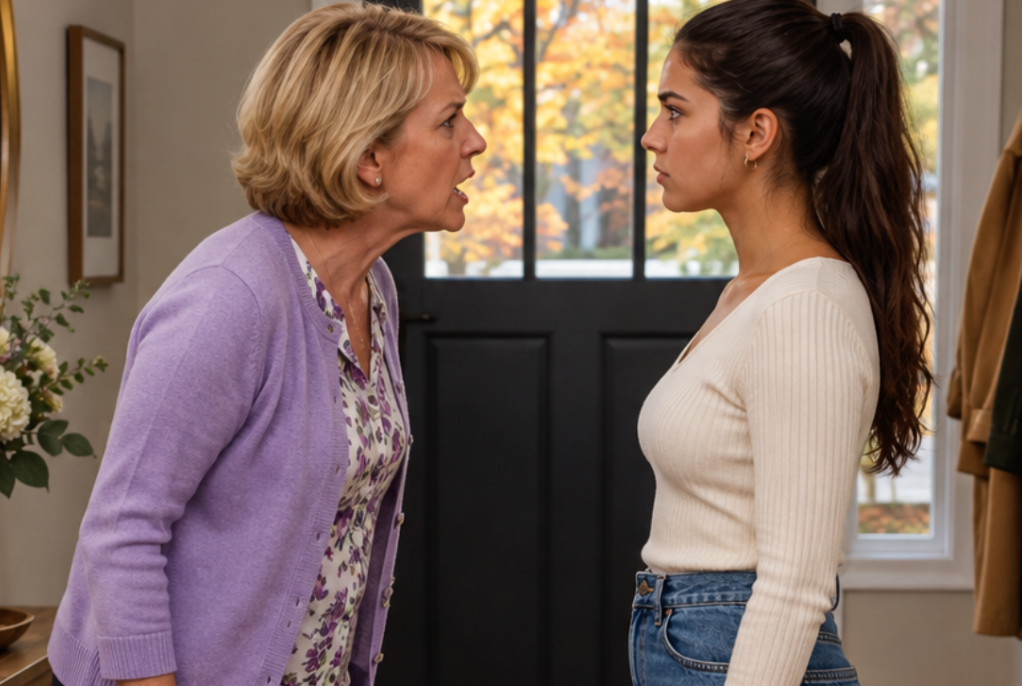
Tanya looked at him. He still hadn’t lifted his head.
“Prepare dinner for ten, immediately! Family’s coming, do you hear me? Immediately!”
Valentina Sergeyevna’s voice on the phone was so sharp that Tanya instinctively pulled it away from her ear. She wasn’t yelling—she was cutting. She was used to giving orders: after all, a daughter-in-law isn’t a person, she’s just the help.
“Valentina Sergeyevna,” Tanya replied calmly, “it’s three o’clock. I just got off work.”
“So what? Are you a wife or what? Go to the store, buy whatever’s needed, and make sure dinner’s on the table by seven!”
“Who’s coming?”
“My sister, her husband, their three kids, my niece with her boyfriend, and his mother-in-law. Can you count? That’s ten people!”
Tanya sighed deeply. Outside the minibus window, the gray September streets stretched by—almost bare lindens, low heavy sky. She just wanted to get home, for some quiet, just lie down for even fifteen minutes.
“Valentina Sergeyevna, please tell Sergey. Let him go to the store.”
The line went uncomfortably silent.
“What?” her mother-in-law said in that tone right before things get serious.
“Let Sergey help. I can’t do it alone.”
“Are you doing this on purpose?!” Valentina Sergeyevna burst out. “At your age I cooked for forty and still cleaned the floors! And you—you ‘can’t manage’! Poor helpless girl!”
Tanya put her phone away in her bag without saying goodbye. The minibus pulled up at her stop.
It was cool and quiet at home. Sergey was lounging on the couch with his tablet—headphones on, legs crossed, totally relaxed. He’d come home from work early. Tanya took off her shoes and hung up her jacket.
“Your mom called,” he said, eyes still glued to the screen. “Did you hear her?”
“I heard.”
“So? If we leave now, we’ll have time to make it to ‘Perekrestok’.”
Tanya looked at him. He still hadn’t looked up.
“Sergey,” she said calmly. “Tell me honestly: do you even hear what you’re saying?”
He finally took out one of his earbuds:
“Come on, Tanya, what’s the problem now? Mom only ever calls to ask for something once in a blue moon…”
“Once in a blue moon?” She gave a small, amused smile—no anger there. “Three weeks ago, she called at eleven at night asking for cottage cheese. Remember? You went.”
Sergey grimaced.
“That was different.”
“Yeah, it was different. That time, she asked you. Now she ordered me.”
He stood up, stretched, and spoke in that voice adults use with picky kids:
“Tanya, let’s not do this. Let’s just go, buy what she needs, take care of it—and that’s it. It’s just one evening.”
She looked at him, thinking: there he is, just as he is. Thirty-four years old. Tall, kind of handsome if you don’t look too hard. He knows how to smile, how to seem reasonable—they say he’s well respected at work. But at home—he’s just a boy. Mama’s boy, who never grew up.
Tanya left. No slamming doors, no drama—she just grabbed her bag and walked out.
In the elevator, she typed a message to her mother-in-law:
“Valentina Sergeevna, make it yourself. I’m already in a taxi.”
She hit send and put her phone away.
Outside, the air smelled of wet leaves and the coming rain. She made her way to the metro, thinking not of her mother-in-law, or of Sergey—but about how she’d wanted for a long time to sign up for a certain course. Accounting for small businesses. Funny? Maybe. But that idea had been quietly, stubbornly circling in her head for months now—whispering, almost shameful, but persistent.
Her phone vibrated. Sergey. She declined the call.
Then he texted:
“Tanya, are you serious? Where did you go? Mom is shocked.”
She put her phone in her pocket.
The café on Mayakovskaya—the one where she sometimes drank coffee alone, just to be herself, not someone’s wife and not someone’s daughter-in-law—was open. Tanya pushed open the door.
At the counter stood a familiar girl, Polina, with her usual reserved smile:
“The usual?”
“Yes,” Tanya said, then added, “And a pastry, please. Any kind.”
She sat by the window. Outside, people hurried past on the sidewalk, collars pulled up, preoccupied with their own lives. No one knew anything about her mother-in-law or the ten guests who were probably already on their way to her home. Here, nobody was demanding anything from anyone.
Her phone vibrated again. This time—a number she didn’t recognize.
Tanya glanced at the screen. Unfamiliar, but a landline—not a mobile number.
She answered the call.
“Tatyana Mikhailovna?” an unfamiliar male voice said. “This is Andrei Nikolaevich from Severna Law Firm. Is this a good time to talk?”
She slowly set her cup down on the table.
“Yes,” she replied cautiously. “It’s a good time.”
“The thing is, your mother-in-law, Valentina Sergeevna Karpova, reached out to us. It’s about the apartment you and your husband bought last year. She claims that part of the funds belong to her. I’d like to discuss the details with you…”
Tanya gazed out the window at the wet pavement, the bare lindens, and the gray September city.
There it was. That’s why everything felt the way it did today. Family, guests, the kitchen—they were just noise. There was something more behind it all.
“Andrey Nikolaevich,” she said calmly. “When would it be convenient for you to meet?”
Andrey Nikolaevich turned out to be polite yet distant—the kind of person who only smiles as much as the job requires, never an inch more. The meeting was set for the day after tomorrow, at the office on Pushkinskaya. Tanya saved the address on her phone, said goodbye, and slowly finished her coffee.
Her thoughts were oddly calm. There was no panic or tears—just a cold clarity, like everything suddenly becoming simple and obvious. As if she had been staring at a blurry painting for a long time, and then someone finally brought it into focus.
So, it’s about the apartment.
They bought it last October—a two-bedroom on Vasilevsky, fifth floor, a view of the courtyard with chestnut trees. Tanya had spent three years quietly saving from her salary, methodically, without telling anyone. Sergey added his share—honestly, no complaints. Valentina Sergeevna came, walked through the rooms, touched the wallpaper, and said, “Well, you could have gone for something bigger.” Not a word about money. Not then, not after.
And now—a lawyer. A city number. “Part of the funds belong to her.”
Tanya paid, stepped outside, and only then allowed herself a single thought:
What a performance she’d been putting on this whole time.
She got home around nine. The guests were gone—either they hadn’t shown up or had already left. The entryway smelled like food; someone had cooked something after all. Sergey was sitting in the kitchen, looking like a man who’d had a long day and wanted someone to notice.
“She showed up,” he said.
“She showed up,” Tanya agreed, hanging up her jacket.
“Mom was in tears. The guests arrived, but the table was empty. She and I had to run to the shops.”
“You managed, I see.”
He stood up, walked to the fridge, opened and closed it for no reason—just to have somewhere to go to avoid the conversation.
“Tanya, do you realize how all that looked? In front of everyone?”
“I do,” she said, and walked into the other room.
He followed her:
“What’s going on with you lately? This isn’t the first time.”
She turned around. She looked at him closely, like you look at someone you’ve known forever but suddenly see differently.
“Sergey, your mother has contacted a lawyer. About our apartment.”
The silence dragged on.
“What?” he finally managed.
“I got a call today. A man named Andrey Nikolaevich, from a law firm. Your mom claims some of the money for the apartment is hers.”
Sergey sat on the edge of the bed, rubbed his face with his hands. He looked bewildered—but not exactly like someone who was hearing this for the first time.
And that was the worst part.
“Did you know?” Tanya asked quietly.
“No. Well… she mentioned something. I didn’t think she meant it seriously.”
“Mentioned what?”
He hesitated:
— She gave us the money. For the down payment.
Tanya slowly exhaled:
— She didn’t give us any money, Seryozha. Not a single penny. You know that.
— I know. But she…
— She what?
He didn’t answer. He stared at the wall with that expression Tanya had learned to recognize perfectly in five years of marriage. It was the face of someone who had already made up their mind but hadn’t yet found the words to say it.
She lay awake through the night.
She stared at the ceiling, thinking about how it had all built up—slowly, year after year, almost unnoticeably. At first, it was just comments—“you don’t cook right,” “you don’t clean right,” “it’s cold in here.” Then came the unannounced visits. Then advice that weren’t really advice, but orders. Then guests for ten without warning. And now—a lawyer.
Valentina Sergeevna was smart. Not the kind of intelligence you brag about, but the kind you use quietly, patiently, like a tool. She never truly caused a scene, never crossed a visible line of rudeness—always stopping exactly where evidence would end. She cried when it suited her. Got sick when it was needed. And in between, she commanded, demanded, belittled—always just carefully enough to be able to say, “Me? I never said a thing out of line.”
Tanya wondered: and Sergey? Did he truly not know—or did he make his choice long ago, and was just pretending there was never a choice to make?
Just before dawn she got up, walked to the kitchen, poured herself a glass of water. Outside, the sky was turning pale, colorless, just like September mornings always feel. The yard was empty, except for someone walking their dog by the far entrance.
Tanya picked up her phone and found an old file in her notes. She’d made it back in the spring—just in case, because there was a feeling inside her, something she never quite let herself name.
The file had numbers. Every deposit, every payment, every transfer—with dates, sums, and screenshots. Three years of careful, quiet work.
She reread it. Closed it. Set her phone on the table.
Then she opened her browser and typed:
“how to check if an encumbrance is registered on an apartment”.
Because a gut feeling is one thing. Knowing for sure is something else entirely.
Rosreestr replied two days later.
There was no encumbrance. The apartment was clean—registered to both of them, no liens, no third-party claims, not a single note that could give Valentina Sergeevna even the slightest leverage. Tanya read the report twice, printed it out, and filed it away in the blue folder she’d bought back in university, the one with the metal clasp.
The folder went into the bottom of her bag next to her notebook.
Meeting with Andrei Nikolaevich turned out to be not scary at all—actually, it was almost boring.
The office on Pushkinskaya was small—two desks, a painting of a lighthouse, the scent of fresh paint in the air. The lawyer greeted her just as he’d spoken on the phone: politely, with no extra words. He slid a piece of paper across the table to her.
— Valentina Sergeevna claims she gave your husband four hundred thousand rubles in cash. Toward the down payment. Last October.
— I see, — Tanya said. — Is there a receipt?
Andrei Nikolaevich hesitated for a moment:
— There’s no written receipt. We only have witness testimony.
— Whose testimony?
— Valentina Sergeyevna’s sister.
Tanya nodded. She opened her bag, took out a folder, and placed it in front of him. First was an extract from the Federal Register, then printed screenshots: transfers from her own card over three years, month by month, showing dates and amounts, bank confirmations. Separate from that was a statement from Sergey’s account—one he unknowingly showed her six months ago when they were reviewing the budget for the renovation together.
— These are all the deposits into the joint account we used for the payment, — she said. — There are no transfers here from Valentina Sergeyevna. Not in October last year, or at any other time.
Andrey Nikolaevich looked at the documents for a long time. When he finally looked up, there was something in his gaze that wasn’t part of any job description: something like respect.
— Tatyana Mikhailovna, — he said carefully, — I am required to pass these materials on to the client. The next step is up to her.
— I understand, — Tanya replied, getting to her feet. — Please go ahead and deliver them.
When she got outside, she paused by the flower shop window—just to stand for a moment and breathe. Buckets of chrysanthemums, burgundy and white, filled the air with the scent of damp soil and the cold.
She didn’t feel triumphant. Only tiredness—deep and old, like dust collected in the corners that you stop noticing until you start a real cleaning.
Sergey was waiting at home.
He was sitting at the kitchen table—not with his tablet or his phone, just sitting there with a glass of water. Tanya took off her shoes, walked into the kitchen, and put the kettle on.
— So? — he asked.
— It’s fine, — she answered.
— Mom called. — He paused. — She said you brought some papers to the lawyer.
— I did.
— Tanya. — There was something unusual in his voice—not irritation or self-justification, but something closer to bewilderment. — Do you realize she’s my mother?
Tanya looked at him. She didn’t rush or look away, just held his gaze for a long moment.
— I know, — she said. — Sergey, I want to ask you something. Just once, no arguments. And I want you to answer honestly.
He nodded—carefully, the way people do when they don’t know what’s coming next.
— Whose side are you on?
There was a long silence. Outside, the rain fell—soft and steady, September rain without wind.
— I don’t understand why there have to be sides, — he finally said.
— I didn’t get it either, — Tanya replied. — For a long time, I thought there had to be a way for everyone to be happy, for everything to work out if I just tried hard enough and avoided conflict. — She poured hot water into a mug. — But it isn’t working.
— What do you want from me?
— I want you to realize it yourself. — She turned. — Not because I told you, but because you see it for yourself.
He said nothing.
Tanya took her mug and went to the other room. She opened a desk drawer and pulled out an old printout from a course website. “Accounting for Small Business, three months, online.” She’d put off signing up twice already—something always came up: repairs, visitors, or she just didn’t have the energy to think about anything except making it to the weekend.
This time, she signed up. Right then, no more putting it off.
When she returned to the kitchen, Sergey was still sitting at the table. But now he looked at her differently—not down at the table, but directly at her.
— Mom’s wrong, — he said quietly. — About the apartment. I know that.
Tanya nodded.
“I’ll tell her.”
“Alright,” she said.
They didn’t talk about it again that evening. But something had shifted—a slow movement, like two people pushing a heavy wardrobe: at first it seems stuck, but eventually you notice a mark left on the floor.
Late at night, after Sergei had already fallen asleep, Tanya stepped out onto the balcony. The rain had stopped. The courtyard gleamed; the streetlamp reflected in the puddle by the playground. Somewhere in the distance, a tram rumbled by.
She stood there, thinking about how she didn’t know how any of this would end. Maybe Valentina Sergeevna would stand down—or maybe she’d find a new way forward. Maybe Sergei would change—or maybe tonight was just one honest moment, and tomorrow everything would go back to normal. Maybe the courses would turn out to be a waste of time—or maybe, a year from now, she’d have something of her own, small but real.
She didn’t know.
But for the first time in a while, not knowing didn’t scare her. It just felt like the future—ordinary, open, and unwritten.
Tanya went back into the apartment, closed the balcony door, and went to bed.
Eight months passed
Valentina Sergeevna quietly dropped her complaints—no explanations, as if nothing had happened. Andrei Nikolaevich stopped calling. The folder with all the records stayed in Tanya’s desk drawer—she kept it on purpose. Not out of spite. Just as a reminder: knowing for sure isn’t paranoia. It’s self-care.
Things with Sergei were up and down.
He kept his promise—he talked to his mother, and from the way things went, it seemed like a real conversation, because for several weeks, Valentina Sergeevna called less and her tone was calmer. Of course, things slowly started to slip back—little comments, unexpected visits, advice that wasn’t really advice. But something had changed. Not in her—in him. Sergei learned how to say, “No, Mom, not today”—softly, with no drama, but also without immediately rushing to her. Tanya noticed this and stayed quiet. She didn’t praise him—just noticed.
She finished the courses in February. Her instructor, Igor Vasilievich, dry and precise like an accounting report, gave her a passing grade with a single comment: “Careful.” That was a compliment.
In April, her friend Lena, who ran a little craft supplies shop, asked Tanya to help with tax documents. Tanya helped. Then another acquaintance reached out. Then a stranger, referred by a friend.
Nothing flashy. No business of her own with a sign or a team—just a handful of clients, evenings at her laptop, small transfers to her bank card. But it was hers. Earned not by keeping calm or staying quiet at the right time, but by choosing and learning something new for herself.
One May evening, she and Sergei sat on the same balcony where she’d stood alone on that September night. They sipped tea, kids’ voices echoed from the yard below, and the chestnut tree by the building finally bloomed.
“You’ve changed,” Sergei said.
Tanya thought about it for a moment.
“No,” she replied. “I just stopped pretending it didn’t hurt.”
He was silent. He covered her hand with his.
She didn’t pull away.