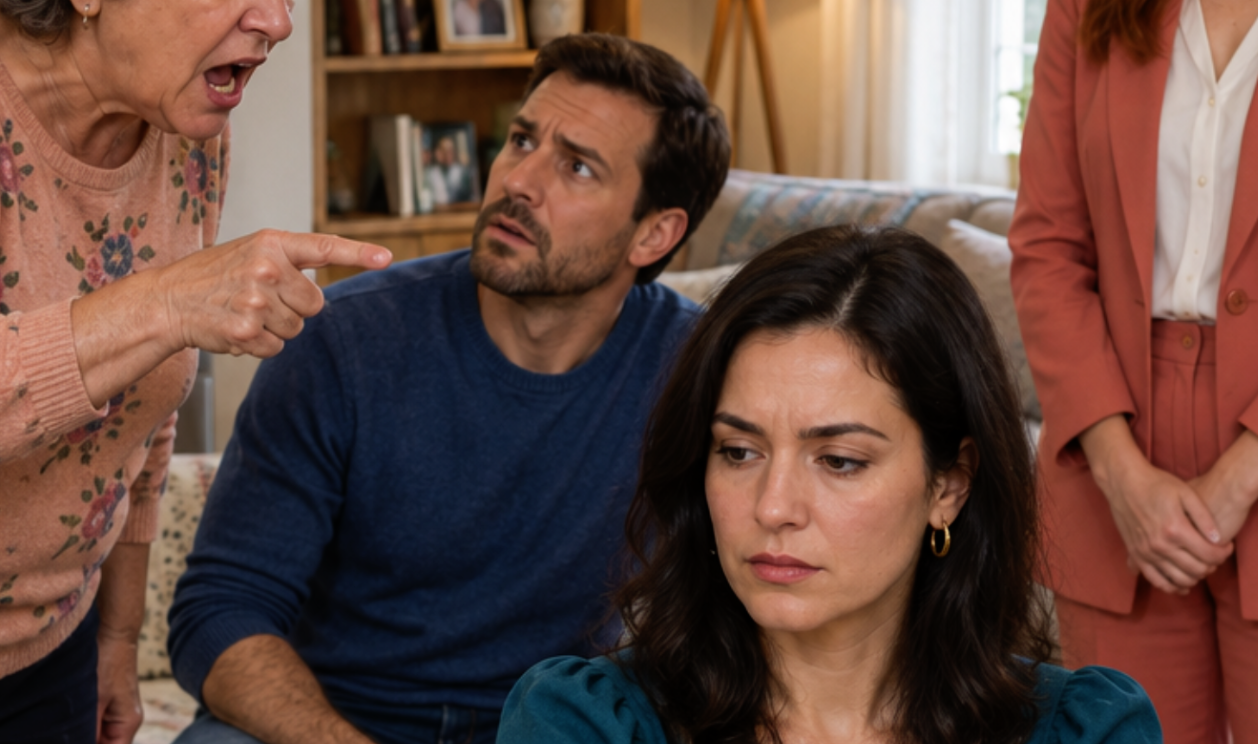
“Beggar! That’s what you are, a beggar. My Seryozhenka, for your information, could have chosen anyone!”
Nina Vasilievna was standing in the middle of my kitchen—in her usual never-ironed synthetic housecoat—and spoke as if she was doing me a huge favor just by being there. She’d shown up without warning, like always. Rang the doorbell at 10:30 in the morning, just as I was trying to finish my coffee.
Sergey sat in the armchair in the living room, silent. Not because he didn’t hear—he definitely did. But whenever his mother spoke, he turned into part of the furniture. Like an armchair with legs.
I set my cup down on the windowsill and looked outside.
Outside, September: yellow leaves scattered on the pavement, kids with backpacks, a woman walking her dog. Just another typical morning. I’d learned to stand at the window like this while Nina Vasilievna talked. It became my shield. No need to leave or slam a door—just watch out the window and wait it out.
“What, cat got your tongue?” she moved even closer, standing right behind my shoulder. “I’m telling you—beggar. No property, no assets, no decent family. Your mother’s God knows where.”
That hit a nerve.
My mother was off-limits.
I turned around—calm, not saying anything extra—and simply said:
“Nina Vasilievna, I’m asking you to leave.”
She was stunned. For about three seconds—a new record. Then she sucked in a deep breath and started again, louder, in a new tone. That I was being rude to my mother-in-law. That Sergey had to put up with a wife like me. That she, Nina Vasilievna, had devoted her whole life to her son, only to be forced to watch some stranger… continued in the comments
Sergey coughed from the living room.
That was his way of joining the conversation.
Mom called me that same evening—I was sorting through paperwork in the bedroom while Sergey and his mother watched TV and whispered about something. I’d gotten used to them talking about me when they thought I couldn’t hear. Or when they just didn’t care if I could.
“Yulechka,” my mom said, and there was something unusual in her voice. Not quite worried—just focused. “Will you have your phone on tomorrow?”
“I will,” I answered. “What’s going on?”
“Nothing’s wrong. I’m just going to be transferring you some money soon. I wanted you to know.”
I didn’t get it then. I thought maybe it was a small thing—sometimes she’d send me three thousand for my birthday or for something specific. I just said, “Alright, Mom,” and we chatted a bit longer—about her garden, the neighbor, about how dry the autumn was this year.
In the morning, I got a notification from the bank on my phone.
I read the amount. Read it again.
Five million rubles.
I was standing in the bathroom, in my robe, toothbrush in hand—reading that notification probably five times over. Then I texted Mom:
Is this real?
She replied right away:
Yes, it’s real. It’s yours. Buy whatever you want. Or just keep it. I’m leaving for a few months, don’t look for me, everything’s fine.
And that was it. The phone went silent. No explanations, no details. Mom disappeared from my life as quietly as she always appeared—without drama, without a scene. She was there, and then she was gone.
I didn’t tell Sergey.
I still don’t know why. Maybe it was because that morning, over breakfast, he just said it offhand as he stood up from the table:
“Mom says we should get a new car. I’m thinking we’ll sell your fur coat, should be about thirty thousand.”
My fur coat. The one my mom gave me three years ago.
I looked at him—he was already heading down the hallway, buttoning his shirt as he went—and I didn’t reply. I just cleared my plate, rinsed it under the tap, and went to the bedroom.
There, in the nightstand drawer, under old receipts and my notebook, was the card where that money had been deposited. I took it out and held it for a moment. Cold plastic. Just an ordinary thing.
Five million.
Sergey didn’t know. Nina Vasilievna didn’t know. And for some reason, I wasn’t in a hurry to tell them.
Days went by. Life went on as usual—I went to work, came home, made dinner, listened to Nina Vasilievna call her son and complain that I hadn’t salted the soup right or didn’t stack the plates properly in the cupboard. Sergey always agreed. With everything. Every time.
Once, I overheard him talking to his mom on the phone—he thought I was already asleep:
“What can you expect, Mom. She brings no dowry, her relatives are questionable. You know how it is.”
I lay in the dark, staring at the ceiling.
No dowry at all.
And in the nightstand drawer, that card with five million sat there. I smiled—almost involuntarily—and closed my eyes.
A month went by. Then another. My mom wasn’t in touch—just the occasional short message:
Everything’s fine, don’t worry.
I had no idea where from—no location, no details. But I wasn’t worried. Somehow, I felt that she knew what she was doing.
But then I started to take action myself.
Quietly. No announcements.
First I opened an account at another bank. Moved some money there—just in case. Then I made an appointment with a lawyer—just for advice, to find out about property gained before marriage and gifts. The lawyer explained everything in detail. I listened carefully and took notes.
On my way home through the city center—past old lindens bare of leaves, past the coffee shop where Mom and I used to spend Sundays—I thought: it’s strange how everything changes inside when you simply have… options. You don’t have to act right away. Just knowing you have that power is enough.
At home, Sergey sat at his laptop, headphones on, watching something. He didn’t even look at me. I hung up my coat, walked to the kitchen, and put the kettle on.
And just then Sergey’s phone rang—loud enough for the whole hallway to hear.
Nina Vasilievna.
I could only hear his side of the call. First—just the usual, “Yeah, Mom, I’m listening.” Then—a pause. A long one. Then he asked again:
“What? How do you know that?”
Another pause.
“How much?”
The kettle boiled. I took it off the heat.
Sergey came out of the room. He paused in the kitchen doorway—phone in hand now, headphones off—and looked at me differently than usual. Like he’d just noticed something he’d never seen before.
“Yulia,” he said slowly. “Is it true?”
I picked up my cup. Poured in the hot water.
“What exactly?” I asked, not turning around.
“Yulia.” His voice sounded strange—not angry or demanding, but lost. Sergei only spoke like that when he truly didn’t understand what was going on. “Mom says your mother wired you some huge amount of money. Is it true?”
I slowly set my cup on the table. Sat down on the stool, folded my hands in front of me, and looked at him.
“How does Nina Vasilievna know about it?”
He blinked. My question clearly caught him off guard.
“Well… she said a neighbor saw you coming out of the bank. And then there was something else…”
“The neighbor,” I repeated quietly.
So that’s how it is. Nina Vasilievna maintained an entire network—friends, neighbors, random acquaintances. A little retirement reconnaissance department. That used to annoy me, but now, for some reason, it just left me tired and surprised.
“Yulia, I’m being serious.”
“Sergei,” I said just as calmly, “not too long ago, you told your mom I had no dowry and my family was a mystery. I heard you. You thought I was asleep.”
He opened his mouth.
Then shut it.
His cheeks slowly flushed— not from anger, but something else. Embarrassment, probably. Maybe from being caught saying things that weren’t meant for other ears, even if spoken in his own hallway.
“This is different,” he finally forced out.
“Different,” I agreed. “Of course.”
I stood up, took my cup, and walked into the other room.
He stayed up for a long time that night. I heard him pacing through the apartment—from the kitchen to the living room and back. Then he called his mother—I caught snatches of words:
she doesn’t say… I don’t know… well, you understand.
Then silence and footsteps again.
I lay there thinking about my mom.
Where she had gone, she never said. The last message was four days ago: just a smiley face and a sun. I’d gotten used to Mom living by her own rules, which didn’t always match everyone else’s. She never explained in advance—she just did, and afterward you’d realize she had a plan. Always.
Five million doesn’t just come out of thin air. I understood that. But I didn’t ask—she had said
it’s yours
, and that was enough for me. Mom never did anything randomly.
As morning neared Sergei finally lay down. He sighed for a long time. Then, into the darkness, he asked:
“So what are you going to do with it?”
“Sleep,” I replied. “It’s nearly three a.m.”
He went quiet.
In the morning, he left for his mother’s.
I watched from the window as he walked out of the building—shoulders hunched, a bag in his hand, clearly filled with the leftovers she’d asked him to bring. It was an old routine: Nina Vasilievna lived ten minutes away and regularly asked her son to bring groceries, fix a shelf, or just come over—”to keep her company.” Sergei always went.
I watched him go, finished my coffee, and got ready for the day.
I had my own plans for today too.
I’d been eyeing a small studio in a new neighborhood for a while—quiet, almost no cars, with a great view of the park. Not to move right away. Just to see. Just to realize it was possible—to have something of my own, a place no one would come into unannounced, no one standing in the kitchen in a synthetic robe.
The realtor was a young woman with tired eyes and a very professional smile. She showed me the studio quickly and efficiently, without wasting any words. Light-colored walls, a big window, and a view of the trees— the lindens had already shed their leaves, standing bare and calm in the September breeze.
“Will you think about it?” the realtor asked.
“I will,” I replied.
We exchanged contacts. I stepped outside, stood on the porch for a while, letting the wind brush my face. Nothing special— just autumn, just the city, just me, not rushing anywhere.
It was a strangely good feeling.
Sergei came back for lunch. He sat at the table, ate in silence, then put down his spoon and said:
“Mom thinks this money should go toward something for both of us.”
I looked up.
“For both of us,” I repeated.
“Yeah. We need a decent car. We could finally do some renovations. Mom says the kitchen has needed fixing for ages…”
“Sergei,” I interrupted quietly, “this is my mom’s money. She transferred it to me.”
“But we’re a family.”
“A family,” I agreed. “The kind where I’m the pauper who owns nothing?”
He flushed again. He started to say something— and didn’t. He does that a lot: starts a sentence and loses it halfway through, realizing it isn’t going where he wants.
“That’s not what I meant.”
“I know exactly what you meant,” I said and got up from the table.
His phone rang in the hallway. Nina Vasilievna. Right on schedule.
He answered, and I could hear her voice— even from here, even through the closed door: loud, confident, demanding. She was speaking quickly; he replied in brief phrases. Then he fell silent altogether.
A long pause.
I stopped in the hallway.
“Mom, hold on,” Sergei said, his voice changed. “Are you sure?”
More silence.
“How many months?”
I didn’t know what Nina Vasilievna had told him this time. But his voice sounded as if the ground had shifted slightly under his feet— just enough to lose his balance.
I grabbed my jacket from the rack, stepped out onto the landing, and quietly closed the door behind me.
The air in the stairwell was cool and smelled like autumn.
I walked down, went outside into the courtyard, and kept walking—no destination, just wandering through the leaves—thinking about my mom and how, wherever she is now, she must be smiling.
I walked for a long time—past old courtyards with benches, past a bakery with the smell of warm bread wafting out, past a pharmacy with a bright storefront. The city moved at its own pace, and no one cared what was going on at my home. That calmed me.
The phone was silent for almost an hour.
Then a message from Sergei came in:
where are you?
I put my phone back in my pocket and went into a small café on the corner—the one with good tea and never any annoying music. I took a table by the window. Ordered tea and something with cinnamon—I can’t even remember what now. I watched the street.
Sergei texted again:
we need to talk.
I replied:
I know. This evening.
He waited for me at home. He was in the living room, sitting without the TV on—just staring at one spot. That was unusual. Sergei without TV or his phone was a rare sight.
“Yul,” he said as I took off my jacket, “mom told me something. About your mom.”
I stopped.
“What exactly?”
He was silent, searching for the right words—carefully, as if he was afraid of making a mistake.
“That she’s been gone for six months now… well, that she isn’t here anymore. That she went far away somewhere. And that before she left, she sold the dacha.”
I slowly walked into the room and sat down across from him.
The dacha. Mom’s dacha in the Leningrad region—a small plot with a little house that she inherited from her parents. I knew she’d been thinking about selling it for a long time. I just didn’t know she already had.
So that’s where the money came from.
“And what now?” I asked.
“What do you mean, what now?” He looked up at me. “Yulia, why didn’t you tell me anything? I am your husband, after all.”
“You’re my husband,” I agreed. “The same one who told my mom I had zero dowry. The one who planned to sell my fur coat to buy a car. The one who, every time your mother called me a pauper, just sat in the armchair and coughed.”
He stared at me. Silent.
“I didn’t say anything because it’s my money, Sergey. My mom’s. She gave me everything she had. Everything. And right now I don’t know why—she didn’t explain. But I know she didn’t do it so your mother could decide how to spend it.”
He lowered his head.
“I didn’t mean to hurt you,” he said quietly.
“I know,” I replied. “There’s a lot you didn’t mean to do. It just happened that way.”
The next day, Nina Vasilievna called.
I picked up—calmly, without that inner anxiety that used to stir at the sound of her voice.
“Yulia,” she began, her voice unusually cautious, “I wanted to… well, talk. Properly.”
“I’m listening, Nina Vasilievna.”
A brief pause.
“You understand, I only want the best for my son.”
“I understand.”
“Good. And now that you… well, now that you’ve got means, maybe it’s worth considering a bigger apartment? Sergey’s wanted one for a long time, and it’d be much easier for me to visit if there was a guest room…”
I almost smiled.
“Nina Vasilievna,” I interrupted gently, “I’ll think about what’s possible myself. If I decide anything—I’ll tell Sergey.”
Silence.
“So you’re not going to…”
“I’m not going to discuss anything right now. Thank you for calling.”
And I hung up.
My hands were absolutely steady. That surprised me—before, after conversations with Nina Vasilievna, it would take me a long time to gather myself, pacing and thinking of what I should have said. Now—nothing. I just put down the phone and went on with my day.
Three days later, Mom got in touch.
Not a text—a voice message. I heard her voice and squeezed my eyes shut for a second: she sounded alive, calm, even younger somehow.
“Yulechka, I’m fine. I’m far away right now, but I’ll explain everything soon. The money is yours, it hasn’t gone anywhere. I wanted you to have solid ground beneath your feet. Do you understand what I mean?”
I listened to her voice and looked out the window at the bare linden branches.
Solid ground beneath my feet.
Yes. I understood.
Mom has always been able to do this—not say too much, but hit precisely on the place that hurts. She saw what I wouldn’t admit to myself: that all these years, I’d been living in someone else’s home, by someone else’s rules, calling it family.
I texted her back:
understood. Love you.
She sent a heart emoji.
Sergey started to change.
It wasn’t sudden or dramatic—it happened gradually, like when something important shifts inside and the person doesn’t quite realize it yet. He began calling his mother less. Or rather, he stopped rushing to answer the phone every single time she called. One evening, she called three times in a row, and he just looked at the screen, set the phone aside, and said:
“I’ll call her back tomorrow.”
I didn’t say anything. I just took note of it.
Another time, he suddenly suggested we go out for dinner—just the two of us, no special occasion. We sat in a small restaurant by the river, enjoying delicious food, and he looked at me in a way he probably hadn’t in three years. It was as if he was seeing me anew, really trying to understand—who I am, what kind of person is sitting across from him.
“I acted like a fool,” he suddenly admitted, with no preamble.
“Yes,” I agreed simply.
“You’re not going to say I didn’t?”
“No, I’m not.”
He smirked—not cheerfully, but honestly. I liked that about him.
Mom came back at the end of February—unexpectedly, as always. She rang the doorbell late in the evening, standing at the threshold with a small suitcase and a sun-kissed face. She smelled of something southern—maybe the sea, or just the sun, which we hadn’t seen for ages.
“Well,” she said as she stepped in, looking around, “tell me everything.”
We stayed up talking until midnight. She told me she’d gone to visit an old friend—a long trip to the seaside, just because she’d always wanted to and had been putting it off. She had sold her dacha, which had become a burden, and decided: enough of waiting.
“What about the money?” I asked.
“The money is for you,” she replied simply. “I’ve seen how you live. You don’t complain, but I’m your mother. I wanted you to know you’re not alone. No matter what happens.”
I looked at her—small, tanned, sporting a new short haircut—and thought she was probably the bravest person I know. She lives the way she wants. No extra words, no explanations. She just does things.
“Did Nina Vasilievna call you?” Mom asked with a slight smirk.
“No. She called me.”
“And?”
“Nothing,” I said. “I hung up.”
Mom laughed softly, satisfied.
Sergey came out of the bedroom, greeted us, and put the kettle on. He acted calm, without any fuss—and that was something new, too. Mom glanced at him then at me—without saying anything. She just gave a small, barely noticeable nod.
Then the three of us drank tea, night unfurled outside the window, and somewhere below the last leaves were rustling as the wind chased them around the yard.
Solid ground under my feet.
Now it was really there. I could feel it—not loudly, not triumphantly. Just a quiet, firm knowledge: whatever happens next—I won’t fall.
Nina Vasilievna showed up a week after Mom came back.
She called ahead—which, in itself, was out of character. Usually, she would just show up and buzz the intercom like she was bestowing some honor on our entire apartment building. This time, though, she called, gave advance notice, and even asked if it was convenient.
Sergey said it was convenient.
I stayed silent.
She showed up in the afternoon—dressed up, carrying some kind of pie. She walked in, looked around, and greeted mom with a pointed politeness—the kind of greeting people use when they already know they’ve lost, but pretend they’ve just changed tactics.
Mom answered briefly and calmly. She always had this way—saying everything needed in just a couple of words, no unnecessary effort.
We sat down for tea.
Nina Vasilievna talked a lot—about the weather, her health, the neighbors. She carefully avoided anything important. I watched her and thought: it takes so much effort for a person to pretend to be someone they’re really not.
Eventually, she couldn’t take it anymore.
“Yulia,” she said, setting down her cup, “I’d like for us to… well, start over. On good terms.”
The room went quiet. Sergey stared at the table. Mom looked out the window.
I waited a moment and replied:
“Nina Vasilievna, I don’t hold a grudge. But I’m not going to pretend nothing happened either.”
She blinked.
“I just want peace in the family.”
“Peace is good,” I agreed. “But peace doesn’t mean I’ll go back to being silent when I’m called poor or when it’s decided for me how to spend my money. I’ve already been through that.”
Nina Vasilievna looked at her son—wordlessly asking him to step in, to support her, to say something. Sergey lifted his head. The pause was long.
“Mom,” he finally said, “Yulia is right.”
Three words. Quietly, without drama.
Nina Vasilievna opened her mouth, then closed it. She picked up her cup, sipped her tea, and stared out the window like she’d suddenly spotted something very interesting there.
Mom gave a barely noticeable smile—just the corner of her mouth, just for herself.
I got up, cleared the extra cups from the table, and headed to the kitchen. It was quiet behind me. Nina Vasilievna didn’t mention peace or starting over again that day. She sat for another half hour, got ready, and left—polite, careful, like a stranger.
Maybe this was the start of something new. Not warm or close—but at least honest.
I did end up buying the studio.
Not to leave—just to have it. My own, in my name, with a view of the park and bare autumn lindens outside the window. I kept the renovation simple—bright walls, wooden floor, a big windowsill that immediately made me want to place flowers on it.
Sergey didn’t find out right away. When he did, he was silent for a long while, then finally asked:
“Why?”
“Because now I have a place that’s just mine,” I answered.
He didn’t get upset. Or maybe he did, but dealt with it on his own, without calling his mom—and that was something new, too.
Sometimes I went there alone on weekends. I’d brew coffee, sit on the windowsill, and look out at the park. I’d just sit, not thinking about anything. It might sound trivial, but for me, it felt almost like a luxury—silence no one could break, space where I didn’t have to explain anything to anyone.
One day mom came there with me. She walked around the room, touched the walls, looked out the window.
“It’s good,” she said simply.
Nothing else. But I knew what she meant.
Life didn’t turn into a fairy tale. Sergey didn’t become a different person—he stayed the same, with all his habits and weaknesses. Nina Vasilievna didn’t turn into a kind mother-in-law—she stayed the same too, just started keeping her distance, because she felt the rules had changed, and not in her favor.
But something real did change.
I changed.
Not loudly, not for everyone to see. I just suddenly realized that I stopped adapting to someone else’s mood, stopped anticipating what Nina Vasilievna would say and how Sergey would react. I stopped living always looking back over my shoulder.
My mom gave me a strange gift—she left for half a year and gave me some money. But in reality she gave me something else. She showed me that you can just go and do what you’ve wanted for a long time. No explanations, no one’s permission needed.
I watched her and learned.
Maybe it was late. But better late than never.
Outside the studio window, bare branches swayed, people with dogs walked along the park paths, and far away a car honked. Just an ordinary day. Just an ordinary autumn.
I finished my coffee, put the cup in the sink, and started getting ready to go home.
Sergey was waiting at home. Maybe there would be some new antics from Nina Vasilievna. Maybe just a quiet evening and the TV.
Whatever it was—I was going there not because I had nowhere else to go.
And that changed everything.