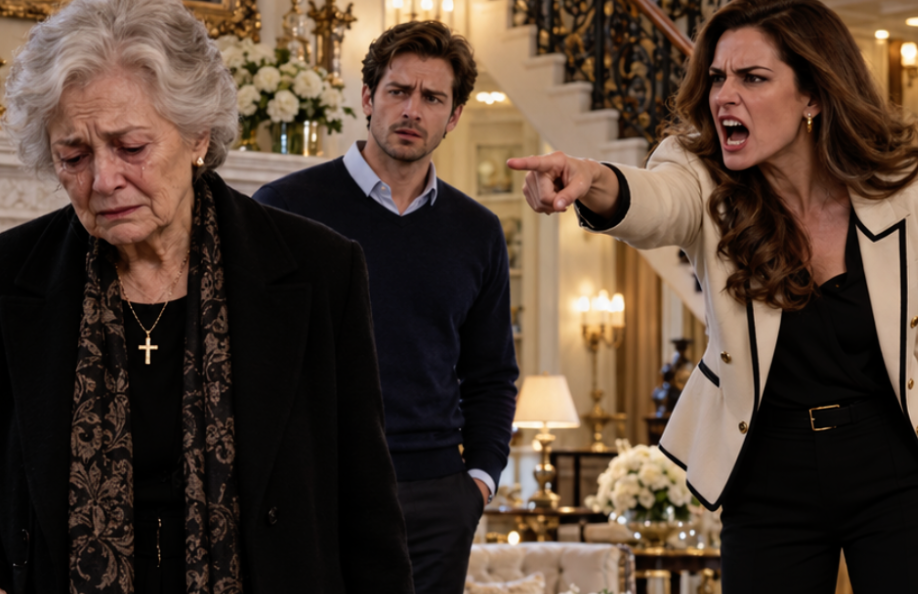
Five days after I laid my husband of forty-three years into the wet earth of a Westchester cemetery, my daughter-in-law, Vanessa, leveled a manicured finger toward the oak front door of our Maple Avenue home. Her voice carried no tremble, no polite hesitation—only the flat, calculating cruelty of someone who believed she had already won.
“Now that Arthur is dead, cry all you want, pack your things, and go live on the streets.”
Three feet behind her stood my only son, Daniel. The boy whose scraped knees I had bandaged, whose college tuition I had funded with grueling night shifts, and whose failed business ventures had quietly hollowed out our family savings. He did not step forward. He did not object. He stared down at the woven rug beneath his polished shoes, studying the patterns as though his mother were nothing more than an inconvenient piece of discarded furniture.
“Daniel,” I whispered, the words catching in my throat. “Did you hear what your wife just said?”
He rubbed his forehead, his tone dripping with practiced exasperation. “Mom, please don’t make a scene. Vanessa is just being practical. We have our own future to protect.”
Practical. That was the word he chose for tossing a seventy-one-year-old widow onto the pavement in the dead of winter.
For forty years, that two-story colonial in White Plains had been my world. I knew every groan of its floorboards, the exact temperature of its stubborn radiator, and the way the morning sun hit the rosebushes Arthur had planted under the bay windows. Yet, standing in that hallway, something extraordinary occurred within me. The suffocating terror that had paralyzed me since Arthur’s passing suddenly evaporated, replaced by an uncanny, crystalline calm.
I reached deep into the pocket of my wool coat. My fingers curled around a small brass key, stamped with the number 413, which Arthur had pressed into my palm three weeks before his death from pancreatic cancer. *Promise me you won’t give this to Daniel,* he had pleaded, his breath shallow, his eyes wide with a frantic vigilance I had mistaken for the delirium of pain medication. *Promise me, Maggie.*
I looked at Vanessa, who was already sticking yellow inventory notes to my heirloom mahogany dining table, and said simply, “Okay.”
She blinked, startled by the absence of tears. “Okay?”
“I’ll leave.”
I walked upstairs, packed a single suitcase with two worn cardigans, my nursing shoes from thirty-six years at Saint Vincent’s Hospital, my mother’s patchwork quilt, and the framed photograph of Arthur and me on our wedding day. On the bed lay a crisp stack of transfer documents Vanessa had prepared before Arthur’s funeral flowers had even withered—a quitclaim deed transferring all my rights in the property to Daniel. Without a word of protest, I signed the papers, left them on the kitchen counter, and walked out into the freezing March dusk.
Neither of them knew that what I carried in my pocket was the prelude to an inheritance beyond their wildest greed—twenty-eight million dollars, a private penthouse overlooking Central Park, and the key to a truth so devastating it would obliterate the illusion of the family I had spent a lifetime nurturing.
That first night was spent in a threadbare motel off Route 119, the heater rattling like an engine on its last breath. Sitting on the edge of the mattress, I retrieved an old business card Arthur had tucked into my handbag months earlier: Jonathan Reed, Estate Attorney, Manhattan. Beside it, the little brass key gleamed beneath the harsh fluorescent bulb. With trembling fingers, I dialed the private number.
It rang only twice.
“Reed and Associates.”
“My name is Margaret Hale,” I whispered into the receiver. “Arthur Hale was my husband.”
A heavy, solemn silence fell over the line. When the attorney spoke again, his voice was laced with profound gravity. “Mrs. Hale. We have been waiting for your call. Tell me, do you have the brass key?”
“Yes.”
“Take the earliest train to Manhattan tomorrow morning. Come directly to our offices. And Mrs. Hale—do not, under any circumstances, mention this conversation to your son. Your husband was convinced you were in imminent danger.”
The morning commute was a blur of gray skies and anonymous faces. When I arrived at the discreet private bank on 47th Street and placed key 413 on the reception desk, the receptionist’s breath hitched. Within moments, I was ushered into a walnut-paneled conference room where Jonathan Reed and the bank’s managing director greeted me with somber deference.
What followed unraveled forty-three years of domestic reality. Jonathan opened a thick leather dossier and slid a balance sheet toward me.
The figure at the bottom read $28,463,912.
I pushed the paper away, shaking my head. “This is a mistake. Arthur drove the same fourteen-year-old sedan until the day he was hospitalized. He wore patched cardigans and repaired old watches in the garage.”
“It is no mistake, Margaret,” Jonathan said gently. “Decades ago, you helped Arthur design a fail-safe medication delivery valve for hospital systems after you witnessed a catastrophic dosing error on your ward. You supplied the medical insight; Arthur engineered the hardware. He patented it, licensed the technology, and retained significant equity when the firm was acquired. He invested every penny through private trusts. He kept it quiet to shield you, but toward the end, his secrecy became a fortress built to defend you.”
“Defend me from what?”
Jonathan turned a laptop toward me. The screen displayed corporate filings for Northline Property Holdings—a shell entity operated by Daniel, Vanessa, and Vanessa’s stepfather, Graham Voss. Voss was a polished real estate speculator whose mountain of leveraged debt was finally collapsing around him. To stave off financial ruin, Daniel and Graham had orchestrated an audacious fraud: they had applied for a $2.4 million bridge loan, pledging our Maple Avenue home as collateral.
To ensure the transaction closed smoothly without interference, Daniel had commissioned an expedited legal petition to place me under involuntary conservatorship. Jonathan pulled up a fabricated medical assessment on stolen Saint Vincent’s stationery, asserting that I suffered from advanced dementia and was incapable of managing my affairs.
At the bottom was the signature of Dr. Eleanor Price.
My stomach heaved. “Dr. Price was the chief of medicine when I was a young nurse,” I choked out. “She passed away three years ago. I sang at her memorial service.”
“Arthur discovered the forgery while he was in the hospice ward,” Jonathan revealed, his jaw tightening. “They needed you out of the house and legally silenced before the loan came due. That quitclaim deed you signed on your bed two nights ago? It is utterly worthless. Months ago, Arthur transferred the entire Maple Avenue property into an irrevocable trust. You are the sole lifetime beneficiary; the bank is the trustee. Daniel has zero legal claim to that house, and you did not possess the individual title to give it away.”
A breath of bitter, incredulous laughter escaped my lips. Vanessa had orchestrated my eviction to claim a house that neither I nor her husband legally owned.
“Arthur left you a safe harbor,” Jonathan added, sliding a set of silver keys across the table. “Your residence is ready.”
By afternoon, an elevator carried me directly into an expansive, sun-drenched penthouse overlooking the treetops of Central Park. On a nightstand beside a plush bed stood a photograph of Arthur and me on our twenty-fifth anniversary. Beside it lay a letter in his familiar, sloping script.
*My darling Maggie,* the letter began. *If you are reading this, I have run out of time. Forgive me for the burden of my silence. When Daniel turned to Graham Voss, he stopped being our son and became a man consumed by an entitlement I could no longer curb. I built this wall of protection around you because I know what he did. If he ever tries to convince you that your memory is failing, remember who you are. You were always the strong one.*
Yet the true depths of the betrayal were still hidden. Two weeks later, a clandestine phone call from my ten-year-old granddaughter, Lily, changed everything. Speaking in hushed, frightened tones, she told me that her mother was tearing apart Arthur’s old garage workshop, but that “Grandpa hid a blue envelope behind the broken wooden clock on his workbench.”
Acting swiftly, Jonathan’s legal team intervened through an inventory order to secure the envelope before it could be destroyed. Inside was a flash drive containing time-stamped video and audio files Arthur had recorded in his final eighteen months.
Sitting beside my dear friend Irene Alvarez in Jonathan’s office, I watched the screen flicker to life. The camera was hidden in Arthur’s workshop. Daniel stood over his dying father, his face contorted with bitter fury.
“You’re sitting on tens of millions of dollars while I’m drowning!” Daniel snarled, slamming his fist against the workbench.
“I will not fund Graham Voss’s criminal house of cards,” Arthur replied, his voice raspy from illness. “And I know about the forged medical records you’ve prepared for your mother. She worked thirty-six years to give you an easy life, Daniel. How could you do this to her?”
Daniel leaned in, his sneer caught in sharp focus. “Because Mom is weak, Dad. She’s a soft-hearted nurse who spent her whole life giving everything away to anyone who asked nicely. Once you’re dead, she’ll sign whatever paper I slide across the table. She always does.”
The screen went dark.
The room was suffocatingly quiet. For seventy-one years, I had believed that unconditional maternal love meant endless forgiveness, endless accommodation, and shielding my child from the consequences of his arrogance. But Daniel had mistaken my tenderness for frailty. He had viewed my devotion as a vulnerability to be harvested.
“Don’t settle, Jonathan,” I said, my voice steady, stripped of all grief. “File the civil suits. Turn the forgeries over to the district attorney. Put every single record into the public registry.”
The legal strike was swift and devastating. On a crisp Thursday morning, a formal process server arrived at Maple Avenue, serving Daniel and Vanessa with an emergency injunction, an eviction notice from the trust, and a formal complaint detailing financial fraud, forgery, and elder exploitation.
When Daniel called me, his voice trembling with panic, he pleaded for mercy, blaming Vanessa, blaming Graham, begging me to “be reasonable” one last time.
“Five days after Arthur was buried, you watched your wife tell me to go live on the streets,” I answered with absolute finality. “I am done rescuing you from the life you chose.”
Over the following months, the conspirators’ house of cards collapsed entirely. Graham Voss was indicted on multiple counts of federal wire fraud and grand larceny. Faced with insurmountable evidence, Daniel was forced into a humiliating civil restitution agreement that stripped him of his personal assets and destroyed his consulting practice. Vanessa, realizing her husband had lied to her as brazenly as he had to his parents, filed for divorce and relocated to a modest rental, desperate to shield young Lily from the fallout.
By late summer, the trust reclaimed the house on Maple Avenue. Standing alone in the empty living room where the outline of our wedding portrait still lingered on the wall, I realized I could never live there again. The wood and plaster held too many ghosts of an agonizing betrayal.
“I want to turn it into a sanctuary,” I told Jonathan. “A transitional home for elderly women who have been cast aside, defrauded, or abandoned by the families they sacrificed everything to serve.”
Together with Irene and a network of advocates, we created the Arthur and Margaret Hale Foundation, using a portion of the twenty-eight million dollars to establish support services, legal aid, and secure housing for vulnerable seniors.
On the afternoon of the foundation’s formal dedication, Jonathan called me into the restored living room of Maple Avenue. On the table sat Arthur’s old leather traveling case, secured by a lock that perfectly matched key 413.
“Your husband gave instructions that this was to be opened only after your legal autonomy was entirely secure,” Jonathan explained.
I inserted the key, turned the cylinder, and lifted the lid. Inside lay a yellowed photograph of Arthur standing outside Saint Vincent’s Hospital forty years ago beside a nine-year-old girl wearing a bright yellow ribbon. Beside it was Arthur’s final letter.
My heart seized as the memory rushed back. Decades earlier, while working the pediatric wards, I had cared for an orphaned girl named Anna, whose mother had died without family. For weeks, I had brought her books, sat with her through night terrors, and used my Christmas bonus to buy her a winter coat and a tiny silver heart necklace. Arthur’s letter revealed that he had spent the subsequent thirty years quietly financing Anna’s education and professional training through a charitable trust.
*Anna Mercer grew up to become a brilliant forensic accountant,* Arthur had written. *She is the one who caught Daniel’s irregular loan applications and alerted me. She helped me erect the legal wall that saved you, Maggie. Because forty years ago, you taught a discarded orphan that she was worthy of love.*
Footsteps echoed softly from the foyer. I turned to see the woman who had greeted me at the private bank on that desperate first morning—the poised professional in the tailored suit.
Tears pooled in her eyes as she reached beneath her collar and pulled out the tarnished silver heart necklace I had purchased with extra shift money four decades ago.
“You told me that somebody always wants you, Margaret,” Anna whispered, her voice breaking. “It just takes them a little longer to find you.”
I held her as we wept, the circle of grace closing around us. Arthur had not merely left me a fortune in paper assets; he had guided me back to the seeds of compassion I had planted long before greed took my son.
A few months later, on the anniversary of Arthur’s passing, I stood in the Maple Avenue garden where the white roses were once again in vigorous bloom. A modest bronze plaque hung near the door: *The Margaret Hale House—Dedicated to every woman who has ever been told she has nowhere left to go.*
A minivan pulled up to the curb. An elderly woman stepped out onto the sidewalk, clutching two plastic grocery bags containing everything she owned, her eyes wide with the raw, hollow terror I remembered all too well.
I walked down the porch steps, extended my hand, and met her gaze.
“You are safe now,” I told her, smiling through the quiet strength Arthur had always known was mine. “Come inside.”