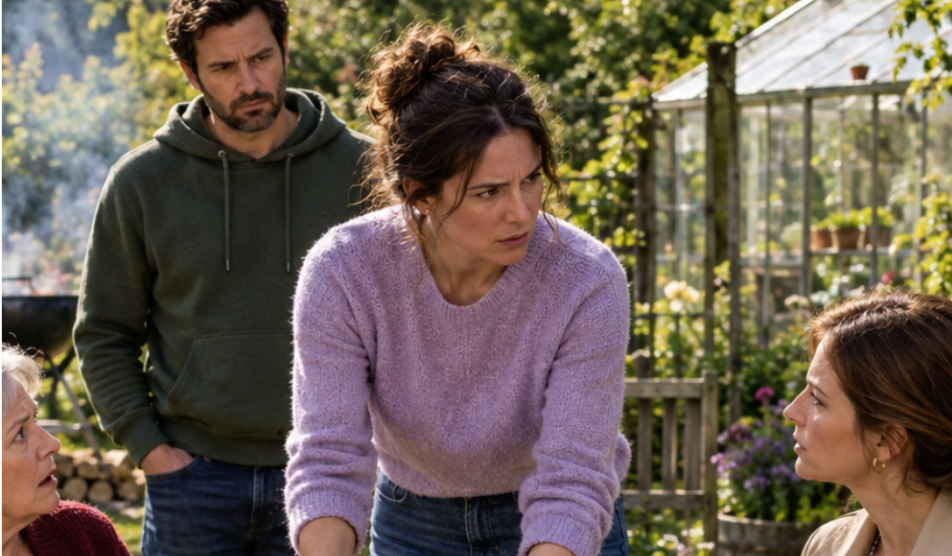
“Polina, just tell me the month! I’ve already finished knitting the booties, and you keep putting it off.”
Aunt Zoya made sure everyone heard her across the table, waving her fork. My mother-in-law froze with her salad bowl halfway over my father-in-law’s plate. Denis reached for the bread even though the basket was sitting right beside his elbow.
For six years—ever since our wedding—she asked me this same question at every family gathering, and for six years, I laughed it off. But this time, I didn’t joke.
“Zoya Mikhailovna, I’m asking you not to bring this up anymore. Not at the table, not on the phone. This is just between Denis and me.”
“Oh, look how sensitive we’ve become,” she huffed, setting her fork down dramatically and casting her eyes around the room, as if searching for witnesses. “Polya, you know I worked thirty years in the maternity hospital. I’ve seen so many women like you—waiting until they’re forty and then crying in the hallway. I’m just thinking of your best interests.”
“Then do a good deed and don’t ask.”
Father-in-law Viktor Palych coughed politely into his fist and raised a glass to the birthday girl. That day was Lyudmila Mikhailovna’s fifty-ninth birthday. The table was stretched all the way to the radiator, and the six of us sat squeezed together in the tiny kitchen, bumping elbows. A homemade Napoleon cake was cooling on the windowsill, the one mother-in-law had baked the night before. Everyone took their drink with a sigh of relief. Everyone but Aunt Zoya.
“Well, what did I even say?” She wasn’t looking at me, but at her sister. “Lyuda, tell her. Am I supposed to keep quiet about Ksyusha too? I only get to see her once a month through a video call, like at the zoo behind glass. Would be nice to see some grandkids here, at least.”
“Zoya, that’s enough,” my mother-in-law said quietly.
“I wasn’t the one who started it. If they don’t want kids, they should just say it and I’ll back off.”
“We do want kids,” I replied. “Just not right now.”
“When then? You’re thirty-four. Denis is thirty-six. Are you two waiting for retirement or what?”
— When we decide ourselves. I promise you’ll be one of the first to know—but not over dinner and not with a drink in hand.
My aunt scoffed and reached for the mustard.
I glanced across the table at Stas. My husband’s cousin and Aunt Zoya’s only son sat opposite, eating aspic without looking up. He hadn’t made eye contact with me all evening. I knew why. And he knew I knew.
Stas went outside to smoke as my mother-in-law carried out the cake. I slipped on my cardigan and followed him down. He stood under the entrance canopy, the smoke drifting toward the streetlight.
— Stas, September first was two weeks ago.
— Polya, not now, — he grimaced. — It’s Aunt Lyuda’s celebration. Let’s not do this here.
— Where then? You don’t answer my calls, and you just reply ‘later’ to my messages. I want to hear a date.
He took a drag and exhaled the smoke slowly, away from me.
Back in February, he showed up at our place one evening and said his Gazelle’s gearbox was dead, and without the truck, he couldn’t work. He asked for three hundred and twenty thousand until autumn. That was our savings for a two-room apartment: I’d inherited a one-bedroom from my grandmother, and we planned to sell it and buy a bigger flat. With a kid, by next summer. I transferred everything from my card, and he wrote a handwritten IOU in front of Denis. He promised to pay it back by September 1st. Denis winced then, saying it was weird to take a note from his own brother. I insisted.
— Polya, I was stuck all August while they fixed the gearbox. I’ve only just started getting orders again.
— Then pay in installments. How much can you manage each month?
— I don’t know! — he smacked his palm against the stair railing. — Do you think it’s easy for me? I send a quarter of my paycheck to Ksyukha every single month, right on time. If I miss it even once, her mother will never let me see her. I’m thirty-eight, living in my mom’s small room. Do you understand that?
His voice suddenly went hoarse. He turned away, and I saw him rub the bridge of his nose, just like Denis does when he’s tired.
— I understand, — I said. — But we have plans too. That money wasn’t saved for a beach holiday.
— Yeah, I know. Mom says there’s no rush for you anyway. No kids yet, so what’s the hurry?
— Mom says that?
He realized he’d said too much and crushed the empty cigarette pack in his fist.
— Well, what? Of course she knows. I don’t hide things from her.
He tossed the cigarette butt in the trash and went back inside. I stayed under the streetlight for another minute. So Aunt Zoya had been asking about kids in front of everyone, fully aware who was holding onto the money for that very child.
When I came back up, they were already cutting the cake in the kitchen. Aunt Zoya untied a bag and showed her sister hand-knitted baby booties, white with a delicate blue ribbon.
— These are for you. For the future, — she said and handed them across the table to me.
On Wednesday after my shift, I went to see Aunt Zoya myself. Stas was out on a run until the weekend—I knew that for sure, because he’d sent Denis photos of the highway somewhere near Vologda the day before.
I brought a piece of paper with me. The night before, I’d mapped everything out by month: twenty thousand each month, sixteen months, and the first payment in October. No interest, no courts or letters. Just a schedule, so we’d have a clear end date and Stas would know the exact amount.
She opened the door in her apron, hands dusted with flour, and greeted me so warmly that it made me feel awkward.
“Pola, come on in! I’m just putting some pies in the oven. Want one with cabbage?”
Her kitchen smelled of yeast and valerian drops. Magnets from Anapa and Ksyusha’s drawing—a house, a sun, and three little people holding hands—were stuck on the fridge. Zoya Mikhailovna poured me tea in a mug with kittens and sat across from me, absolutely beaming. From her face, I could tell exactly what she was thinking. She thought I had come to tell her something really important.
I placed the paper on the oilcloth-covered table.
“Zoya Mikhailovna, I’m here about the money. Stas borrowed it from us in February, the term is up. I’m not asking for everything at once. Look, here’s a proposed schedule: twenty thousand a month. We’re willing to wait for over a year.”
She didn’t even look at the paper. The smile faded from her face slowly, like steam leaving a window.
“So that’s why you’re here,” she said. “And here I was, silly me, thinking you came just to visit.”
“I did come as a friend. No lawyers, no drama.”
“No drama,” my aunt repeated. She grabbed her phone from the table, pressed at the screen slowly with a flour-dusted finger, and then turned it to show me.
Ksyusha looked at me from the screen: nine years old, gappy smile, two ponytails tied with cherry hairbands.
“Do you know the last time I hugged her? It was in June. I had one week during school holidays. Even then, her mother stayed at a hotel nearby, watching us so we wouldn’t talk too much. Stas sends her money every month, but she still says it’s not enough. He doesn’t drink, Polya. He’s faithful. His car’s his living; without it, he’s nothing.”
Her voice broke on the last word. She turned toward the window and stared at the poplar tree in the yard for a long time.
“I can’t even help my own son, you know? My pension’s twenty-three thousand. I spent thirty years caring for other people’s children. And now I see my grandkids only through my phone.”
I felt truly sorry for her. The kind of sympathy that leaves a lump in your throat. I pushed the paper closer to her.
“That’s why I’m offering payments in installments.”
She turned back to me, her face suddenly more composed and resolved.
“And why are you two in such a rush? Both of you are healthy, you both have jobs, no kids yet. Have a baby first, then we’ll talk about money—I’ll be the first to tell Stas to pay up. For a stroller, for a crib. But when it’s just about your square meters, you can wait.”
“Having a child and paying off a debt are separate things, Zoya Mikhailovna.”
“You made my brother sign an IOU.” She pushed the paper back to me with the edge of her hand, like wiping away crumbs. “Denis would never have done it on his own. That was all you.”
“Yes, I did. That’s why Stas should call me by Sunday. Me—not Denis.”
I never did try the pies. I left the paper on the oilcloth table.
***
On Sunday, Stas didn’t call. On Monday evening, my mother-in-law called instead.
“Polina, honey, please don’t be upset,” Lyudmila Mikhailovna’s voice was careful, as if she were walking on ice. “I just wanted to ask—maybe you and Denis should see a doctor? Just to get a checkup.”
I turned off the stove under the buckwheat.
“Lyudmila Mikhailovna, we’re both healthy. We’re just choosing to wait.”
“Yes, yes, I understand. It’s just that Zoya says maybe there’s something wrong with you, something… female, and that’s why you’ve become so tense. And you’re lashing out at Stasik because of it. She only wants what’s best, you know—she really understands these things.”
I said goodbye as politely as I could manage and put my phone face-down on the table. Denis was sitting barefoot on a stool by the fridge after his shift, and he’d heard every word.
“Was it Mom?” he asked.
“Your aunt is telling the family that I can’t have children. That’s supposedly why I’m so upset about the money.”
“Polya, that’s just how she is. Don’t make a fuss. It’ll all work out.”
“Work out how, Denis? To my face, she says they’ll pay back the money when I have a baby. But behind my back, she tells everyone I can’t have one.”
He didn’t respond. He went to the bathroom, and I could hear the water running for a long time.
That evening, I sat down at the kitchen table and typed up a letter—dry and to the point: the amount, the date of the IOU, the deadline for repayment. I asked for the money to be returned within seven days of receiving the letter, or I’d have to take it to court. The next morning before work, I stopped by the post office and sent it by registered mail with delivery confirmation to Stas at his mother’s address.
That evening, Denis noticed the postal receipt sitting on the hallway table.
“Did you actually send him a letter? To your brother? In the mail?”
“Registered mail. So no one can say later that I didn’t warn them.”
He stared at the receipt for a long time, then put it back gently, as if it belonged to someone else.
On Friday evening, as I left the lab after my shift, Aunt Zoya was waiting for me by the steps with an opened envelope in her hand.
============================
She was standing by the steps of the lab wearing a gray coat, holding the envelope between two fingers as if it were something dirty. I hadn’t even had time to brush the plaster dust off my sleeves—I had spent all day casting models, and then stayed late fitting the ceramic color for an elderly woman’s dental bridge.
“Stas came back from his trip yesterday and picked this up at the post office,” my aunt said instead of greeting me. “He brought it to me and just sat at the kitchen table looking defeated. Is that what you wanted?”
“All I wanted was for him to call me. He didn’t call.”
“Come with me,” she said, nodding toward the bus stop bench. “We’re not talking here on the steps.”
We sat down. My bus went by—I let it go. Zoya Mikhailovna folded the envelope in half and put it in her purse.
“Let’s do this like adults, Polya. I’ll pay off everything for Stas. All three hundred and twenty, every last penny. I’ve got money put aside in my savings—was saving it for my funeral and a headstone.”
I stayed silent. Just last week, right in her kitchen, she had told me all about her twenty-three thousand pension and how she couldn’t help her son.
“But I’ll pay,” she continued, “once you show me a note from the clinic. As soon as you get registered for pregnancy, I’ll transfer it the same day. For a stroller, for a crib, whatever you want. Even for your two-bedroom apartment.”
“Are you serious right now?”
“As serious as it gets. I’d happily give that money for a grandchild. But I’m not giving it for your concrete. I wouldn’t give my son money for a car, and I won’t give you money for fixing up your walls.”
“Zoya Mikhailovna, are you suggesting I buy back my own debt from you? That I pay in children?”
“I’m trying to give you a normal life!” she raised her voice, and a woman on the next bench looked over. My aunt lowered her voice. “And stop embarrassing yourself with all these letters. Didn’t your husband tell you? Denis already told Stas over the phone back in August—it’s not urgent, pay it back when you can. So now you’re going against your own husband.”
She stood up, adjusted her coat, and walked off toward the crosswalk without looking back. I missed another bus.
***
Denis was fixing the balcony door handle at home. I took off my jacket, hung it up, went into the kitchen, and only then asked:
“Did you tell Stas in August that it wasn’t urgent?”
The screwdriver stopped.
“I told you,” he replied without turning around. “He called me, said his car broke down. Asked me to wait. I told him it wasn’t urgent.”
“Then why didn’t you tell me?”
“Because you would have started right away.” He finally turned to face her. “Polya, he’s my brother. We used to sleep in the same room at the dacha our whole childhood. Aunt Zoya took me to kindergarten when my mom worked double shifts at the factory. She patched up my scraped knees with green antiseptic. I can’t drag her son to court.”
“But you could offer a delay without me? This is our money, Denis.”
“I didn’t forgive the debt. I just said to wait.”
“The IOU is in my name. And it has a single due date, September first. No one changed that.”
He set the screwdriver on the windowsill, stood for a moment, then went into the other room. He closed the door quietly. That silence was worse than if he’d slammed it.
I couldn’t sleep that night. I sat in the kitchen under the glow of the range hood, the IOU in its clear folder and those same little booties in front of me. White, with a blue ribbon. I hadn’t put them away; they’d been on the fridge for almost two weeks now.
I kept thinking, what if she’s right? I’m thirty-four. The apartment can wait, but a child can’t wait forever. Maybe Denis is right, and no amount of money is worth his mother not speaking to me anymore. Maybe I’m just stubborn, and it’s more important for me to win than to live in peace. I put the kettle on twice and forgot about it both times, only coming back when it clicked itself off.
Then I opened the IOU. Stas’s handwriting was big, like a schoolboy’s. “I, Stanislav Andreevich Kravtsov, have received three hundred and twenty thousand rubles from Polina Sergeyevna Lebedeva. I promise to repay by September first.” Signature, date: February twentieth.
And I realized it wasn’t the sum keeping me here. It was the fact that my future child had become a bargaining chip on a bench at the bus stop. That for my own money, I was being told when I could have a baby.
The deadline on the IOU passed on Thursday. On Friday, I took two hours off work, paid the court fee through my banking app, and took my application for a court order to the local magistrate’s office. A copy of the IOU, a copy of the letter, the delivery notification. The sum was less than five hundred thousand, the debt was uncontested—there was nothing to argue. The woman at the window took my papers, stamped them, and said a copy of the order would be sent to the debtor.
That evening, I told Denis. He just nodded, as if he’d been expecting it.
“Tomorrow we’re closing the dacha for the season,” he said. “Dad’s taking down the greenhouse. Are you coming?”
“I’m coming.”
“Stas is bringing Inna. Introducing her to the family.”
He said it evenly, without reproach. But the way he looked at me, it felt like he was asking something else entirely.
============================
At the dacha, the air was filled with the smell of smoke and damp apples. My father-in-law was taking the plastic off the greenhouse since morning, Denis helped him roll it up, and my mother-in-law and her sister were chopping vegetables on the veranda. Aunt Zoya greeted me with a nod, as if we’d only seen each other yesterday and nothing had happened.
Stas and Inna arrived just in time for lunch. Inna turned out to be petite, fair, wearing a beige trench coat, carrying a pie wrapped in foil and accompanied by her first-grade son, who dashed straight to the swings. She smiled at everyone, but you could tell it was a bit strained, like when you’re a guest in someone else’s home. My aunt was overjoyed—she sat Inna right next to her, offered her the best pieces, and started praising the pie before it was even cut.
There were eight of us at the table outside, if you counted the little boy who ate standing up, barely waiting to get back to the swings. My father-in-law made a toast to the harvest. Stas was pouring drinks. He didn’t look at me, just like he hadn’t at that birthday party before.
My aunt waited until everyone had taken a sip, then placed her hand on Inna’s shoulder.
“Now, take notes, everyone,” she said loudly so the whole table could hear. “Look at Innochka’s son, he’s a joy. And our Polya, still nothing. Polya, when are you going to have a baby? Will you give us some good news by New Year?”
Inna gave me an awkward smile. My mother-in-law lowered her eyes to her plate. Denis froze by the grill.
I set the bowl of salad I’d been holding onto the table.
“Zoya Mikhailovna, may I ask something too? Since we’re doing this in public. When will your son pay back the three hundred and twenty thousand he borrowed from me back in February, with a written agreement to return it by September first?”
The only sound was the creaking of the swings.
“We were planning to use that money to buy a two-bedroom,” I continued, “for that same child you ask about at every family gathering. And last week you suggested I pay it back for your son, if I register for prenatal care.”
“Polya, what are you doing?” Stas set the bottle down. “Why are you starting this now?”
“I’m not starting anything. On Friday I submitted a claim to the magistrate. You’ll be getting a court order. And as for kids, Zoya Mikhailovna, that’s your son’s area now. He knows better than anyone when we’ll finally have the means.”
Inna slowly removed Aunt Zoya’s hand from her shoulder.
“You told me it was for a car loan,” she said quietly to Stas.
Stas stood up so abruptly that his plastic chair toppled into the grass, and he stormed off behind the house. My mother-in-law stared at me as if she’d never seen me before.
“Polina, how could you? In front of a guest.”
Aunt Zoya fell silent. Then, looking at her hands instead of me, she spoke very quietly:
“I hugged you as a daughter at your wedding.”
And she walked into the house. Nobody followed her. Denis stood for a moment, set the skewers on the grill, took his car keys out, and said to me:
“Let’s go.”
He was silent the whole drive back to the city. So was I.
***
Three weeks later, I received the court notice: Stas had filed an objection, and the magistrate canceled the order. If the debtor objects, the order is revoked without any hearing, and now I’d have to file a regular lawsuit—with court dates and summonses, dragging it out for months.
I was sitting in the kitchen working on a new application when Denis got home from work. He came straight to me, still in his jacket, and sat across the table.
“If it goes to court,” he said, “I’ll testify. I’ll say the money was ours together and the deadline was never extended. I had no right to make decisions without you.”
I looked at him. He seemed older than he had a month ago.
“Mom isn’t speaking to me,” he added. “Not to me either, not just you. When I come over to help Dad in the garage, she goes to the neighbor’s.”
Inna never came to the dacha again. Rumor has it she and Stas broke up just a week after that lunch. Aunt Zoya is telling everyone it’s my fault. Maybe she’s a little right. I have no clue what Stas told Inna about the money, or if there was anything between them besides that. But the first crack really did appear after my question at the table.
The family chat with those morning greeting cards went quiet. They didn’t remove me from the group—just nobody writes anything anymore.
The tiny baby booties are still in my dresser drawer. I can’t bring myself to throw them away, but I can’t look at them either. Denis and I never went back to discussing the two-bedroom apartment or having a child. Every time I start thinking about it, I hear her voice across the table.
Most likely, I’ll repay the money. The IOU is in my name, signed by Stas, with a deadline. There really isn’t much to argue about in court. But I won’t be invited to the dacha again, and Lyudmila Mikhailovna won’t call me on my birthday—even though she’s always been the first for six years.
Sometimes I wonder: could I have just waited for the judge’s paperwork and kept quiet at the table one more time? Quiet, no Inna, no chair knocked over, no talk of legal advice in front of everyone.
Be honest: would you have said something out loud to your aunt, in front of a new person meeting your family for the first time? Or would you have stayed quiet one more time and gone to court without embarrassing anyone
continued in the comments