An Autumn Gathering in the Garden: Blue House, Old Apples, and Family Surprises
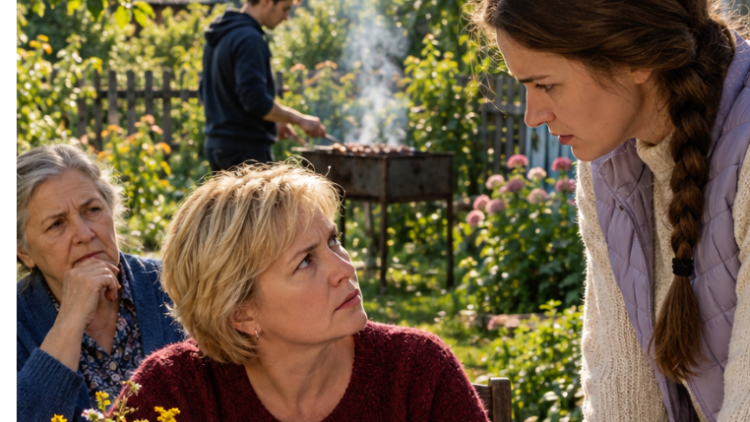
The dacha at my mother-in-law’s in the garden community near Tunoshna: six acres, a light blue board house, and old apple trees. On the first Sunday of October, it was cold but sunny. There were two tables pushed together in the yard covered with oilcloth, a grill near the fence, and boxes of Antonovka apples lining the path. Around twenty-five relatives gathered, half of whom I’d only ever seen at our wedding.
My mother-in-law, wearing a burgundy fleece jacket, was slicing bread. She noticed us at the gate—the knife paused for a second, then started chopping again. Stas turned away from the grill towards the smoke. Aunt Lyuba loudly told someone, ‘So they showed up after all.’ Artyom stayed by the car, saying he needed to check the tire.
I sat at the edge, next to the very cousin who liked my post with a heart. She pushed some cucumbers toward me without looking up. For an hour, we chatted about harvests, gas prices, and someone’s grandson in the army. The envelope sat in my bag on my lap. Even though there were sixty bills inside, it felt almost weightless.
Then my mother-in-law stood up with a shot glass.
‘To those who remember kindness,’ she said, her eyes lingering on me. ‘And for those who don’t, only God will judge.’
I stood up, took out the envelope, and walked around the table. My mother-in-law watched me as I walked, and her smile slowly faded, piece by piece.
‘Nina Arkadyevna,’ I said loudly so even those by the grill could hear, ‘in July, you gave Artyom and me three hundred thousand as a gift for an apartment in front of everyone. Three weeks ago, you asked for it back. I’m returning it now, in full, in front of everyone, just as you gave it. Please count it and sign the receipt.’
I placed the envelope and two sheets of paper with a blue pen in front of her. The quiet was so thick you could hear the fat sizzling on the grill.
‘Nina,’ Aunt Lyuba was the first to speak, her voice not angry but confused. ‘Are you really taking back your gift from the kids?’
My mother-in-law didn’t answer. She stared at the envelope, and I knew she was thinking about the bank paperwork, about court, and how now there was no way out for her, even though what she really wanted most was to throw that envelope at my feet. When she looked up, I realized she understood: I knew everything.
Stas stepped away from the grill.
‘Mom, let me say something.’
‘Sit down,’ she said, and he sat right on a crate of apples.
She opened the envelope and started counting. Her lips moved, her fingers fumbled with the bills, and twenty-five pairs of eyes watched her hands. At first the pen wouldn’t write, leaving empty grooves. My mother-in-law signed with force on one sheet, then the other, tearing the paper at the end of her signature.
I folded my copy four times.
‘Thank you. Now we owe each other nothing.’
And I headed toward the gate. Artyom was by the car. As I walked past, he didn’t open the door for me, just went towards the table. I saw him sit next to his mother on the bench and put his hand on her back. The bus stop on the highway was almost two kilometers away, and no one followed me.
***
Artyom came back Tuesday evening. He spent two nights at his mother’s in Bragino, texting me briefly: At work, I’ll be back. He walked in, sat down on a stool in the hallway, and took ages to untie a lace that was already loose.
‘She paid the bank everything on Monday,’ he said. ‘Stas called. There won’t be a court case.’
‘Good.’
Mom hasn’t left her room for two days. Aunt Lyuba refuses to call her, saying this is an unthinkable shame for our family: taking back a gift from your son in front of everyone. Now everyone’s talking about it.
He looked up at me, and there was no anger in his eyes—just exhaustion, like someone coming off a night shift.
“You knew what she needed that money for. You knew she wouldn’t be able to refuse in front of everyone. You didn’t just return her money, Ksyusha. You gave her a bill.”
“I just wanted people to stop calling me a thief.”
“They did stop. Now they’re saying that about her instead.”
I had so much I could say. About Mom’s eighty thousand tucked away in her savings, about late-night chats, about that heart she sent under my message. But I kept quiet, because none of those replies would have fixed anything.
We didn’t go to the bank on October fifteenth. Our 180 thousand is still in a new deposit, and someone else bought the one-bedroom place by the Kotorosl—our manager let us know politely. Stas sent just one message: “Thank you. You didn’t have to.” A minute later, another: “Mom doesn’t know I’m texting you.”
Artyom didn’t leave. We’re still having dinner together, still going to the hardware store on Saturdays for shelves for our rented apartment. But just the other day, he told me he’ll spend New Year’s with his mom alone, and I didn’t argue.
The IOU sits in the dresser drawer, under the wedding photos. In the top photo, my mother-in-law’s laughing in a turquoise dress, microphone in hand, with Aunt Lyuba beside her, wiping away tears. Sometimes, I take out both papers and can’t decide which one tells the real story of our family.
Be honest: knowing what my mother-in-law truly needed the money for, would you have quietly given it to her in her kitchen—or done what I did and returned it in front of the whole family? Continued in the comments.