Lyoha pulled himself up to the playpen bar all by himself, swaying like a tiny captain on deck. Zhenya dropped down onto the mat nearby and held her hands out just in case, not touching him. He balanced for a whole four seconds before plopping onto his diaper, kicking his feet in pure delight.
“Eight months old and already standing,” she said. “Lyoha, you’re ahead of every schedule I’ve seen.”
The phone started singing on the shelf, screen lighting up with ‘Nina Egorovna’. Zhenya put it on speaker and lifted her son onto her lap.
“Zhenya, it’s twenty-six degrees here, and the water feels like warm milk,” her mother reported. “How about you guys?”
“Lyoha just pulled himself up by the edge and now demands applause. Come on, there’s two of you, clap for him!”
“Valera, get over here—your grandson is standing!” Nina Egorovna yelled off to the side. “Valera, take a break from your fishing floats!”
“Standing? It’s in his blood,” came the distant voice of Valeriy Stepanovich. “All the Vetrov family started early. And left early, when it was time.”
“Dad, you’re always the philosopher on the pier,” Zhenya laughed. “Did you catch any fish yet?”
“Caught one. Small, but an honest catch.”
Two years ago, her parents packed three bags and moved to the seaside, closer to the water and to Nina Egorovna’s sister. They left their two-room apartment on Teplichnaya to their daughter—she was an adult now, after all. Ever since, a magnet with two seagulls had been clinging to the fridge—the only tangible proof that somewhere, there was still sun, a pier, and those early morning fishing floats.
“Is Kirill home?” her mother asked carefully.
“He’ll be back soon. And no, he’s not giving me a hard time if that’s what you’re asking. Mom, every time you ask that, it sounds like you’re running an investigation over here.”
“I’m just asking. I am your mother, after all.”
Half an hour later, the door clicked open and Kirill came in with a bag of apricots, set it down on the floor, and scooped up his son under the arms.
“Our little hero!” He lifted Lyoha above his head. “Lyoha, did you know your dad finally fixed the fuse box today—the one three guys before me couldn’t figure out?”
“Don’t tell him about the fuse box, he’s too little for thrillers,” Zhenya said. “Should I wash the apricots, or did you just bring them for the vibe?”
“I’ll wash them. Zhenya, here’s what I’m thinking: let’s go to Anapa in September. The sea, your folks, and Lyoha in his little sunhat.”
“Great idea. I’m giving you an A+ for that one.”
They met in the simplest, silliest way, like something out of a cheap TV drama: something sparked above the supermarket cash register, and twenty minutes later a man in a blue jumpsuit showed up—short, sturdy, with a dimple in his chin. He winked, said, “Don’t turn it off, I like daring women,” and Zhenya snorted, but gave him her number anyway. A week later, they were strolling on the promenade. Four months after that—a quick registry office wedding, no dress, no guests.
The first sign wasn’t even what was said, but how it was said. Nina Egorovna called on Friday, asking about Lyoha, about formula, if her daughter was tired, and as Kirill passed by, he tossed a short phrase into the air.
“She’s checking up. Every week, she checks if I’m doing everything right over here.”
“She’s asking about her grandson, not you,” Zhenya replied. “Sure, you’re the star of the show, but today’s episode isn’t about you.”
“Right. It’s just—I mean, who am I in this apartment? Registered and that’s it. Pretty much just a tenant with a kid.”
A tenant with a child and apricots. The dream of any housing association.
He just waved his hand and walked into the room, while she blamed it all on November: it’s dark, heavy, everyone feels uneasy. That was when Tamara Viktorovna’s visits started happening more often. Kirill’s mother would show up at the door with apples and her usual phrase: “I was just passing by, thought I’d check on my grandson.”
“It’s so cozy here,” she’d say, slowly walking through the rooms like an inspector. “So spacious. Zhenya, you’re really lucky with your parents. Others don’t inherit anything at all.”
“I got lucky with people, not with square meters,” Zhenya replied, fastening Lyoha’s sweater.
“Square meters are made by people, too. Look at the Sviridovs—my neighbors—everything is divided equally for them. Fair and square. He’s the owner, she’s the owner, and nobody has to prove anything to anyone.”
“The Sviridovs are a wonderful family. But I only saw them once in my life, and couldn’t figure out why they were voting in my hallway.”
“Kirusha is proud,” Tamara Viktorovna continued, as if she hadn’t heard. “He needs to feel like a man, not a freeloader. My late Vitaly always brought things into the house, and we shared everything, down to the last spoon. That’s what a real family was.”
“May Vitaly Ivanovich rest in peace, but as far as I know, no one ever asked him for half an apartment as a matter of pride.”
“You’ve become rude.”
“I’m just precise. Comes with the job of being a careful person.”
In spring, Zhenya found out she was pregnant, and the house grew quiet for a while, as if after a good snowfall. Kirill would spin her around the room, bring boxes of oranges, and promise everything would be different now. Tamara Viktorovna rushed over with a cake and tiny booties, announcing that real life was finally about to begin.
In May, Lyoha was born, and the first weeks blurred together into one long day of feeding, laundry, and half-sleep. Kirill would get up at night, rock him, change him, and whisper silly stories to his son about wires and light bulbs. Back then, Zhenya thought all the warning signs she’d noticed were just due to sleep deprivation.
By July, Tamara Viktorovna had “found a good person on Prosveshcheniya who can handle everything in forty minutes.” She shared the news at dinner, sounding as proud as if she were announcing a spa trip. Kirill silently sat next to his mother and nodded.
“It’s time to get everything sorted properly,” he said. “Half should go to me. So I don’t feel like a guest in my own home.”
“A guest is someone who leaves,” Zhenya replied, wiping Lyoha’s chin. “You’re not leaving—you’re sitting here demanding signatures. That’s a different story altogether.”
“Zhenya, you don’t understand,” Tamara Viktorovna interjected. “If you’re hesitating, it means you don’t trust him. You either have trust, or you don’t.”
“Trust means I don’t need a stamped pass to enter my own apartment. A deed isn’t a vitamin for male pride, Tamara Viktorovna. Pride that needs a signature is called something shorter.”
“Ah, so this is how you talk to the mother of my son!”
“Respectfully, by full name, without raising my voice. If you’d like, I can write it down and send you a sample.”
Kirill abruptly pushed back his chair, stood up, and started pacing the room, clenching and unclenching his fingers.
“I’m thirty-one years old and I have nothing! Absolutely nothing! No home, no share, not even a scrap of paper! I gave you a son, I got up at night for him, and you treat me like some lodger!”
“You got up at night for your son, not for taking over my night shifts. You don’t get paid in square meters for that, only in words of gratitude. And I gave you those words every single day.”
“Words!” he exhaled sharply. “Words are worthless!”
“Exactly, that’s why it’s funny you want half the apartment in exchange for the word ‘trust.'”
“You don’t love me. You just keep me around because it’s convenient for you.”
“Kirill, I do love you. But my love doesn’t come with an entry fee or a security deposit.”
Tamara Viktorovna stood up, adjusted her sweater, and spoke in that even tone usually reserved for delivering verdicts in amateur theater.
“So you want my son to live his whole life on someone else’s property. Fine, enjoy your precious square meters, Your Majesty.”
“I’m not just sitting here, I’m living. And just between us, there’s no throne in here—just a fold-out couch.”
The next day, Vika, the shop supervisor and the only person Zhenya felt free to say anything around, stopped by. She brought a bag of children’s clothes, sat down on the floor next to Lyova, and listened to the whole story without a single ‘oh no.’
“Don’t even think about it,” she finally said. “My sister went through the same thing. She registered half the property, and a year later they kept splitting and splitting until she was left with just one room and a head of gray hair.”
“Vika, but this is family.”
“Zhenya, ‘family’ isn’t a magic spell against greed. You say that word and it sounds like an empty box. Listen to it.”
“I hear it,” Zhenya admitted. “It sounds hollow.”
That evening, she went down to the mailboxes to collect receipts and pulled a white rectangle with a red stripe out from among the usual flyers. It was an official letter addressed to Kirill Dmitrievich Lapin. Overdue payments for child support, case file, collection proceedings.
Zhenya read it over three times, standing by the dim light above the mailboxes. Her husband had another child. All this time—from their first conversation by the broken cash register, from the promenade, from the registry office, from the apricots.
She went back upstairs, placed the letter on the table, and sat down opposite the empty chair. Kirill came in at ten, took off his shoes, reached for his son, and then noticed the red stripe.
“What’s this?” he asked, far too calmly.
“That’s your biography. The chapter you decided to leave unpublished.”
“Zhenya, listen…”
“I’m listening. I’ve got lots of patience but not much time: Lyova only sleeps for two hours.”
He sat down, gripping the edge of the table, and started speaking fast, swallowing his words.
“It was before you! We weren’t together long, she had a baby, I paid, then they stopped the payments, then I changed jobs, it piled up. I didn’t hide it, I just never mentioned it!”
“Not hiding and not telling—Kirill, that’s just the same door from opposite sides.”
“I was afraid you’d leave! I loved you and I was scared!”
“You weren’t afraid to lose me. You were afraid you’d have to explain why there’s a boy with a father he never met.”
“He’s six years old, I hardly even know him!”
“He doesn’t know you either. Strange, isn’t it? He doesn’t know you exactly because you don’t know him.”
Tamara Viktorovna showed up in the morning with a bag of apples – and when she saw the paper with the red stripe on the table, she wasn’t surprised at all. She set down the bag, sighed, and sat quietly. Not a single question, not even a “how could this happen.”
“Tamara Viktorovna,” Zhenya said quietly, “how old is the boy?”
“Six,” she replied automatically, then suddenly stopped herself.
“Thank you. You’ve helped the investigation a lot – even though we’re not pretending to be detectives here. You knew everything.”
“So what?!” Kirill’s mother’s voice grew agitated. “What was I supposed to do, shout it for the whole building to hear? Youth, a mistake! The boy is growing up, he has a normal mother, why dig it all up again!”
“Digging up is when you poke at the past. This isn’t the past. This is a responsibility that walks down the street with you.”
“You’re hysterical! You’re making a whole tragedy out of a piece of paper!”
“The piece of paper wasn’t written for me. And ‘hysterical’ is the most interesting word you’ve found in this room – considering you’re the only one shouting.”
Kirill jumped up, turned to her, and started talking, his voice breaking.
“Enough! You’ve been tearing into me for two days! Yes, there was a child! Yes, I have a responsibility! So what now, am I supposed to stand under your window with a guitar?!”
“No need to stand under my window, you’re off-key anyway. What I need is something else: for the person hiding one son not to have rights over the home of the second.”
“So that’s what this is about! The apartment means more to you than I do!”
“Lev means more to me. Someone who erases one child so easily will eventually erase the second the same way – with that same little dimple on his chin.”
“How dare you…”
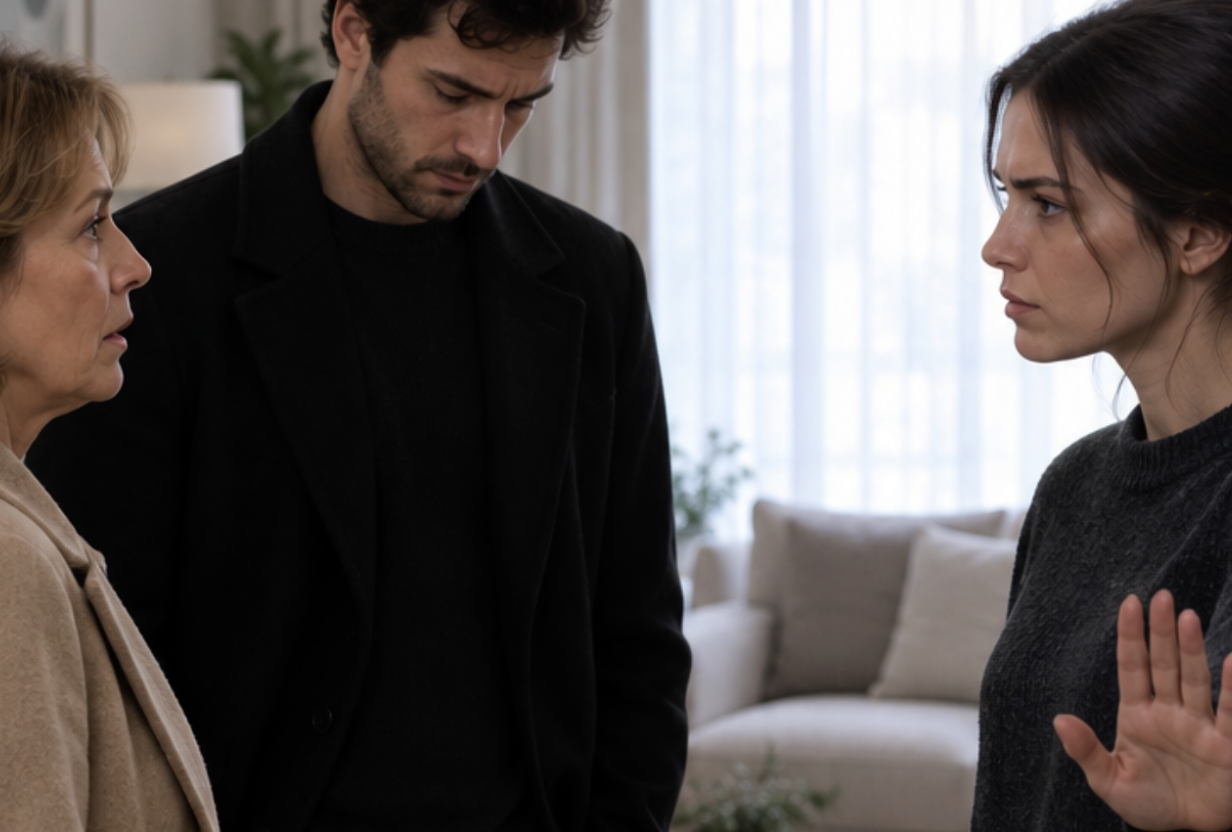
“Both of you should go – you and your mom,” Zhenya said evenly, not even a hint of emotion. “Your gym bag is in the storage room. You have half an hour.”
Kirill packed noisily and slowly, dropping things everywhere and explaining to each shirt just how unfairly he was being treated. Tamara Viktorovna stood in the hallway hugging her bag of apples, repeating that “people don’t treat people this way.”
“You’re throwing us out onto the street! Throwing a father out with a child!”
“The father gets to stay with the child – he’s not leaving one apartment for another. It’s just two blocks on foot, Tamara Viktorovna. You told me yourself you pass by there.”
“You’ll remember this day!”
“Of course I will. I have an excellent memory, it’s my best trait.”
The door closed. Through the thin wall, Zhenya could hear them arguing out in the hallway – she couldn’t make out every word, but the message was clear.
“I told you: tell her yourself, properly, ahead of time!” Tamara Viktorovna hissed. “If you’d confessed, she’d have cried and forgiven you!”
“Nobody would’ve found out!” Kirill snapped back. “If that paper hadn’t shown up, everything would’ve been fine! Everything would’ve been as it should!”
“Fine! Now you’ve got two responsibilities, can you get that through your head? Two! One for each boy!”
“I get it! I can’t handle a third wedding, Mom, I barely managed this one…”
“Keep your voice down, the whole building is listening!”
“Let them listen! She didn’t even try to see my side! She just kicked me out like I’m nobody! Can you believe it – gave me half an hour, like a delivery guy!”
Zhenya stepped away from the door and picked up her son. Lev gripped her finger tightly with his whole little hand, and that was the only confirmation she needed that she had been right.
She called her parents, and when her mother answered, she didn’t say her usual “everything is fine.”
“Come over,” Zhenya said. “I need help.”
On the other end, there was a brief silence, then Nina Yegorovna’s voice became businesslike and much younger.
“Valera, the tickets! Zhenya, what happened, please don’t cry.”
“I’m not crying. Kirill has a child, six years old, and a debt because of it. We’re getting divorced.”
“I told you!” Valery Stepanovich boomed in the background. “He smiles too much! People who smile a lot always leave things unsaid!”
“Dad, you’re a genius—just a little late to the party.”
“We’ll be there by tomorrow evening,” her mom said. “Do you hear me? Tomorrow.”
Zhenya put down the phone and walked through the apartment. The coat rack in the hallway was empty, making the corridor feel wider. Nothing was broken or damaged—everything was clean, as if someone had wiped away mist from a window, suddenly making everything clear.
She tucked Lyova into bed, sat down next to the playpen, and texted Vika one word: “Kicked him out.” Vika replied within seconds: “Smart girl. I’ll bring dumplings and valerian drops in the morning. The valerian is for me.”
The hardest part of the divorce for Zhenya wasn’t the paperwork, but the nights spent wondering how things could have been different. But then morning would come, Lyova would stand at the edge of his crib, rocking and demanding applause, and the new day would put everything into place.
Kirill was left with two debts, someone else’s furniture in his old room, and the confidence that it was the woman’s fault—she just didn’t see things from his perspective. Zhenya was left with her son, an apartment on Teplichnaya, a seagull magnet, and parents already on the train.
She never put up with anything for years or insulted anyone in return—she simply closed the door behind people, firmly but with courtesy, and always on time. In the morning, someone left a bag of apples outside her door; Zhenya took it to the mailboxes with a short note: “Thank you, we have our own.”