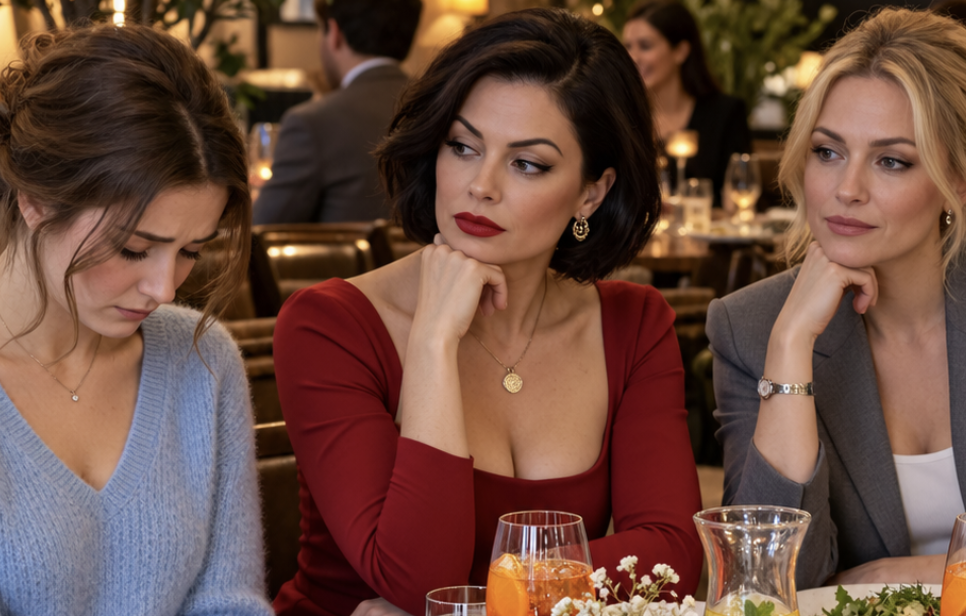
September that year turned out to be unusually warm. During the day, the sun still felt almost summery, but toward evening a chill crept into the air, and the first yellow leaves rustled along the sidewalks.
Tetiana had twice wanted to cancel the meeting. At first, she typed into their group chat: “Girls, I might not make it. I have a lot to do.” Then she deleted the message.
After all, it had been thirty years.
Thirty years since they had graduated from teacher-training college. Back then, they had been seventeen or eighteen, exchanging lecture notes, running to the cafeteria for tea and a bun, borrowing nylon tights from one another before dances, and being absolutely certain that by forty-five, life was practically over.
Now most of them were approaching fifty.
They had decided to meet at a small restaurant near the city center. Nothing fancy—just a private room for twelve people, a large table, light-colored curtains, a little vase of dried flowers, and a waitress who occasionally came in to collect empty plates.
Tetiana was one of the last to arrive.
“Tania!” Svitlana was the first to jump to her feet. “My God, you haven’t changed at all!”
Tetiana laughed.
“Oh, don’t make things up. Of course I’ve changed.”
“All right, fine, you wear glasses now,” Svitlana said, hugging her. “But otherwise, you’re exactly the same.”
Tetiana took off her light jacket and looked around somewhat shyly. She recognized some of them immediately. Others only after hearing their voices.
Olena was sitting by the window.
During their student years, she and Tetiana had never really been friends. They had simply studied in the same group. They might exchange a few words during a break, they had once been assigned classroom duty together, and a few times they had been paired up for practical lessons.
Nothing more.
“Hi, Tania,” Olena said warmly.
“Hi.”
“Sit with us. There’s an empty seat right here.”
Sitting across from them was Iryna.
Tetiana recognized her immediately too.
Iryna had hardly changed—not physically, of course, but in the way she spoke. Even back in college, she had loved knowing everything about everyone and possessed a strange ability to make an insulting remark sound as though she were merely joking.
“Oh, Tania,” she drawled, looking Tetiana up and down. “You’re still just as modest as ever.”
“I suppose so,” Tetiana said with a smile.
“Girls, remember how afraid she was to answer at the board during our first year?”
Someone laughed.
Tetiana smiled too, although she suddenly felt uncomfortable.
“That’s true.”
“See? And I kept wondering whether life had finally taught you to stand up for yourself.”
“Oh, Iryna, here we go,” Svitlana said, waving her hand.
“What? I didn’t say anything bad.”
The salads arrived.
The conversation shifted to their teachers, the dormitory, and old photographs. For several minutes, Tetiana relaxed.
She listened as Natalia talked about her granddaughter, Svitlana complained about prices, and Olena laughed over an old story about a psychology exam.
Then Iryna turned her attention back to Tetiana.
“Tania, where do you work now?”
“At a store. I’m an administrator.”
“Seriously?”
“Yes.”
“So you never ended up working in your profession?”
“I did for a while. Then things just worked out differently.”
Iryna shook her head.
“That’s a shame. We studied for so long.”
Tetiana picked up her glass of water.
“Well, life turns out differently for everyone.”
“That’s certainly true,” Iryna agreed. “I always said you have to know how to present yourself. But you were always sitting quietly somewhere. Nobody even noticed you.”
Tetiana said nothing.
No one paid much attention. Several different conversations were happening around the table at once.
A little later, everyone began talking about where they lived.
“I’m in a new apartment building now,” Iryna said. “Although I don’t really like the neighborhood. We’re thinking of buying another apartment. Mom says it’s better to do it now while we can.”
“What about you, Tania?” Natalia asked.
“I have my own house. A small one. On the outskirts.”
“You bought it yourself?” Iryna even raised her eyebrows.
Tetiana did not understand why that particular word—“yourself”—bothered her so much.
“Yes.”
“Wow.”
Iryna smiled.
“Good for you. So you finally learned how to get by.”
Tetiana lowered her eyes.
“Something like that.”
Olena, who until then had been silently cutting a baked potato with her fork, lifted her head.
But Iryna was already continuing.
“And what about your husband?”
The table became slightly quieter.
“We went our separate ways a long time ago,” Tetiana replied.
“Ah.”
Iryna made that expression that somehow conveyed sympathy and curiosity at the same time.
“So you’re alone?”
“Alone.”
“And the children?”
“Three.”
“They all lived with you?”
“With me.”
“Wow.”
Iryna leaned back in her chair.
“Well, three children are difficult, of course. There’s not much room for a career after that.”
Tetiana felt her cheeks beginning to burn.
She hated moments like this.
She had hated them when she was twenty, and she hated them now.
Whenever she needed to respond quickly, it was as though every word disappeared from her mind. Later, at home, she could think of ten brilliant answers.
But when the moment actually came, she simply stayed silent.
“The children are grown up now,” she said quietly.
“Well, at least now you can finally live for yourself,” Iryna said with a smile. “It sounds like your best years were spent on the children.”
Tetiana froze.
That one hurt.
Her best years?
For some reason, she immediately pictured Maksym in first grade—skinny, wearing an oversized jacket and holding a bouquet of asters.
Then Mariika with a fever of almost forty degrees, when Tetiana had spent the entire night replacing the wet towels on her forehead.
And little Sasha, whose hand she had held on the way to kindergarten as he cried and repeated, “Mom, just promise you’ll be the first one to pick me up.”
She remembered her night shifts.
How she had gone without things herself so she could pay for her eldest son’s dormitory.
How she had worn old boots through winter because Mariika needed braces.
How she had repaired the roof.
How she had taken extra shifts.
How once she had fallen asleep in the kitchen while sitting on a stool because she had barely slept for two days.
She had never considered those years wasted.
But she could not say that now.
“Iryna.”
Olena’s voice was quiet.
Yet the whole table suddenly fell silent.
“What?” Iryna turned toward her.
“Maybe that’s enough?”
“Enough of what?”
“All of this.”
Iryna laughed.
“Olena, we’re just talking.”
“No. You’re talking as though Tania is reporting to you about how she lived her life.”
“Oh, for God’s sake. Tania, did I offend you?”
Everyone looked at Tetiana.
That was the worst part.
She automatically shook her head.
“No, not really…”
“See?” Iryna said triumphantly.
“No, I don’t,” Olena replied. “I can see that she simply doesn’t want to argue.”
Tetiana looked at her in surprise.
Olena set down her fork.
“You keep saying things like, ‘You didn’t have a career,’ ‘Your best years went to the children,’ ‘You finally learned how to get by’… Do you even know what kind of life she had?”
Iryna shrugged.
“And you do?”
“I know a little.”
“From where?”
Olena turned toward Tetiana.
“Your oldest son is Maksym Kovalenko?”
Tetiana became even more surprised.
“Yes.”
“That’s how. I teach him.”
Tetiana was silent for several seconds.
“At the university?”
“Yes. This is already the second year.”
Olena smiled.
“He doesn’t like talking about himself. But once after class, we were discussing family. At the time, I didn’t even know you were his mother.”
Tetiana stared at her with wide eyes.
“What did he say?”
“That his mother raised three children on her own.”
Iryna stopped smiling.
Olena continued.
“That she worked two jobs. That she helped the oldest get an education, helped her daughter get established, and got the youngest through the years after school. And that she never once told them, ‘I sacrificed my life for you.’”
Tetiana’s fingers began to tremble.
She hid her hands beneath the table.
Maksym had never said anything like that to her.
Never.
On the contrary, whenever he came home, he always complained:
“Mom, why did you pack all these jars for me again? What am I, some starving student?”
And yet he always took the jam, the pickles, and the homemade adjika with him.
“And another thing,” Olena said. “He’s very proud of you.”
Tetiana lowered her head.
“Please don’t…”
“Yes. I should.”
Olena was now looking at Iryna.
“You asked whether Tania bought the house herself. She did. She bought her car herself too.”
Iryna snorted.
“A car isn’t exactly an achievement these days.”
“I didn’t say it was.”
Olena spoke calmly, without raising her voice.
That made her words sound even stronger.
“It’s simply strange to hear you say, ‘You bought it yourself?’ as though you’re shocked that someone could actually buy something for herself.”
“And what exactly are you trying to say?”
“Exactly what I said.”
“No. Finish what you started.”
Olena paused.
“All right. I’ll finish. Nobody gave Tania an apartment as a wedding present.”
Iryna went pale.
“What does that have to do with anything?”
“Nothing. Just like Tania’s career has nothing to do with our reunion tonight.”
“My parents were able to help me, so they helped me. So what?”
“Nothing. It’s wonderful when parents are able to help.”
Olena even nodded.
“But after receiving that kind of help, it isn’t very nice to sit here lecturing someone who had no help at all about how she should have lived her life.”
Iryna flushed.
“You don’t know anything about my life.”
“I agree.”
“My mother still helps me sometimes. So what?”
“Absolutely nothing.”
Olena picked up her glass of water.
“But that makes it even less appropriate to mock someone who spent her whole life pulling everything together on her own.”
Silence settled over the table.
Somewhere beyond the door, dishes clinked.
Iryna stared out the window.
Tetiana felt even more uncomfortable than before.
“Olena, you shouldn’t have said all that,” she whispered.
“Yes, I should have.”
“I could have handled it myself…”
Olena smiled faintly.
“Tania, you would have stayed silent. Just like thirty years ago.”
Several of the women laughed quietly.
Even Tetiana did.
“That’s true,” she admitted.
The tension eased a little.
Svitlana pushed a plate toward Tetiana.
“Here, have some more salad. At this rate, you’re all going to start fighting and I’ll be left to finish it alone.”
This time everyone around the table laughed more loudly.
Only Iryna remained silent.
Within a few minutes, the conversations split up again.
They talked about children, work, fuel prices, rose seedlings, and how long everyone had spent getting there because of the evening traffic.
Tetiana barely listened.
One sentence kept circling in her head.
“He’s very proud of you.”
By the time everyone began leaving, it was already dark outside.
The air had turned cold.
Tetiana zipped up her jacket and took her keys from her handbag.
“Tania!”
She turned around.
Olena was catching up with her.
“Are you driving?”
“Yes. Mine is over there.”
A small used Renault was parked near the curb.
Nothing special.
Tetiana had bought it three years earlier after saving money for almost four years.
Olena looked at the car and smiled.
“So Maksym was telling the truth.”
“About what?”
“That you’re stubborn.”
Tetiana laughed.
“I’m not sure that’s a compliment.”
“Coming from him, it definitely was.”
They stood there silently for a moment.
Then Tetiana said:
“Thank you.”
“For what?”
“You know.”
Olena sighed.
“Maybe I shouldn’t have said that thing about Iryna’s parents.”
“Maybe.”
“But she made me angry.”
Tetiana smiled.
“I noticed.”
Olena was about to leave, but Tetiana touched her sleeve.
“Olena…”
“What?”
“Did Maksym really say those things?”
“About you?”
“Yes.”
“He really did.”
“On his own? You didn’t ask him?”
“On his own.”
Tetiana’s eyes began to shine.
She quickly turned away, pretending to search for something in her handbag.
“What an idiot I am,” she said quietly. “Crying in a parking lot after all these years.”
Olena said nothing.
She simply stood beside her.
Across the road, the windows of apartment buildings glowed.
A bus passed, its tires whispering across the damp asphalt.
A yellow leaf fell from the tree above them and landed directly on the hood of Tetiana’s car.
“You know,” Tetiana finally said, “I always thought the children had a hard time because of me.”
“Why?”
“Because other families had more. Better clothes, vacations by the sea every summer, new phones… And I was always saying, ‘Wait until payday.’ ‘We can’t afford it this month.’ ‘Maybe next year.’”
Olena looked at her.
“Maksym told me something different.”
“What?”
“How you used to get up at five in the morning to bake pies for him before a trip. How you traveled halfway across the country to see him when he got sick during his first year. How you sold your gold chain so he could have enough money for a laptop for his studies.”
Tetiana wiped her cheek.
“My God. He told you that too?”
“He did.”
“I asked him not to tell anyone…”
“Tania, he wasn’t telling me because he was ashamed of it.”
Olena paused.
“He was proud.”
Tetiana stared somewhere across the road.
She suddenly remembered that same gold chain.
Her mother had given it to her for her twentieth birthday. It had sat in a jewelry box for almost twenty years, until one morning Tetiana took it to a pawnshop.
She had cried on the way home that day.
Not because of the gold.
Because she could not simply buy her son a laptop out of her salary the way other parents could.
And only now, many years later, she thought about that story differently for the first time.
Not as proof of how poor she had been.
But as proof that somehow, she had managed.
“Life is strange,” Tetiana said quietly.
“How so?”
“Thirty years ago, I thought you didn’t even notice me.”
Olena laughed.
“And I thought you didn’t like me.”
“Why?”
“Because you hardly ever talked to me.”
“I hardly talked to half the group.”
“That’s true.”
They laughed.
Then Olena hugged her.
Not ceremoniously, without any beautiful words.
Just tightly.
“Drive carefully.”
“I will.”
Tetiana got into the car.
Her phone vibrated inside her handbag.
A message from Maksym.
“Mom, did you already go to the reunion? How was it?”
Tetiana stared at the screen for a long time.
Then she typed:
“Good. I met your teacher.”
The three dots appeared almost immediately.
“Olena Serhiivna???”
Tetiana smiled.
“Her.”
“Oh.”
“What do you mean, ‘oh’?”
There was no answer for about thirty seconds.
Then another message arrived.
“I hope she didn’t tell you anything she wasn’t supposed to.”
Tetiana wiped another tear from her cheek with her palm.
“She did.”
Another pause.
“Mom, I only said good things.”
Tetiana typed:
“I know.”
She was about to put a period after it, but changed her mind.
Then she added:
“I’m proud of you too.”
She sent it.
Maksym did not reply immediately.
Only after Tetiana started the engine did her phone light up again.
The message contained just three words:
“I’m proud too.”
Tetiana sat in the dark car in the middle of the restaurant parking lot and cried.
Quietly, without sobbing.
But this time, she was not ashamed at all.
Because sometimes a person has to live half a lifetime, raise three children, survive a divorce, count every bit of money until payday, buy a small house and an old car, only to accidentally hear one September evening from a woman who is almost a stranger what she herself had never dared to say about her own life:
She had made it.