At seven o’clock on Saturday morning, I was already standing behind my mother-in-law with a curling iron in my hand. The kitchen smelled of hairspray and the coffee Viktoria Ivanivna had brewed for herself in a cezve. As usual, she didn’t offer me any. On the windowsill, twenty-four place cards with the guests’ names were drying. My mother-in-law had spent the entire week writing them out in blue marker, carefully, letter by letter, like on a greeting card.
“Not so tight, Katya,” she said, looking at herself in the little mirror I had placed on the table for her. “I’m seventy, not sixteen. I want it to look dignified.”
I loosened the curl and curled it again. Dignified it was.
Then came Lesya, Mark’s sister. Soft waves, a little volume at the crown—exactly like the photo she had found on her phone. Lesya twirled in front of the hallway mirror and laughed that now she looked no older than thirty instead of thirty-eight. At the beauty salon where I work, a hairstyle like that costs eight hundred hryvnias. But in the very first year of my marriage to Mark, my mother-in-law had explained the family rule to me: you don’t take money from your own people.
When I was already putting the curling iron and combs back into my case, Viktoria Ivanivna asked without turning around:
“What are you wearing today?”
“A dress. The one I wore to Mark’s name-day celebration.”
“Ah,” she said, adjusting her brooch. “Well, you’ll be comfortable there.”
At the time, I didn’t understand what she meant by “there.”
The Podilska Svitlytsia restaurant stood above the Bug River, and you could see the water from the banquet hall. That evening, it was gray and covered with tiny ripples. A heavy shower had passed in the afternoon, the chestnut trees along the embankment were wet and dotted with yellow leaves, and shells crunched underfoot. Above the long table swayed two golden balloons: a seven and a zero.
I walked along the table carrying a gift bag, reading the place cards.
“Lida.”
“Galyna.”
“Lesya.”
“Danylko.”
“Mark.”
Next to Mark’s card stood another one: “Vadym.”
Mine wasn’t there.
I walked around the table a second time, then a third, more slowly, as though my card might have hidden under a napkin or fallen beneath a plate of aspic.
In the seat where I always sat, beside my husband, there was an unfamiliar man of about forty in a light-blue shirt. He nodded politely to me and immediately began examining his fork.
Mark stood up.
“Katya, why are you standing? Sit down.”
“Where, Mark?”
He looked at the table, then at Vadym, then back at me. I could see the realization dawning on him, and I saw something else too: he truly hadn’t known anything about it. Whenever Mark gets confused, his ears turn red.
They were blazing now.
Viktoria Ivanivna sat at the head of the table in a gray velvet dress, and the hairstyle I had done for her that morning was still flawless.
“Oh, Katyusha,” my mother-in-law said, touching her temple as if checking her curls. “It turned out so awkwardly. Lida came from Zhytomyr out of nowhere. I wasn’t expecting her. And the hall can’t fit any more people—twenty-four seats, that’s all. You’re young, they’ll bring you a little chair.”
Lida, my mother-in-law’s former classmate, waved at me from across the table with her glass.
A waiter brought in a white plastic chair from the summer terrace and placed it in the corner, right beside the kitchen doors.
The doors swung open every minute, letting out trays and the smell of roast meat.
The seat was still wet from the rain.
The waiter apologized, wiped it with a paper napkin, and gray streaks remained on the napkin.
“Mom, what is this?” Mark asked quietly.
“Don’t make a scene in front of everyone, son,” she replied just as quietly, smiling at the guests. “She’ll sit there for three hours. She won’t fall apart.”
Mark didn’t say anything.
He turned around and went to the restaurant administrator.
Through the glass doors, I could see him asking her something. The woman flipped through a folder and handed him a sheet of paper.
He stared at that sheet for a very long time.
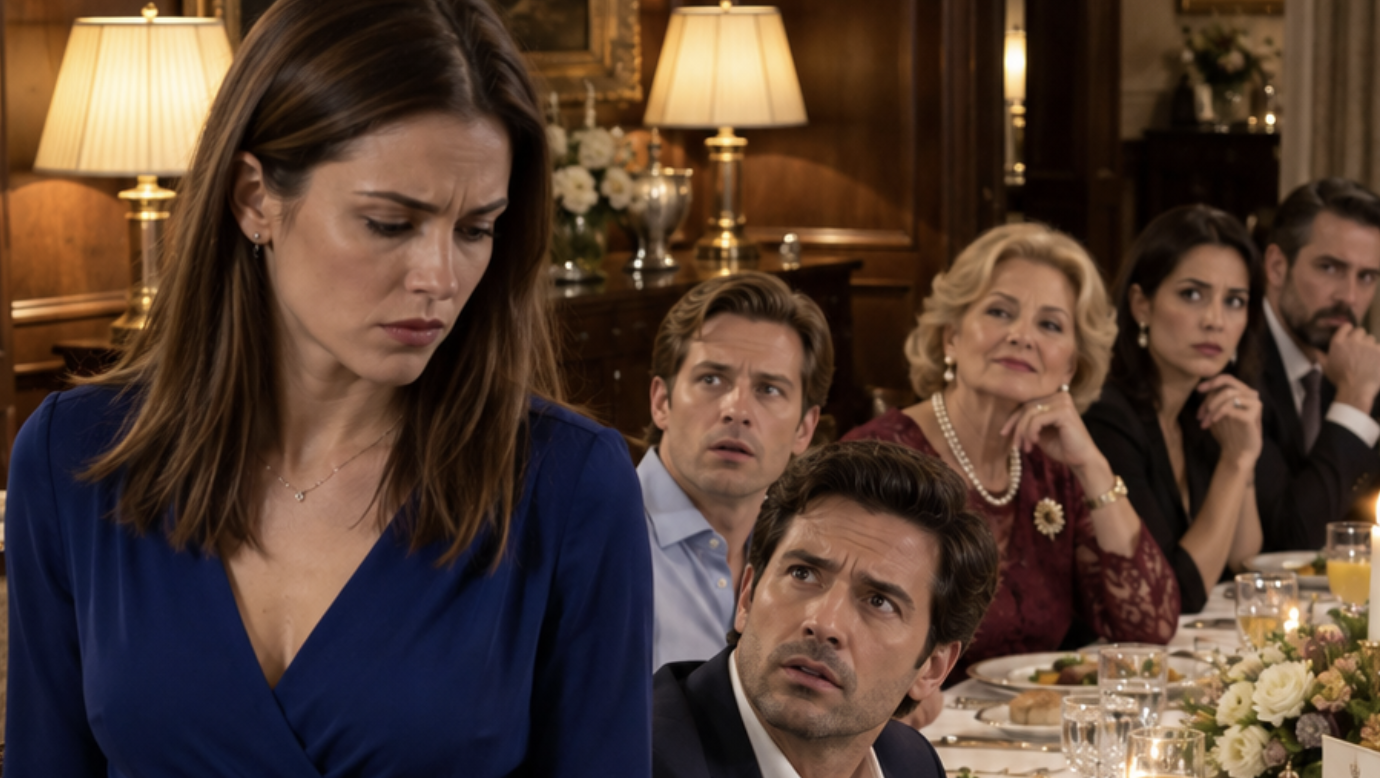
And I sat down on the plastic chair.
Not because I agreed.
It was simply worse to stand in the middle of the hall holding a gift bag while twenty-four people stared at you.
The cold from the damp seat immediately seeped through the thin fabric of my dress.
The host, a cheerful man with a microphone and bow tie, announced:
“And now, a few words from our charming birthday lady!”
Viktoria Ivanivna stood up.
She thanked everyone at length, mentioning each person by name.
Lida—for coming all the way from Zhytomyr.
Aunt Halyna—for thirty years side by side at the sewing factory.
Her children.
Her grandson Danylko.
And Vadym in particular:
“A serious man who, I hope, will soon become completely part of our family.”
Lesya blushed and lowered her eyes.
Then my mother-in-law turned toward my corner.
“And thanks to our Katya too. She’s modest, she’s comfortable anywhere. Right, Katya? She’s used to being on her feet all day at the hair salon.”
Someone laughed briefly.
Someone coughed.
Lida took a sip from her glass.
I sat there staring at my hands.
My fingers still smelled of the hairspray I had used that morning to fix her curls.
The kitchen door opened again, and someone carried a tray of stuffed cabbage rolls past me.
“And now,” the host exclaimed, “a few words from the beloved son!”
Mark returned to the table.
He didn’t pick up a glass.
In his hand was the same squared sheet of paper, folded into four.
“Mom, happy birthday,” he said. “I love you. You know that.”
He unfolded the paper.
“I just went to ask them for a proper chair for my wife. And they showed me the seating plan you brought to the restaurant on Monday. Written in your handwriting, Mom. Lida is already here, sitting right next to you. And over here, on the side, there’s a note: ‘For the daughter-in-law—separate chair by the kitchen, from the terrace.’ So Lida did not arrive unexpectedly. And there were enough chairs.”
The hall became so quiet that we could hear someone in the kitchen drop a pot lid.
“At seven this morning, Katya did this hairstyle for you,” Mark continued evenly, though his ears were still burning red. “And Lesya’s too. For free, like always. Lesya and Danylko have been living in Katya’s apartment in Vyshenka for six months and paying only utilities. The embroidered blouse you’re about to unwrap—Katya waited two months for it to be made by a craftswoman from Kosiv. And you seated her over there, where they put serving trays. And then you mocked her on top of it.”
Viktoria Ivanivna had turned as white as the tablecloth.
Her fingers crushed the napkin in her hands.
“So today I’m going to sit wherever my wife is sitting,” Mark finished.
He picked up his plate and walked across the entire hall toward my corner.
Vadym was the first to stand.
“I didn’t know it was like this,” he said, genuinely confused. “Please, take my seat. I’m terribly embarrassed.”
“Vika, how could you?” Aunt Halyna said quietly, setting down her fork.
I stood up from the plastic chair.
“Thank you, Vadym. But we’re leaving.”
I walked over to my mother-in-law and placed the gift bag beside her chair.
“Happy anniversary, Viktoria Ivanivna. I wish you good health.”
She didn’t answer.
She stared past me at the wet chair in the corner as though she were seeing it for the first time.
On the stairs, Mark took my hand.
Outside, it had begun drizzling again.
He took off his jacket and placed it over my shoulders, even though that left him standing there in only a shirt.
At home, he didn’t go into the kitchen or the bedroom.
He sat down right on the hallway floor, leaning against the wardrobe, without even taking off his shoes.
“I didn’t know, Katya. Honestly.”
“I could see that.”
“For thirty-five years, I thought Mom was just like that. Picky, sharp-tongued, but family. And she planned this. In writing. Since Monday.”
I sat down beside him on the cold tile and rested my head on his shoulder.
We stayed like that for a long time.
The neighbor behind the wall was watching a TV series.
Later that night, Mark’s phone lit up with a message from Lesya:
“What have you done? Mom is taking heart drops and crying. Auntie from Khmilnyk recorded your toast on her phone and posted it in the family chat, and now all the relatives are calling. Vadym said he doesn’t understand what kind of family he’s getting into. What if Katya takes the apartment back now? Danylko’s school is only five minutes away.”
Mark read it aloud and stared at the screen for a long time.
“The apartment is the first thing she’s worried about,” he said. “Not you.”
I didn’t say anything.
I felt sorry for him and, strangely enough, for my mother-in-law too.
Seventy years old.
A velvet dress.
Twenty-four place cards written in blue marker.
And now all of it was traveling from phone to phone among the relatives with captions like, “Well, Vika really did it this time.”
On Wednesday, the homeowners’ association called me.
The water meters in the Vyshenka apartment were due for verification, and the technician would come on Thursday. The owner had to sign the paperwork.
The woman on the phone also mentioned that the apartment had three months of unpaid utility bills totaling four thousand two hundred hryvnias.
I had bought that apartment myself.
Twenty-seven square meters in a new building, eight years before I got married.
I saved for it for seven years.
I worked without days off, took clients at home in the evenings, and my parents contributed a little from the sale of their summer cottage.
When Lesya found herself alone that winter with nine-year-old Danylko, living in a rented room, I was the first one to say:
“Live there. Just pay the utilities.”
I still printed out a free-use agreement, and Lesya signed it while laughing.
“You’re really going to make me sign paperwork?”
On Thursday, Mark and I went there together.
He took the day off work.
Vadym opened the door wearing sweatpants and gray socks.
When he saw us, he became embarrassed like a schoolboy called to the board.
In the hallway stood a pair of men’s size-forty-five shoes.
Where my mirror had once hung on the wall, there was now a huge television.
The mirror stood on the floor beside the shoe cabinet.
Danylko’s desk had been pushed into a corner near the radiator.
While the technician worked in the bathroom, Vadym stood in the kitchen doorway, not knowing what to do with his hands.
“Have you been living here long?” Mark asked.
“Since July. They told me Kateryna knew about it.” Vadym rubbed the back of his head. “And I’m sorry about Saturday. Viktoria Ivanivna showed me my seat a week beforehand. I told her to put me at the end of the table because I felt awkward. But she said, ‘Sit there, you’re one of us now. Katya will put up with it. She isn’t going anywhere.’”
Mark slowly repeated:
“She isn’t going anywhere.”
He didn’t say another word about his mother that day.
On Monday, Inna Vasylivna came in to have her hair dyed.
She had been my client for six years.
She was a lawyer, always brought her own thermos of herbal tea, and always wanted a cool blonde shade.
While the dye was developing for the required thirty-five minutes, I casually asked her about a “friend.”
“If the agreement doesn’t specify an end date, the owner can terminate it,” Inna Vasylivna said, nodding at my reflection without turning her foil-wrapped head. “Give written notice, preferably by registered mail with an itemized list of contents, and keep a copy. One month is a reasonable period. You could give three months or six months too. That is your right, not your obligation.”
She paused, then looked at me through the mirror.
“Katya, this isn’t about a friend, is it?”
I didn’t answer and went to prepare the wash station.
That evening, I told Mark I was thinking of giving Lesya one month.
I expected anything.
That he would ask me to wait until summer.
That he would say, “But she’s my sister.”
That he would silently leave the room.
Instead, he said:
“Give her one month. But I’ll tell Lesya myself. She’s my sister. And I’m the one who should be ashamed that I stayed silent all these years while Mom kept picking at you.”
He went to see his sister that very evening.
He came home late, quiet, his hair damp from the drizzle.
He told me briefly what happened.
Lesya had screamed that because of “some stupid chair,” Katya was throwing her and her child onto the street.
And Mark had replied that Katya had let her live there with no conditions whatsoever, while Lesya and their mother had decided behind Katya’s back that “she wasn’t going anywhere.”
“She is going somewhere, Lesya. One month.”
The very next day, Mark found a one-bedroom rental apartment through a realtor he knew.
It was only two blocks away from Danylko’s school so the boy wouldn’t have to change classes again.
He even negotiated a discount for the first month.
“Danylko isn’t guilty of anything,” he said when I looked at him in surprise. “He’s the only normal person in this whole story.”
They returned the keys to me at the end of October.
The apartment was clean.
Lesya had washed the floors, wiped down the windowsills, and even hung the mirror back in its place.
On the refrigerator, held by a magnet, was one of Danylko’s drawings.
A long table.
Balloons above it.
Lots of people with round heads.
And at the edge, beside Uncle Mark, he had drawn a separate chair.
On it sat a woman holding scissors.
Beneath the drawing, in large crooked letters, he had written:
“AUNT KATYA.”
I stood in the kitchen for a long time holding that drawing.
Then I carefully took it down and put it in my bag.
A week later, I rented the apartment to a young nurse from the regional hospital.
For money.
With a proper contract.
Just as I would with a stranger.
Viktoria Ivanivna came to our place in December, when the first wet snow had fallen.
She rang the doorbell in the evening without warning.
She stood on the landing wearing a coat with an astrakhan collar, and beneath the collar I could see white embroidery from the blouse I had given her—the one from Kosiv.
In her hands was a poppy-seed cake wrapped in a towel.
“Well,” she said instead of hello. “You’ve been sulking for two months already. Mark doesn’t call, people are asking questions. That’s enough.”
Mark came out of the room and stood behind me.
“I came here like a normal person,” my mother-in-law said, holding out the cake. “The holidays are coming. Lesya needs her hair done for the engagement—Vadym finally proposed. And I’ll need mine done for Christmas Eve too… You’re the hairdresser in the family. Who else would we go to?”
I didn’t take the cake.
She stood there with her arms outstretched for a moment, then lowered them.
“It was just a chair, Katya. You’re far too sensitive. I lost my son in front of everyone because of you, and you’re still offended.”
Behind me, in our kitchen, stood four chairs.
Wooden ones, with soft cushions I had covered myself with linen fabric the previous winter.
One of them always stood by the window.
For guests.
For her too.
I felt Mark lightly touch my shoulder.
He didn’t push me forward.
He didn’t hold me back.
He simply let me know that he was there.
“Viktoria Ivanivna,” I said. “There will always be a chair for you in our home. But without respect for me, you will never cross the threshold of my home again.”