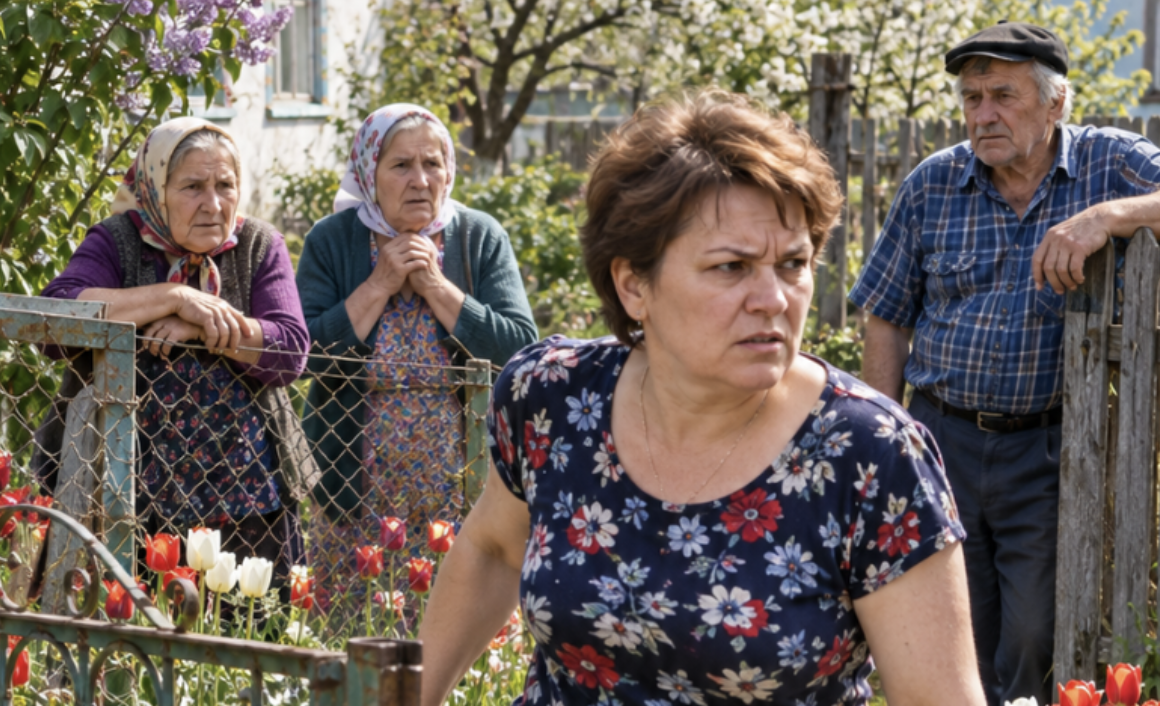
The gate in Hanna’s yard had always stuck a little. You had to lift it by the handle before pushing it because the lower edge scraped against the concrete path. Marharyta Stepanivna knew this by heart. In more than thirty years, she had opened that gate hundreds of times: carrying a jar of cherry jam, a bag of early potatoes, or a pot of stuffed cabbage rolls whenever her sister “didn’t have the strength to stand at the stove.”
That April evening, she didn’t lift it.
She simply kicked it, and the gate flew open with a metallic crash against the post. In the neighboring yard, Brovko immediately began barking furiously.
The whole street talked for a long time about what happened next.
Because no one had ever heard Marharyta Stepanivna raise her voice.
In the village, she was known as a woman who was impossible to quarrel with.
For thirty-two years, she had sat behind the counter at the post office, where pensions were handed out and parcels accepted. People often came to her angry: the line was too long, they had filled in the wrong form, or a package had gotten lost somewhere.
But they usually left calmer.
She knew how to listen, nod, and find the one phrase that made a person finally exhale.
“A quarrel is like a crack in a clay jug,” she used to tell her younger coworkers. “You can glue it back together, but it will never hold water quite the same way again.”
She had learned that saying from her mother and lived by it her entire life.
She stayed silent when people hurt her.
She gave in when she could have insisted.
And more than anyone else, she gave in to Hanna.
Hanna was seven years younger.
When their mother became bedridden, Marharyta was fifteen and little Hanna was eight. The older sister became the younger one’s nanny, cook, and protector.
“Don’t bother Hanna, she’s still little,” Marharyta heard throughout her childhood.
Hanna had long since grown up, married Vitaliy, and had two children, Denys and Ulyana.
But somehow, “she’s still little” had never disappeared.
Marharyta looked after her niece and nephew while her sister went shopping in town. She lent money that was repaid only half the time. She gave Hanna her sewing machine “for a week,” and that week had now lasted nine years.
Every spring, she planted Hanna’s tomato seedlings because “you’ve got the magic touch, Rita,” and every autumn she went to dig up her sister’s potatoes even though her own were still waiting in the ground.
“Why do you keep doing all that for her?” their neighbor Nina Vasylivna would say in frustration. “She’s climbed onto your neck and made herself comfortable.”
“Oh, Nina, let her. She’s family. It’s not difficult for me.”
Marharyta had given birth to Mykhailo late, at forty-three.
No one in the family talked about the boy’s father. The man had entered her life quietly and left just as quietly when little Myshko was not yet a year old.
Marharyta never complained.
She simply took another job, working the supermarket checkout on Saturdays.
Myshko grew up as the kind of boy who dismantled anything that had screws in it.
In seventh grade, he repaired Nina Vasylivna’s television.
In ninth grade, he fixed his physics teacher’s laptop.
He won prizes in mathematics competitions, and his teacher, Lidiya Ivanivna, told Marharyta at a parent meeting:
“Your boy has a good head on his shoulders. You need to send him to Kyiv, to the Polytechnic Institute. If he stays here, he’ll bury his potential.”
Marharyta walked home smiling the entire way.
For a woman who had completed only communications operator courses after school, the words “higher education” sounded almost festive.
On the top shelf of her wardrobe sat an old cookie tin where she put away a few hundred hryvnias every month.
For the dormitory.
For a new laptop, because the old one could barely run the programs Myshko needed.
For his first year, until he settled in.
In March, Hanna celebrated her fifty-third birthday.
As usual, everyone contributed to the table. Marharyta brought aspic and her signature Napoleon cake. Hanna made Olivier salad and roasted chicken.
Denys sat staring into his phone.
Ulyana photographed the salads.
“So, Myshko,” Hanna said, pouring herself some fruit drink and turning toward her nephew. “Where are you going after school?”
“To Kyiv. KPI. Computer science.”
Hanna laughed.
Not cruelly exactly, but in the way adults laugh when a child says something amusing.
“Kyiv! Vitaliy, did you hear that?” She put a hand on Myshko’s shoulder. “Sweetheart, I only want what’s best for you. You’re a smart boy, nobody’s arguing with that. But you shouldn’t try to jump higher than your head. The kids there have private tutors and parents who rent apartments for them. What do you have? Your mother works at the post office. Go to a college in the district center and train as an electrician. Vitaliy can get you a job at his repair shop afterward. You’ll have something solid to do.”
Denys snorted without looking up from his screen.
“Hanna, that’s enough,” Marharyta said gently, passing her sister the salad bowl. “He has his whole life ahead of him. Try the aspic instead. I made it with extra garlic this time, just how you like it.”
Myshko did not say another word for the rest of the evening.
Marharyta thought he was simply tired.
A few weeks passed, and she began noticing things she did not want to notice.
The light in her son’s room now went out at ten instead of two in the morning.
The mathematics problem book that used to be full of bookmarks lay gathering dust on the windowsill.
Myshko no longer told her at dinner about clever problems he had solved.
He ate silently and went to his room.
One evening, she brought him some tea.
“Myshko, did you register for the practice NMT exam? Lidiya Ivanivna said registration is closing soon.”
“No.”
“Why not?”
“What’s the point?” He pushed his notebook away so sharply that it slid off the desk. “Mom, let’s be honest. I’m never going to get in anywhere.”
“What are you talking about? You came third in the regional competition—”
“Third in the region, Mom! In Kyiv there are thousands of people like me. They have tutors who charge six hundred hryvnias an hour, and I learn from videos online.”
“And you learn very well! You’re the smartest boy I know—”
“You say that because you’re my mother.”
He stood up, and his voice cracked.
“You’ve spent my whole life telling me everything will work out! But it doesn’t. Do you think I don’t see you counting the money in that tin on top of the wardrobe? Or running to the supermarket after the post office every Saturday?”
“Mykhailo…”
“What, Mykhailo? Aunt Hanna is the only one telling the truth!”
The room became silent.
They could hear the kitchen tap dripping.
“What does she say?” Marharyta asked very calmly.
Myshko turned toward the window.
“She says it all the time. When I painted her fence. When I chopped wood for her. ‘Myshko, don’t take it personally, but you know yourself that you’re not the kind of person who gets ahead in life. You’re a loser, and there’s nothing you can do about it. Why make your mother go broke paying for Kyiv?’ And then she laughs. And Denys sits there beside her and laughs too.”
Marharyta said nothing.
She put the cup on the desk.
Then she removed her apron, folded it neatly into quarters the way she had folded everything all her life, and placed it on the chair.
“Mom, where are you going?”
“I’ll be back.”
Hanna lived four houses away.
That evening, she was standing on the porch sorting the first green onions into a bowl when the gate slammed into the post with a deafening clang.
“Hanna!”
The bowl of onions ended up abandoned on the steps.
“Rita? What’s wrong? Did something happen?”
“It did.”
Marharyta stood in the middle of the yard, and her voice sounded unlike anything Hanna had ever heard from her before.
“What have you been saying to my son? Huh? What are you whispering to him behind the fence while he chops your firewood?”
“Rita, why are you shouting? People can hear you…”
“Let them hear! Let the whole street hear! I’ve been silent for thirty years. Now you’re going to listen to me. Don’t you dare. Do you hear me? Don’t you dare tell my child he’s a loser. Not behind the fence, not at the table, nowhere, ever.”
“But I was only trying to help him! So he wouldn’t be disappointed later…”
“Helping?”
Marharyta laughed, but there was bitterness in the sound.
“You’re jealous, Hanna. That’s what your kindness is. Your children didn’t want to study. I remember how you got Denys into technical school, and he dropped out in his second year. He’s twenty-seven and still asks you for fuel money. Ulyana has spent three years ‘finding herself’ on your sofa. Both of them live off you. But my son wants to study! And he will study. And you will never again tell him that he can’t do it.”
Hanna opened her mouth.
Then closed it.
“Rita… you’ve never…”
“Exactly. Never. Enough.”
By the water pump, Nina Vasylivna stood frozen with an empty bucket in her hand.
Vitaliy poked his head out of the garage holding a wrench, assessed the situation, and quietly closed the door again.
Brovko finally stopped barking.
Marharyta turned around and walked away.
But as she left, she stopped, lifted the gate properly by the handle, and carefully closed it behind her.
Myshko was sitting on a bench near their gate.
He had run after his mother, reached Hanna’s fence, and heard everything.
“Mom… did you really mean all that?”
Marharyta sat beside him.
Now that it was over, she had started trembling.
“My legs can barely hold me,” she admitted. “That was the first time in my life I ever shouted at someone. And it had to be my sister.”
Suddenly, Myshko laughed for the first time in weeks and put an arm around her shoulders.
“You should have seen Uncle Vitaliy. He hid in the garage so fast you’d think you were shouting at him.”
They sat together in the April twilight.
Smoke from last year’s burned garden stalks drifted through the air.
Marharyta took her son’s hand.
“Listen to me. I don’t need you to be the best student in Kyiv. I need you to try. If it doesn’t work out, I’ll love you exactly the same, and nobody will ever reproach you for it. But you have to try. Otherwise, it means she was right. And she wasn’t.”
Myshko was silent for a long time.
“All right,” he finally said. “I’ll register for the practice exam tomorrow.”
Hanna did not speak to her sister for three weeks.
She walked past the post office looking the other way.
Marharyta did not sleep the first night. She drank mint tea and checked her blood pressure with the monitor Myshko had given her for her birthday.
She waited for shame to wash over her the way it always had after the slightest disagreement.
But the shame never came.
Instead, she felt something strange, as though she had been carrying a heavy bag for years and had finally put it down.
Meanwhile, Myshko took his mathematics book off the windowsill.
When Lidiya Ivanivna learned that he had decided not to give up, she told him:
“Come after classes. We’ll study together. No money.”
So until June, twice a week, he stayed in the empty classroom until seven in the evening.
At night, the light in his room began burning late again.
He took the NMT on a hot June day.
Marharyta took the day off from the post office and spent an hour pacing outside the testing center with a bottle of water and sandwiches her son never ended up eating.
In August, when the late apricots were already falling in the orchards, Myshko burst into the post office in the middle of the working day.
A line of pensioners filled the room.
Nina Vasylivna was among them.
“Mom!”
He pushed his phone toward the service window.
“State-funded place! KPI, computer science! I’ve been recommended for a state-funded place!”
Marharyta Stepanivna stared at the screen and could not read a single word because everything blurred before her eyes.
Someone in line started clapping.
Others joined in.
Then Nina Vasylivna announced loudly enough for the whole room to hear:
“There you go! And someone said he shouldn’t try to jump higher than his head!”
That same evening, someone knocked on the door.
Hanna stood outside holding a heavy bag.
“Here.”
She placed the bag on the doorstep.
“Your sewing machine. I thought maybe Myshko would need something altered before he leaves.”
Marharyta looked at her sister and waited.
“He’s done well, your boy,” Hanna said, shifting from one foot to the other. “Back then, I… went too far. I know I did.”
“You did,” Marharyta agreed. “But tell him that. Not me.”
Hanna nodded.
She walked into the room where Myshko was packing his belongings into a large sports bag and stood in the doorway.
“Well, student,” she said unusually quietly. “Don’t pay attention to what I said. I’m happy for you. Truly.”
“Thank you, Aunt Hanna,” he replied.
Then, after thinking for a moment, he added:
“Come visit during the holidays. I’ll set up your phone so you can video-call Ulyana.”
Hanna snorted, but she smiled.
On the first of September, Marharyta Stepanivna saw her son off at the bus station.
Inside his bag was a new laptop bought with the money from the old cookie tin, along with a jar of cherry jam “so you don’t starve in the dormitory.”
The bus pulled away.
Myshko waved from the window until it disappeared around the bend.
Marharyta still believes that quarrelling is bad.
She still believes that a crack in a clay jug lasts forever.
But now she knows something else too:
Silence creates cracks as well.
Only not in a jug.
Inside you.
And you carry that crack for years while someone else decides how much your child is worth.
“Sometimes it’s actually useful to say what’s on your mind,” she laughs whenever Nina Vasylivna brings up that famous argument by the water pump.
“Even if the whole street hears you.”
And in autumn, Vitaliy finally repaired Hanna’s gate.
It doesn’t stick anymore.