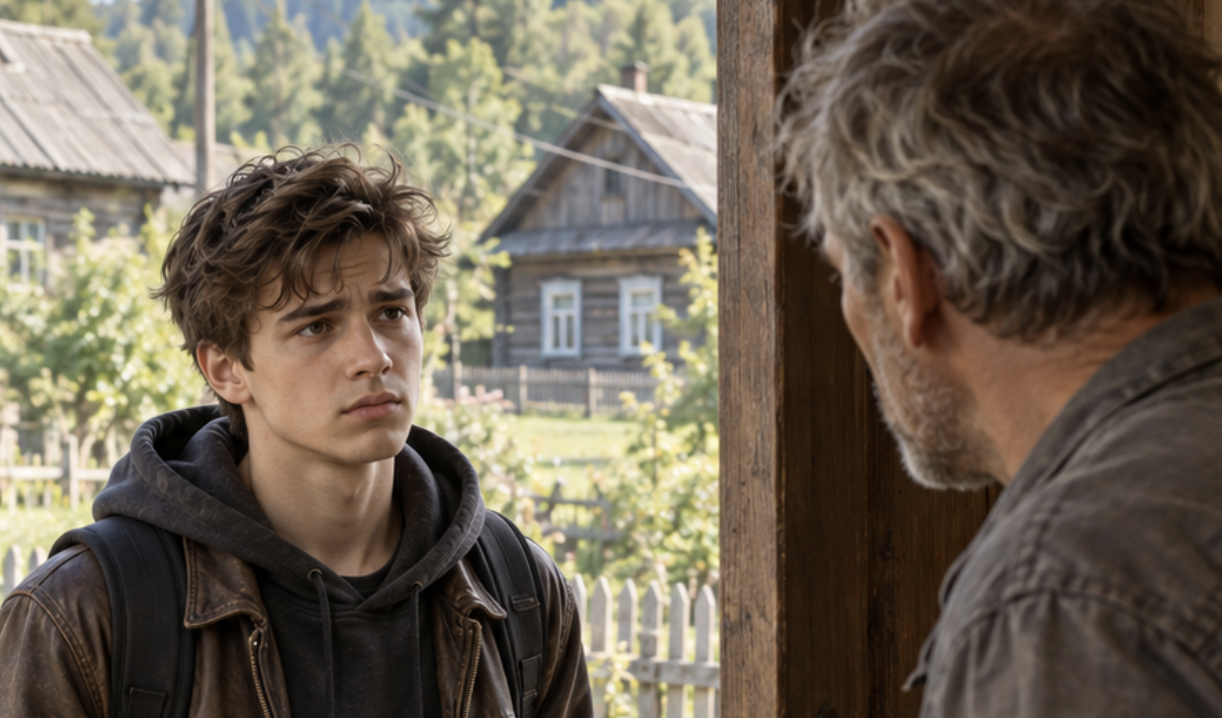
Olena wrote to him at night, when the apartment had finally gone quiet.
She would sit down in the kitchen, pull the lamp closer, and write in her neat teacher’s handwriting: “Dad, we’re doing fine.” Then she would seal the envelope, write the address she had known by heart since childhood, and place it on the shelf beside the keys so she could drop it into the mailbox on her way to work in the morning.
Over sixteen years, there had been twenty-eight such envelopes.
But one of them she never sent.
She wrote it—and couldn’t bring herself to mail it. She hid it in a drawer beneath the passports, beneath an old medical record, beneath all those things every family keeps for years even though no one really needs them.
Because that letter contained something she would never have been able to say to her father even face-to-face.
Oleksandr Semenovych’s house stood at the edge of the village, where the road sloped down toward the Southern Bug River and disappeared into a thicket of willows. Beyond that there was nothing—only water, reeds, and someone’s old fishing nets stretched over stakes.
The village had long grown used to the fact that Semenovych visited no one.
He didn’t quarrel with anyone, didn’t sit around chatting, didn’t socialize. He simply greeted people with a nod and kept walking. At the shop he bought bread, matches, sometimes cigarettes, even though he had quit smoking about ten years earlier. He bought them out of habit and handed them out to the boys near the garages.
He had remarkable hands. A log house, carved window trim, ash-wood stairs, a custom kitchen—people drove all the way from Vinnytsia to hire him, and he could spend three weeks silently building someone’s porch and say no more than five words to the owner the entire time.
He and Hanna had started building the house together. He finished it alone. His wife fell ill when Olena was ten, and by winter she was gone.
After that, there were two of them.
Then there was only one.
That summer, sixteen years earlier, a young engineer from Vinnytsia came to the village.
Taras.
He was installing a water line to the farm, wore a shirt even in the heat, and Olena, who had just taken charge of her first class at the local school, somehow began stepping outside the gate at exactly the time he returned from the work site.
Oleksandr Semenovych saw everything from the veranda.
He stayed silent until October.
And when Taras asked for her hand, he said something he would carry inside himself afterward like a nail in his shoe.
“You’ll live in the city for six months and forget what this place smells like.”
“Dad, it’s not the end of the world.”
“It is, Olena. People don’t come back from there.”
“They do. Every weekend.”
“They don’t,” he said, looking past her. “Choose. Either him or me.”
She stood there holding the back of a chair and crying.
Then she chose.
Her father did not attend the wedding.
In the group photograph, there was an empty space beside the bride because the guests had moved apart, thinking someone was about to step in.
You could even see the floor tiles in the place where he should have been standing.
For the first three years, Olena called.
He never answered.
Then came the letters.
Once a month, sometimes more often, an envelope bearing her handwriting appeared in the mailbox on the gate. Oleksandr Semenovych would take it out, carry it to the workshop, and place it in a drawer of his workbench—the same drawer where he kept his planes and a tin of nails.
He never opened a single one.
Only at night, when he couldn’t sleep, would he pull open the drawer, go through the stack one by one, and look at the dates stamped on the envelopes.
Then he would push the drawer closed and go plane wood, because wood, at least, never asked questions.
By the middle of July, the heat was so intense that even the dog had stopped coming out from beneath the shed.
Kudlai lay in a hollow he had dug beside the porch, breathing rapidly and shallowly. Oleksandr Semenovych sat on the steps sharpening a scythe—not because he planned to mow anything, but because his hands needed something to do.
Suddenly Kudlai lifted his head.
He didn’t bark.
He simply stood up and walked toward the gate, wagging his tail.
Oleksandr Semenovych turned around.
A boy of about fifteen stood behind the gate.
Thin, fair-haired, wearing a dusty T-shirt, with a backpack hanging from one shoulder. His sneakers were gray with dust all the way up to the laces. It was obvious that he had walked the last several kilometers.
The boy wasn’t looking at the house or at the boat beneath the shed.
He was looking directly at him.
“Good afternoon. Are you Oleksandr Semenovych?”
His voice cracked halfway through the sentence.
“I am. Whose boy are you?”
The boy shifted from one foot to the other.
“Ivan. I’m your grandson.”
The scythe dropped onto the boards.
Oleksandr Semenovych stared and could not look away.
The boy’s eyes were gray, narrowed slightly against the sun. His hands were in his pockets. His left shoulder was pushed forward.
That was exactly how Olena had stood in the kitchen on the evening he had forced her to choose.
“Does your mother know you’re here?”
“No. I told her I was going to a friend’s.” Ivan spoke quickly. “I took a bus to Vinnytsia, then to the district center, then a minibus to the turnoff. From there I walked seven kilometers. Nobody stopped to give me a ride. Aunt Rita gave me the address. She writes to Mom.”
“Seven kilometers in this heat.”
“Well.” The boy shrugged. “I thought it was closer.”
Kudlai nudged his knee.
Oleksandr Semenovych looked at the dog.
“He barks at strangers. Always has.”
“He didn’t bark at me.”
“I can see that.”
They were silent for a moment.
“Could you give me something to drink, please?” Ivan said.
The old man went inside and brought out a mug of well water.
The boy took it with both hands, the way children do, and drank for a long time without stopping.
Olena had drunk exactly the same way when she was five.
“So why did you come?” Oleksandr Semenovych asked, in a different tone now.
“To see.”
“What is there to see here?”
“Mom said you built the boat yourself. And the house. And that you have more wood planes than we have spoons.” Ivan wiped his mouth. “I thought she was exaggerating.”
The old man nodded toward the workshop.
“Go take a look.”
That short sentence—“go take a look”—was the first permission to stay.
The workshop smelled of pine resin and fresh shavings. Shelves of tools lined the walls. On the workbench lay an unfinished piece of carved trim with a grapevine running along the edge.
Ivan stopped over it.
“Can I touch it?”
“Touch it. It’s not made of sugar.”
The boy ran only the pads of his fingers over the carving.
Then he moved along the shelves, studying the chisels, and said without turning around:
“I made a stool last year. The shop teacher praised me. It’s a little crooked, though.”
“Does it stand?”
“Yes.”
“Crooked is only half a problem. Worse when it’s straight but still wobbles.”
Ivan laughed—a short exhale, barely audible.
His mother had laughed the same way.
“Listen… Could I help you? I don’t have anywhere to stay anyway. The minibus isn’t until tomorrow.”
Oleksandr Semenovych took a plane from the shelf.
Not the one he used every day, but an old one darkened by time, its wooden body polished by other hands, with two burned letters on the side.
“Here. See that board? There’s a knot over there. Make one pass. Don’t rush.”
“‘I.T.’ Whose initials are those?”
“My father’s. Ivan Tymofiyovych.”
The boy raised his eyes.
“So I was named after him?”
“Looks that way,” the old man said, and for some reason his voice grew rough. “Plane the board. Don’t just stand there.”
The first pass was uneven.
The second was better.
“Don’t press down on it. Let it move by itself. You just guide it.”
On the third try, a long, thin shaving curled from beneath the blade, twisted into a spiral, and settled on the workbench.
“You’ve got it.”
Ivan smiled with his whole face—openly, like a child.
By evening they had finished two boards and marked the third.
The grandfather showed him how.
The grandson repeated.
They spoke little, and neither of them minded.
They ate dinner on the veranda, when the cool air had already begun drifting up from the river.
Buckwheat, bread, tomatoes from the garden, tea with thyme.
Ivan ate with concentration, almost silently.
After honest work, that was how a fifteen-year-old ate.
And Oleksandr Semenovych kept looking at him, unable to get used to the thought:
This is my grandson.
At my table.
Today he used my plane.
Night fell.
Fog drifted over the Bug.
Ivan opened his backpack and took out a photograph.
“Here. Mom and Sofiyka.”
Olena was standing in the picture.
Thinner, calmer, with silver threads at her temples.
Beside her was a girl of about ten, with two braids and gaps where her front teeth were missing.
The old man held the photograph for a long time.
“Beautiful,” he finally said.
“She remembers you,” the boy said. “She never gets angry. She just sighs and goes quiet. And on her birthday she puts your photograph on the table—the one where you’re standing with her by the boat. She’s little in it, wearing a sun hat.”
Oleksandr Semenovych said nothing.
“I came to ask you something,” Ivan said.
“Ask.”
“Why didn’t you answer her even once? Sixteen years. When I was born, she wrote to you. When Sofiyka was born, she wrote. And you stayed silent. Why?”
It became so quiet that they could hear the water lapping against the bank below.
“Because I’m a fool,” the old man said. “A proud fool. And that’s worse.”
The boy looked at him with his mother’s eyes.
There was no anger in them.
There was pain, but not for himself.
“Did you read the letters?”
“No.”
Ivan was silent for a moment.
Then he reached into his backpack again and pulled out an envelope—creased, one corner bent, without a stamp or postmark.
“Then at least read this one.”
“What is it?”
“She wrote it last year. And never sent it. I found it in the drawer when I was looking for some documents.” The boy placed the envelope on the table and pushed it toward his grandfather. “I took it without permission. Mom doesn’t know.”
Oleksandr Semenovych stared at the envelope for a long time.
Then he picked up a knife and carefully opened the edge.
“Dad.
I’m not going to send you this letter because there is nothing good in it, and I promised myself I would only write good things to you.
I’m thirty-seven.
I’ve been teaching for twenty years, and I know by heart how to talk to other people’s children.
But I don’t know how to talk to you.
Last month Ivan asked why we don’t have a single photograph of you on the wall where you’re older.
I told him Grandpa doesn’t like having his picture taken.
That isn’t true, and he probably understood.
Dad, I’m not angry.
I’m simply afraid of one thing.
I’m afraid someone from the village will call me and tell me something after which nothing can ever be fixed.
And I’ll arrive one day later than I should have.
I don’t want to arrive one day too late.
Your Olena.”
Oleksandr Semenovych placed the sheet on the table.
His palm rested over the paper without moving.
“Go to sleep,” he said hoarsely. “The bed’s made in the second room.”
“And you?”
“I’m going to the workshop.”
He read all night.
Twenty-eight envelopes, arranged by date.
The first was about a room in Zamostia where the water in the kettle froze during winter.
The second was about the school, where she had finally been given her own class.
Then came news that Taras had started his own crew and now traveled to work sites on his own.
Then:
“Dad, you’re going to have a grandson.”
Then:
“We named him Ivan, after your father. You always said that name had to live on in our family.”
There was the first step.
Kindergarten.
The first day of school.
And from one envelope fell a sheet of paper folded into four parts: a crooked house, a river, and a little man with an axe.
At the bottom, in block letters:
“GRANDPA.”
Then came Sofiyka.
“You have a granddaughter now. She looks like Mom, especially her eyes.”
In the nineteenth letter there was a dried cherry branch.
And three lines:
“This is from our tree, the one by the well. I passed through the village in May. I didn’t come in. Forgive me.”
Twenty-eight letters.
Sixteen years laid out by date across the workbench.
Toward dawn, he turned off the lamp, went out into the yard, and stood for a long time watching the fog rise above the reeds.
Then he went into the house and opened the door to a room he had not opened in years.
There were two beds and a child’s bed inside, all made by his own hands.
He had once furnished the entire room, down to the last shelf, back when he still thought they might come for Christmas.
He had not entered it since.
At six in the morning, Oleksandr Semenovych found clean bedding in an old chest and made all three beds.
When Ivan came out onto the porch, his grandfather was already standing there with a phone in his hand.
“Want me to tell you the number?”
“No need.”
The number had been written in pencil on the workshop doorframe.
Aunt Nina had given it to him about twelve years earlier, and over the years the digits had faded so badly that he had traced over them twice.
He had never called.
The ringing seemed unbearably long.
Then there was a click, and a frightened, sleepy voice said:
“Hello?”
No one expects calls like that at half past six in the morning.
“Olena. It’s your father.”
The silence on the other end was so complete he could hear the clock ticking in her room.
“Olena. Can you hear me?”
Then, very quietly:
“I hear you… Dad?”
“Come,” he said. “Bring Taras and the children. Ivan is already here. He spent the night. He’s learning to use a wood plane. He’s talented. Just like you.”
There was a sob on the other end.
“Dad…”
“Don’t cry. The beds are already made.”
He paused and added what he had not said aloud for sixteen years:
“I made it one day early, my girl. Do you hear me? One day early.”
At noon on Sunday, a car stopped outside the yard.
Olena got out first.
For a moment she froze beside the same gate.
Then she ran across the yard the way she had as a child whenever her father came home from winter work.
“Dad…”
“Olenka.”
He embraced his daughter and did not let go for a long time.
Taras got out of the car, stood to the side, and did not interfere.
Then Oleksandr Semenovych straightened up and held out his hand.
“Hello, son-in-law. Forgive this old fool.”
“There’s nothing to forgive, Oleksandr Semenovych.”
And then Sofiyka was already flying across the yard from the car as though they had seen each other only yesterday.
“Grandpa!”
He lifted her into his arms, pressed her to himself, and could no longer hold back his tears.
Ivan stood on the veranda watching them.
He laughed almost silently, only his shoulders trembling.
That was how people laughed when something inside them finally loosened after keeping them from breathing for far too long.
That evening, all five of them sat on the veranda.
They drank tea and ate the little pies Olena had carried on her lap the entire drive.
Sofiyka followed her grandfather everywhere.
“Grandpa, does the boat float? Are there fish? Will you teach me?”
“It floats. There are. I’ll teach you.”
Late that night, when the lights in the house had already gone out, Oleksandr Semenovych asked his daughter for a pen.
“What do you need it for?” Olena asked, confused.
“I need it.”
He sat down beneath the lamp on the veranda, placed a sheet of paper in front of him, and stared at it for a long time, the way a carpenter looks at a board before picking up a plane.
Then, at the top, he wrote:
“My daughter.”
The twenty-ninth letter in this family was finally being written by him.