Veronika didn’t realize at first that the comments about money had become a pattern. In the beginning, she thought that was simply how her mother-in-law was: always ready to discuss who earned what and who had achieved more. Plenty of people were like that. It was unpleasant, but she could put up with it.
She managed to put up with it for about a year.
Veronika worked as an administrator at a dental clinic. She wasn’t the director or the head dentist—she was the administrator. She earned forty-eight thousand a month, plus small bonuses. Her husband, Ivan, was a procurement manager at a construction company and earned around seventy thousand. Veronika knew there was a difference. She had never thought it made her worth any less.
Before the wedding, she had lived in a two-bedroom apartment her grandfather had given her while he was still alive and well enough to arrange the paperwork. It was in a good neighborhood, in a sturdy building from the nineties, and it had been renovated. When she and Ivan married, deciding where to live was easy: he moved in with her. There was no reason to rent a place or take out a mortgage when they already had a comfortable home.
At first, Ivan’s mother, Oksana Leonidovna, visited only occasionally and behaved politely. Veronika could tell she was taking stock of the apartment, the furnishings, and Veronika herself, but she put it down to ordinary parental curiosity. The first few months after a wedding were often like that.
Then something changed.
The first pointed conversation about money came during their second year of marriage. Oksana Leonidovna was visiting, and the three of them were having tea when she asked, as naturally as if she were asking about the weather:
 
“Veronika, aren’t they going to give you a raise? Forty-eight thousand is very little for Moscow.”
“It’s a fixed salary,” Veronika replied. “I get bonuses as well.”
“Even with bonuses, it isn’t much.” Oksana Leonidovna shook her head. “Ivan makes seventy, and even he says that isn’t enough.”
Ivan made a vague sound without taking either side.
Veronika said nothing. She thought it best to let the subject drop.
But the subject never did drop. Whenever Oksana Leonidovna came over, the conversation eventually returned to the same point: Veronika didn’t earn enough. The wording changed, but the message didn’t.
Sometimes her mother-in-law talked about their “standard of living.” Sometimes it was “ambition.” Sometimes she asked whether Veronika had considered finding a job with better prospects. She always wore an expression that suggested she already knew the answer: no, because Veronika wasn’t capable of anything better.
After one such evening, Veronika spoke to Ivan plainly.
“Your mother makes me feel like I’m not good enough every time she visits. It hurts.”
Ivan grimaced.
“That’s just how she talks. Don’t pay attention to it.”
“Vanya, she’s done it four times this week.”
“Mom worries about us. She wants things to go well.”
“If she wanted to know whether things were going well, she’d ask how we were. Reminding me every time that I don’t earn much is something else.”
Ivan was quiet for a moment.
“Don’t get worked up. She doesn’t mean any harm.”
Veronika let it go. She understood that he wasn’t going to back her up. It wasn’t that Ivan didn’t love his wife. It was simply easier to tell her to ignore the remarks than to tell his mother she had crossed a line.
The next time, Veronika answered for herself, calmly and without raising her voice. Oksana Leonidovna had once again begun talking about how Ivan contributed more to the household. Veronika said:
 
“Oksana Leonidovna, we live in my apartment. That’s a contribution to this family too, and a substantial one if you think about it.”
Her mother-in-law paused. For a second, something flashed in her eyes—surprise, perhaps, or irritation—but she quickly recovered.
“The apartment is yours. No one disputes that,” she said. “But you didn’t earn your grandfather’s apartment. It was given to you.”
“And what of it?” Veronika asked. “Ivan didn’t bring a home into the marriage either. We started with what we had.”
“Ivan earns money,” Oksana Leonidovna replied curtly, ending the discussion.
Ivan sat beside them, staring at his plate.
After that evening, their conversations turned into little skirmishes that always ended the same way. Veronika answered back, Oksana Leonidovna refused to give ground, and Ivan got annoyed—not with his mother, but with his wife for being unable to “just keep quiet.” That hurt more than anything. His mother’s remarks were bad enough; what stung most was that Ivan never stood beside Veronika when she needed him to.
Gradually, Veronika began avoiding visits. She didn’t object when Ivan went to see his mother alone. When Oksana Leonidovna called, Veronika kept her answers brief and neutral. Work stopped coming up, largely because they spoke so little.
Oksana Leonidovna apparently drew her own conclusion. Once, during a conversation with Ivan—which he later repeated to Veronika without seeming to understand why he was telling her—his mother said, “Veronika is sulking. That means she knows I’m right.”
In early October, Oksana Leonidovna called and invited them to Sunday lunch. Her voice was normal, almost friendly. There was no preamble, no hint that anything was wrong. Just lunch with the family.
Ivan mentioned it that evening.
“Mom’s invited us over on Sunday. Shall we go?”
Veronika set down her book and thought for a moment.
“Ivan, the last time we were there, we argued.”
“We won’t argue this time. We’ll just have lunch.”
“Do you think that, or are you hoping?”
Ivan gave her a slightly guilty smile.
“Hoping. But Mom really does want us to have a pleasant visit. Maybe we can go, eat, and come home.”
Veronika was silent for a moment, then nodded.
 
“All right. But if she starts again, I’m leaving.”
“Agreed,” Ivan said with relief, as if the hardest part was over.
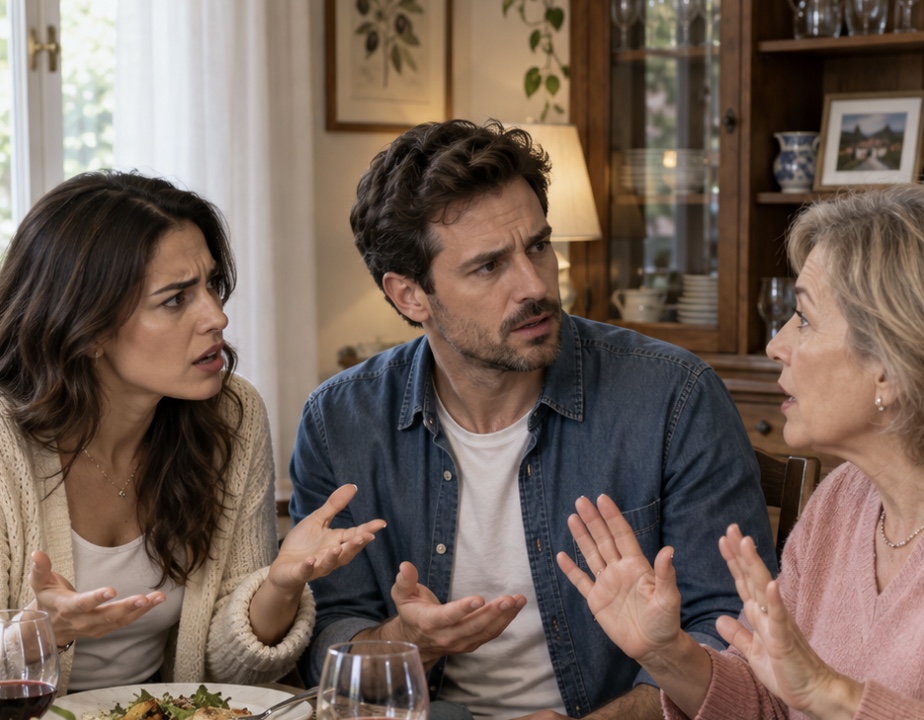
They arrived at two on Sunday. Oksana Leonidovna opened the door and smiled. Veronika even thought the smile looked sincere. The kitchen smelled of roasted meat and something sweet. Plates, bread, and a small dish of pickles were on the table. Everything seemed peaceful.
For the first forty minutes, it was. Ivan and his mother discussed family news—a cousin who was moving, a neighbor whose car had broken down. Veronika ate, answered when someone spoke to her, and stayed out of conversations that didn’t involve her. Perhaps it really would be just lunch.
Then Oksana Leonidovna asked about her job, as though the question had occurred to her in passing.
“Veronika, is the clinic expanding? You’re on Leninskaya Street, aren’t you? I heard the unit next door became available.”
“I don’t know. That isn’t part of my job,” Veronika answered.
“What is part of your job?” Oksana Leonidovna asked with an expression of genuine curiosity. “I mean, what do you actually do?”
“I schedule patients, handle records and payments, and coordinate with the dentists.”
“So, reception,” her mother-in-law said with a nod. She didn’t sound openly rude, but she had reduced the entire job to one word.
“Administration,” Veronika corrected her.
“Yes, yes.” Oksana Leonidovna turned to her son. “Vanya, do you remember Katya Voronova? Nina Semyonovna’s daughter from our street? She studied economics, and now she’s a finance director. Such an accomplished girl.”
Ivan shrugged.
“I barely remember her.”
“Surely you do. You went to kindergarten together.” His mother carried on. “My point is, when someone invests in their education, you can see the results later. It puts them on a different level.”
Veronika reached for some bread and said nothing.
“Veronika, you didn’t go to university, did you?” Oksana Leonidovna asked directly, as though confirming an obvious fact.
 
“I finished college, then took professional courses,” Veronika said evenly.
“College isn’t a university degree,” her mother-in-law said in the matter-of-fact tone someone might use to state a medical finding. “I’m not judging you. It’s simply a fact. Your prospects are different, of course.”
“Oksana Leonidovna,” Veronika said, looking at her, “I’m satisfied with where I am.”
“You may be.” Oksana Leonidovna turned slightly toward Ivan. “But Ivan won’t be content to stay where he is. He’s developing, moving forward. He needs someone beside him who’s moving forward too.”
Ivan kept his eyes on his plate. Veronika watched him for a second, then another. She waited. Ivan continued eating.
“Honestly,” Oksana Leonidovna went on, as calmly as if she were discussing an abstract question, “Ivan, you need a woman on your level. Someone educated, with a career. An equal, financially and in terms of ambition. Veronika is a nice woman; I’m not saying otherwise. But you’re in different leagues. Do you understand?”
Ivan looked up at his mother, then at his wife, and lowered his eyes again.
Veronika slowly set her fork on the edge of her plate. She looked at the tablecloth, the little dish of pickles, the bread. Then she looked at Oksana Leonidovna, who had already moved on to another subject, as if she had said all that needed saying and the matter was settled.
That was the moment something shifted inside Veronika. It wasn’t anger. It was something colder and firmer.
She stood up.
Oksana Leonidovna stopped mid-sentence. Ivan raised his head.
“Veronika?” he said.
She didn’t answer immediately. She stood looking at her mother-in-law, who leaned back slightly in her chair with an expression of mild puzzlement, as though she had already forgotten that she had just suggested her son find another wife.
“You said, in front of my husband, that he needs another woman,” Veronika said. Her voice was steady, almost quiet. Something in it made Oksana Leonidovna fall silent. “You said I had no talent and that I’d achieved nothing.”
“Veronika, I was only talking about the reality of the situation,” her mother-in-law began.
“No.” Veronika shook her head. “You were humiliating me. And you expected me to keep quiet again.” She looked at Ivan. “You expected the same thing.”
Ivan opened his mouth.
“Veronika, let’s not make a scene—”
“Vanya,” she interrupted, not harshly but firmly, “I’m not making a scene. I’m leaving.”
She picked up her handbag from the back of her chair. Oksana Leonidovna straightened.
“Veronika, sit down. There’s no need for this.”
“There is,” Veronika said, already walking toward the door. “There absolutely is.”
 
“Veronika!” Ivan rose from the table.
She stopped in the kitchen doorway. It wasn’t because she had changed her mind. She realized that leaving without saying anything more would feel wrong—not for her mother-in-law’s sake, but for her own.
Veronika turned around.
“Oksana Leonidovna,” she said in a voice she had never used with this woman before, making no effort to soften the words, “you just suggested your son find another wife. At the lunch table. In front of me. You pointed out that I don’t have a university degree. Have I got that right?”
Oksana Leonidovna said nothing. She looked like someone who had been caught doing something she saw no shame in, though being caught was awkward.
“Then before I go, I’d like to remind you of something,” Veronika continued. “You don’t have a university degree either, Oksana Leonidovna. You never did. You finished technical college in 1983. I know because Ivan told me. And university was free in your day—you could apply wherever you wanted and study. So when you treat a degree as the measure of a person’s worth, you’re setting a standard you didn’t meet yourself. That isn’t an insult. It’s simply a fact.”
The kitchen went quiet. Ivan stood by the table, watching his wife with an expression Veronika couldn’t quite place. He wasn’t angry, and he wasn’t supportive. He looked like a man who hadn’t expected things to go this far.
“You…” Oksana Leonidovna began.
“I haven’t finished,” Veronika said, cutting her off without raising her voice. “You say I’ve brought nothing to this family. That Ivan is the main breadwinner and carries us both. Fine. Let’s look at the facts. We live in my apartment, the one my grandfather gave me before the wedding. It has never been shared property. Ivan moved in after we married. He didn’t have a home of his own then, and he still doesn’t, because he hasn’t bought one in the three years we’ve been married. We split the utilities equally. We split the groceries equally. I paid more for last year’s renovation because it’s my apartment and I wanted the work done properly. So when you say I’ve contributed nothing, I don’t know what you mean.”
Oksana Leonidovna flushed. It was visible even in the kitchen light.
“You’re talking about my son as if he were a tenant!” she cried. “He’s your husband!”
“Yes, he is,” Veronika agreed. “That’s exactly why I’ve put up with your comments for three years. For his sake. Because I thought family was worth protecting. But today you said he needs another woman. I’m done protecting that.”
“Veronika, enough!” Ivan finally spoke up. “Mom, you stop too. Both of you, calm down.”
“Ivan.” Veronika looked at her husband. “You just said ‘both of you,’ as though your mother and I started this together. She suggested you replace me. You kept eating your soup.”
Ivan had no answer.
 
“Exactly,” Veronika said.
She headed for the front door.
Oksana Leonidovna called something after her. Veronika heard her voice but not the words. She put on her jacket and shoes in the hall and opened the door. The landing was cool and smelled faintly of bleach; someone had cleaned it recently. Veronika stepped out, shut the door behind her, and took the stairs instead of calling the lift.
She didn’t think about much on the way down. She just counted the steps without meaning to. Nine flights, eighty-one steps.
Outside, it was windy and overcast. October. Veronika walked to the bus stop, waited, and rode to the metro. On the train she stood holding a rail and looked at her reflection in the dark window. Her face was tired but calm. It wasn’t how she had expected to look after a scene like that.
The apartment was quiet when she got home. Veronika took off her jacket, went into the kitchen, and put the kettle on. While the water heated, she sat at the table looking at a magnet on the fridge. She and Ivan had bought it in St. Petersburg three years earlier, on their first trip together. It showed the Bronze Horseman. Veronika looked at it for a long time. Then she poured hot water into a mug and went into the living room.
Ivan came home around eight that evening. He called first, and Veronika answered.
“Are you home?” he asked.
“Yes.”
“I’m coming over.”
He arrived silent and tense. He went into the kitchen and sat down. Veronika remained standing by the stove.
“Why did you speak to my mother like that?” he began, almost as soon as he sat down.
“Ivan.” Veronika turned to him. “I didn’t start it.”
“You know what she’s like.” He rubbed his forehead. “Why did you bring up her education? Why did you bring up the apartment? She’s in tears now.”
“I’m sorry she’s upset,” Veronika said. “I mean that. But what she said isn’t just a quirk of her personality. She’s been saying the same things for three years.”
“She’s worried about me!”
“Ivan, she suggested you find another wife. That isn’t worry. She thinks I’m not good enough for you, and she says it openly.”
“You’re taking her words too literally.”
“Literally?” Veronika stared at him. “She said, ‘You need a woman on your level.’ Those were her words. She said them in front of me. Yes, I’m taking them literally.”
 
Ivan fell silent. Then he said something he probably shouldn’t have.
“Veronika, you humiliated my mother.”
“And she humiliated me,” Veronika replied. “The difference is that she’s done it for three years. I spoke up once, today, in response.”
“You should have kept quiet.”
“No.” Veronika shook her head. “I do not owe anyone silence when they’re humiliating me. That includes you.”
Ivan stood and paced across the kitchen.
“You need to apologize to her.”
Veronika watched him for a long time. She thought that she had loved him—or the man he had seemed to be at the beginning. For three years she had looked for an ally in him and hadn’t found one. Today, while his mother told him to find another woman in front of his wife, he had eaten his soup. Ivan wasn’t a cruel man. He was simply weak where Veronika had needed him to be strong.
“Vanya,” she said, “I won’t apologize to her. And I won’t apologize to you for answering an insult.”
“Then I don’t know how we’re supposed to go on living together.”
“I do,” Veronika said. “We don’t.”
It took Ivan a moment to understand.
“What?”
“Pack your things.” Veronika said it without shouting or crying. It was simply a decision she had made. “This is my apartment. You know that, and I know that. You aren’t registered here. There’s no lease. You lived here with your wife, and your wife is asking you to leave.”
“Veronika, are you serious?”
“Completely.”
Ivan looked at her with confusion, hurt, and something else she didn’t try to identify.
“Over one lunch?”
“Not over lunch,” Veronika said. “Over three years. Lunch was the last straw.”
Ivan took nearly two hours to pack. Veronika sat in the living room, hearing cupboards open and close and a zipper rasp along a bag. She didn’t go in. At one point he appeared in the doorway.
“Where are my documents?”
“Top drawer of the dresser, on the left.”
“Thanks.”
 
“You’re welcome.”
When the front door closed, Veronika sat motionless for a few more minutes. Then she got up and walked around the apartment, from the living room to the kitchen and from the kitchen to the hall. Ivan’s jacket was still hanging on the coat rack—a gray one with a hood. He must have forgotten it. Veronika took it down, folded it neatly, and placed it by the door. He could collect it when he needed it.
Veronika filed for divorce two weeks later. Ivan didn’t object. He came in, signed the papers, and left. They barely spoke during the proceedings. The apartment was hers from before the marriage, so there was nothing to divide.
Oksana Leonidovna called once, a month after the divorce. Veronika saw her name on the screen and waited for the ringing to stop. She didn’t call back.
Ivan sent a message in December. It was brief: “How are you?”
 
Veronika held the phone for a while, then set it aside. She replied the next day, just as briefly: “Fine.” They didn’t write again.
The magnet with the Bronze Horseman stayed on the kitchen fridge until spring. Then, while doing a little cleaning, Veronika took it down and turned it over in her hands. The trip to St. Petersburg had been a good one. There was no reason to pretend otherwise.
She put the magnet in a drawer. She didn’t throw it away; she simply put it out of sight. In its place, she hung a new one she had brought back from Kazan in March, when the clinic had sent her to a conference.
It was the first trip she had taken alone. She’d enjoyed it.