Anna came home later than usual. She had stayed at work until the accounting department finished closing the quarterly report. In the elevator, she took out her phone and scrolled through her messages. Nothing important. Pavel had written only, “I’ll be home by eight,” and that had been three hours ago.
The apartment greeted her with silence and the smell of reheated food. Apparently, her husband had already come home and eaten. Anna took off her coat and hung up her bag. In the kitchen, a plate with leftover buckwheat sat beside an unwashed frying pan. Pavel was in the living room, scrolling through something on his phone.
“Hi,” Anna said as she passed him.
“Hi. I left some soup for you.”
“Okay.”
She warmed it up and sat at the table. It had been a long day, and all she wanted now was quiet. The soup was too salty; she had cooked it in a hurry the night before. Anna ate half a bowl, then placed it in the sink.
They lived alone in a rented two-bedroom apartment on Malaya Yubileynaya Street. They split the rent and shared the cost of groceries and utilities. Their incomes were roughly equal: Anna earned sixty-eight thousand rubles a month as a project manager for a construction company, while Pavel made slightly less as a process engineer at a factory. They were not wealthy, but they were comfortable. Every month, each of them put fifteen thousand rubles into savings for a mortgage down payment. It was their shared plan, agreed upon even before the wedding.
 
Pavel’s parents, Inna Stanislavovna and Valery Olegovich, knew almost everything about their finances. Not because Anna told them, but because Pavel called his mother three or four times a week and spoke without much of a filter. He told her how much the bathroom repairs had cost, when they bought a new kettle, and even how busy Anna was at work.
At first, Anna did not think much of it. Parents were parents. If they wanted to know, let them know.
The questions from Inna Stanislavovna began about a year and a half earlier. She and her husband had come to visit, and while inspecting the kitchen, Anna’s mother-in-law noticed the new microwave.
“Why did you buy one? The old microwave still worked perfectly well.”
“The old one belonged to me before we got married,” Anna explained. “I gave it to my mother.”
“It was still an unnecessary expense. You should be saving now, not wasting money.”
She said it as though she were pointing out an obvious fact that the younger couple had somehow forgotten. Pavel nodded. Anna said nothing. She did not want to start an argument during their visit.
Later, Inna Stanislavovna criticized Anna’s winter boots. There was no reason, she said, to spend eight thousand rubles when cheaper shoes were available at the market. Then she complained that the couple ordered food too often.
Pavel always interpreted these remarks as concern.
 
“Mom just worries that we aren’t saving enough,” he would say afterward.
Anna began to notice that after each conversation with his mother, Pavel became slightly tense for several days and paid much closer attention to Anna’s spending.
“Mom says we should save more. Maybe we could cut back on restaurants and go only once a month?” he suggested one evening.
“We already go once a month,” Anna replied.
“All right, then,” Pavel said with a shrug, and he dropped the subject.
Soon Valery Olegovich joined in. Pavel’s father was a quiet but practical man. He had spent his entire career at the same factory where Pavel now worked, although he had been a foreman. He began calling his son every couple of weeks, always ending the conversation with the same questions: “How is the mortgage fund going? How much have you saved?”
Pavel answered willingly. Once, over dinner, he repeated one of their conversations to Anna.
“Dad says we should find out which bank offers the best mortgage. He recommends Sberbank.”
“We can figure that out ourselves,” Anna said.
“Of course. He just has experience with these things.”
Anna restrained herself, but the exchange stayed with her, uncomfortable as a pebble inside a shoe.
A few months later, Pavel’s parents asked them for money. The first request was small—five thousand rubles. Inna Stanislavovna wanted new bedroom curtains before her sister came to visit. Pavel transferred the money from his card and told Anna that evening.
“Why didn’t you ask me first?”
“Because it was my money.”
“It came from our shared budget. You took out five thousand, which means we’ll save five thousand less this month.”
Pavel was silent for a moment, then nodded.
“You’re right. I’ll tell you next time.”
The next time, he did not tell her either. He simply bought his father a charger “while he was passing the shop” because Valery Olegovich had asked for one. It was a small purchase, less than a thousand rubles. Then came medicine for Inna Stanislavovna that was unavailable at her neighborhood pharmacy. Then something else. Each individual expense seemed insignificant, but the total kept growing. Anna noticed it only at the end of the month, when they could not make their usual transfer into savings.
“Pasha, we agreed that we would discuss these expenses first.”
“They’re tiny things.”
 
“Three rubles is tiny. Three thousand that you never mentioned is not.”
Pavel promised again. Then, after a while, another urgent and supposedly minor expense appeared.
Anna understood that he was not acting out of malice. Pavel had grown accustomed to helping his parents without thinking, as automatically as brushing his teeth every morning. Once Inna Stanislavovna realized that he rarely refused, she became a little more confident with every new request.
Several more months passed. Anna watched the requests grow. Two thousand became five, then ten. “The refrigerator broke; help us pay the repairman.” “Dad needs dental work, and his pension won’t arrive until next week.” Every reason sounded legitimate. And every time, Pavel gave them money without consulting his wife.
April turned out to be an excellent month for Anna. She completed a major project—the reconstruction of a warehouse complex on the southern highway—which had taken almost a year of work. Management rewarded her with a bonus of one hundred and twenty thousand rubles, deposited directly into her account at the end of the workday on Friday.
Anna read the notification in the office and checked it a second time to make sure she had not imagined it. She messaged her mother and her closest friend, Svetlana, and both were delighted for her. She traveled home in a wonderful mood.
Over dinner, she told Pavel.
“One hundred and twenty thousand?” His eyebrows rose. “Seriously?”
“Seriously. It’s for an entire year of work.”
“That’s fantastic. Well done.”
He hugged her and poured her more tea. They sat together and discussed where they might travel during the summer. Anna thought they could put part of the money into their mortgage fund and use the rest for the vacation they had postponed for so long. Perhaps they could finally visit Karelia, as they had planned the previous year.
On Sunday, Inna Stanislavovna called.
“Is Pasha home?” she asked.
“Yes. I’ll get him.”
 
Anna handed over the phone and went into the kitchen. Through the wall, she heard fragments of the conversation: “Yes, Mom,” “I understand,” and “All right.” The call lasted about twenty minutes. When Pavel came into the kitchen, he wore the cautious expression he always had when he was preparing to say something he knew might not be welcome.
“There’s a problem,” he said, sitting opposite her.
“What happened this time?”
“It’s their country house. The roof has been leaking since autumn, but they kept postponing the repairs. Now they say it has to be fixed immediately or the whole thing could fall apart by summer.”
“And?”
Pavel rubbed his knee with one hand.
“Well, Mom said that since you’ve received such a good bonus, maybe we could help. The workers want sixty thousand for labor, and the materials will cost another forty thousand or so. About a hundred thousand altogether.”
Anna looked at her husband, then at the cup of tea cooling in front of her.
“So, almost my entire bonus.”
“Not all of it. You got one hundred and twenty, didn’t you? You would still have twenty left.”
“Pasha, that is my money. I earned it. You and I haven’t even discussed what I’m going to do with it.”
“I know. But Mom asked, and I couldn’t refuse immediately.”
“You could have avoided making any promises until you had spoken to me.”
Pavel looked up. He was clearly uncomfortable, but he was not ready to retreat.
“Anya, the house is genuinely rotting. They can’t afford that kind of repair. Dad has only his pension, and Mom’s salary is small.”
 
“I sympathize, but it is their house and their responsibility. I have nothing to do with it.”
“You’re their daughter-in-law.”
“That does not mean I’m obligated to pay for repairs to their property,” Anna replied calmly. She did not raise her voice, although inside she felt the familiar pressure of exhaustion tightening around her.
Pavel was silent before finally saying, “All right. Let’s not decide today. I’ll tell Mom we’re thinking about it.”
On Thursday evening, the doorbell rang. Inna Stanislavovna stood outside in an autumn coat, holding a large shopping bag. She said she happened to be nearby and had brought them a cabbage pie and a jar of jam.
Anna let her in. Her mother-in-law took off her shoes in the entryway and looked around.
“You’ve made yourselves very comfortable here,” she observed as she entered the kitchen. “Everything is so tidy.”
“Please, sit down,” Anna said.
 
While Anna put the kettle on, Inna Stanislavovna unwrapped the pie, set it on the table, and straightened the tablecloth. Then she began speaking in a smooth, quiet voice, as though they were continuing a conversation that had merely been paused the week before.
“Anya, please understand us. We aren’t complaining. The roof really is in terrible condition. Valera climbed up to inspect it himself. The boards are rotten, and two sheets of slate are cracked. If we don’t repair it before summer, the whole roof could collapse.”
Anna placed a cup of tea in front of her.
“I understand that the situation is unpleasant. But giving one hundred thousand rubles from my bonus is not a decision I made.”
“Who else can help us?” Inna Stanislavovna folded her hands on the table. “We don’t have that kind of money. Pasha said you can afford it now.”
“Pasha should not have told you that without asking me.”
Her mother-in-law paused, then studied her carefully. She did not look openly hostile, but there was pressure in her gaze.
“Anya, we are a family. You keep separating yourself from us with all this talk about ‘my money’ and ‘my bonus.’ When Pasha has a problem, you help him, don’t you? We are family too, and families help one another.”
“When Pavel has a problem, he and I solve it together. We discuss it as a couple. That is not the same thing.”
Footsteps sounded in the entryway. Pavel had returned earlier than expected. He entered the kitchen, saw his mother, and looked surprised for a moment before quickly controlling his expression.
 
“Oh, Mom. You came over. Did you bring pie?”
“I did. Anya and I were just talking.”
Pavel put down his bag and sat beside his mother. He looked from her to his wife, rapidly assessing the situation.
“Anya, think about it again,” he said. “The roof really does need fixing. We can replace the money later.”
Anna slowly set her cup on the table.
“So the two of you have already decided?”
“No one has decided anything,” Pavel said quickly. “We’re only discussing it.”
“You’re discussing my bonus as if it were already sitting in your pocket.” Anna’s voice remained even, yet something in it made Inna Stanislavovna shift back in her chair. “I’ll say this one more time: I will not give that money toward someone else’s country house. Not a hundred thousand, not fifty, and not twenty.”
“Anna,” her mother-in-law began, “I understand that it is your money, but—”
“Exactly. It is mine, and I am asking you to end this conversation.”
Inna Stanislavovna straightened her back. She lifted the cup with both hands, took a sip, and then gave her son a look Anna had learned to recognize: Do something about your wife.
 
Pavel turned to Anna.
“Why do you have to be so harsh? Mom came here to talk, not to argue.”
“I’m not arguing. I’m explaining my position.”
“And your position is to refuse to help my parents even though we have the means?”
Anna held her husband’s gaze longer than a simple reply required.
“My position is that my money should not be discussed behind my back. And once again, you sided with your mother before speaking to me.”
Inna Stanislavovna set down her cup. Her voice was no longer gentle; it became firm and businesslike.
“Anya, children are supposed to help their parents. This should not even have to be requested. It is normal. You have everything you need, while we have a serious problem. Is helping us really so difficult?”
Anna opened her mouth to respond, but Pavel spoke first, quietly and almost apologetically.
“Mom is right. We can afford it. We’ll simply give up the vacation.”
Anna rose slowly from the table. There was nothing sudden in the movement. She stood the way people do when a conversation has reached the point where remaining seated no longer makes sense.
“Pasha, you just suggested canceling our vacation so that my bonus could pay for your parents’ country house. Do you hear yourself?”
“Anya, don’t turn it into a tragedy.”
“I’m not.” Anna walked to the window, stood there for a second, and then turned around. “But you have just made another decision for me, exactly as you have done with every smaller sum for the past year and a half.”
 
Inna Stanislavovna looked at her son expectantly, waiting for him to put his wife in her place.
“Pavlik, explain it to her.”
“There is nothing you need to explain to me.” Anna faced her mother-in-law directly. “Inna Stanislavovna, I understand that your roof is a problem. I understand that you don’t have enough money. But I worked for that bonus for a year. I went to the office every day, managed the project, and carried responsibility for the result. Now you have come here to tell me how I ought to spend what I earned.”
“I am not telling you what to do,” Inna Stanislavovna said, pressing her lips together. “I am asking for help.”
“No, you are not asking. You are saying that children are obligated to pay. Those are two different things.”
“Anna,” her mother-in-law said, raising her voice for the first time that evening, “you have been part of this family for three years. Can’t you show a little understanding? Or do you care only about keeping the money for yourself?”
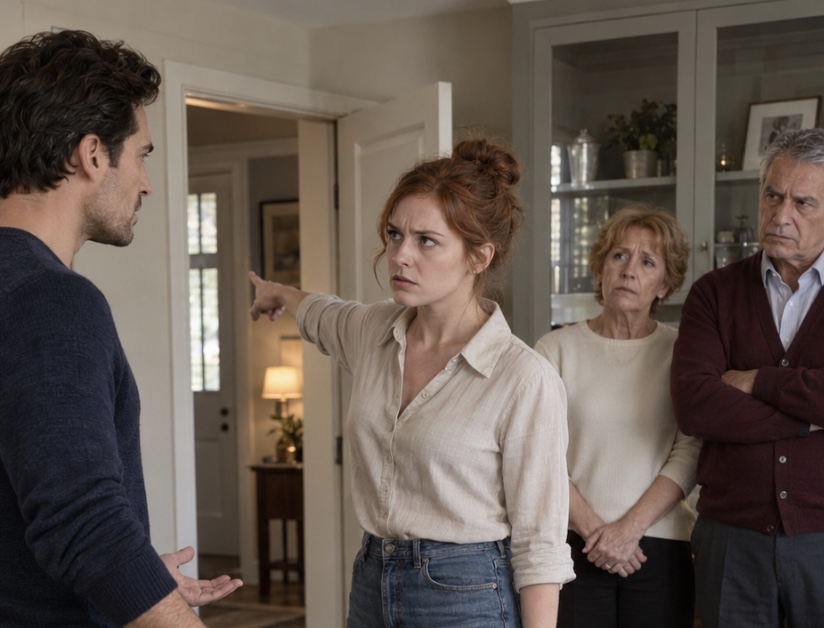
“Enough.” Anna did not speak loudly, yet the kitchen instantly became quiet. “I want you to leave.”
Inna Stanislavovna drew herself up.
“What?”
“Leave this apartment. Now.”
“Pavlik!” She turned to her son. “Do you hear the way she is speaking to me?”
Pavel stood and took a step toward his wife.
 
“Anya, wait. Don’t do this.”
“She is throwing me out!” his mother cried. “I am your mother, Pasha! I came with a pie and nothing but good intentions, and she treats me like a stranger!”
“You came for money,” Anna said. “The pie was an excuse.”
“This is greed—plain and simple greed!” Inna Stanislavovna jumped to her feet, pushing the chair back so sharply that it scraped against the floor. “Pasha, do you see what is happening? Do you see what she is doing?”
Pavel stood between them looking like a man confronted with a problem he had no intention of solving.
“Mom, wait. Anya, let’s all calm down.”
“I am calm,” Anna replied. “Inna Stanislavovna, please get your coat.”
For several seconds, her mother-in-law remained where she was, looking first at Anna and then at her son. Finally, she grabbed her bag from the counter and marched into the entryway. Pavel followed—not to stop his wife, but to see his mother out. That alone answered every question Anna might have asked.
She stayed in the kitchen while their lowered voices drifted in from the hall. She stared at the table: two cups, a jar of jam, and a pie wrapped in foil. She took her mother-in-law’s cup, poured the remaining tea into the sink, and placed it with the dishes.
The front door slammed.
Pavel returned and stopped in the doorway without entering the kitchen.
 
“Why did you have to do that?” he asked.
“Do what?”
“Be so rude. She’s my mother.”
Anna turned toward him.
“Pasha, I need you to answer one question. Don’t defend your mother or explain how tired she is. Just answer me: do you believe my bonus should have paid for the repairs to their house?”
Pavel hesitated.
“I think we could have helped.”
“So the answer is yes.”
“Anya, it isn’t that simple.”
“It is simple to me.” Anna folded her arms. “Listen carefully. If your parents reach into our wallet one more time, you can pack your things and go live with them. I mean it.”
Pavel stared at her. Something changed in his expression—not fear, exactly, but the realization that she was not making an empty threat.
“All right,” he said after a pause. “I understand.”
“I hope you do.”
The next few days passed quietly. Pavel did not raise the subject again. Inna Stanislavovna called every day, but Pavel stepped into the hall, kept the conversations short, and returned without saying much. Anna did not listen—or at least tried not to.
On the fifth evening, Pavel sat beside her and said, “I spoke to Mom. She and Dad will find another way to deal with the house. Maybe they’ll take out a loan, or perhaps they’ll ask Uncle Gena.”
 
“Good,” Anna replied.
“Are you still angry?”
“No. I just haven’t forgotten.”
And she had not. The anger was gone, but something inside her had become more alert. It was like stepping on something sharp in a dark room: afterward, you always moved carefully whenever you entered that room again.
A week passed. Anna worked late to finish the closing documents for her completed project and returned around nine. She heated dinner. Pavel was home watching something on his laptop. They greeted each other, ate, and carried on as usual.
On Saturday morning, Pavel spent longer than normal on the phone in the kitchen. Anna was making coffee and could see him from the corner of her eye, listening and giving brief replies. The call dragged on. When he finally put down his phone, the particular silence that always preceded an uncomfortable conversation settled over the room.
“Dad called,” Pavel said.
Anna did not respond. She poured her coffee and placed the cup on the table.
“He has a problem. He lent money to a neighbor last autumn, and the neighbor has repaid only part of it. Now Dad doesn’t have enough to renew the car insurance.”
“How much?” Anna asked, although she already knew she would not like the answer.
“Twenty-five thousand. He says he’ll return it in June when the utility recalculation comes through.”
Anna set down her cup and looked at her husband.
“Pasha.”
“Anya, it’s Dad. This isn’t the country house. It’s insurance, and he can’t drive without it.”
“Pasha, it has been ten days.”
“I know.”
 
“You made me a promise.”
“This is different.” Pavel met her eyes. “Dad has always taken care of himself. It was just bad luck this time. It isn’t his fault the neighbor didn’t repay everything.”
Anna leaned back in her chair. Something inside her did not flare up. Instead, it became perfectly still and clear. It was the feeling of studying a problem for a long time and finally realizing that it had no solution because the original premise had been wrong.
“So this is a different case,” she repeated. “And next time, there will be another different case. Every time, you will explain why this particular request is an exception.”
“Anya, that isn’t fair.”
“It is entirely fair. You have broken your promise.”
“I haven’t decided anything yet! I only told you that Dad asked.”
“Because you want me to agree.”
Pavel stared at the table before saying, “What am I supposed to do? Refuse my own father?”
“Yes,” Anna answered. “That is exactly what you are supposed to do.”
“I can’t.”
Anna got up and walked into the other room. She stood by the window for a while, then returned to the kitchen.
“Pasha, I’m going to tell you something, and I want you to listen without immediately arguing. Can you do that?”
Her husband nodded.
“You are a good man. You help your parents because you love them, and I understand that. But you cannot love them in a way that keeps taking money out of my pocket. I am not a bank, and I am not an emergency fund for your entire family. I am your wife—the person you share your life with and the person to whom you made a promise. You broke that promise again after only ten days.”
Pavel said nothing.
“I’m filing for divorce,” Anna said.
 
Her husband looked up sharply.
“What?”
“I’m filing for divorce. I have made my decision.”
“Over twenty-five thousand rubles?” Pavel jumped to his feet. “Anya, are you serious? It’s only money!”
“No.” Anna shook her head. “It is not only money. It is the choice you make every single time. You always choose them.”
“I’m not choosing anyone. I’m helping my family!”
“And what am I? Am I not your family?”
Pavel fell silent and rubbed his temple.
“Anya, let’s not act in the heat of the moment. We can discuss this properly.”
“I am discussing it properly. I’m speaking quietly, without shouting. Are you listening to me?”
“Yes. But divorce is too much.”
“For me, it is exactly enough.” Anna picked up her bag from the sofa and took out her phone. “I’m going to stay with my mother today. I’ll spend a few days there while I work out what happens next.”
“Anya, wait. Let’s talk.”
“We have talked. Many times.”
Pavel stood in the middle of the kitchen, staring at his wife the way people stare at something they believed was solid only minutes before, only to discover that it was not.
“You can’t simply leave because of this.”
“I’m not leaving because of the insurance,” Anna said as she closed her bag. “I’m leaving because you cannot say no to your parents. I lived with that for three years, believing it would change. It did not.”
Pavel did not argue again. Perhaps he understood that they had run out of words. Or perhaps he was simply too tired to dispute something that was true.
Anna went to her mother’s home that same day. A week later, she arranged a consultation with a lawyer. There was little property to divide—only a modest balance in their joint account. Her bonus remained untouched in her personal account.
 
The divorce was finalized by the end of June. Pavel was quiet during the hearing and did not contest anything. After signing the papers, he left first.
Inna Stanislavovna called once, a week after the court’s decision. She spoke at length, accusing Anna of destroying the family, calling her ungrateful, and complaining that Pavel was now alone.
Anna listened for about a minute.
“Good luck to you, Inna Stanislavovna,” she said, and ended the call.
She did not block the number. She simply silenced it. There were no more calls.
That summer, Anna finally went to Karelia. She traveled alone for four days, rented a small cottage beside a lake, and brought books and a thermos. Every morning, she drank coffee on the wooden porch and watched the water. No one suggested canceling the trip to pay for someone else’s roof.
She now decided for herself where her money would go: part into savings, and part toward the life she had postponed for far too long.