Anastasia packed her suitcase in a hurry. The wedding had been on Saturday, and by Sunday morning she and Vyacheslav were already expected at his mother’s house.
It had simply worked out that way, without much discussion. Renting an apartment was expensive, and they planned to save for a down payment together. Until then, they would live with his mother. Vyacheslav said she did not mind, there was plenty of space, and it would only be temporary.
Anastasia agreed. She could put up with anything if it was temporary.
The house stood on the edge of a residential neighborhood about twenty minutes outside the city. It was large, with a vegetable garden, a veranda, and old apple trees lining the fence. Her mother-in-law, Zinaida Ivanovna, met them at the gate. She was a short, heavyset woman of about sixty-five, with closely cropped hair and an observant gaze that Anastasia initially mistook for kindness.
“Finally,” Zinaida Ivanovna said as she embraced her son. “Come inside. I’ve already made lunch.”
She gave Anastasia a nod—not coldly, but not warmly either. It was neutral, the kind of nod you gave a new neighbor before deciding whether you liked them.
 
They were given a small room on the second floor with a single window overlooking the yard. It contained a wardrobe, a bed, and a nightstand. Anastasia unpacked and arranged her belongings neatly, trying to take up as little space as possible.
Over lunch, Zinaida Ivanovna questioned her. What did she do for a living? How much did she earn? Did she have parents, and where did they live?
Anastasia answered. She worked as a bank clerk and earned an average salary—thirty-eight thousand rubles. Her parents lived in another town, two hundred kilometers away. Zinaida Ivanovna listened, nodded, and asked more questions. Vyacheslav ate, occasionally adding a neutral comment.
It was an ordinary conversation. Anastasia sensed nothing troubling.
The troubling part began later.
Three days after they moved in, her mother-in-law entered their room without knocking. Anastasia was alone; Vyacheslav had already left for work.
Zinaida Ivanovna looked around the room, then asked, “What time do you get up in the morning?”
“At seven,” Anastasia replied. “I have to be at work by eight.”
“I get up at six. Don’t use the shower too early. I need it myself.”
“All right. I’ll shower after you.”
 
“Good. Then that’s settled.”
Zinaida Ivanovna walked out.
Anastasia remained sitting on the bed, staring at the closed door. It was nothing serious, she told herself. They had merely agreed on a schedule. These things happened when people were learning to live together.
But the conversations about schedules did not stop. Every two or three days, Zinaida Ivanovna found another rule that needed to be explained. She told Anastasia what time she should come home from work because she went to bed early and noise disturbed her. She showed her how to close the refrigerator—firmly, until it clicked, instead of merely pushing the door.
Each remark seemed reasonable on its own. Taken together, however, they created a world in which Anastasia was constantly doing something wrong.
“Slava,” Anastasia said one evening, “your mother watches everything I do.”
“What do you mean?”
“I mean that every few days she explains how to close the refrigerator properly or when I’m allowed to take a shower.”
Vyacheslav shrugged. He was lying on the bed, scrolling through his phone and barely paying attention.
“She’s used to doing things her way. You’ll get used to it.”
“Slava, I’m not talking about her liking order. I’m saying this happens every day.”
“Nastya, don’t make a big deal out of it. Mom can be difficult, but she doesn’t mean any harm. Just ignore it.”
Anastasia was silent for a moment.
“Okay,” she finally said.
 
But ignoring it proved impossible.
Especially at mealtimes.
Zinaida Ivanovna did all the cooking. Anastasia offered to help, but her mother-in-law politely refused, saying she was used to working alone and knew where everything belonged. Anastasia did not insist.
At the table, however, things were different.
Zinaida Ivanovna served everyone herself, dividing the food equally according to her own judgment. Whenever Anastasia reached for a second helping, her mother-in-law would look at her. She said nothing; she merely watched. The look alone was enough to make Anastasia put the serving spoon back.
One evening, Anastasia came home later than usual after a difficult day at work. She had missed lunch and was genuinely hungry by dinnertime. She gave herself a normal portion—the amount she would have taken at her parents’ house without a second thought.
Zinaida Ivanovna glanced sideways at her plate.
“We don’t have much tonight,” she said. “Vyacheslav hasn’t eaten yet.”
 
At that exact moment, Vyacheslav walked into the kitchen.
“I already ate at work, Mom,” he said, taking a seat.
Zinaida Ivanovna said nothing more, but her expression was eloquent. Anastasia ate in silence, thinking that what was on her plate had never had anything to do with whether Vyacheslav had eaten.
After dinner, Anastasia washed the dishes. She had taken on that responsibility voluntarily as a compromise. Zinaida Ivanovna stood beside her and watched.
Once, she said, “You’re holding the sponge incorrectly. You need to move it in circles, like this—not back and forth.”
Anastasia adjusted her grip and finished washing the dishes without a word.
That evening, she spoke to Vyacheslav again.
“Slava, she stands beside me while I wash the dishes and explains how I should hold the sponge.”
“That’s just how Mom is. She’s a perfectionist.”
“Slava.”
“Nastya, what do you expect me to do? Start a fight with my mother over a sponge?”
“No. I want you to understand that this isn’t about the sponge.”
“Then what is it about?”
 
Anastasia looked at her husband. He was looking back—not angrily, merely wearily, like someone who could not understand why a problem had appeared where, in his opinion, no problem existed.
“Never mind,” Anastasia said. “Good night.”
She made a habit of putting money aside. She transferred it to a separate bank card that she never touched. In her head, she calculated how much she would need for a rental deposit and the first month’s rent. At the rate she was saving, it would take about a year and a half. That was a long time, but she could see no other way out.
Vyacheslav knew nothing about the savings. Anastasia did not tell him because she felt certain he would say something like, “There’s no need to rush. Mom doesn’t mind. We’re living perfectly well here.”
Anastasia no longer wanted to explain that “perfectly well” was not how she would describe it.
Three months passed. Then two more.
The control did not lessen; it merely became part of the background, like noise behind a wall. Zinaida Ivanovna checked whether Anastasia had turned off the light in their room before leaving for work. Once, she counted the apples in the bowl on the table and asked at dinner who had taken one. Anastasia admitted she had eaten it that afternoon while she was home. Zinaida Ivanovna nodded. She said nothing, but it was the kind of nod that conveyed more than words ever could.
Vyacheslav saw all of this. Anastasia was certain of that—he was not blind. He simply chose not to notice. Whenever something happened at the table or during a conversation, he lowered his eyes, began looking at his phone, or got up to fetch a glass of water. That was his method: he could be present and absent at the same time.
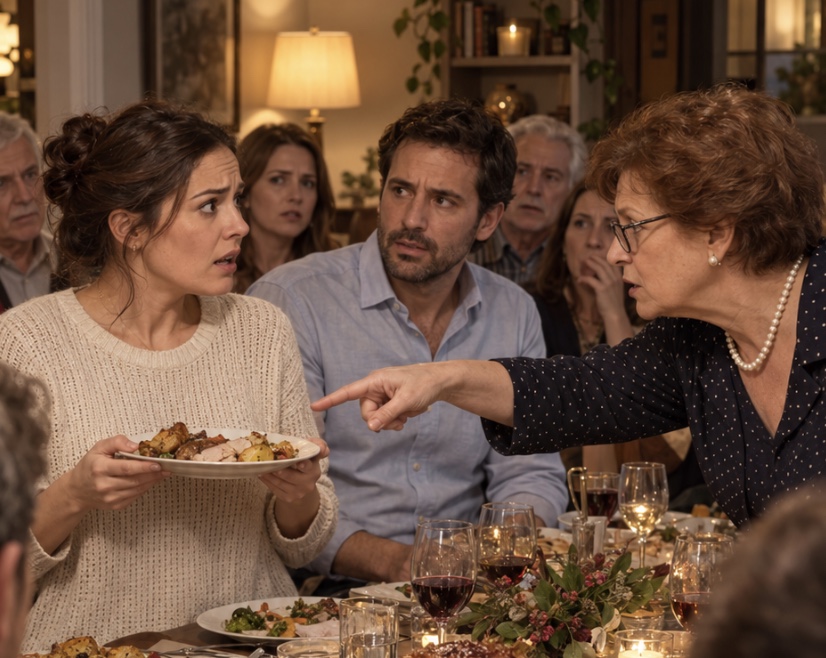
One Sunday in early December, Zinaida Ivanovna prepared borscht and meat for lunch because Vyacheslav’s cousin Igor was visiting with his wife, Lena. The table was set in the living room, and extra chairs were brought in from the kitchen. The house was noisy. Igor talked about work, Lena asked questions, and Zinaida Ivanovna served the borscht.
 
Anastasia arrived later than everyone else. Saturday had been a working day because of the quarterly report, and she had spent Sunday morning finishing paperwork. By the time she reached home at one o’clock, she was starving. Everyone was already seated at the table.
“Anastasia, sit down,” Zinaida Ivanovna said, nodding toward the empty chair.
Anastasia took her seat, picked up a bowl, and ladled herself some borscht. Then she reached for the platter of meat, took two pieces and some bread, and set them in front of her.
Zinaida Ivanovna, who was standing near the stove holding the ladle, looked at her daughter-in-law’s plate. Then she glanced at everyone else’s. Igor had not taken any meat yet because he was busy talking to Vyacheslav.
Anastasia began to eat. The borscht was hot and delicious. She had consumed nothing all morning except a quick cup of coffee.
“Anastasia,” Zinaida Ivanovna said.
She did not raise her voice, but her tone was unmistakably clear.
Anastasia looked up.
Her mother-in-law was staring at her plate.
“You need to leave some for everyone else,” Zinaida Ivanovna said. “Don’t take it all for yourself.”
The table grew slightly quieter. Igor tried to continue what he had been saying to Vyacheslav but stopped in the middle of his sentence. Lena stared down at her plate.
Anastasia slowly lowered her spoon.
She looked at the platter. At least eight pieces of meat remained. Then she looked at her own plate and finally at Zinaida Ivanovna.
“There’s still plenty on the platter,” Anastasia said evenly.
“I can see that. But you helped yourself without asking.”
“It’s a shared dish.”
“This is my house,” Zinaida Ivanovna replied calmly. “And I cooked the food.”
Anastasia looked at Vyacheslav. Her husband sat rigidly, gazing somewhere toward the window. He lifted his cup and slowly took a sip of tea, in no hurry whatsoever.
Beside him, Lena coughed delicately and asked Igor something about the drive, clearly trying to steer the conversation elsewhere.
 
Anastasia picked up her spoon again and resumed eating—silently, steadily, without rushing.
Zinaida Ivanovna remained where she was for another second, then returned to the stove. Gradually, conversation resumed. Igor went back to his story, Lena laughed, and Vyacheslav joined in.
As Anastasia ate, she thought about the money on her separate bank card. She calculated the balance in her head. If she managed to save a little more in January, perhaps she could leave within a year instead of a year and a half.
Zinaida Ivanovna returned to the table carrying a teapot. She placed it on its stand and began pouring tea. When she stopped beside Anastasia, it seemed accidental, simply the natural order in which she was moving around the table.
“Shared or not,” her mother-in-law said, returning to the subject as though there had been no pause at all, “a person should know when enough is enough. It’s a matter of good manners.”
Igor stared at his plate. Lena pretended to study the breadbasket.
Anastasia placed her fork on the table.
 
She did not slam it down in anger. She simply set it neatly beside her plate and looked at Zinaida Ivanovna.
“Zinaida Ivanovna, please don’t comment on how much I eat.”
Her mother-in-law stopped with the teapot still in her hand.
“What did you say?”
“I asked you not to comment on my food. I’ve been working since this morning, and I didn’t have lunch. There is enough on the platter for everyone. I haven’t taken anything away from anyone.”
“I merely said you should leave some for the others.”
“There is enough for them. Look at the platter.”
Zinaida Ivanovna put down the teapot and straightened her back.
“How dare you speak to me like that?”
“Calmly,” Anastasia replied. “That is exactly how I’m speaking to you.”
“In my house, I decide how people behave at the table. I cooked this meal. I am the woman of this house.”
“I understand that. But monitoring another person’s plate has nothing to do with keeping order in your home. That is something else.”
Zinaida Ivanovna drew a sharp breath.
“What ingratitude!” she declared, looking somewhere above Anastasia’s head. “You live in someone else’s house, eat someone else’s food, and still think you can demand your rights. I never expected this from you.”
“I don’t eat someone else’s food. I live here with my husband, and I contribute to the household expenses.”
“Slava,” Zinaida Ivanovna said, turning to her son. “Can you hear how your wife is speaking to me?”
Vyacheslav sat between his mother and his wife. He put down his cup, looked first at Zinaida Ivanovna, and then at Anastasia.
“Nastya, Mom was only…”
“Only what?” Anastasia asked.
“Well, she’s used to doing things her way. You don’t need to take it so personally.”
Anastasia stared at her husband. Vyacheslav’s gaze settled somewhere between her and her plate—in that familiar empty space he always looked toward when he did not want to choose a side.
 
“So you think she’s right?” Anastasia asked.
“I think there’s no need to cause a scene at the table.”
“This isn’t a scene. It’s a conversation. Or can’t you tell the difference?”
Vyacheslav said nothing.
Igor cleared his throat and announced that he and Lena should probably be going. Lena agreed at once. They both stood almost simultaneously, thanked Zinaida Ivanovna for lunch, and said their goodbyes quickly, without unnecessary conversation.
When the door closed behind them, the house fell silent.
Zinaida Ivanovna began clearing the table without a word, wearing an expression worse than anything she might have said.
Anastasia stood and carried her plate to the sink. Vyacheslav remained seated.
“Nastya,” he called.
She turned around.
“You understand that Mom didn’t mean any harm, don’t you?”
“Slava, I want to talk to you. Not here.”
 
They went upstairs to their room. Vyacheslav closed the door. Anastasia sat on the bed with her hands folded in her lap.
“I don’t want to live here anymore,” she said.
“Because of one lunch?”
“Not because of one lunch. For five months, I’ve been told how to hold a dish sponge, when I’m allowed to shower, how to hang clothes on the line, whether I can take an apple, and how much food I may put on my plate. Today she said it in front of other people—in front of Igor and Lena, out loud, at the table.”
“That’s just how Mom is. She treats everyone that way.”
“Everyone—or me?”
Vyacheslav paused.
“Nastya, where would we go? Renting an apartment costs money, and a mortgage costs even more. We live here for free, and Mom doesn’t mind.”
“‘Mom doesn’t mind.’ Those are the important words, aren’t they? Her opinion decides everything. Mine doesn’t.”
“You’re being dramatic.”
“Slava.” Anastasia spoke quietly, but something in her tone made him fall silent. “I am not being dramatic. I endured this for five months. Today, for the first time, I calmly asked her not to comment on my food. Once. And you took her side.”
“I didn’t take anyone’s side.”
 
“That is precisely the problem.”
Vyacheslav paced across the room and stopped by the window. The yard was quiet beneath a gray December sky, the apple trees bare.
“What do you want?” he asked.
“I want us to live separately. We can rent an apartment and start saving for a place of our own. That is normal for a married couple.”
“Financially, this isn’t the best time.”
“When will it be a better time?”
“Well… maybe in the spring.”
“Slava, you said the same thing in September.”
He did not answer.
“I understand,” Anastasia said. “You’re not going to leave.”
“Nastya, wait. Don’t jump to conclusions.”
“This isn’t a sudden conclusion. I’ve been waiting for an answer for five months.” Anastasia stood. “I’ll tell you plainly: if you aren’t prepared to move out of this house, I’ll leave on my own. And then the conversation will no longer be about an apartment. It will be about us.”
 
Vyacheslav looked at his wife. His eyes held the expression she had been seeing more and more often lately—not anger, not indifference, but something in between. It was the weariness of a man faced with a demand he could not understand.
“You want a divorce because Mom commented on your plate?”
“No. I want to know whether you’re prepared to be a husband or only a son. Those are different roles.”
“That isn’t fair.”
“Maybe not. But it’s true.”
Vyacheslav sat down on the bed and remained silent for a long time.
“Give me some time to think,” he finally said.
“All right,” Anastasia replied. “Until this evening.”
She left the room and went downstairs to the kitchen, where she poured herself a glass of water. Zinaida Ivanovna was washing the dishes with her back turned and did not look around.
Anastasia drank the water, set down the glass, and returned upstairs.
By evening, Vyacheslav still had not given her an answer. At around eight, he went down to the kitchen to speak with his mother. Anastasia could hear them from the floor above. She could not make out the words, but Vyacheslav’s tone was apologetic—the tone people used when explaining someone else’s behavior and asking to be understood. He was not defending her. He was explaining her.
Anastasia took out her suitcase and opened the wardrobe.
She packed methodically: clothes, documents, her laptop with all her work files, her cosmetics bag, the book she was reading, her chargers, and the bank card holding her savings.
Vyacheslav entered the room and stopped in the doorway.
“You’re already packing?”
“Yes.”
“Nastya, wait. Let’s talk properly tomorrow. Everyone’s upset today.”
“Slava, instead of coming to me, you went to your mother. I heard you.” Anastasia closed the suitcase. “That tells me everything I need to know.”
“That isn’t fair.”
“Perhaps not. But it’s what I see.”
 
“Where will you go?”
“I’ll find somewhere.”
“Nastya.” Vyacheslav took a step into the room. “Don’t do it like this. Let’s talk. I’m not saying Mom is right. I’m just…”
“Just what?”
He fell silent. Once again, that same silence.
“I’m only asking you not to do this today.”
“You’re asking me to wait. Again.” Anastasia picked up her suitcase. “I’ve waited long enough.”
She left the room. Vyacheslav followed her down the stairs, saying that she needed to calm down, that everything would be different tomorrow, and that she should not act so rashly. Zinaida Ivanovna stood in the kitchen doorway and watched in silence.
Anastasia put on her coat and took her car keys. The car belonged to her; she had bought it before the marriage. Then she opened the front door.
“Nastya,” Vyacheslav said.
“Call me when you’ve made a concrete decision,” Anastasia replied. “Not when you feel like talking. When you’ve actually decided.”
 
The door closed behind her.
She rented a one-bedroom apartment on the fourth floor. It had a proper stove and a bright kitchen. The landlord was an elderly man who spoke little and asked no unnecessary questions. He accepted the deposit and the first month’s rent, then handed her the keys.
Vyacheslav called repeatedly. Once, he came to see her. He stood in the entrance hall of the building and said that he missed her and was ready to talk. Anastasia went downstairs and listened.
“Are you ready to move out of your mother’s house?” she asked.
“Well… not immediately. But we could…”
“Slava,” Anastasia interrupted. “We’re going in circles.”
“Mom is elderly. I can’t abandon her.”
“Nobody is asking you to abandon her. Living separately is not abandonment.”
“To her, it’s the same thing.”
Anastasia nodded. It was an honest answer—perhaps the most honest one he had given her throughout their entire marriage.
“Then you and I want different things,” she said. “It isn’t about blame or resentment. It’s simply a fact.”
She filed for divorce three weeks later. Vyacheslav did not contest it. There was almost no property to divide because they had acquired very little together. The car was hers, as were her savings. They had purchased a few pieces of furniture during those months, but they reached an agreement without going to court.
 
The divorce was finalized in February.
By spring, Anastasia had settled comfortably into her apartment. She bought a proper mat for the entrance hall and put up a shelf in the kitchen. She cooked for herself whenever she wished and made as much food as she wanted. No one stood beside her watching what she put on her plate.
One evening in March, she made herself a late dinner. She had come home exhausted from work, so she cooked pasta with cheese—a generous helping piled high—and poured herself a glass of wine.
She set the plate on the table and looked at it.
Then she picked up her fork and began to eat.
Quietly. Peacefully.
Without needing anyone’s permission.