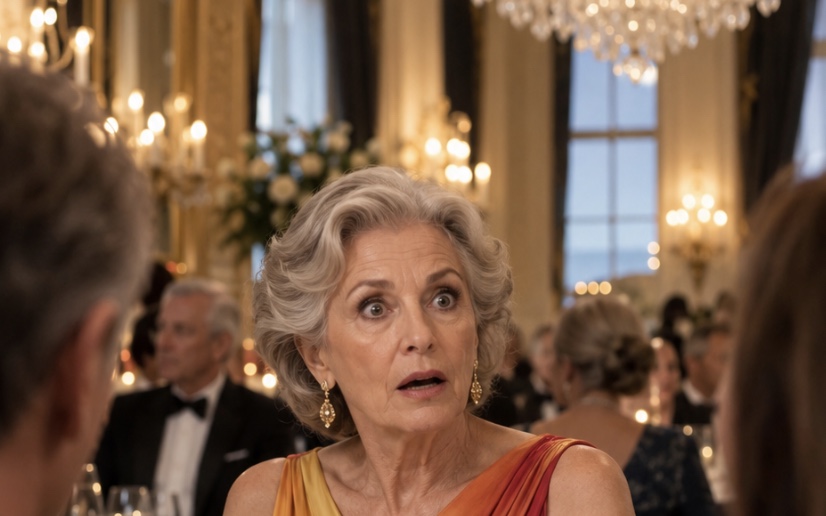
The café fell silent—so silent that the clink of a fork against a plate at the next table could be heard clearly. Everyone was staring at Veronika: Anton’s relatives seated along the long table, the waitress frozen near the entrance with a tray in her hands, and Tamara Viktorovna herself, sitting at the head of the table in the foil crown her granddaughter had placed on her head half an hour earlier.
Veronika was holding a box tied with a satin ribbon. It was finally her turn to present her gift. Everyone else had already given theirs: someone had brought a shawl, someone else a dinner set, while Anton had handed his mother a gift certificate for a beauty salon that he had chosen with his sister.
But Veronika remained standing without moving.
“Well?” Tamara Viktorovna drummed her fingers impatiently against the tablecloth. Her face wore its usual condescending smirk. “What have you brought me? I hope it isn’t like the last one.”
That casually delivered remark became the final straw.
 
Veronika placed the box on the chair beside her.
“Do you honestly believe,” she said calmly, even though everything inside her was trembling, “that after all the insults I’ve had to hear from you, I still owe you a gift?”
Someone at the table gasped. Anton’s sister covered her mouth with her hand. Anton himself turned sharply toward his wife, his expression caught somewhere between fear and confusion.
Tamara Viktorovna went pale, then flushed crimson. And then something happened that no one had expected.
An elderly woman sitting near the end of the table—a longtime family friend whom Veronika had only occasionally seen at celebrations—spoke quietly but firmly.
“She’s right, you know. It isn’t decent to air someone else’s private life in front of everyone, Tamara. I’ve told you that many times.”
The sentence was spoken almost in a whisper, yet it rang loudly through the silent room. A murmur of agreement passed among the guests.
Tamara Viktorovna jumped to her feet, nearly knocking over a glass of champagne. Without looking at anyone, she hurried toward the exit. The café door slammed so hard that the garland of balloons hanging above the table began to sway.
 
No one knew what would happen next.
Anton looked helplessly from the closed door to his wife. Veronika lowered her gaze to her hands and suddenly realized that, for the first time in a very long while, she did not feel like crying.
To understand how an ordinary family dinner had reached such a dramatic ending, it was necessary to go back several years—to the time when Veronika first met Anton’s mother.
Her divorce from her first husband had been painful. She had escaped a marriage in which she was constantly criticized, every decision she made was questioned, and every attempt to take initiative was met with disapproval. At the time, she had believed that things could never become worse. She had already reached the bottom, and the only direction left was upward.
She met Anton through mutual friends sometime after the divorce, when she had slowly begun learning to trust people again.
He was calm and considerate, and he knew how to listen. During the first months of their relationship, Veronika felt as if she had finally met someone beside whom she could relax. Anton encouraged her when she doubted herself, praised her professional achievements, and seemed genuinely proud of her success.
Veronika worked in marketing for a large company and had risen to a management position fairly quickly.
 
She met Tamara Viktorovna at a family lunch shortly after her relationship with Anton became serious. Her first impression proved deceptive. The older woman initially seemed friendly, if somewhat blunt in her judgments.
The longer they communicated, however, the clearer it became that her friendliness was merely a façade. Behind it was a woman accustomed to controlling everyone around her and finding faults in the smallest details.
The criticism began almost immediately.
According to Tamara Viktorovna, Veronika’s cooking was never tasty enough. Sometimes her clothes were “inappropriate for her age,” while on other occasions she supposedly dressed “as if she were going to a funeral.” Her manner of speaking was either too arrogant or far too common.
Nothing Veronika did was ever right, and eventually she stopped trying to please her.
She attempted to limit their contact. She did not call unless there was an important reason and never visited without an invitation. She remained polite but maintained a firm distance.
Avoiding Tamara Viktorovna entirely was impossible, however. The family regularly gathered for holidays, birthdays, and anniversaries, and Anton’s mother always placed herself at the center of attention—both at the table and in every conversation.
One particular story became especially painful for Veronika. Her mother-in-law loved repeating it in front of guests, especially newcomers who had not yet heard her version of events.
 
“Can you imagine?” she would begin while pouring tea or cutting a pie. “Veronika was in such a terrible state after her divorce. It was pitiful to look at her. My Anton practically rescued her. He took pity on the poor woman. Not that she has ever shown him much gratitude.”
Veronika heard those words dozens of times, and each time something tightened painfully inside her.
She wanted to object. She wanted to explain that nobody had “rescued” her, that she and Anton had entered the relationship as equals, and that she had never been a helpless wreck. She had simply been a woman recovering from a divorce—a capable adult who could make her own decisions.
Yet Veronika always restrained herself. Starting an argument in front of relatives seemed humiliating, both for her and for her marriage.
After such gatherings, she told Anton how hurt she felt. His answer was always the same.
“Please try to be patient. She’s become like this with age. Her personality has changed. I’m sure she’ll calm down eventually and get used to you.”
So Veronika remained patient.
She believed her husband. She hoped that sooner or later his mother’s attitude would soften and that all they needed was time.
 
But the years passed, and the hostility did not disappear. Only its form changed. Direct criticism was replaced by jokes delivered with a smile but containing the same poison.
Money became another source of tension.
Despite constantly criticizing her daughter-in-law, Tamara Viktorovna never hesitated to ask the couple for financial help. Sometimes she needed money for medicine, sometimes for repairs, and sometimes for vaguely defined “urgent expenses.” The list was updated with remarkable regularity.
Veronika earned most of the household income. Her salary was considerably higher than Anton’s. Nevertheless, every request was presented as though Anton alone were providing the money and his wife had nothing to do with it.
“Mom has asked us to help,” Anton would say, avoiding Veronika’s eyes.
Without replying, she would take out her phone and transfer the requested amount.
This hypocrisy angered her even more than the insults. Tamara Viktorovna accepted money from the very woman she publicly described as ungrateful and unworthy of her son.
 
Still, Veronika said nothing. She did not want to cause a conflict between mother and son. She loved Anton and kept hoping that her patience would eventually be rewarded.
The situation finally came to a head as Tamara Viktorovna’s birthday approached.
Several weeks before the celebration, she posted a detailed list of the presents she wanted in the family group chat. She even specified brands and personal preferences, making the message sound more like an order than a list of suggestions.
As Veronika read it, the familiar irritation rose inside her again.
“Maybe we shouldn’t go this time?” she cautiously suggested to her husband that evening. “We could say we already have plans.”
“She’ll only be even more offended,” Anton replied with a sigh. “Besides, it’s her birthday. Let’s endure it one last time. Afterward, I promise I’ll speak to her myself and ask her to treat you more kindly.”
Once again, Veronika agreed.
 
The celebration was arranged at a café. Anton paid for the rented room and most of the food. Everyone treated Tamara Viktorovna’s gift list as a direct instruction: one person bought jewelry, another chose a household appliance, and several relatives simply brought envelopes containing money.
The evening began peacefully enough.
The closest family members were there, including her children and grandchildren, as well as several of the birthday woman’s friends. Among them was the elderly woman who would later speak in Veronika’s defense.
Soft music played in the background. The guests made toasts, ate dinner, and presented their gifts.
As the evening progressed, however, Tamara Viktorovna grew increasingly uninhibited. The wine and the attention seemed to loosen her tongue.
The first jab came when the conversation turned to Veronika’s career.
“Well, she’s a big boss now,” Tamara Viktorovna drawled, addressing the guests with a mocking smile. “Always running around and making money. I doubt she can cook a proper bowl of soup or iron her husband’s shirt. Fortunately, my Anton is a patient man.”
 
The guests laughed awkwardly. Someone attempted to change the subject, but Tamara Viktorovna had sensed that she had an audience and had no intention of stopping.
“You know,” she continued a little later while filling the wine glasses, “sometimes I think her first husband must have left her for a reason. There was probably more to that story. I’m only joking, of course.”
She noticed Veronika’s face tighten, but there was not the slightest trace of regret in her voice.
Heat rushed into Veronika’s cheeks.
She looked at Anton, expecting him to defend her or at least tell his mother that she had gone too far. Instead, he gave an uncomfortable smile and tried to redirect the conversation by suggesting another toast to the birthday woman.
Pleased with the effect she had created, Tamara Viktorovna continued making similar “jokes” throughout the evening.
 
She mocked the way Veronika held her fork. Then she ridiculed her for not wanting children—an especially painful subject because Veronika and Anton had made that decision together and had no intention of discussing it with anyone else.
Each remark was followed by Tamara Viktorovna’s own laughter and the uncomfortable silence of everyone around her.
Veronika sat quietly, struggling to maintain a calm expression. Inside her, however, years of exhaustion were accumulating: exhaustion from constantly remaining patient, from trying to earn the approval of a woman who seemed determined never to accept her, regardless of what she did.
She thought about everything she had invested in these relationships.
She remembered how many times she had stayed silent, how often she had swallowed her anger, and how much money she had given without complaint.
In return, she had received mockery, accusations, and endless stories about her supposed ingratitude.
By the time it was her turn to present the gift, Veronika understood that she could no longer tolerate it.
 
What happened next was already known: her words cutting through the silence of the café, the elderly guest unexpectedly supporting her, the approving remarks from other relatives who had long since stopped finding Tamara Viktorovna’s jokes amusing, and the birthday woman fleeing from her own celebration.
Several months passed after that evening.
Tamara Viktorovna neither called nor wrote. Her resentment was too deep for her to make the first move.
Anton found himself torn between his wife and his mother. At first, he tried speaking to both of them, apologizing first to one and then to the other. Gradually, however, he was forced to admit something he had refused to acknowledge for years: his mother truly had treated Veronika unfairly, and his wife’s patience had a limit he had never seriously considered.
The couple finally spoke honestly a few days after the birthday celebration. It was late in the evening, and they were alone.
“Forgive me,” Anton said quietly, staring at the floor. “I saw what was happening. I understood it too, but I kept postponing the conversation with my mother. I hoped the problem would somehow resolve itself. It didn’t. It only became worse.”
Veronika remained silent, waiting for him to continue.
 
“I don’t ever want you to tolerate that treatment again,” he added. “Not even for my sake. Especially not for my sake.”
That conversation became a turning point for them both.
Veronika realized that her husband had finally seen what she had been trying to explain for years. Anton understood that his silence was damaging not only the relationship between his mother and his wife, but also his own marriage.
Their contact with Tamara Viktorovna was suspended—perhaps for a long time, perhaps forever.
Her name occasionally came up in conversations with other relatives, who passed along her complaints and grievances. But she no longer contacted her son or daughter-in-law directly.
Anton visited his mother by himself, trying to preserve at least a formal connection. He stopped insisting that Veronika reconcile with her. The distance separating the two women had become too great, and it was painfully obvious that Tamara Viktorovna had spent years creating it herself.
Months after the disastrous birthday celebration, Veronika noticed something unexpected.
 
The silence that followed the estrangement brought her relief rather than anxiety.
She no longer prepared for every family gathering as if it were an ordeal. She stopped rehearsing responses to future insults in her head. She no longer kept track of the money her mother-in-law borrowed and never intended to return.
Sometimes Veronika wondered whether she should have spoken up much earlier instead of turning her patience into a performance that lasted for years.
But she understood something else as well: what had happened in the café was not a sudden emotional outburst. It was the result of a long and painful journey she had needed to complete before finding the strength to say aloud what she had carried inside for so long.
Tamara Viktorovna’s celebration certainly had not gone according to plan.
Yet perhaps that ruined birthday had given Veronika the most important gift of all—not something a person receives, but the freedom that comes when they finally refuse to tolerate any more humiliation.