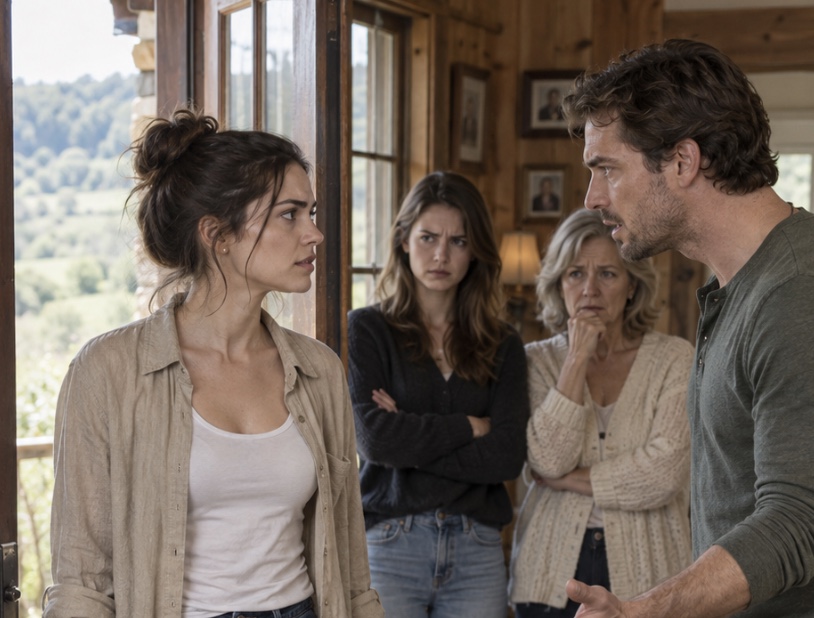
“SIGN THE HOUSE OVER TO YOUR SISTER,” MY HUSBAND SAID. SO I PACKED HIM TWO BAGS
I set the dish of plum pie in the middle of the table, between the teapot and Gena’s elbow.
“We had a well drilled here,” he was telling his sister. “It cost a hundred and sixty thousand. But now there’s water all year round—you could even come in January.”
We.
I wiped my hands on my apron and remained standing.
“Not we,” I said. “Me.”
The veranda fell silent. Dasha stopped chewing and looked at her mother.
 
“Toma,” Gena said quietly. “Why say that in front of the children?”
“I haven’t said anything wrong. I paid for the well, the contract is in my name, and I found the workers. Lyusya should know whom to call if the pump breaks.”
“Couldn’t you have found a cheaper option?” Lyusya asked.
“The cheaper option was the public water pump and buckets again.”
Gena carefully set his glass on the oilcloth as if he were putting a full stop at the end of the discussion.
My mother’s apartment in the district center had been sold in 2012, six months after her funeral, once the legal waiting period was over. Every ruble from the sale went into this place—six hundred square meters of land and a prefabricated house with a collapsed porch. I added my own savings on top of that.
It was a quiet, warm evening, the kind when the garden asks nothing of you. The whole family was gathered around the table: my mother-in-law at the head, Lyusya with her children, and Gena beside his mother.
“What’s in the pie?” Dasha asked.
“Plums. From the tree by the fence.”
“But those are sour!”
 
“They’re sweet in a pie,” I said, cutting the first slice for her.
Artyom poked at his phone while chewing. Lyusya was wearing my cardigan because hers was too thin and a chill had begun drifting in from the river.
My mother-in-law pushed her plate aside and began talking about how people had once managed without wells, carrying water from the village well without complaining, and how everyone had been healthier in those days.
“Mom, times are different now,” Lyusya said.
“Times are different, but women are the same.” Zoya Markovna turned to me. “Tamara, do you have any jam left from last year? I promised Rita two jars.”
“It’s in the cellar. Help yourself.”
“I will.”
That was how she always asked—after she had already decided.
I went to the kitchen to make another pot of tea. My stove was old and only two of its four burners worked, but I had long since learned to manage. Through the window I could see the veranda. Everyone remained seated, eating. Not one person turned around.
When I came back with the teapot, Gena was pouring fruit compote and telling everyone how we had brought the property back to life: how we had filled the pit beneath the foundation, carried bags of gravel in the trunk, and spent the first summer in a construction trailer without electricity. He told the story smoothly, pausing in all the right places. And in his version, we had done everything together.
“Gena, you came here twice that first summer,” I said.
“Three times.”
“Fine. Three.”
“Tamara, what kind of person are you?” my mother-in-law protested. “You won’t even let your husband speak in front of his sister.”
“Let him speak. I’m not stopping him.”
“You are. You weigh every word as if you worked in a pharmacy.”
Artyom looked up from his phone.
“How deep is the well?”
“Thirty-four meters,” I said. “There’s limestone down there, and the water comes from beneath it.”
“Cool.”
“It is,” I agreed.
 
“Lyusya has decided to rent out her apartment,” my mother-in-law said, reaching for the teapot. “She’s already looking at tenants.”
“Mom,” Lyusya warned.
“What? It’s a sensible idea. Extra money never hurts.”
Lyusya glanced quickly at her brother. Gena stared at the table.
“Uncle Gena, will you come pick apples with us?” Dasha asked.
“I’m wearing slippers.”
Artyom and I went instead. He held the bag and used his phone as a flashlight while I shook one of the lower branches.
“Aunt Toma, is this tree old?”
“As old as your brother. I brought it home on my lap on the bus, its roots wrapped in a wet cloth. Everyone stared at me.”
“Grandpa would have said it was easier to buy a mature tree.”
“He would have.”
When we returned, Lyusya was already standing in the doorway with two bags.
“Tamara, I took a few cucumbers and a zucchini. Is that all right?”
“Take them.”
“And jam,” my mother-in-law added from behind her. “I packed four jars for her—gooseberry and cherry.”
 
“There were only two jars of gooseberry jam left!”
“That’s right. We took both.”
Gena drove them to the station. I stayed behind with the dishes.
It was nearly midnight when I finished washing everything. Gena came back, stood in the kitchen doorway, and picked at the doorframe with his fingernail.
“Why did you make a scene at dinner?”
“I told the truth.”
“You don’t say things like that in front of family.”
He left, then returned a minute later.
“We’ll talk tomorrow. Seriously.”
***
He started the conversation the following evening while I was clearing the table.
“Sit down,” Gena said. “Just for five minutes.”
I sat. He moved the saltshaker aside as if it were in his way.
“You need to sign the house over to Lyusya.”
The dishcloth remained frozen in my hand.
“What?”
“The house. Transfer the ownership to her. She’s alone with two children in a two-room apartment. Artyom is fifteen; he needs a room of his own. And what do you need a country house for? You’ll retire in two years and sit out here alone.”
“I don’t just sit here. I live here.”
“Toma, don’t pick at my words.”
 
He began explaining that Lyusya had always been unlucky, that her husband had abandoned her when Dasha was still an infant, that their mother worried herself sick over her, and that he was the older brother and responsible for everyone.
“Responsible to whom?” I asked.
“To my sister. I’ve been responsible for her since I was fourteen. Our father left, and I became the man of the house.”
“Then who is responsible for me?”
“You’re a grown woman.”
I placed the dishcloth neatly on the edge of the table, as though its position mattered.
“Gena, this house was bought with the money from my mother’s apartment. The deed is in my name alone. The money came from the account opened after I received my inheritance. Every ruble can be traced.”
“You’re going to wave documents in my face after thirty-one years together?”
“Your mother spent three winters in our bedroom while I slept in the kitchen. Did I ever wave that in your face?”
He rubbed his face with his palm.
“You don’t understand. You wouldn’t lose anything. You could still come here whenever you wanted. Lyusya’s name would only be on the paperwork.”
“Her name goes on the paperwork, and by spring I discover there’s no room for me.”
“You always assume the worst of people.”
“I judge people by what they do. Who rebuilt the porch? Who replaced the roof the year before last while you were away fishing?”
“Here we go again!”
“No. We aren’t going again. This is the first time I’ve said it aloud.”
“I’m not asking for myself,” he said. “I’ve never asked for anything for myself in my life.”
 
“That summer you were changing jobs and said you couldn’t contribute. Did I reproach you even once?”
“Don’t start.”
“You didn’t contribute to me either.”
“What didn’t I give you?”
“Nothing, Gena. Absolutely nothing.”
My mother-in-law was standing in the doorway in her robe, holding a cup. I had no idea how long she had been there.
“Tamara, don’t get worked up,” she said. “Think about it for a week. The house is large. There’s enough room for everyone.”
“Who exactly is everyone?”
“Who do you think? Family.”
I stood, wiped my hands on my apron, then took it off and hung it on its nail.
“No,” I said. “It is not going to happen. Not in a week, not in a year, and not in my will.”
“Don’t make a rash decision,” Gena said.
“This isn’t rash. I made this decision thirteen years ago while dismantling the rotten porch with my own hands.”
He did not shout. He merely nodded—the way people nod when they hear exactly what they expected—then went to bed.
 
The next morning, a printout lay on the kitchen table. The heading read: “Deed of Gift: Required Documents.” At the bottom, someone had written a phone number and the name Irina Valeryevna by hand.
I folded the sheet into quarters and slipped it into the pocket of my robe. I carried it with me all day.
“Why didn’t you eat breakfast?” my mother-in-law asked.
“I’m not hungry.”
Then I walked around the property. I should have pruned the raspberry canes in July, but I had kept putting it off. The currant bush by the fence had grown taller than I was. I stood staring at it for a long time, as if a bush might give me an answer.
That afternoon, my mother-in-law went through my cellar. I stepped outside for water and found jars lined up on the porch.
“Zoya Markovna, where are those going?”
“Two for Rita, two for Nadya, and the rest for Lyusya. I’ll say they’re from me. It’s awkward to visit people empty-handed.”
“From you,” I repeated.
“Well, yes. You don’t keep count.”
She was right. I had never counted. Perhaps that was the whole problem.
That evening Gena went outside with his phone and stood beside the water barrel. The kitchen window was open.
“She’s digging her heels in. That’s just her nature,” he told someone. “Give her time. Where is she going to go?”
He moved toward the gate, and I could no longer make out the words.
On Saturday, he left for town. He said he was taking medicine to his mother.
 
His mother was sitting on my veranda at the time, stripping currants from their stems.
***
I sat opposite her and pulled the basin closer.
“Zoya Markovna, Gena says he’s gone to see you.”
“Me?” She raised her head. “But I’m here.”
“That’s what I thought.”
She worked her lips, then returned to the berries.
“Then he must have gone to Lyusya. They have things to discuss.”
“What things?”
“Ordinary things.” The pause stretched too long. “Don’t get the wrong idea, Tamara. No one is throwing you out. They’ll leave you the room overlooking the apple trees. It’s warm, and the stove is nearby.”
The spoon struck the metal basin with a sharp clang.
“They’ll leave it for me?”
My mother-in-law began speaking quickly, as people do when they realize they have said too much. Nothing had been decided, she insisted. They had merely discussed possibilities for the future. Lyusya would rent out her apartment and use the money for the children. She and the children would live here because the house was large, it could be heated, and it would not stand empty all winter.
“When did you discuss this?” I asked.
“Back in July.”
“July,” I repeated.
“Lyusya came here with a tape measure,” my mother-in-law said. “The day you went into town for your appointment. They measured the rooms to see where the beds would fit.”
I stayed until we finished. I cleaned my half of the currants, carried the basin inside, and placed it on the stove. My hands moved on their own.
Then I went to the back room, where the old wardrobe and winter clothes were stored, and pulled the curtain aside.
On the wallpaper beside the window, level with my elbow, were two pencil crosses with a number written between them. Someone had measured the wall and made a note so they would not forget. I rubbed the marks with my finger. The pencil did not come off.
So the dinner at which Gena had said, “You need to sign over the house,” had not been the beginning of the conversation. It had been the end. The beginning had happened without me in July—with a tape measure, between two bus departures.
Lyusya called that evening.
 
“Toma, don’t start imagining things,” she said. “Mom always gets everything mixed up.”
“What did she mix up?”
“That business with the tape measure. We were only looking. You never know how life might turn out.”
“When are your tenants moving in?”
She fell silent for a long time.
“October first,” she finally said. “Toma, what am I supposed to do—live on two salaries forever?”
“I don’t know.”
“Exactly.”
That evening I called my son in Tver.
“Mom, sign the house over to me instead and be done with it,” Kirill said. “We’ll draw up a deed of gift, and they’ll leave you alone forever. I can come during my vacation and settle everything in a week.”
“I don’t want to.”
“Why?”
 
I looked out the window at the apple trees, which were nothing but black shapes in the darkness.
“Because then it wouldn’t be mine again.”
“Mom, I’m not like them.”
“I know. I still don’t want to. For the first time in my life, I want something to belong only to me.”
He was silent for a moment, then said I was stubborn. I agreed.
Gena returned on Sunday evening. He and his mother sat down for tea on the veranda, and soon I heard the familiar, even murmur of their voices—the domestic hum I had listened to all my life.
I took a yellow folder from the dresser and placed it on the oilcloth between the teapot and a small vase.
“Open it,” I told Gena.
“What is it?”
“Open it.”
Inside were the certificate confirming my inheritance, the purchase agreement naming me as the sole buyer, the bank statement, the well contract, the receipts for gravel, the roof, and the pump.
“So what?” He did not even lean closer to read them.
“So the rooms could have been measured while I was here.”
 
Gena slowly turned toward his mother.
“Mom. Did you tell her?”
“I didn’t tell her anything,” Zoya Markovna replied, folding her napkin into quarters, then folding it once more.
“She didn’t tell me,” I said. “She let it slip. There’s a difference.”
“Tamara, you should learn to hold your tongue,” my mother-in-law snapped.
“I held it for thirty-one years. That’s enough.”
She stood, picked up her cup, and carried it toward the house. At the doorway she turned back.
“God will judge you. You don’t wrap family in legal papers.”
Gena sat for another ten minutes, staring at the folder as if it belonged to a stranger. Then he said, “Fine,” repeated it once, and went to the bedroom. Through the wall I heard him speaking to someone on the phone in short phrases, but I could not distinguish the words.
I went outside and sat on the top step. The nights were already turning cold. Dampness rose from the earth, and the darkness smelled of fallen apples.
***
For three days, Gena did not speak to me. He ate, went outside to the grill, and watched the news with the sound off. On the fourth day, my mother-in-law left to stay with her niece in town, claiming her legs were bothering her.
The weather was fine during those days—offensively fine. I picked the last tomatoes while they were still green; they would never ripen on the vine before the frost.
That evening, Gena and I sat down to dinner alone.
“Here is how it’s going to be,” he said, pushing his plate away. “Either you sign the house over to Lyusya, or I pack my things. You can live here alone with your precious papers.”
He waited. I could see it in the way he leaned forward, his fingers gripping the edge of the table—the face of a man who already knew how the scene would end.
I felt no fear. Inside me, everything became calm and spacious, like a room after an unnecessary wardrobe has been carried out.
“All right,” I said.
“What do you mean, all right?”
“Pack.”
He laughed, then stopped.
“Who are you trying to frighten? Where am I supposed to go?”
 
“To Lyusya’s. You promised her a house. She can surely find a corner for you.”
He watched as I walked into the bedroom. I pulled an old travel bag from beneath the bed—the one we had once taken to Anapa—and began packing. Shirts. His razor. Blood-pressure pills. Phone charger. A warm jacket, because September was almost here.
“Take your boots,” I said.
“What boots?”
“Your rubber boots.”
“I don’t own rubber boots.”
“Exactly.”
He tried a different approach. Sitting on the edge of the bed, he lowered his voice. He had spoken in anger, he said. Transferring the house was not essential; I could simply write a will. Everything would remain as it was, and no one would even notice.
“Gena,” I said.
“What?”
“You just gave me an ultimatum: the house or your belongings. I chose.”
“That isn’t what I said.”
“It is exactly what you said. I was here. So was your dinner plate.”
He kept talking. I would regret it. His mother had been right about me from the beginning. A woman living alone in a garden community was both ridiculous and pitiful. I zipped the second bag and carried them both to the porch.
“Give me the car keys. I’ll drive myself,” he said once we were outside.
“No. I’ll take you.”
I could have waited until morning. I could have given him a week or a month. I could have left the bags unpacked, simply said no, and carried on, because he probably would never have gone anywhere. But I did not. Not because I feared changing my mind. I simply did not want to fry his eggs again the next morning.
Once we reached the road, he asked where we were going.
“To your sister’s.”
“She isn’t expecting me.”
“You didn’t ask me either before giving her my country house.”
We drove the rest of the way in silence—forty kilometers, then the bridge, then unfamiliar apartment courtyards with swings. He believed I would turn the car around. I could see it in the set of his neck and the way his hand rested on the door handle.
Lyusya opened the door in her robe. Both children stood behind her in the hallway: Artyom wearing headphones and Dasha barefoot on the cold floor.
“Toma, what are you doing here?” Lyusya asked.
I placed the first bag on the threshold and the second beside it.
“Take him,” I said. “You asked for the house. You won’t get the house, but you can have your brother.”
“Have you lost your mind? I only have two rooms!”
“I had one when your mother spent three winters in our bedroom.”
“It’s the middle of the night!” Lyusya glanced at the children and lowered her voice. “Did you think about them at all?”
“He didn’t wait until morning to give me his ultimatum.”
“Uncle Gena, are you going to live with us now?” Dasha asked.
No one answered. Artyom removed one earphone, looked at me, then put it back in.
 
I walked down the stairs and drove away.
At home, I did not turn on the overhead light. I sat on the porch in the dark. My legs ached, my palms smelled of gasoline, cold drifted from the apple trees, and a dog barked beyond the road.
Little by little, I understood that I no longer had to divide this house with anyone—not its rooms, not its jam, not even my Sundays.
My phone vibrated in my pocket. Eight missed calls from my mother-in-law. I did not call back.
Gena called after midnight.
“Toma, open the gate. I’m in a taxi.”
“No.”
“Are you serious?”
“Gena, I spoke seriously twice today.”
He said I would regret it and hung up.
In the morning, I checked the pump, swept the veranda, and took his old cap from its nail. I held it for a moment, then hung it back up. Let it stay there.
***
In September, I filed for divorce in the magistrate’s court. Gena refused to consent, so a hearing was scheduled for the following month. He failed to appear on October 28. The second hearing was set for November 12, and he promised to come with a lawyer. Lyusya was already telling the relatives that the house was marital property because I had bought it while we were married.
 
She called me at the end of October for the first time since that night.
“Toma, take him back,” she said.
“Where?”
“Home. He lies on the sofa and watches television until two in the morning. Artyom has to sleep on a folding bed in the kitchen, and he starts school at eight. You have to understand—I have children.”
“I understand.”
“And?”
“And nothing.”
She ended the call first.
At the beginning of November, Gena came for his tools. He stood outside the gate, and I did not invite him in.
“Give me the toolbox and my fishing rods.”
I brought them out. He checked whether all the keys were there before finally looking up at me.
“Do you have any idea what you’ve done?”
“Yes.”
“You don’t understand anything!”
He put the toolbox in the trunk of someone else’s car—a man from Lyusya’s apartment complex had driven him—and left without saying goodbye.
I prepared the house for winter by myself. I asked a man from the fourth lane to fix the door and clean the chimney. He charged me the neighbor’s rate. Firewood arrived the previous week, and I carried it all beneath the shelter over two evenings.
Kirill called in November and asked whether I had reconsidered signing the house over to him. I had not.
 
I never called Zoya Markovna, and she never called me. She called everyone else—her sister in Klin, her neighbor Raya, her niece, and distant relatives—and told them what kind of woman I was. The stories reached me through third parties, embellished along the way.
Was I right—or had the wrong person been punished?
On Saturday, I covered the roses with fir branches. I worked alone and unhurriedly, and not once did I look at the clock to make sure I would be on time for someone else’s lunch.