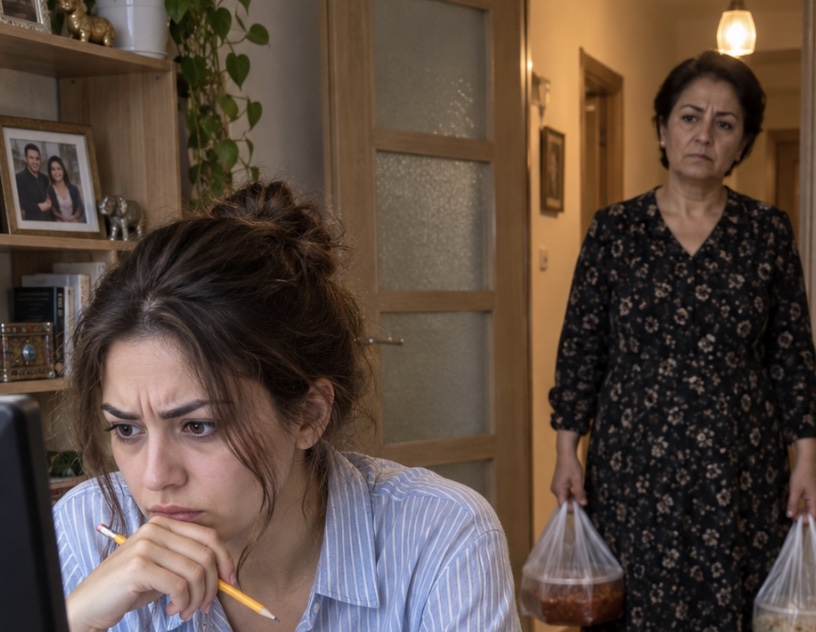
I had learned to recognize Nelli Arkadyevna’s footsteps without fail.
We lived on the fifth floor of a building with no elevator. Her heels struck the stairs with a confident rhythm as she climbed, taking two steps at a time. On the third floor, she always stopped to catch her breath. Then the steady ascent resumed.
After our wedding, Lyosha and I moved into a small two-room apartment on the outskirts of town. It was far from perfect. The old wallpaper peeled away from the walls in places, and the radiators worked only when they felt like it. Still, I felt comfortable there.
I set up my workspace beside the window. A computer, a graphics tablet, and a coffee mug balanced on the armrest of my chair—that was everything I needed. I worked remotely as a designer, finding clients online and spending most of my days working on layouts.
Lyosha practically lived at the veterinary clinic. His shifts often lasted twenty-four hours, so he was rarely home.
His mother, Nelli Arkadyevna, lived just a few bus stops away.
 
Once she found herself living alone, all that restless energy of hers needed somewhere to go.
Or, more precisely, someone.
That someone was me.
She came over every day, usually after lunch. She had her own key to our apartment.
The moment I heard those familiar heels on the stairs, I automatically minimized my work.
There was no point pretending I would finish anything.
Lyosha was no help with this particular problem.
Every conversation ended with the same words:
“Varya, don’t be upset. Mom’s just worried about us.”
“Worried.”
What a convenient word.
Apparently, it could excuse any amount of interference.
 
That day, I was racing against a deadline.
I was finishing a brand identity, a catalog, and a logo for a furniture company, all at once.
I sat staring at the monitor, absentmindedly chewing my pencil while trying to find the right shade.
Then I heard the familiar routine.
Heels on the stairs.
Two steps at a time.
A pause on the third floor.
Everything right on schedule.
Nelli Arkadyevna arrived carrying a large bag. She ran a finger along the shelf above the sink.
Naturally, it came away dusty.
“Varenka, I’ve brought you some borscht. Have you eaten anything today?”
I had.
I’d had a sandwich that morning and planned to warm up the previous evening’s dinner for lunch.
But answering would have made no difference.
What followed was always the same.
My mother-in-law opened the kitchen cupboard and began rearranging the jars of grains.
Buckwheat on the top shelf.
 
Rice on the bottom.
Millet tucked into the far corner.
As far as she was concerned, that was the only sensible arrangement.
“Why is everything all over the place again? I only just put it all in order.”
Yes.
Just recently.
And before that.
And before that, too.
Every time she left, I put everything back where I wanted it.
Every time she returned, she rearranged it again.
Calmly.
Confidently.
As though there were no other possible way.
Then she looked into the room and noticed the layout open on my screen.
She let out a heavy sigh.
“Playing with your pictures again. How can you call that work? Real work means getting up in the morning and going to an office. You have a boss, and you get a salary every month. This is just… something to keep you entertained.”
I had long since stopped explaining that working from home was still working.
 
It was about as useful as explaining the purpose of a vacuum cleaner to a cat.
She looked at my computer with such pity that you might have thought it was a terminally ill patient.
But that day, something unexpected happened.
I walked calmly over to the cupboard.
Right in front of her, I moved the jars back.
Buckwheat went on the bottom shelf.
Rice went in the middle.
No irritation.
No argument.
I simply restored the arrangement that suited me.
“Nelli Arkadyevna, it’s much easier for me to use them this way.”
She studied my face.
Then she slowly shook her head.
A few minutes later, she left.
I went back to my desk, but I couldn’t concentrate.
An unfamiliar feeling had settled inside me.
It wasn’t hurt.
It wasn’t anger, either.
It was closer to surprise.
 
For the first time, I had allowed myself to do something my own way.
Such a small thing.
Just a few jars.
Lyosha came home that evening, and I told him what had happened.
He fiddled with the button on his cuff, sat quietly for a moment, then gave me his usual response.
“Varya… Mom’s only worried about us. She’s very lonely.”
Later, he spoke to her on the phone.
I was lying in the other room, but I could hear Nelli Arkadyevna’s voice clearly through the speaker.
“I’m doing my best for the two of you, Lyosha. And she can’t even say one kind word. She just sits there in silence…”
A week later, I came down with a nasty cold.
A high fever, a sore throat, and barely enough strength to get off the couch.
Lyosha managed to come home for a little while.
He stopped at the pharmacy, brought me medicine, and made chicken broth.
He set it beside the couch and gently stroked my hair.
He was a kind man.
Sometimes too gentle for his own good.
That was when the front door opened.
Nelli Arkadyevna appeared in the doorway.
Her bag was even heavier than usual.
Homemade broth.
A jar of honey.
Warm woolen socks.
When she saw me stretched out on the couch and Lyosha in the kitchen, she gave a satisfied nod.
As if the scene confirmed everything she had suspected.
 
Without even taking off her coat, she grabbed a bucket and started washing the floor.
I lay there listening to the wet cloth slap against the linoleum.
Then she changed the sheets on our bed.
Nobody had asked her to.
After that, she opened the refrigerator and spent a long time inspecting its contents.
Finally, she called loudly for her son.
“Lyosha! Come here!”
Her voice had the sharp authority of a prosecutor.
“Look for yourself. There’s nothing in the refrigerator. She doesn’t cook at all. You must be going hungry.”
Lyosha stood uncertainly in the kitchen doorway, tugging at his shirt sleeve.
From the couch, I could see him perfectly.
His upturned nose.
His freckles.
The guilty look in his eyes.
And his complete silence.
“I’m only trying to help you,” my mother-in-law continued as she unpacked the groceries. “Just look at this. She’s lying there sick, and there’s nothing to eat. How can you live like this?”
A wave of nausea rose inside me.
But it had nothing to do with my fever.
It felt as though someone had placed a heavy stone on my chest.
Slowly, I sat up and pushed the blanket aside.
“I’m ill, that’s all,” I said evenly. “We can manage. Thank you for thinking of us, Nelli Arkadyevna, but right now I really need to rest.”
I walked her to the door myself.
Calmly.
Almost gently.
I opened it and waited.
She looked closely at me, then at her son.
Lyosha looked away.
My mother-in-law left without another word.
That was when the thought first occurred to me:
Changing the locks would only take a few hours.
For two days, Nelli Arkadyevna stayed away.
On the third, she came back.
As though nothing had happened.
Another week or so passed.
At my request, Lyosha finally spoke to his mother.
 
He asked her to call before coming over.
She seemed to agree.
My husband breathed a sigh of relief.
I went back to work.
I was finishing a brand identity for a chain of coffee shops, and the deadline was approaching fast.
I had headphones on.
The finished layout was open on my screen.
Cold coffee, a pencil, and several pages of scribbled notes covered the desk.
Suddenly, the doorbell rang.
A long, insistent ring.
I glanced at the clock.
Half past one.
I had no doubt who was standing outside.
With my headphones on, I hadn’t heard her footsteps.
But it could only be Nelli Arkadyevna.
Lyosha had asked her to call first.
And apparently, she was following his instructions.
She had simply chosen to ring the doorbell instead of my phone.
I stayed in my chair.
A few seconds later, the bell rang again.
Then came a knock.
After that, silence.
I thought she had finally left.
 
But instead of retreating footsteps, I heard a different sound.
The lock clicked.
Brief.
Familiar.
I turned sharply.
The handle moved.
The door opened.
Nelli Arkadyevna walked straight in with the confidence of someone entering her own home.
She hung her handbag on a hook and took off her shoes.
Then she looked at me.
“Didn’t you hear me? I rang so many times. Good thing I brought my key.”
She headed straight for the kitchen.
Inspected the sink.
Touched the sponge.
Then came back to my room and looked over my desk.
“At the computer again. And look at this mess. Look at yourself, too. Your hair isn’t done, you’re still in your house clothes… Lyosha will be home soon.”
“Nelli Arkadyevna,” I said calmly, “please leave your key on the little cabinet by the door.”
She stared at me.
“Varya… are you serious?”
“Completely. Leave the key. We’re changing the lock today. And please don’t come tomorrow. Or the day after. If you’d like to visit, call me first. On the phone. Ask whether it’s a good time. Then we can sit down and talk.”
 
For several seconds, she said nothing.
Then she quietly put her shoes back on.
Took her handbag from the hook.
And left.
A locksmith came that same day.
We had the lock replaced.
Now there were only two sets of keys.
One for me.
One for Lyosha.
Nelli Arkadyevna no longer comes over without an invitation.
 
These days, she calls only her son.
She complains to her friends.
Tells everyone her daughter-in-law threw her out.
And I sit peacefully at my computer.
Working.
For the first time in ages, I can enjoy the loveliest sound in the world.
Silence on the landing.