My husband, Vadim, and I had been living in our own three-room apartment in an ordinary residential neighborhood for ten years. Yet every Saturday, at precisely half past one, we were expected at the solid old building where his father lived.
Vadim was afraid of his father. It went beyond respect or concern for his opinion. It was fear, plain and simple. That fear made him bend over backward: tracking down expensive medications that were difficult to find, arranging repairs, and sorting out one household problem after another.
“He raised me,” Vadim would repeat. “I owe him everything.”
My father-in-law, Arkady Petrovich, had once held a senior position in a powerful government department. At seventy-four, he still stood ramrod straight and spoke in a deep, commanding voice. He seemed convinced that people came to his home to report for duty rather than to visit.
I managed a lending department and supervised twelve employees. But the moment I crossed his threshold, I felt myself shrink into a frightened schoolgirl waiting to be reprimanded in front of the class.
That Saturday in November, it all started with a piece of meat.
 
I was standing at his enormous oak table, slicing roast pork. The knife was awkward: heavy, thick, and rather blunt. My slices came out uneven, nowhere near as thin and neat as Arkady Petrovich expected everything in his home to be.
“What kind of way is that to hold a knife?” he demanded behind me. “You’re sawing, not slicing. Ruining perfectly good food. Give it here.”
I looked at his hands. They were large and marked with age spots, with a heavy old ring on his fourth finger.
A small, uneven scrap of pork lay beside the cutting board. He speared it disdainfully with the tip of the knife and held it in front of my face, as though I had just destroyed an important government document.
I loosened my fingers and let go of the handle.
Stepping back, I struck my hip against the corner of the table.
It hurt, but I swallowed the pain.
For the sake of peace, I kept quiet again.
“Everything should be on the table by lunchtime. Vadim!” my father-in-law barked toward the hallway, looking past me at the dusty window. “Your wife is taking forever again. We’re waiting.”
A month later, we celebrated Vadim’s forty-fifth birthday.
In our own home.
I had spent the morning washing the floors with a lemon-scented cleaner and airing out the rooms. I hoped that being surrounded by my own walls might help me feel a little more confident.
My friends from university were gathered around the table, and our son, Kostya, had come over.
 
The television was muted, with a sports channel flickering across the screen.
I brought a heavy roasting pan out of the oven. The duck had turned out beautifully, its skin glossy and golden, its aroma filling the apartment.
My friend Irina, who always seemed to be on a diet, took a delighted bite of breast meat and closed her eyes.
“Olga, this is incredible!” she said, reaching for a napkin. “You have to teach me. Every time I try, mine turns out like shoe leather. What did you use for the marinade?”
I opened my mouth to tell her about the orange juice and soy sauce, but Arkady Petrovich, seated beside the window, dropped his fork onto his plate with a sharp clatter.
“There’s nothing worth learning here, Irina,” he said.
His tone silenced the entire table.
He dabbed his lips with a paper napkin, crumpled it, and tossed it straight into his unfinished salad.
“The bird is dry. The sauce is sickeningly sweet. Olga’s taste has always been rather unsophisticated, to put it politely. Be quiet, woman.”
That last remark was aimed at me, although I had not said a word.
 
“Don’t argue.”
Irina looked at me.
There was so much embarrassment and pity in her expression that I wanted to disappear beneath the table.
For a moment, I saw myself through someone else’s eyes: a grown woman standing in her own living room, being scolded in front of her guests like a servant who had done something wrong.
Meanwhile, Vadim was studying the label on a bottle of mineral water with extraordinary concentration.
He barely blinked.
He pretended nothing unusual was happening.
A rushing noise filled my ears.
“Arkady Petrovich,” I finally said, “there’s nothing wrong with the duck. If you don’t like it, there are potatoes over there. Help yourself. Or have dinner at your own place.”
Under the table, Kostya nudged me with his foot.
Vadim swallowed hard, his Adam’s apple jerking.
My father-in-law slowly turned his head toward me. His thin lips tightened into a hard line.
“You’re forgetting yourself,” he said through clenched teeth, staring at the bridge of my nose rather than meeting my eyes. “You’re speaking to your husband’s father.”
“And I’m speaking in my own home,” I replied flatly.
Then I turned and went into the kitchen.
He did not cause a scene that evening. Perhaps he preferred not to put on a performance in front of outsiders.
An hour later, however, he said a curt goodbye to Vadim and left without even looking at me.
For the next month, Arkady Petrovich made a point of ignoring us.
Or, more precisely, ignoring me.
 
He still called Vadim. But whatever he said left my husband sitting in the kitchen for an hour afterward, sighing heavily, measuring drops of a calming tincture from a dark bottle, and talking about going over to “apologize.”
The smell of that alcohol-based medicine, combined with the sight of his slumped shoulders, made me tremble with anger.
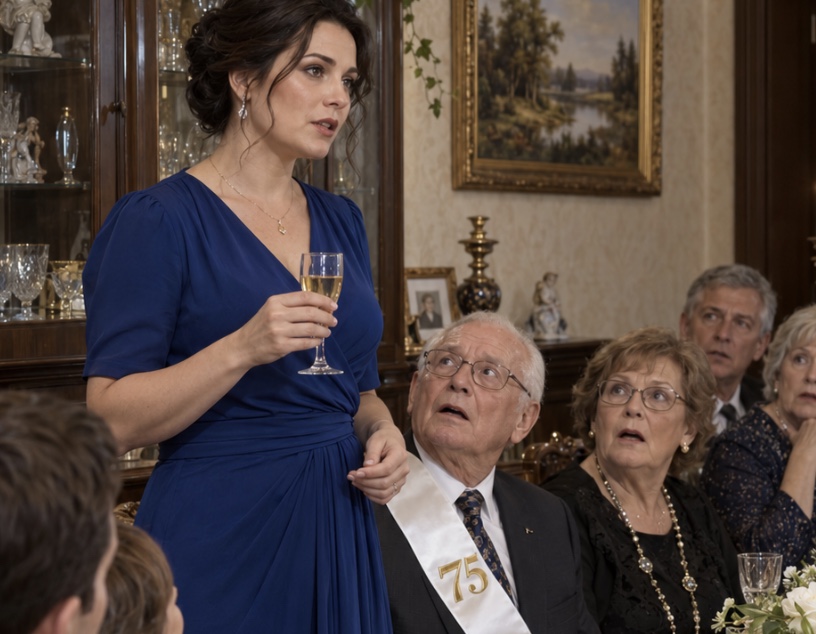
Two months later, Arkady Petrovich celebrated his seventy-fifth birthday in grand style.
His entire old circle attended: heavyset men in formal suits and their wives, wearing thick makeup and overpowering vintage perfume.
Starched tablecloths covered the tables. Crystal glasses gleamed beneath the lights. Small tartlets filled with caviar stood on serving platters.
The room was stuffy. The air conditioning was clearly struggling.
Arkady Petrovich occupied the head of a long table.
People presented gifts and offered toasts to his remarkable contributions, his achievements, his unwavering principles, and his service to the country.
It all sounded solemn, familiar, and faintly insincere.
Vadim was supposed to deliver the fifth toast.
He had spent ages preparing it, writing on a sheet of graph paper, nervously crossing out whole lines and starting again.
Finally, he stood.
 
He adjusted his tie, which seemed to be choking him almost as badly as the atmosphere in the room.
“Dad… Arkady Petrovich,” he began, looking down at his notes. “I’d like to remember our trips to the river. How you taught me to put up a tent… And later, when I applied to university, you always believed in me…”
“All right, sit down, great orator,” the birthday man interrupted condescendingly.
He picked up a cocktail stick with an olive on it and turned it lazily between his fingers.
“What tent? You were afraid to put a worm on a hook. You just stood there crying. And you got into university because I called the right people. On your own, you wouldn’t have managed two coherent sentences in the entrance exam. Sit down and stop embarrassing yourself.”
Vadim remained standing, a half-empty glass in his hand.
Within a second, his face had turned gray.
His lips trembled.
Then he slowly lowered himself onto his chair.
The guests beside us, men his father’s age, gave knowing little chuckles.
Petrovich being Petrovich, their expressions seemed to say. Harsh, perhaps, but fair.
I looked at my husband.
At his bowed shoulders.
At the way he tried to wipe his forehead discreetly with a crumpled napkin.
Suddenly, I could not get enough air.
My elegant navy dress, which had felt so comfortable earlier, became unbearably tight beneath my arms. The zipper seemed to dig into my spine.
I pushed my chair back, stood, and picked up my glass of mineral water.
The water trembled slightly.
 
“I’d like to say something too.”
My father-in-law turned his familiar, oppressive stare toward me.
“Be quiet, woman,” he said almost lazily, suppressing a small, weary yawn as he reached for the napkins. “Sit down.”
“No. I won’t sit down, and I won’t keep quiet anymore.”
I looked directly at him.
“You’re going to hear me out. Everyone here is making lovely speeches in your honor while you sit at the head of the table humiliating your own son.”
Someone to my right gasped softly.
“Olga… God, please don’t,” Vadim whispered.
He caught the edge of my dress and tugged downward. His fingers were ice-cold.
I pulled the fabric free.
“I have to, Vadim. I really do.”
Then I turned back to his father.
“You tell everyone how helpless and useless he is. But who calls half the city in the middle of the night looking for your blood pressure medication? Who comes over to fix your leaking tap while you stand beside him issuing orders?
 
“He does. Your son. Because he has a conscience.”
I took a short breath and continued, my voice steadier now.
“And you, Arkady Petrovich, have very little left beyond your self-importance and your old arrogance. You play the great commander here, but at home you’re an angry, lonely old man in a huge, empty apartment.
“You treat people like dirt. Vadim and me included. Your days of ordering everyone around are over.
“And unless you apologize to your son right now, you can pay a delivery service to bring you that glass of water when you need it.”
Arkady Petrovich lurched forward.
“Get out,” he said, his face darkening to crimson.
A thick blue vein bulged at his temple.
“Get out of here! Vadim! Take her away!”
The table fell completely silent.
These people were used to seeing Arkady Petrovich as an immovable force, a man whose presence made everyone straighten their backs and choose their words carefully.
Now they were looking at a breathless, bewildered old man with a sauce stain on his cuff.
Vadim slowly stood up.
And suddenly I noticed something.
His shoulders were no longer hunched.
He carefully placed his napkin on the table, looked at his father for a long moment, then turned to me.
“Come on, Olga,” he said quietly. “There’s nothing here for us anymore.”
He took my arm, and we walked toward the exit.
Kostya caught up with us at the door. Without a word, he handed me my bag and held open the restaurant’s heavy glass door.
Outside, the warm city air smelled of traffic fumes.
A year and a half has passed.
Arkady Petrovich still lives alone in his enormous old apartment.
 
Vadim no longer visits him.
Occasionally, a distant relative from another city calls my husband and passes along news.
My father-in-law replaces his agency housekeepers almost every month. According to him, one fails to clean beneath the sofa properly, another puts too much salt in the soup, and a third makes his teaspoons disappear.
He argues with the building manager, writes complaints to utility companies, demands inspections, and always finds something to be dissatisfied with.
He has almost no friends left.
Few people want to spend hours listening to his bitter grumbling.
He lives among old carpets, heavy furniture, and gleaming crystal, alone with his unshakable conviction that he is always right.
For Vadim, the first month was agonizing.
He lay awake at night, took drops for his heart, and checked his blood pressure constantly.
He paced from room to room, dialed his father’s number, and listened to the busy signal.
Arkady Petrovich had blocked him.
But as autumn approached, something in my husband began to ease.
 
He stopped flinching whenever the phone rang.
He put the blood pressure monitor away in the back of a dresser drawer.
In November, he went to the shopping mall and bought himself a ridiculous, bright yellow puffer jacket, replacing the dull gray coats his father had always advised him to choose.
We started spending our evenings watching old comedies, eating pistachios on the sofa, and laughing out loud.
Life felt lighter for me too.
I cook whatever I like, however I like.
Nobody stands behind me anymore, checking how I hold a knife, how much salt I add, or whether every slice of meat is perfectly even.
But sometimes…
Sometimes I remember the old man’s crimson face, his trembling hands against the white tablecloth, and the way he sank heavily back into his chair.
Yes, I protected us.
 
Yes, I helped my husband escape the fear that had held him for so many years.
But I also struck exactly where it hurt most.
On his birthday.
In front of everyone.
I crushed the one thing that still seemed to give his life meaning: the illusion of his own greatness.
And I left an old, angry, and probably deeply unhappy man to spend the rest of his life alone.