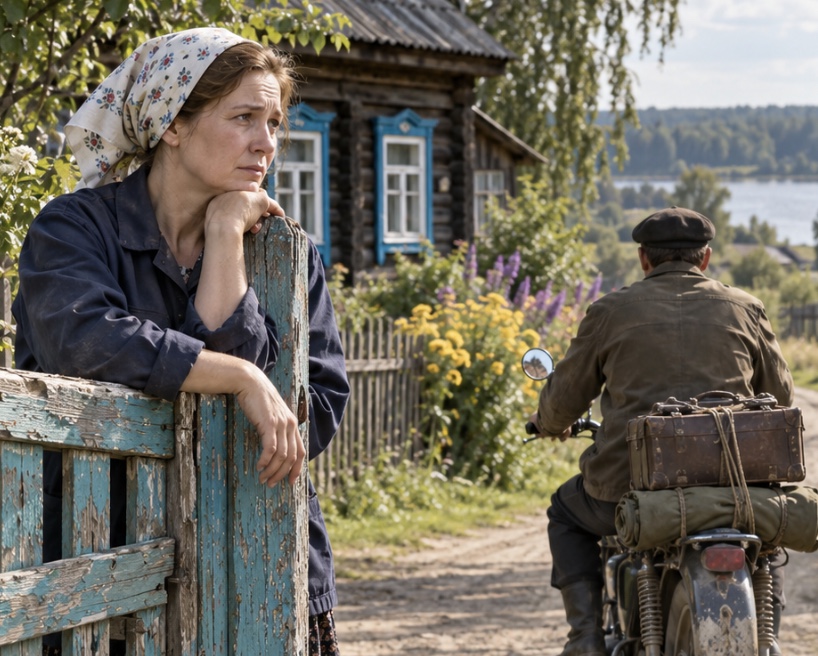
Yegor rode away on his motorcycle in October, after the potatoes had been dug up and the dry stalks burned beyond the vegetable garden. He left me a house with a leaking roof and the faint, sugary scent of another woman’s perfume on his pillow.
I stood by the gate in rubber boots and a work headscarf, watching his motorcycle bounce over the potholes on the road out of the village. A suitcase was strapped to the frame, along with a bundle of tools he had barely used in his entire life. The engine rattled somewhere around the bend for a little longer, then fell silent. Still, I stood there, listening to the crows calling over the empty field.
Every dog in our village knew Yegor had been riding into the district town to see Nastya, the shop assistant. Young, shapely, with dyed hair. A little perfume, a smile, and suddenly a man forgot he was already past fifty.
Forgot he had a wife at home. Animals to look after.
A daughter, Katya, living in the city.
I didn’t cry. It’s strange how that happens: you expect to burst into tears, but inside there is only emptiness. As though something has been pulled out of you, and the place it occupied hasn’t begun to ache yet.
 
The pain came later.
That day, I simply went inside, took off my boots, and put the kettle on.
For the first week, I hardly slept.
I would lie down, close my eyes, and listen to the wind forcing its way through the gap beneath the roof ridge. Water dripped into the attic and ran along a beam. By morning, a damp patch would be spreading across the ceiling.
Yegor had promised to repair the roof back in spring. But there was always something else to do. Always “tomorrow” or “the day after.”
He took all the money.
Every last banknote.
He hadn’t just taken his own share. He had emptied the envelope containing our joint savings. We had added to it little by little: money from my job at the farm and from his occasional odd jobs.
Before leaving, he said:
“You’re strong. You’ll manage. I need something to get me through until I settle in.”
Settle in, indeed.
 
Into Nastya’s little apartment above the shop, where the walls were as thin as plywood and you could hear the delivery men hauling crates downstairs.
Outside, Manka, our goat, was waiting to be fed. The hens huddled beneath the lean-to. The shed door hung crookedly on its hinges.
I got up before dawn, pulled on my padded jacket, and went outside. Frost silvered the grass, and the ground crunched beneath my boots.
The first freeze.
And there I was, without money, without another pair of hands, and with no help to count on.
I milked Manka, collected eggs, and made cabbage soup from whatever remained in the cellar from summer. I patched the roof myself. I climbed into the attic with a bucket of tar and some old roofing felt, sealing the seams until my fingers turned black and grew stiff with cold.
Eventually, I fixed it.
The repair was crooked and ugly, but the dripping stopped.
Below, the first snow lay over the vegetable garden, thin as gauze. The earth beneath it still seemed to breathe.
Katya called from the city in the evenings. Every time, she said much the same thing.
 
“Mom, I just don’t understand… How could this happen? You were together for so many years, and then suddenly… Maybe you were too hard on him. Maybe that’s why he left.”
I listened without answering.
Katya didn’t know what it meant to climb up and repair a roof yourself. She didn’t know her father had taken every penny we had saved. I hadn’t told her.
But after those conversations, I would sit in the kitchen for a long time, feeling a sickening weight pressing against my chest.
The hurt made it difficult to swallow. It was like being struck and then told you had brought it on yourself.
One evening, I finally reached my limit.
“Katya, your father left me with a leaking roof and an empty savings envelope. I didn’t throw him out. He got on his motorcycle and went to another woman. I won’t discuss this again. That’s all.”
She hung up without even saying goodbye.
I put the phone on the table, sat on a stool, and stared out the window. My hands were cracked, my nails broken, my calluses yellowed.
Inside, though, I felt something unfamiliar. Neither happiness nor pain. It was as if I had finally crawled out from beneath a heavy weight and could take a full breath.
That evening, my neighbor Tikhon came over. He kept bees and had lived alone for years. He set a jar of honey on the step and adjusted his cap.
“Your porch is wobbling all over the place. Let me give you a hand.”
I almost refused. I had already grown used to doing everything myself.
Then I looked at him and nodded.
He returned the next morning with boards and a wood plane. He worked quietly, occasionally whistling under his breath. By lunchtime, the porch was level and no longer shifted beneath my feet.
 
He had a cup of tea, thanked me, and went home.
I sat there thinking that Yegor had never repaired that porch in all our years together, despite promising to do it every spring.
Summer brought the heat.
And with it came visitors I hadn’t invited.
By then, the hens were laying well, Manka was giving milk, and the vegetable garden was producing a decent harvest. The first jars of preserves were already lined up on the cellar shelves.
Whenever I looked at them, the same thought came to me.
I could do this.
On my own.
I really could.
Tikhon stopped by in the evenings. Sometimes he straightened a section of fence; sometimes he tightened the gate hinges. I gave him supper and tea. He thanked me and left.
Naturally, the village began to whisper.
I didn’t care.
The sun blazed, the grass dried out, and the garden was full of flowers and fragrance.
 
Then, one afternoon, as I carried a bucket back from the well, a car stopped outside my gate.
Two women got out.
I recognized the first immediately: Nastya. She wore heels and a flowered dress, with bright lipstick on her mouth. Behind her came a red-haired friend holding a phone, as though they had arrived to film a performance rather than have a conversation.
“Hello,” Nastya said, with the confidence of someone walking into her own yard. “Yegor asked me to collect the special-occasion dishes. He said you’d hand them over.”
I lowered the bucket to the ground.
Across the fence, my neighbor Zoya froze with a bedsheet in her hands and listened closely. Two other women stopped beside the road. The mobile shop had just arrived, and people were gathering near the village store, so there was no shortage of spectators.
“He’s said plenty of things,” I replied.
“Well, just give them to me and save us the trouble,” Nastya said with a smirk. “Why keep what isn’t yours? He said you were here alone and had let the whole place go…”
She glanced past me at the yard, the house, and the vegetable beds.
I watched her expression change.
The fence stood straight.
 
The beds were weeded.
The hens wandered around the yard.
Clean laundry dried on the line.
Nothing about the place suggested neglect.
“He also said,” Nastya continued, raising her voice so everyone near the fence could hear, “that being with you was… well, like being with a log. No offense.”
Heat rushed up the back of my neck.
Something dropped inside my chest.
I gripped the bucket handle so tightly that the metal dug into my palm. The red-haired woman raised her phone.
She was recording.
Suddenly, everything looked painfully sharp. It was as if someone had adjusted a lens, bringing every little line on Nastya’s face into focus.
Zoya gasped behind the fence. The women near the shop fell quiet.
Only one thought filled my mind.
Don’t lose control.
If I started shouting, they would drive away satisfied. By tomorrow, the whole district would be talking about the scene I had made at my gate.
I turned, went inside, and returned with a cracked earthenware bowl. Yegor had brought it home from a fair once, then dropped it that very evening.
“Here,” I said, holding it out. “There’s nothing else of his here. His hands haven’t done anything in this house for years. Not to the walls, the fence, or the roof. He never even fixed the porch.”
Nastya opened her mouth, but I continued before she could speak.
“The dishes are mine. Tell him he can promise you whatever he likes. What belongs to me stays with me.”
The bowl remained beside the gate.
Nastya didn’t take it.
They got back into the car and drove away.
 
Zoya adjusted the sheet on her washing line and said softly:
“Well done. Honestly, well done.”
I watched the car disappear and suddenly realized something.
I wasn’t afraid anymore.
Not at all.
Autumn arrived early that year.
The birches beyond the village had begun turning yellow before summer ended. I dug up the potatoes, stored them in the cellar, and sealed the last jars.
Everything was in good order: a clean yard, a sturdy fence, young goats bounding around beside the shed.
I looked at it all and could hardly believe I had accomplished so much with my own hands.
And Tikhon’s, of course.
By then, he came over every evening. We drank tea. He told me about his bees, and I told him about Manka.
Sometimes we sat in silence for a long while. But with him, silence wasn’t empty. It was warm, like bread fresh from the oven.
Beside him, I felt safe and at ease. That kind of peace only comes with someone who doesn’t need every feeling explained.
The village had already drawn its own conclusions about us, naturally.
 
There wasn’t much to decide. We were simply two people who were no longer young and felt more comfortable together than alone.
Then one evening, while Tikhon sat at my kitchen table, an engine rattled outside.
I recognized the sound immediately.
The motorcycle Yegor had ridden away on a year earlier.
He was standing by the gate.
He had lost weight, and his cheeks looked hollow. He wore a city jacket too light for the weather and worn-out boots. He coughed into his hand.
The motorcycle looked battered too: a bent fender, peeling paint.
“Let me in, will you?” he muttered, stumbling over his words and breaking into a harsh, wheezing cough. “Nastya threw me out. She’s renting the apartment to someone else. I’m sick. I need treatment…”
Zoya immediately appeared above the fence.
Who else would be the first witness to someone else’s troubles? Nothing stays secret in a village. Within half an hour, everyone would know Yegor had turned up at my gate, from the women at the well to the last stray dog.
I stepped onto the porch.
The new, solid porch Tikhon had rebuilt with good boards.
And suddenly, I thought: a year ago, I had stood here watching Yegor leave. Now he was standing below, looking up at me with something close to desperation.
He raised his eyes.
First, he noticed the level porch. Then the freshly painted window frames, the repaired fence, and the gate that finally hung properly.
Then his gaze moved past me into the brightly lit kitchen.
A man was sitting at my table.
Another man.
In Yegor’s mind, that meant another man in his house, at his table.
Red blotches spread across his face.
“Who’s that in there?” he asked in a low, strained growl.
 
“Tikhon,” I answered calmly. “Our neighbor. He’s done more for me in this past year than you did in all our years together. He rebuilt the porch, repaired the fence, and fixed the gate. You couldn’t even get around to the porch, Yegor.”
“I’m your husband!”
“You were,” I said firmly. “Then you got on your motorcycle and left. You took the money, abandoned Manka, and filled our daughter’s head with who knows what. Now that your young woman has thrown you out, you expect to come home? No. This is my home. There’s no place for you here anymore.”
He stood there, his lips twitching, but he had nothing left to say.
Behind the fence, everything had gone quiet too. I knew perfectly well that the whole street was listening, holding its breath.
“Go to your mother in Dubrovka,” I said. “She’ll take you in. You can’t turn to me anymore.”
Yegor stared at me for a long time.
And I could see that he understood.
All of it.
He stood in the yard while the wind tugged at the hem of his jacket, making him seem smaller and more forlorn.
Then he turned and climbed onto the motorcycle.
It wouldn’t start at first.
The engine coughed almost as badly as he did.
Eventually, it caught, rattled, lurched forward, and carried him away.
Tikhon came out onto the porch and stood beside me.
He didn’t say anything.
That was enough.
In spring, melting snow began dripping onto the metal canopy above the porch. Manka bleated in the shed, demanding to be let out onto the first fresh grass.
Yegor was living with his mother in Dubrovka and picking up work here and there. His motorcycle stood rusting beside her fence, as though it too had grown tired of unfamiliar roads.
Katya started visiting me on weekends. She helped in the garden, tended the beds, and carried water.
One day, while we sorted seeds at the kitchen table, she spoke quietly.
“Mom, I’m sorry. I didn’t know what had really happened.”
 
After my divorce from Yegor, Tikhon and I moved in together.
Later, we got married.
The village talked about it for a long time.
Some people supported me. They said I had done the right thing, that you shouldn’t take someone back simply because life had become difficult for them after they betrayed you.
Others shook their heads.
“But he was sick. And he’s still her daughter’s father. She could at least have let him stay in the entryway.”
Even now, I sometimes wonder whether I made the right choice.
On one hand, he betrayed me. He abandoned me, took our savings, humiliated me, and left for another woman. He returned only when she no longer wanted him.
On the other hand, I feel sorry for him.
Not as a husband.
As a person.
But perhaps pity is a poor foundation for a home.
Especially a home you rebuilt with your own hands after being left alone with the cold, a leaking roof, and an empty envelope.