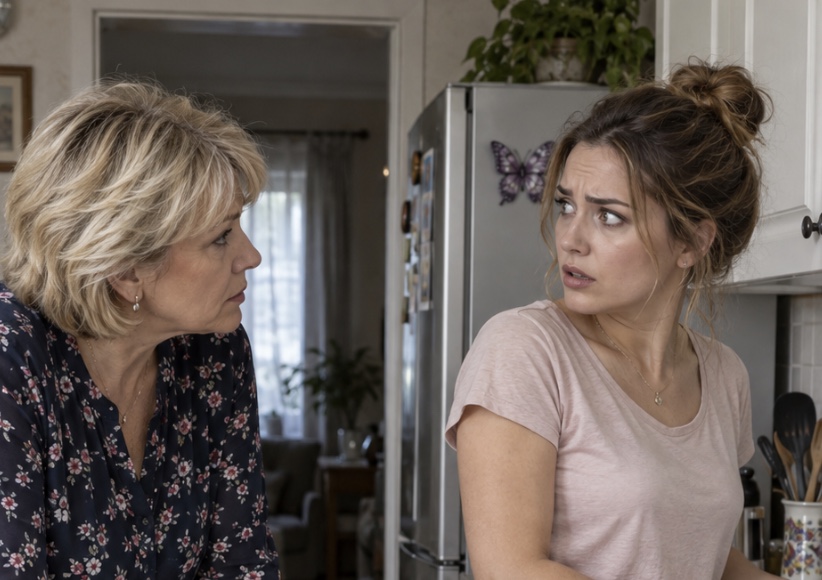
“I’ve already worked it all out,” Irina Leonidovna said confidently, pushing her cup aside and resting her elbows on the edge of the table, as though the decision had been made and there was nothing left to discuss. “First, we’ll take your gold jewelry to a pawnshop. If they offer too little, we’ll sell it through a jeweler I know. It should bring in a decent amount—enough to cover all of Ilya’s university tuition.”
Polina froze beside the sink, still holding a plate she had been about to rinse.
The tap kept running, washing away the remains of dinner, but her mother-in-law’s words drowned out the sound.
“Whose gold jewelry?” she asked slowly.
She left the water running and remained with her back to the table, hoping she had misheard or that Irina Leonidovna had simply expressed herself badly.
“Yours, Polina. Of course, yours,” her mother-in-law replied almost affectionately, though there was an unmistakable edge to her voice. “The jewelry your late aunt left you. You never wear it anyway. It just sits in that box doing nothing, while a child’s future hangs in the balance.”
Polina rinsed her hands, shook the water from her fingers, and dried them on a kitchen potholder.
Ilya was Anton’s son from his first marriage.
 
He was hardly a little child anymore. He had spent the entire summer hanging out with friends, barely studying, and had predictably failed his entrance exams. He hadn’t qualified for a tuition-free place.
Anton couldn’t afford the fees. His ex-wife had immediately announced that she didn’t have that kind of money either.
And now Irina Leonidovna had found a way to solve the problem at someone else’s expense.
Anton himself sat on a stool near the window. He was staring at his phone, pretending to examine the utility bills.
Whenever a serious conversation began brewing at home, he generally preferred to make himself invisible and avoid getting involved for as long as possible.
“Irina Leonidovna,” Polina began calmly, taking a seat across from her mother-in-law, “those pieces mean more to me than their weight in gold. There are my grandmother’s earrings and a heavy pendant that belonged to my aunt. They’re family keepsakes. Why should I sell them?”
“Because I don’t want to be worse off than everyone else!” Irina Leonidovna snapped, adjusting her elegant chiffon blouse. “My neighbor’s grandson got into a good university. Why should mine have any less? Is he supposed to join the army or get a job loading trucks? Family is supposed to help in situations like this!”
 
“Then let his family help.”
“But we’re all one family!” the older woman insisted. “Anton is his father, and you’re Anton’s wife. That means you should understand the situation and support us.”
Polina slowly turned toward her husband.
Anton continued scrolling diligently, as though the fate of humanity depended on something on his screen.
“Anton, don’t you have anything to say to your mother?”
He swallowed nervously, slipped the phone into the pocket of his lounge pants, and looked somewhere above Polina’s head, toward the extractor hood.
“Well, Polina… Mom does have a point.”
“What point, exactly?” she asked in an unusually quiet voice.
Anton shifted on his stool.
“Why do you even need that jewelry? You never wear it. It’s not as though you’re particularly fond of gold. It sits on the top shelf, taking up space and collecting dust. Ilya needs a chance to start his adult life properly. Once we have the money, we’ll buy it back. Or get you something else—even better.”
Now everything was clear.
 
They had already discussed it without her.
They had settled the matter, assigned their roles, and even decided what promises to make after the jewelry was sold.
Behind her back, her husband and mother-in-law had agreed to dispose of an inheritance that had nothing to do with either of them.
A deep, heavy anger began building inside her.
At first, Polina wanted to answer immediately, but her voice failed her. The words caught in her throat.
She stayed silent for several seconds, collecting her thoughts and trying not to say more than she intended.
“You’ve certainly made yourselves comfortable deciding things for me,” she finally said coldly. “Both you and your son. Unfortunately, your plans go much further than I’m willing to allow.”
Irina Leonidovna’s eyes widened. Red blotches quickly spread across her face.
“How dare you! Who do you think you are, speaking to your husband’s mother like that?”
“I’m simply being honest. My aunt spent twenty years working in harsh conditions, and it cost her her health. She didn’t collect those pieces so your grandson could sell them to cover the consequences of skipping classes and refusing to study.”
 
“You’re heartless!” her mother-in-law cried, throwing up her hands. “You haven’t an ounce of sympathy! So the boy made a mistake. It could happen to anyone. Anton works for your family and brings everything home, while you cling to a few bits of metal and refuse to help!”
Polina gave a faint, humorless smile.
It was an old, familiar tactic: make her feel guilty, then portray Anton as the sole provider to whom everyone supposedly owed a debt.
“He brings everything home?” Polina narrowed her eyes and turned to her husband. “Then tell your mother where your quarterly bonus disappears. And explain why I’ve been buying groceries with my credit card for the past two weeks.”
Anton immediately flushed.
“Polina, don’t start. That isn’t what we’re talking about.”
“It’s exactly what we’re talking about,” she said sharply, planting her palms on the table. “Irina Leonidovna, every month your son sends his ex-wife money on top of child support. For Ilya’s entertainment, clothes, and whatever else he wants. He also pays your bills and covers your trips for treatment and vacations.”
Her mother-in-law opened her mouth but said nothing.
“I’ve kept quiet until now,” Polina continued before she could interrupt. “Anton and I agreed that he could manage his own earnings. I stayed out of it. But from now on, you’ll fund your own wishes. Nobody is getting my inheritance. Not today, not next week, and not later.”
“How can you—” Irina Leonidovna turned to her son, expecting him to defend her. “Anton, do you hear the way she’s speaking to me?”
Anton clenched his jaw and abruptly stood.
“That’s enough. Sort out your women’s arguments yourselves. I’m not getting involved.”
 
He hurried into the hallway, snatched his windbreaker from its hook, and headed for the door. A floorboard creaked beneath his foot, followed by a loud slam.
The two women were left alone in the kitchen.
Irina Leonidovna glared at her daughter-in-law. Polina calmly picked up her cup and put it in the sink.
“You’ll have to find the money yourself, Irina Leonidovna,” she said without turning around. “Sell your country cottage. Your grandson’s future matters more than any property, surely.”
Her mother-in-law offered no reply.
She grabbed her shiny handbag from the cabinet, fastened her coat, and soon left as well.
Once she was alone, Polina leaned her shoulder against the kitchen doorframe and closed her eyes.
The apartment was completely quiet, yet the tension seemed to linger in the air. Through the wall, she could hear the neighbors’ television, its steady murmur unusually distinct.
Anton returned late that evening.
Polina was already in bed beneath a blanket, reading on her phone. He undressed without switching on the light, tossed his jeans onto the chair by the window, and dropped heavily onto the mattress beside her.
“Asleep already, of course,” he muttered resentfully.
 
“I’m awake.”
Anton shifted and propped himself up against the pillows.
“You shouldn’t have treated Mom like that. She was trying to help. Her intentions were good.”
“People with good intentions take their own belongings to a pawnshop. They don’t decide what to do with someone else’s.”
“You act like you’re guarding some priceless treasure,” Anton said sarcastically. “I’ve never once seen you wear that jewelry. Why keep it locked in a box and worry over it?”
Polina set her phone on the bedside table.
“Because it’s my safety net if life gets difficult. And I’m not spending it on your son after he spent an entire year refusing to open a textbook.”
“He’s still a teenager! He was going through a difficult time!”
“He wasn’t going through a difficult time. He’s used to doing nothing and having everything handed to him,” Polina replied sharply. “We paid for private tutors all year. From our shared budget, by the way. I said nothing when we gave up our vacation because of those expenses. But now he’s failed his exams, and I’m supposed to hand over my aunt’s jewelry?”
“I told you I’d replace it!” Anton raised his voice.
“How?”
Polina switched on the bedside lamp, filling the bedroom with warm yellow light.
“You spend every last penny of your salary. Child support, extra transfers, helping your mother, car payments. Where will you get the money to replace the jewelry?”
Anton frowned and stared at his clasped hands.
“I’ll find a second job.”
“You haven’t managed to replace the kitchen tap in six months. When are you going to take on a second job?”
“So everything is my fault?” he began, falling into his usual complaint. “I’m a terrible father and a useless husband. Everyone takes advantage of me, but the moment I need help, they turn their backs.”
“Nobody is forcing you to do any of this. You let your ex-wife keep asking for more. You taught Ilya that adults would solve every problem for him. This is the result. Let him get a job. He can deliver packages, wait tables, or help on a construction site. After working for a year, he might understand what money costs—and perhaps he’ll prepare properly next time.”
“My son isn’t going to sweep streets!” Anton snapped.
 
“Then he can do his military service. At least his living expenses will be covered.”
Anton sprang out of bed.
“You know what? If you’re that greedy—if those scraps of metal matter more to you than your family…”
He strode to the wardrobe, pulled open the door, and reached toward the top shelf. Between several old shoeboxes sat a wooden jewelry box.
Polina didn’t move.
She simply watched his hand.
“If you take that box, start packing your things immediately,” she said quietly.
There was no shouting, no scene.
Anton froze with his fingers just a few inches from the dark wooden lid.
“You’re going to throw me out of my own apartment?” He tried to laugh, but his voice lacked confidence.
“Half this apartment belongs to me. We pay equal shares of the mortgage. But I won’t live under the same roof as someone who’s willing to steal from me.”
“I’m not a thief. I’m your husband!”
“Being my husband doesn’t give you permission to take my belongings. If you open that box and take the jewelry, you’ll be stealing. Go ahead, Anton. Take it. Then we’ll see what happens.”
A heavy silence settled over the bedroom.
 
Anton stood with his back to the bed, his hand suspended near the box and his shoulders rigid.
Polina knew he was weighing the consequences.
If he took the gold, this would become far more than a kitchen argument. They would have to divide the apartment. He would have to explain things to his mother, find somewhere to rent, and pay for his new life himself.
His hand slowly dropped.
He slammed the wardrobe door.
“Choke on your precious gold,” he said through clenched teeth.
“Thank you,” Polina replied evenly, switching off the lamp.
Anton went to sleep on the living room sofa.
The next day, Irina Leonidovna called again. Polina saw her name on the screen and let the phone ring.
She could speak to her son. Their relationship and their problems were theirs to manage.
By the end of the week, the conflict had gradually subsided.
As Polina had expected, Ilya didn’t enroll anywhere. Paying tuition was no longer an option because nobody was willing to cover it.
Anton’s ex-wife shouted at him over the phone and demanded that he take out a loan. This time, however, he refused. He already had enough debt from the car.
Ilya had to get a job as a courier for a delivery service.
 
Irina Leonidovna stopped arriving uninvited. Even her calls became much less frequent, and Polina felt a considerable sense of relief.
For another couple of weeks, Anton behaved like a deeply wounded man. He slept in the living room, walked around looking miserable, and made a point of refusing dinner.
Eventually, though, his resentment faded.
He realized nobody was going to coax him, fuss over him, or follow him around with a plate of food. Living on ready meals quickly lost its appeal, too.
Anton returned to the bedroom and began greeting his wife in the mornings again.
The wooden box containing her aunt’s jewelry remained on the wardrobe’s top shelf.
 
Polina carried on with her life without fooling herself.
People rarely change overnight. Anton would probably remain indecisive. Her mother-in-law would keep looking for ways to benefit herself. His ex-wife would continue asking for money.
But now they all understood one essential rule.
Polina’s boundaries were to be respected.