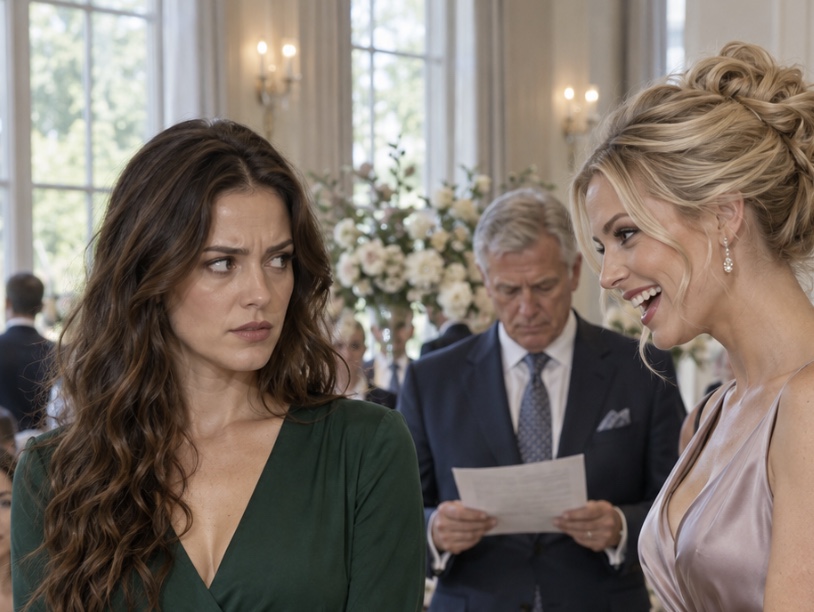
“Miss, may I ask who you’re here to see?” Violetta looked at me as if I’d walked into the wrong house.
But I was exactly where I’d been invited. The restaurant’s spacious banquet hall overlooked the river. Candles glowed on the tables, waiters carried trays between roughly sixty guests in evening wear, and everyone had gathered to celebrate the fifteenth anniversary of the Delta store chain. The owner himself had invited me. I hadn’t spotted him yet, but the hostess had already found something about me that caught her eye.
My bag.
It was brown leather, with worn corners and a slightly faded strap. I had made it myself thirteen years ago, when I opened my workshop. It was the first thing I ever produced. Since then, it had been more places than half the people in that room, and I had no intention of replacing it with a shiny clutch for one evening.
 
“I was invited,” I said calmly. “I’m a guest.”
“A guest,” Violetta repeated, stretching out the word. She lifted her chin and waved a hand covered in rings. “Did a friend invite you, by any chance? Or are you accompanying someone from the staff?”
The hall smelled of candle wax, expensive perfume, and warm cheese canapés. I adjusted the strap on my shoulder.
“I’m not accompanying anyone. I came on my own.”
She looked me up and down: plain dark dress, flat shoes, and that bag. Her expression said everything. She doesn’t belong here. Someone made a mistake at the door.
I knew that look by heart. Years earlier, I’d seen it on the face of the first shop manager I approached with my samples. She turned a bag over in her hands, asked whether I had “any sort of name,” and handed it back without another glance. I saw the same look at trade shows, right up until people picked up my work. That was when I learned to stop arguing. I put my products on the table and waited. The craftsmanship spoke for itself. It always had.
“You know,” Violetta said, lowering her voice as if we were sharing a confidence, though she made sure the two men beside her could hear, “this is a private event. Partners, serious people. I don’t have anything against you, but usually someone carrying an accessory like that comes in to collect the dishes.”
One of the men gave a short laugh. The other looked away.
 
For thirteen years, I had built my business from a cutting table in a rented room to a workshop employing twenty people, with my products stocked in the city’s finest boutiques. I had grown used to being judged by my work. Now the wife of a man who had spent six months trying to secure a contract with me was telling me I belonged at the kitchen sink.
I could have answered. I could have given my name, shown her the invitation, and ended the conversation in one sentence. Something stopped me.
Near a column, an older guest in a gray suit was speaking to the man beside him.
“Arkady’s been chasing one leatherworker for half a year,” he said. “Claims she’s the best in the whole region. He finally talked her into it. I think they’re signing tonight.”
I let myself smile faintly and said nothing.
“What are you smiling at?” Violetta narrowed her eyes. “I’m serious. People can’t just wander in here.”
“I understand,” I replied. “I’ll stand out of the way. I wouldn’t want to disturb the serious people.”
I moved to a window and set my glass on the sill. Beyond the glass, the river had gone dark, and the lights of the bridge trembled on the water. Violetta watched me with a victorious expression. In her mind, she had chased me off and restored order to her world. All I had done was refuse to argue. Yet something heavy and steady was rising inside me, like a river approaching flood level. I knew the evening wasn’t over.
 
Half an hour later, she found me again.
My fingers had gone cold, though the hall was warm. It wasn’t fear. It was the kind of anger that stays quiet while it gathers strength.
This time, Violetta had brought three women in glittering dresses. All four stared at me as though I were an exhibit.
“There, girls, I told you,” Violetta said, pointing straight at my bag. “Take a look. What even is that? Where do they sell those? At the market around the corner?”
The women laughed. One covered her mouth; another leaned closer to inspect it, as if I were a shop display.
“And look at the strap!” Violetta’s laughter was high and rattling, like a spoon shaking against a glass. “The finish is coming off! Darling, couldn’t you at least polish it? Or is this your style—poor but presentable?”
I stood there without speaking.
Over thirteen years, thousands of meters of leather had passed through my hands. With my eyes closed, I could tell calfskin from goatskin by touch, vegetable tanning from chrome tanning, a clean cut from a ragged one. I had made this bag from the first piece of leather I bought with my last bit of money after leaving the factory to start my business. Every worn patch held a memory: an order, a business trip, an exhibition, a sleepless night spent refining a pattern. And here was a woman who had never earned a ruble through her own work, giving me a lesson in quality.
 
“So is it really from the market?” one of the women asked.
“It’s handmade,” I said. “One of a kind.”
“Oh, naturally.” Violetta rolled her eyes. “Everything is ‘handmade’ these days. We know what that means—cheap stuff dressed up with a fancy word. Don’t take offense, dear, but you can tell a lot about a person from what they carry. A bag is your calling card. And yours…”
She let the sentence trail off, finishing it with a dismissive wave. The women burst out laughing again.
Other guests began to turn toward us. Some were curious; some looked uncomfortable. It was an ugly spectacle, but nobody challenged the hostess. Violetta had found exactly what she wanted: an audience, the center of the room, and an outsider to ridicule.
Then she changed her tone. She pressed a hand to her chest, pretending to be embarrassed on my behalf.
“No, I mean well,” she said. “Would you like the number of my leatherworker? He makes gorgeous bags. All my friends go to him. Honestly, bringing that into a place like this is embarrassing. People will think we invite just anyone.”
Her leatherworker who makes gorgeous bags. I nearly laughed aloud. Half the beautiful leather goods in this city’s expensive shop windows came out of my workshop. For all I knew, her man bought my products and resold them under his own label. Still, I kept quiet.
My cheeks burned. I could leave. I could call Arkady, say one sentence, and end this immediately. I could simply tell her my name.
But if I opened my mouth to defend myself, I would become the person she thought she saw: someone pleading to be accepted at the table of important people. I hadn’t come here to ask for a favor.
 
Let my work speak. Not me.
“You’re right,” I said softly. “A person’s belongings can tell you a great deal about them.”
Something in my voice silenced Violetta for a moment. Only a moment.
“Rude, too,” she scoffed to her friends. “Did you hear that? You can’t say a word to her.”
She led them toward the champagne table. As they walked away, I caught a fragment of her conversation: “Tell Gosha to escort her out. It’ll look bad in front of the partners.”
I remained alone by the window. I had kept my composure. I hadn’t shouted or sunk to her level. But it had cost me something: sixty people had just watched me become the evening’s joke, and the bitterness lingered in my mouth like paint that wouldn’t wash off my fingers.
A young man wearing an event coordinator’s badge was already approaching, straightening his bow tie.
“I’m terribly sorry,” Gosha said with a practiced, apologetic smile. “Could you come with me? There’s been a small mix-up with the seating.”
There was no seating mix-up. I knew it, and he knew I knew it. Violetta stood a little way off with her arms crossed, watching us.
“What sort of mix-up?” I asked.
 
“Well…” Gosha hesitated and glanced toward her. “This is a guest-list event, and there seems to be some confusion. If you’ll come with me to the lobby, we can sort it out there.”
I didn’t blame him. He was a young employee doing what the hostess had told him to do: remove an inconvenient guest. He looked embarrassed, avoided my eyes, and kept worrying the edge of his badge. On another day, I might have felt sorry for him.
I looked at Gosha, at Violetta in the distance, and at the guests beginning to watch us again. Then I made what seemed like the sensible decision: I would leave of my own accord, without making a scene. Not because I was frightened. I simply didn’t want to be part of this circus. Arkady would find out, call me, apologize, and we could sign the papers at my workshop tomorrow, like adults.
That seemed right. I almost convinced myself that leaving with my dignity intact would be a victory.
“You don’t need to escort me,” I said. “I’ll see myself out.”
I took my bag from the windowsill, settled the strap on my shoulder, and walked toward the doors. Calmly, steadily, looking straight ahead. It was my decision to go.
Violetta turned it into something else.
 
“That’s right!” she announced loudly enough for the whole hall to hear. “Off you go. Everyone has their place. Some people dine with business partners; others come in from the cold to warm up. Don’t take it personally. That’s how the world works.”
Laughter spread across the hall. Not everyone joined in, but enough people did for it to catch up with me at the doors. My quiet departure had become an eviction. I no longer looked like someone choosing to leave. I looked like someone being thrown out. Violetta had secured the last word and the last laugh.
“Walk her all the way out, Gosha,” she added sweetly. “Just to be safe.”
I stopped three steps from the doors. I didn’t turn around. I rested my hand on my bag.
Inside it were samples from my new collection and the contract I had brought for Arkady. They had been there the whole time.
For thirteen years, I had believed the world was changing—that people were finally judged by what they did. Yet here it was again: the bag, the shoes, the loudest voice in the room. Worst of all, I had nearly let her win. I was walking toward the door she had ordered me through.
My fingers tightened around the clasp, then relaxed.
I had just taken hold of the cold brass door handle when a man’s voice rose above the laughter behind me.
“Nelly Sergeyevna? Are you leaving already? I’ve been looking for you everywhere.”
The laughter stopped as abruptly as if someone had pulled a plug.
 
Arkady crossed the hall toward me, and the guests moved aside to let him pass. Tall and graying, in a dark suit without a tie, he was the man whose celebration this was. He held out his hand and smiled with the unmistakable warmth of someone pleased to see me.
“Forgive me for not meeting you when you arrived,” he said. “I got caught up talking to the suppliers. Why are you by the doors? Your seat is at the main table.”
I released the handle and turned.
“Good evening, Arkady Lvovich.”
From the corner of my eye, I saw Violetta. Her smile was still fixed in place, but her eyes darted from me to her husband and back. The color began to drain from her face. She opened her mouth, then closed it.
“Friends!” Arkady turned to the room, still holding my hand. “Since we’re all here, allow me to introduce Nelly Sergeyevna. We’ve spent six months trying to bring her products into our stores. She’s the finest leatherworker in the region. Her handmade bags and briefcases are the reason customers will come to us from across the city. We’re signing the contract tonight.”
A thick silence settled over the hall. Someone started clapping, and then everyone joined in. The women in glittering dresses clapped especially hard, carefully avoiding one another’s eyes.
“Arkasha,” Violetta said, her voice thin and strained. “Arkasha, I didn’t know. How could I have known she was—”
“She was what?” Arkady asked. His voice was level, without anger. That calmness seemed to unsettle her more than shouting would have.
 
I placed my worn, supposedly “market-bought” bag on the nearest table and opened it. I took out the contract folder and a catalog. Across its glossy pages, my products lay on velvet like precious objects.
“You told me earlier,” I said quietly. In the silence, everyone could hear me. “You can tell what a person is like by what they carry. You said a bag is someone’s calling card.”
I laid my hand on the worn leather.
“I made this bag thirteen years ago from the first piece of leather I could afford. I bought it with my final paycheck. I carried it to the meetings that built my business into one your husband wants to work with. So yes, you were right: belongings can tell us about people. Perhaps we should take a look at yours.”
Violetta had gone pale. Her fingers gripped the back of a chair.
“And you’ve had a rule for this party,” I continued. “Keep just anyone from coming in. Protect your circle from outsiders. You’ve enforced it all evening. But if you apply it fairly, I’m not the person who doesn’t belong here. The guest your husband spent six months pursuing was being driven out by someone who hasn’t contributed a single useful word to tonight’s business.”
I turned to Arkady.
“I’ll be happy to sign the contract, on one condition: I work directly with you and your purchasing team. No intermediaries who divide guests into people who matter and people who don’t. Agreed?”
“Agreed,” Arkady said, offering me his hand first.
We signed the contract that evening at the main table, with witnesses present. Arkady handed me the pen himself. Guests who had laughed at me half an hour earlier now came over to exchange business cards and ask whether I could make a briefcase for an anniversary gift. I answered each of them as calmly as I would have before they knew my name.
 
Violetta left before the banquet ended. She slipped through a side door without saying goodbye. Arkady didn’t follow her. He stayed at the table, going over delivery dates with me. At one point, without looking up from the papers, he said briefly, “I’m sorry for her. We’ll speak at home.” Neither of us mentioned her again. Whether she continued to host his business events was none of my concern. But I suspected she would think twice before pointing at a stranger’s bag again.
It was after midnight when I stepped onto the riverfront. Cold air rose from the river, and the bridge lights shivered in the black water. My bag hung from my shoulder—the same worn bag with its faded strap, now heavier with a signed contract inside. I adjusted the strap out of habit. For the first time that evening, I wasn’t doing it because I felt I had to defend it. I was simply making myself comfortable.
Thirteen years earlier, I had spent the last of my money on a piece of leather, with no idea whether I could turn it into a business. Tonight, I had taken from the bag I made with that leather a contract that would change my workshop’s future.
The whole hall had laughed at it. Yet to me, it was the most valuable thing in the room.