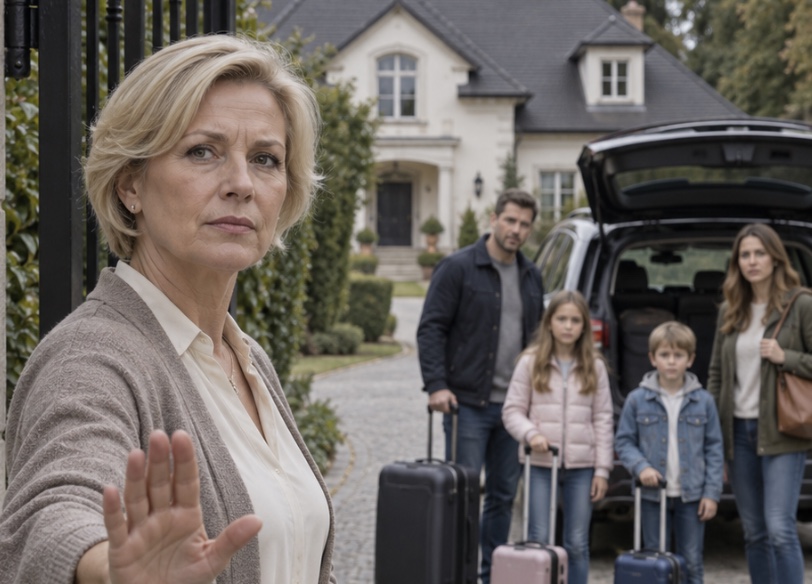
“Open the gates! Zina, her husband, and the children are already on their way!” Tamara Lvovna announced cheerfully from her car.
Polina remained beside the garden bench, paintbrush in hand.
It had been hot since nine that morning. The August sun warmed her back, fresh paint gleamed on the wooden slats, and a screwdriver lay in the grass where she had left it after tightening the bench’s loose fittings.
Her mother-in-law’s car had stopped outside the closed gates. Tamara Lvovna had not even bothered to get out. She lowered her window and gestured impatiently toward the gate.
“Polina, what are you standing there for? Open up. I’ll drive into the yard. Zina will be here in about forty minutes.”
Polina laid her brush across the paint can.
“Why is Zina coming here with her whole family?”
“Why do you think? To stay.”
Tamara Lvovna said it so casually that Polina thought she must have misheard.
“Stay where?”
 
“Here. With you.”
“With her husband and children?”
“Well, she isn’t going to leave them in the city,” Tamara Lvovna said with a laugh. “The children are on holiday, the weather’s lovely, and they’ll have plenty of room to run around here.”
Polina wiped the paint from her fingers with a rag.
“How long are they coming for?”
“Until the end of August. Perhaps they’ll leave a little sooner if they sort things out quickly. Now open the gates. The sun is shining right in my face.”
Polina looked at the gates, then back at her mother-in-law.
“No. First, explain when Zina’s family decided they would be living in my house until the end of August.”
Tamara Lvovna’s smile faded.
“Didn’t Fedot tell you?”
“Yesterday he said Zina was having trouble with her rented apartment.”
“There you are.”
“That was all he said.”
“Then he didn’t get around to finishing the story.”
 
“Judging by Zina’s car full of belongings, it’s a bit late to finish it now.”
Tamara Lvovna finally switched off the engine.
“Polina, don’t make a fuss over nothing. Fedot will come out in a moment and explain everything.”
But Polina already understood the essential part: someone had decided that her consent was the last, and apparently least important, step in their plan.
The previous evening, Fedot had told her about his sister. They were having dinner on the veranda when his mother called. After the conversation, he said Zina had fallen out with her landlord.
For several years, Zina had rented an apartment with her husband, Andrei, and their two children: nine-year-old Egor and six-year-old Liza. The neighbourhood suited them. The school was close, Andrei’s commute was convenient, and the shops were within walking distance.
At the start of the summer, however, their landlord had decided to change the terms. Several major events were being held in the city, bringing in tourists, and he believed short-term rentals would earn him more. He told Zina she could either pay considerably more or move out.
“That’s unpleasant,” Polina had said. “I hope they find another place quickly.”
“Mom’s worried about them too,” Fedot replied.
And that had been the end of the conversation.
He said nothing about a family arriving at their gates the very next morning with suitcases, boxes, and children’s bicycles.
If Tamara Lvovna had arrived even half an hour later, Polina might have heard the rest from Fedot. But her mother-in-law had decided to get there first.
The house outside which she now waited belonged to Polina.
Polina had inherited the plot from her grandfather several years earlier. There had been a small old house on it, but it was no longer suitable for year-round living. At first, she planned to renovate it. After speaking with builders, she realised it made more sense to start again.
She completed the necessary paperwork, had the old building taken down, and gradually built a new house in its place.
Construction took time. Polina had never tried to finish everything in a single season. Once the main work was done, she sold her one-bedroom apartment in the city and put the money toward completing the house.
 
That paid for a proper kitchen, heating, a bathroom, three bedrooms, and a spacious living room. A few months later, Polina moved out of the city for good.
The city was about forty kilometres away. The distance was not ideal for daily travel, but Polina loved the quiet, the garden, and the chance to step into her own yard each morning instead of a shared apartment corridor.
Fedot had not yet entered her life when she built the house.
They met later, when Polina took her car in for routine servicing. Fedot worked as a service adviser at the garage. He explained the work without talking down to her and never tried to sell her repairs she did not need. After her second visit, he asked for her phone number.
They dated for almost a year.
Then Fedot moved into Polina’s house. After several months of living together comfortably, they married.
Fedot had never been confused about who owned the property. He knew where the land had come from, whose money had paid to finish the house, and whose name appeared on the documents.
That made the scene at the gates all the more astonishing to Polina.
She heard the front door open.
Fedot stepped onto the porch in a T-shirt and lounge trousers, saw his mother’s car, and immediately understood.
“Mom, you’re here already?”
“Why should I wait?” Tamara Lvovna called back. “Zina will be here soon, and you haven’t even prepared anything.”
Polina turned to her husband.
 
“Did you know your sister was moving in here today until the end of August?”
Fedot hesitated for only a second, but that was answer enough.
“Mom called yesterday…”
“I didn’t ask who called.”
“Yes. I knew.”
Polina nodded slowly.
“Interesting.”
“Pol, I was going to talk to you this morning.”
“It is morning.”
“I only woke up half an hour ago.”
“And Zina is already on the road.”
Fedot looked at his mother.
“Mom, I told you I had to speak to Polina first.”
“What’s there to discuss?” Tamara Lvovna asked. “You said yourself that your sister needed help.”
“I said we should help her. I never said she could move in today.”
“So I sped things up a little.”
Polina gave a brief, humourless laugh.
A little. That was quite a way to describe it.
 
The previous evening, Tamara Lvovna had called her son immediately after speaking to Zina. Her daughter had complained that decent rentals were disappearing quickly, while she and Andrei refused to pay their old landlord’s higher price.
Tamara Lvovna had found a solution at once.
Fedot had a large house. Three bedrooms. A yard. Zina and Andrei could drive into the city. The children would benefit from the fresh air.
Best of all, it would cost nothing.
When Fedot heard about his sister’s problem, he had said, “Of course we should help.”
He meant that he would talk to Polina that evening or the following morning so they could decide together what help to offer.
Tamara Lvovna heard only the first part.
Ten minutes later, she called her daughter.
“Start packing. You can stay with Fedot until the end of the summer.”
“Are you sure Polina won’t mind?” Zina had asked.
“Why would she? The house is big.”
That answer was enough for Zina.
She did not call Polina. She did not check with her brother. She did not ask whether the owners of the house were willing to accommodate four people for nearly a month.
That evening, Zina and Andrei began packing.
By morning, they had loaded one car with clothes, boxes of the children’s things, Andrei’s laptop, bedding, and two bicycles. The other held more bags and a folding desk. Andrei worked remotely and intended to set up in one of the bedrooms.
Zina had even changed the address on several deliveries. Orders from online shops were now due to arrive at Polina’s house over the next few days.
None of the prospective guests thought to mention that to the owner.
“They’re family,” Tamara Lvovna told Polina. “You have plenty of space. Put up with them until September, and Zina and Andrei can save some money. Then they’ll rent somewhere else.”
Polina rested the rag against the rim of the paint can and studied her mother-in-law.
“Why can’t they stay with you?”
“With me?”
Tamara Lvovna pointed at herself.
 
“Yes. You have a three-room apartment.”
“Polina, how can you compare the two? I have an ordinary apartment in the city. This is a house.”
“You have three rooms?”
“Yes, but the children would be cramped.”
“Two adults and two children can fit in a three-room apartment.”
“Andrei works from home. He needs quiet.”
“Then give him one of the rooms.”
Tamara Lvovna frowned.
“And where am I supposed to go?”
“You can stay in your own home.”
Fedot turned away to hide an involuntary smile.
His mother noticed at once.
“Do you find this funny?”
“No, Mom.”
“I need peace and quiet too! I’m used to living alone. Children make noise and run about from morning until night. Andrei is always talking for work. Zina will take over the place with her bags. I’d lose my mind after three days.”
Polina spread her hands.
“So that explains it.”
“Explains what?”
“Why you’re sending them here.”
“Because they’ll be more comfortable here!”
 
“No. Because you don’t want the noise, bags, bicycles, and Andrei’s work calls in your apartment. You’ve decided I should put up with them instead.”
Tamara Lvovna opened her car door and finally got out.
“For heaven’s sake, there’s only a month until autumn!”
“Exactly. Just one month. You can host them.”
“You have a huge plot of land!”
“And you have an available apartment.”
“It isn’t available. I live there.”
“I live here too.”
Her mother-in-law fell silent for a few seconds.
Polina picked up the paint can.
“I won’t open the gates for them to move in.”
“Are you serious?”
“Completely.”
“Where is Zina supposed to go?”
“That should have been settled before she loaded the car.”
Polina returned to the bench. As far as she was concerned, the conversation was over.
Tamara Lvovna clearly felt otherwise. She walked toward her son.
“Fedot, tell her!”
“Tell her what?”
“To open the gates.” 
“Mom, it’s her house. I shouldn’t have suggested anything without speaking to her.”
“You didn’t suggest anything? You said we should help your sister!”
“Yes. And I intended to discuss it with my wife.”
“What’s changed now?”
Polina looked back at them.
“Now I’ve discovered that ‘help’ apparently means four people living in my home for a month.”
Tamara Lvovna threw up her hands.
“Until the end of August, not a month! Half the summer is already gone.”
“Is that supposed to make it easier for me?”
Her mother-in-law looked at Fedot as though he ought to restore the natural order immediately.
But Fedot said nothing. Perhaps, for the first time that morning, he was beginning to see how absurd the whole thing looked.
At eleven twenty, a white car appeared outside the gates.
Zina was driving. Egor sat beside her, while Liza was in the back among bags and packages.
Andrei arrived behind them in a second car. Two children’s bicycles were fastened to its roof, and the boot was packed with boxes.
Zina sounded her horn.
The gates remained closed.
She sounded it again.
Polina kept painting the bench’s last slat.
Fedot’s phone rang almost immediately.
“Where are you?” Zina’s voice was loud enough for Polina to hear. “Why are the gates closed?”
“I’m in the yard.”
“Then open them.”
“Zina, there’s a problem.”
“What problem? We’re here.”
“Mom told you to come before I spoke to Polina.”
 
There was a brief silence.
“So?”
“She hasn’t agreed to it.”
“Fedot, are you joking? My children are in the car. We’ve brought half our apartment here!”
“I can see that.”
“Then open the gates.”
Fedot looked at his wife.
Polina dipped her brush into the paint.
“Pol, could we let them in for now?” he asked, covering the phone with his hand. “Just for a few days. They’re already here.”
“Why?”
“So they can look for an apartment without rushing.”
“All right. Pay for a hotel for them for three days.”
At first Fedot did not understand.
“What?”
“A hotel. Or a serviced apartment. Pay from your savings. Three days, a week—however long they need to find a place.”
“That would cost quite a bit for four people.”
“I’m sure it would.”
“It’s money down the drain.”
Polina put down her brush.
“Now imagine that, instead of spending that money, someone intends to use my house, my time, and my comfort. It’s free only for Zina. I would still pay a price.”
Fedot frowned.
“That isn’t what I meant.”
“What did you mean, then? You think a hotel is expensive, so you’d rather I provide accommodation for free. This is why you discuss such things before your relatives turn up with boxes.”
Fedot had no answer.
Meanwhile, Zina had stepped out of her car. Andrei got out of his and removed his sunglasses.
“Are we going to stand here all day?” Zina called through the gates.
 
Tamara Lvovna hurried over to her.
“We’ll sort it out in a moment.”
“What is there to sort out? You told me we could come.”
“I thought you could!”
Polina approached the gate.
“No, Zina. You couldn’t. Your mother told you that without asking me.”
Zina looked taken aback.
“Fedot agreed.”
“Fedot agreed that you needed help. He never asked me if your family could live here.”
“So what are we supposed to do now?”
“Find somewhere to stay.”
Zina glanced at the children.
Egor had climbed out and was examining the bicycles on his father’s car. Liza was asking for water.
“We’ve been packing since this morning,” Zina said. “The children are tired.”
“I believe you. That makes it even harder to understand why your mother sent you here without making sure we were expecting you.”
Tamara Lvovna immediately cut in.
“Stop putting all the blame on me! I wanted to help my daughter.”
“Then help her.”
“What do you think I’m doing?”
“You’re standing outside my fence and demanding that I help her.”
Until then, Andrei had stayed quiet. Now he came over to his wife.
“Zina, did you speak to Fedot yourself?”
“Mom said it was all settled.”
“I asked you about that yesterday.”
“You asked whether they would definitely take us in. I called Mom again.”
 
Andrei let out a slow breath and looked at Tamara Lvovna.
“So nobody asked the people who own the house?”
“Fedot is my son!”
“That wasn’t my question.”
His mother-in-law clearly had not expected him to challenge her too.
“You have nowhere to live, and you’re arguing over who said what!”
“That’s exactly why I’m asking,” Andrei replied. “I wouldn’t have loaded up the cars if I’d known nobody had invited us.”
Zina gave him an angry look.
“And where do we go now?”
“Let’s get the children some water first.”
Polina brought out two bottles and passed them through the small gate. She had no intention of dragging the children into the adults’ dispute.
Tamara Lvovna seized on the gesture.
“See? The children aren’t to blame. Open up for their sake, at least. Let them come in and rest.”
Polina looked at her mother-in-law.
“Get into your cars and go to your apartment.”
“Here we go again!”
“You have water, a bathroom, a kitchen, and three rooms there. The children won’t have to stand outside.”
“What about my peace and quiet?”
For a moment, Polina could only stare at her.
“Tamara Lvovna, are you seriously asking me that?”
Her mother-in-law stopped short.
“You don’t want noisy children in your apartment. You don’t want Andrei working from one of your rooms. You don’t want their belongings filling the place. Yet you’ve spent the entire morning insisting none of that would be difficult for me. Show us how easy it is.”
Fedot coughed to hide a smile.
This time, his mother did not even glance at him.
Polina continued, “You can take in your daughter and grandchildren until they find somewhere else. If Andrei needs to, he can rent a workspace for a few days or work from your apartment. They have an option.”
“My place will be like a railway station.”
“And mine wouldn’t?”
Tamara Lvovna tightened her grip on her handbag. She had nothing to say.
That was when the argument ended. She had not accepted Polina’s point, but every objection now led back to the same question: why should inconveniences Tamara Lvovna refused to tolerate in her own apartment be considered trivial in Polina’s house?
Zina was the first to give in.
“Mom, let’s go to your place. There’s no point staying here.”
“Zina, darling…”
“Where else are we going to go? Fedot isn’t paying for a hotel, and no one was expecting us here. Let’s leave.”
Andrei was already opening his car door.
“We’ll unload today. I’ll look at listings tonight.”
Tamara Lvovna’s face reddened.
“So they’re all coming to me now?”
“Free accommodation was your idea,” Polina reminded her.
 
Her mother-in-law said nothing.
A few minutes later, both cars turned around.
Tamara Lvovna lingered behind them.
“I didn’t expect this from you.”
Polina picked up the paint can.
“And I didn’t expect to learn this morning that four people were moving into my home. Surprises happen.”
“Fedot, are you coming?”
He shook his head.
“No, Mom. I’m staying home.”
Tamara Lvovna got into her car and drove away after her daughter.
The gates had never opened.
Polina returned to her bench. The paint on one side was already beginning to dry.
Fedot walked around the yard for a few minutes, then brought an old newspaper from the shed and placed it beneath the paint can.
“Are you angry?”
“Yes.”
“With Mom?”
 
Polina looked at him.
“With you too.”
He nodded.
“Fair enough.”
“You knew yesterday.”
“I knew Mom wanted them to stay here.”
“And decided to tell me this morning.”
“Yes.”
“If she hadn’t arrived first, how was that conversation supposed to go? ‘Good morning, Pol. My sister will be here in an hour to stay until September’?”
“It sounds awful when you put it like that.”
“That’s because it would have been awful.”
Fedot sat on the dry end of another bench.
“I thought I’d talk to you and explain the situation. You get along with Zina, and you like the children. I didn’t think a few weeks would be a disaster.”
“And I thought my husband would ask me before offering someone else my house.”
“I didn’t offer it.”
“You told your mother Zina needed help while knowing exactly what solution she had in mind.”
Fedot rubbed his chin.
“Yes. I can’t argue with that.”
Polina resumed painting.
“I might have agreed to let them stay for two or three days if Zina had called me herself, explained the situation, and asked. Might have. But after being informed this morning that they were moving in until the end of the month, there was nothing left to discuss.”
“I understand.”
“I hope so.”
For the next two days, Tamara Lvovna barely called her son.
Meanwhile, Zina quickly discovered that living in her mother’s apartment really was inconvenient.
 
Egor and Liza took one room. Zina slept in another with her mother, and Andrei tried to work in the third. The bicycles had to be left briefly in the shared hallway with the neighbours’ permission. Boxes lined the walls, and the children moved constantly from room to room.
By the evening of the first day, Tamara Lvovna was asking how long her daughter intended to keep looking for an apartment.
“Mom, you said staying until September wouldn’t be a problem.”
“I thought you’d be staying with Fedot.”
“And I thought you’d arranged it with him and Polina.”
There was little more to say after that.
Andrei searched carefully, though with much more urgency than before. On the third day, he found a small two-bedroom apartment in a neighbouring district. It was farther from the children’s old school, but the landlords wanted long-term tenants and had no plans to change the rent every season.
That evening, Zina called her brother.
“We’re moving tomorrow.”
“You found a place?”
“Yes.”
“Is it all right?”
“It is. Andrei checked the lease.”
There was a brief pause.
“Zina, I’m sorry about Saturday.”
“Why are you apologising? Mom arranged a fine mess for all of us.”
“I’m partly responsible. I should have told her straight away that nothing was decided without Polina.”
“You should have,” Zina agreed. “And I should have called Polina myself.”
They left it there.
Nobody fell out forever. The children had a roof over their heads. And the housing problem that Tamara Lvovna had considered impossible to solve without her daughter-in-law’s house was, somehow, solved in three days.
That evening, Fedot went outside to find Polina.
She was removing the painter’s tape from the dry bench. The colour had turned out well, and she was inspecting a slat where the paint had gone on a little thick.
“Zina found an apartment,” he said.
“Good.”
 
“They’re leaving Mom’s tomorrow.”
Polina smiled.
“That was quick.”
“Very. Apparently Mom is excellent motivation for finding a place.”
Polina laughed and looked up at him.
Fedot smiled too, but soon grew serious.
“Pol, I want to apologise.”
She waited.
“I did tell Mom we should help Zina. And I knew she meant our house. I assumed I’d talk to you in the morning and you’d agree. Mom decided my answer was enough.”
“But it wasn’t.”
“I know that now.”
“You knew it before.”
Fedot winced.
“All right. You’re right. I just didn’t think about how arrogant it would look from your side.”
“That’s closer to the truth.”
He crouched beside her, then spotted the open paint can and moved back so he would not knock it over with his elbow.
“I won’t agree to things on your behalf again. Even tentatively.”
“Especially when it concerns my house.”
“Especially then.”
Polina pressed the lid onto the paint can.
She did not want to turn one family argument into a week of punishment for her husband. Fedot had admitted his mistake, made no further promises to his sister, and stopped making excuses for his mother.
For now, that was enough.
A week later, Zina called Polina herself.
The conversation was a little awkward.
“I wanted to say… I’m sorry about that whole circus at the gates.”
“You could have called beforehand.”
“I could have. Mom said everything was settled, and I was so angry about the apartment that I was relieved to hear it. I stopped thinking.”
“It happens.”
“We’ve settled into the new place. The children even like the neighbourhood.”
“I’m glad.”
Zina hesitated.
“By the way, I redirected the deliveries. Nothing should turn up at your house.”
Polina could not help smiling.
“Thank you. I was already picturing your boxes arriving after everything that happened.”
“I would have been mortified.”
With that, the unpleasantness between Polina and her sister-in-law came to an end.
Tamara Lvovna was a different matter.
She stayed away for almost two weeks. She called Fedot but pointedly avoided mentioning Polina. Eventually, though, she came back.
That Saturday, Polina was in the yard again. The bench stood in its place, late-summer flowers bloomed nearby, and the first apples were beginning to redden on the tree.
The familiar car stopped outside the gates.
 
Polina looked up.
The window came down.
This time, Tamara Lvovna did not demand that the gates be opened.
“Is Fedot home?”
“He is.”
“May I come in?”
Polina paused briefly.
“You may today.”
She opened the small gate, but Tamara Lvovna did not drive into the yard. She parked outside and came in on foot.
No one brought up Zina. Tamara Lvovna handed her son a bag of plums and spent half an hour talking about what she had been doing. On her way out, she stopped beside the bench.
“It turned out well.”
“I like it too.”
Her mother-in-law held a finger above one of the wooden slats without touching it.
“I was too hasty that day.”
Polina looked at her. For Tamara Lvovna, that was probably as close as she could come to admitting she had been wrong.
“What matters is that we sorted it out.”
“I only wanted to help Zina.”
“You can help her. But first you should decide what help you’re willing to give.”
Tamara Lvovna did not reply.
She did not argue either.
 
A minute later, she walked out through the small gate.
Polina closed it and returned to the yard.
That August morning, Tamara Lvovna had arrived convinced that the hardest part was already done. Her daughter had packed, the bicycles were secured to the car, and the relatives were on their way. Surely all Polina had left to do was open the gates.
The gates stayed closed.
And no one tried again to appoint Polina’s house as free accommodation without asking its owner.