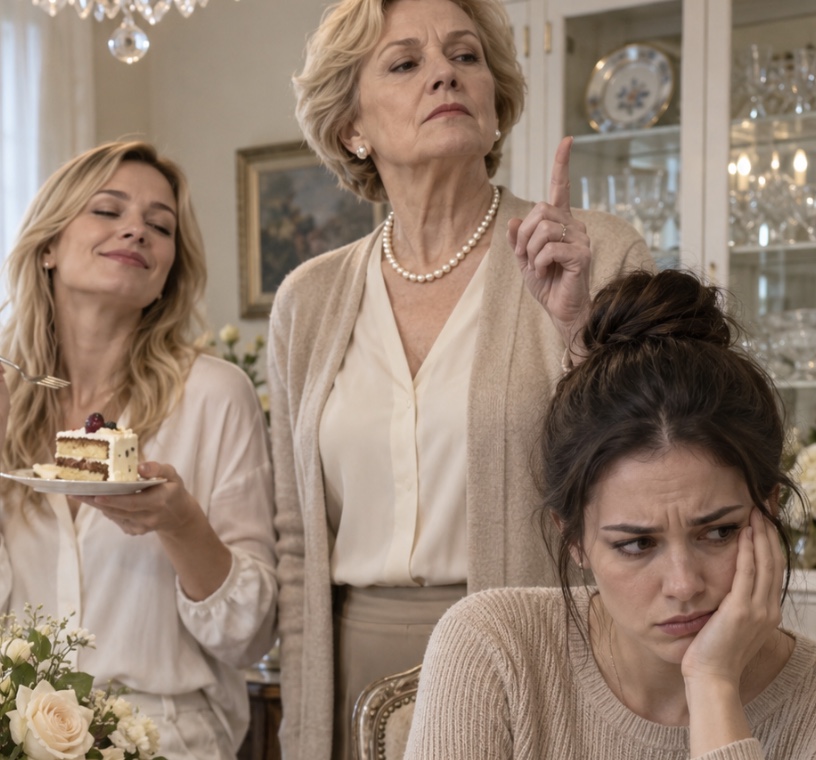
“She’s a freeloader—that’s exactly what she is. She has everything handed to her: a ready-made house, a husband by her side, every bill paid. All she has to do is live and enjoy herself,” Nina Stepanovna said quietly but distinctly.
At that very moment, Varvara was walking past the guest room carrying two heavy grocery bags and was about to turn toward the kitchen. The door stood slightly open, so every word reached her as clearly as if the conversation had been intended for her ears.
“Mom, keep your voice down,” Zhanna replied. “She might hear you.”
“So what if she does? Am I lying? Demyan carries this entire household on his shoulders while she does nothing but give orders.”
Varvara stopped.
Only briefly—perhaps for two seconds.
She looked down at the plastic handles cutting into her fingers, then glanced toward the half-open door.
One bag contained vegetables, meat, cheese, and fruit—all the things Nina Stepanovna had personally added to the shopping list that morning. The second held a particular brand of yogurt, mineral water, and the coffee Zhanna preferred.
Varvara had just paid for everything with her own card.
 
She gave a silent, bitter smile and continued toward the kitchen.
After setting the bags on the table, she began putting the groceries away. For the first time in a long while, she felt no desire to excuse someone else’s rudeness by blaming exhaustion, age, or a difficult personality.
Nina Stepanovna’s food went into the refrigerator. Zhanna’s yogurt went onto the top shelf. Varvara placed the coffee in the cupboard and automatically checked the receipt in the delivery app.
The total was substantial.
Especially considering that orders like this had become almost a daily occurrence over the summer.
It was a hot August day. The dry air outside smelled of dust, apples, and wood warmed by the sun. Summer was nearing its end, yet the guests who had arrived in early June for “a few weeks” continued living in the house as confidently as though their only autumn plan was to exchange their summer slippers for warmer ones.
Nina Stepanovna had arrived first.
At the end of May, she called her son and announced that she had finally decided to undertake a major renovation of her two-bedroom apartment.
“They’re going to tear up the floors, replace the plumbing, and dismantle the kitchen. I refuse to live in all that dust. Demyan, could I stay with you for three weeks? As soon as the dirtiest work is finished, I’ll go home.”
Demyan looked at Varvara.
 
“Of course she can come,” Varvara answered.
Why not?
The house was spacious. Besides their bedroom, Varvara’s office, and a large living room, there was a separate guest room. Upstairs, there was also a smaller room that they normally used for storage.
Nina Stepanovna arrived carrying two suitcases, a box of medicine, several bags of clothes, and an enormous tote somehow containing a hairdryer, her own pillow, house slippers, and half a kitchen’s worth of utensils.
“I’m not staying long, so I didn’t bring much,” she explained.
Varvara glanced at the luggage but made no comment.
For the first few days, everything really did go smoothly.
Every morning, her mother-in-law asked whether she was causing any inconvenience. She cleaned up after herself and occasionally cooked dinner. Varvara even wondered why she had been so nervous before the visit.
Then Zhanna called.
Demyan’s sister was thirty-two. She worked as an administrator at a small beauty salon and had been renting apartments for several years.
At the beginning of June, her latest lease expired.
“The landlady wants to raise the rent, and I’m hardly home during the summer anyway. Could I stay with you for a month while I look for another place?” she asked her brother.
Once again, Demyan turned to his wife.
Varvara shrugged.
“We have enough space.”
Zhanna arrived three days later.
She brought even more belongings than her mother: two suitcases, a gym bag, a box of shoes, cosmetics, a coffee maker, and a houseplant in a heavy pot.
“It’s only temporary,” she announced cheerfully.
The upstairs storage room temporarily became Zhanna’s bedroom.
During the first two weeks, no one particularly disturbed anyone else.
Demyan left for work every morning. Varvara worked from home part of the week and went to the office on the other days. She managed purchasing for a chain of small stores and was accustomed to planning everything in advance—deliveries, payments, household maintenance, and groceries.
Most things in the house were governed by an established system.
 
Utility bills were charged automatically to her card. So was the internet. Water deliveries, septic-system maintenance, garbage collection, and seasonal work on the property were all connected to her banking app or personal accounts.
This arrangement had not begun after the wedding.
It had existed long before Demyan entered her life.
The house belonged to Varvara.
Her grandfather had left it to her.
As a child, she had spent nearly every summer there. Back then, the place looked completely different: an old extension, a wood-burning stove, creaking floorboards, an overgrown yard, and a well beside the fence.
After her grandfather died, Varvara completed the inheritance process within the required period. Several years later, when she could afford it, she began renovating the property seriously.
The electrical wiring, heating system, and pipes were replaced. Proper sewage was installed, several rooms were insulated, and the roof was renewed. Paths were laid across the yard, a parking space was created, and a greenhouse and small utility building were added.
All of this had happened before she even met Demyan.
He first visited the house several years later.
They met during the winter at a mutual friend’s birthday party and dated for about ten months. Demyan lived in his own place, while Varvara remained in her house.
That autumn, he moved in with her.
It was not because he had nowhere else to live. They had simply decided that they were ready to build a life together.
Several months later, they officially married.
There had never been any suggestion that the house had suddenly become shared property. Demyan knew its history perfectly well and had never claimed ownership.
 
For a long time, they never argued about money.
Demyan contributed to their household expenses. He transferred part of his income to Varvara, sometimes bought groceries himself, and paid for things needed in the yard. Varvara covered most of the bills because everything had originally been set up in her name.
They both understood and accepted this arrangement.
The problem began when two more people settled into their daily lives.
During the first three weeks, Nina Stepanovna practically counted down the days.
“Only about ten days left,” she would announce.
Then:
“One more week, and I’ll be back home.”
But the renovation schedule unexpectedly began to shift.
“The workers are behind.”
Varvara did not ask for details.
After some time had passed, she finally asked:
“How is the renovation going?”
“It’s almost finished.”
Two more weeks later, Varvara overheard Nina Stepanovna speaking to a friend on the phone.
“Everything is already done. It turned out beautifully. I just need to arrange the furniture properly, and then I’ll return.”
Varvara had heard this by accident.
 
She was surprised but chose not to interfere.
Another week passed.
Her mother-in-law remained in the house.
Meanwhile, Zhanna stopped mentioning her apartment search altogether.
At first, she had checked rental listings every day.
“This one is too far away.”
“That one is on the ground floor.”
“The owner of this place seems strange.”
Eventually, apartment listings disappeared from her conversations completely.
Near the end of July, Varvara asked:
“Have you found anything?”
Zhanna looked at her as if the question had come entirely out of nowhere.
“Not yet. The rental market is inconvenient during the summer. There will be more options in the autumn.”
“And until autumn?”
 
“Well, I’m not really bothering anyone here.”
Varvara did not like the way she phrased that.
Something else, however, irritated her even more.
The guests were gradually ceasing to behave like guests.
Nina Stepanovna was the first to cross that line.
One morning, a sheet of paper appeared on the refrigerator.
Milk.
Cottage cheese.
Nuts.
Lightly salted fish.
A particular variety of apples.
Still mineral water.
Varvara removed the paper and asked:
 
“What is this?”
“A list.”
“I can see that. Who is it for?”
“These things will be useful for everyone.”
“No one here eats that fish except you.”
“So what? I’m not asking for much.”
At the time, Varvara simply added the items to her grocery order.
A few days later, Zhanna sent her a message.
“Varya, if you’re ordering groceries, add my coffee. But only the kind I usually buy. Don’t get a different one.”
Then came another message:
“And some sugar-free yogurt.”
Later:
“If the delivery is coming today, get some berries too.”
These requests soon became routine.
Neither woman ever asked whether Varvara was comfortable paying for them.
Nina Stepanovna might open the refrigerator in the evening and remark:
“We’re almost out of cheese.”
Or:
“Buy a different kind of bread tomorrow.”
Zhanna would occasionally add:
“I need almond milk, please.”
A month later, Varvara opened her transaction history and silently compared the figures for several minutes.
Her expenses had risen considerably.
That was logical.
Four people now lived in the house instead of two.
Water consumption had increased, as had the electricity bill. The washing machine ran almost every day. Everyone used the internet, and food disappeared much faster.
Zhanna also enjoyed taking long showers, while Nina Stepanovna left the air conditioner running in the guest room during hot weather, even when she went out for several hours.
Varvara had no intention of holding a family meeting over every kilowatt of electricity.
Still, she increasingly disliked the feeling that her temporary hospitality had turned into permanent personal service.
Demyan occasionally bought something on his way home from work.
Usually, he would call and ask:
“Do we need milk?”
“Yes, get some.”
He would return with milk, bread, and perhaps something for dinner.
Varvara continued paying for the main grocery orders.
That was why the first time she heard herself called a “freeloader,” the accusation seemed so absurd that she did not immediately become angry.
 
At first, it amused her.
Then it made her curious.
Where had Nina Stepanovna gotten such an idea?
Varvara did not storm out of the kitchen to demand an explanation. Instead, she calmly finished putting away the groceries, threw out the packaging, wiped the table, and opened her banking app.
The transactions from the previous three months were all there.
Grocery deliveries.
Electricity.
Water.
Internet.
Household maintenance.
Other purchases for the property.
Then she opened the list of transfers she had received from Demyan.
They were regular.
But when compared with the total expenses, it was obvious that his contribution covered less than one-third of their household costs.
That fact did not bother Varvara in itself.
Their marriage was not a competition.
Demyan helped with physical work around the house, took care of the car, and handled various jobs in the yard. Under normal circumstances, their arrangement suited them both.
Yet someone was already telling relatives that Demyan practically supported the owner of the house.
That evening, Varvara decided to clarify one detail.
“Demyan, do you send money to your mother?”
Her husband looked away from his phone.
“Sometimes.”
“What for?”
“Small expenses.”
“Does she ask you?”
“Occasionally. Why?”
 
“I was just wondering.”
Demyan shrugged.
“I tell her it comes from the family budget.”
That was when everything became clear.
“Which family budget?”
“What do you mean?”
“Why do you call it money from the family budget?”
“Because our money is shared.”
Varvara looked at him.
“Demyan, you send it from your personal card.”
“Yes.”
“Then why don’t you simply tell her, ‘I sent you some money’?”
He thought for a moment.
“I don’t know. What difference does it make?”
The difference revealed itself rather quickly.
Whenever Nina Stepanovna heard the words “family budget,” she interpreted them in a very particular way.
In her version of events, Demyan earned all the money and handed it over to his wife. Varvara merely spent it, while her son somehow still managed to help both his mother and sister.
 
Over the next few days, Varvara discovered how firmly her mother-in-law believed this story.
Nina Stepanovna spoke freely to relatives on the phone.
“Demyan carries everything on his shoulders.”
“The house is enormous, and the expenses must be tremendous.”
“Varvara certainly lives comfortably.”
Once, Varvara even heard her say:
“My son ought to think about himself, but he puts everything into that house.”
Varvara walked past without reacting.
For the moment.
She wanted to see just how far this story would go.
The answer came on Sunday.
The day began peacefully.
That morning, Varvara gathered tomatoes from the greenhouse and then spent several hours attending to her own affairs. Demyan repaired the latch on the garden gate. Zhanna did not emerge from her room until almost noon.
By lunchtime, everyone had gathered in the kitchen.
Varvara had prepared roasted chicken, vegetables, and rice. Nina Stepanovna brought a salad from the refrigerator, while Zhanna scrolled through her phone.
They were discussing various relatives when Nina Stepanovna glanced at the food on the table and suddenly said:
“Demyan brought another full bag home from the store yesterday.”
“So?” he asked.
“Nothing. Sometimes I simply wonder how you manage to carry so much responsibility.”
Varvara looked up.
Zhanna continued staring at her phone.
“Mom, don’t start,” Demyan warned.
“What am I starting? I’m only telling the truth.”
Nina Stepanovna turned toward Varvara.
“Varya, you should buy groceries yourself occasionally. You can’t leave everything to the man.”
Varvara put down her fork.
“What?”
“Don’t take offense. I mean it kindly. Demyan supports this house, supports you, and still helps us.”
Demyan immediately tensed.
“Mom.”
But his mother was enjoying her speech too much to stop.
“And then people wonder why men become exhausted. Of course they do, when there’s a freeloader at home…”
Zhanna’s head snapped up.
The kitchen fell silent.
Varvara stared at Nina Stepanovna for several seconds without blinking.
Then she reached for her phone.
“Excellent,” she said.
 
“What’s excellent?” her mother-in-law asked cautiously.
“We can finally discuss this properly.”
Varvara opened her banking app.
Demyan rubbed his chin.
“Varya…”
“No, Demyan. Now that everyone is interested, everyone should see.”
She placed the phone on the table.
“Nina Stepanovna, you claim that your son supports this household?”
“Doesn’t he?”
“Let’s find out.”
Varvara opened her payment history.
“Here are the groceries for June.”
She scrolled down the screen.
“Here is July.”
She swiped again.
“And here is August.”
Nina Stepanovna looked at the display but said nothing.
“This is my card,” Varvara continued. “Now let’s look at the electricity.”
She opened the next transaction.
“Water.”
Another transaction.
“Internet.”
Then another.
“Garbage collection, system maintenance, and household supplies.”
Zhanna stopped pretending that the conversation had nothing to do with her.
Varvara opened a different section.
“Now let’s look at Demyan’s transfers to me during those same months.”
Demyan remained completely still.
 
“Varya, I already know all this.”
“You know. Your mother doesn’t.”
Nina Stepanovna frowned.
“I have no intention of digging through your finances.”
“You’ve already done that. You simply did it without seeing the numbers.”
Her mother-in-law lifted her chin indignantly.
“Don’t speak to me in that tone.”
“Fine. We’ll stick to the facts.”
Varvara moved the phone closer to the center of the table.
“Demyan’s contribution covers less than one-third of the household’s current expenses. That has always been acceptable to me, and it remains acceptable. We’re married, and we decide for ourselves how to divide our responsibilities. But telling people that he supports me is rather strange.”
Nina Stepanovna turned to her son.
“Demyan?”
He exhaled.
“She’s telling the truth.”
His mother’s expression changed.
“What do you mean?”
“Exactly what she said.”
“But you told me you gave me money from the family budget.”
“That’s because Varvara and I are a family and share household expenses.”
Varvara looked at her husband but said nothing.
Nina Stepanovna was still trying to rebuild the version of reality she preferred.
“So you simply transfer less money to her?”
“Mom, that isn’t the point.”
“Then what is?”
Varvara picked up her phone again.
“There’s another interesting part.”
She opened the incoming payments on her account.
“This is my income.”
 
She did not mention her position, exact salary, or other details. She merely showed the regular deposits and their dates.
“Now let’s find the transfers from either of you.”
She scrolled through the screen.
“Zero.”
She changed the month.
“Zero again.”
Then the next.
“And once more—zero.”
Nina Stepanovna flushed.
“We’re guests!”
“Of course you are.”
Zhanna finally joined the conversation.
“Exactly. You invited us to stay. Are you seriously going to charge us for every plate of food now?”
Varvara turned toward her.
“No.”
“Then what is all this about?”
“Guests usually stay for several days—or for the length of time originally agreed upon.”
Zhanna put down her phone.
“And?”
“Your mother asked to stay for three weeks.”
Nina Stepanovna opened her mouth.
“My apartment was being renovated.”
“The renovation ended a long time ago.”
Her mother-in-law frowned.
“How would you know?”
“I heard you say so on the phone.”
Nina Stepanovna fell silent.
Varvara looked at Zhanna.
“You planned to stay for one month while you searched for another apartment.”
“I’m still looking.”
“When was the last time you viewed one?”
“Recently.”
“When?”
Zhanna looked away.
“What difference does it make?”
“A great deal. You’re approaching your third month here.”
Zhanna leaned back in her chair irritably.
“Am I required to report everything to you now?”
“No. But if you live in my house for three months, ask me to buy specific groceries, and then support conversations about me being a freeloader, I naturally become curious about what you would call your own situation.”
“I never called you a freeloader.”
“You were sitting in the room when your mother did.”
Zhanna blushed.
 
“I told her to speak more quietly.”
“Exactly.”
This time, Zhanna had no answer.
Nina Stepanovna raised her voice.
“Don’t attack Zhanna! She has nothing to do with this.”
“Then let’s return to you.”
“What complaint do you have against me?”
Varvara moved the phone aside.
“None concerning money. I never asked you to pay for staying here. You arrived as a guest.”
“Then that settles it.”
“No, it doesn’t. A guest does not remain for three months after her renovation has ended and tell relatives that the owner of the house is living off her son.”
Her mother-in-law turned sharply toward Demyan.
“Are you going to sit there in silence?”
In the past, this would have been the moment when he tried to smooth everything over.
He would have told his wife not to take the words personally, asked his mother to calm down, and warned his sister not to interfere.
Then everyone would have retreated to separate rooms, and nothing would have changed.
This time, however, Demyan sat among three people in a situation where facts could no longer be covered with vague appeals for understanding.
He looked at his mother.
“Varvara is right.”
Nina Stepanovna leaned forward in disbelief.
“What?”
“She really does pay most of our expenses.”
“And what about you?”
“I contribute, but less than she does.”
“Why have you never told me?”
Her question sounded almost accusatory.
Demyan frowned.
“Because I didn’t realize you were keeping track of our finances.”
“I’m not keeping track!”
“Then why are you telling relatives that I support everyone?”
Nina Stepanovna looked confused.
“That was how I understood it.”
“You understood it incorrectly.”
“Because of the things you told me!”
“I said that the money I transferred came from the family budget. I never said I was the only person contributing to that budget.”
Varvara looked at her husband.
This was an important moment.
He had finally said what he should have said months earlier.
But it was too late for the entire dispute to end with a simple, “Well, now that’s cleared up.”
Nina Stepanovna folded her arms.
“Fine. I made a mistake. Can we end this humiliation now?”
“Almost,” Varvara replied.
Zhanna looked wary.
“What does ‘almost’ mean?”
“It means we’re bringing this extended visit to an end.”
Her mother-in-law slowly turned her head.
“You’re throwing us out?”
“I’m suggesting that you calmly pack your belongings and move out by the coming weekend.”
“This is my son’s house!”
“No, it isn’t.”
The answer came so quickly that Demyan did not even have time to intervene.
Varvara looked directly at her mother-in-law.
“This house belongs to me. I inherited it from my grandfather. Demyan moved here later, and he knows that perfectly well.”
Nina Stepanovna stared at her son.
“And you’re going to allow this?”
“Mom, your apartment has been ready for a long time.”
 
“There are still countless little things to finish.”
“You told people yourself that the renovation was over.”
“It’s inconvenient for me to return right now.”
“Why?”
His mother did not answer.
The real reason was far too obvious.
Life here was more comfortable.
She did not have to shop for groceries, think about utility bills, or cook every day. She could ask for products to be added to the delivery, use everything in the house, and still tell relatives about her self-sacrificing son.
Zhanna also understood where the conversation was going.
“And where am I supposed to go?”
Varvara turned to her.
“You’re an adult woman.”
“I can’t find an apartment in a few days.”
“You haven’t found one in three months.”
“I’m not obligated to accept the first place I see.”
“No, you aren’t. You can stay at a hotel, rent an apartment, find a room, or choose a studio. The decision is yours.”
Zhanna went pale.
“Are you serious?”
“Completely.”
Nina Stepanovna stood abruptly.
“Is all of this because of one word?”
Varvara rose as well.
“No.”
“Then what is it about?”
“Three months.”
Her mother-in-law stared at her in silence.
“It’s about the shopping lists. The groceries you expect me to pay for. The expenses that have risen in almost every category. The fact that your apartment has been ready for weeks. The fact that Zhanna stopped even pretending to search for a home. And yes, finally, it’s about the word ‘freeloader,’ because it revealed just how badly you had confused everyone’s roles in this house.”
Zhanna stood too.
“I’m not going to sit here and be humiliated.”
“No one is keeping you here.”
“Fine.”
She left the kitchen and loudly slammed the door of her upstairs room.
Nina Stepanovna remained behind.
“You’re going to destroy Demyan’s relationship with his family.”
Varvara shook her head.
“No. I’m going to stop paying for your indefinite vacation.”
“You’re unbelievably petty.”
“Perhaps. But at least I know how to count.”
Her mother-in-law spun toward her son.
“Say something!”
Demyan ran his palm across the table.
“Pack your things by Saturday, Mom.”
Nina Stepanovna froze.
She clearly had not expected that.
“You’re throwing your own mother out?”
“No. Your apartment has been renovated. You’re returning home.”
“After everything I’ve—”
“Stop.”
For the first time, Demyan interrupted her firmly.
“You came here for three weeks. Three months have passed. Varvara never once demanded money from you or complained that you were in the way. Meanwhile, you’ve been telling relatives that she lives at my expense.”
Nina Stepanovna stood motionless.
Then she picked up her plate, carried it to the sink, and said nothing more.
The remaining days were tense, but fortunately they passed quickly.
Nina Stepanovna made a point of no longer asking anyone to buy things for her.
Zhanna reopened the rental listings that very evening.
It turned out there were plenty of available options nearby.
 
On Tuesday, she went to view a studio apartment.
She returned late.
“It’s acceptable,” she said curtly to her brother.
On Wednesday, she paid the deposit.
“So it was possible to find a place in two days?” Varvara asked when Zhanna announced that she would move on Saturday.
Zhanna gave her an irritated look.
“When you have no choice, it’s possible.”
“You had a choice all summer.”
Zhanna did not respond.
Meanwhile, Nina Stepanovna called the contractor who had completed her renovation and asked him to confirm whether everything was finished.
On Thursday, she visited the apartment.
She returned that evening looking surprisingly calm.
“It’s perfectly fine there,” she informed her son.
Demyan could not resist asking:
“What exactly did you think might have changed during the past three months?”
His mother shot him an angry look and went to pack.
On Saturday morning, the suitcases stood by the porch.
Demyan drove his mother home first.
Her apartment was indeed completely ready to live in.
Zhanna moved after lunch. Her studio was small but tidy, and it was only a few stops away from her workplace.
Before leaving, she paused beside the car.
“I still think you could have handled it more gently.”
Varvara leaned one shoulder against the doorframe.
“You could have moved out in July.”
Zhanna rolled her eyes.
“You always reduce everything to logic.”
“It’s a useful habit.”
And that was how they parted.
That evening, the house felt unusually quiet.
No doors slammed upstairs. No one asked whether the mineral water had run out. The air conditioner in the guest room was no longer running beside an open window. The extra bottles and towels had disappeared from the bathroom.
Varvara walked through the house and, for the first time all summer, saw it as she remembered it.
Demyan was sitting on the veranda.
“Can we talk?” he asked.
“We should have done that a long time ago.”
Varvara sat opposite him.
Her husband spent several seconds gathering his thoughts.
“I really am responsible for what happened.”
“For which part, exactly?”
“For allowing my mother to spread that nonsense.”
“Why did you allow it?”
“At first, I didn’t know.”
“And afterward?”
Demyan rubbed the back of his neck.
“Later, I realized that she saw things more or less that way. But I thought it would seem ugly if I started explaining exactly who paid for what.”
Varvara looked at him in disbelief.
“And letting her tell people that I’m financially dependent on you seemed better?”
“No.”
“Then what stopped you?”
“I suppose I liked the fact that she was proud of me.”
The answer was unexpectedly honest.
Varvara said nothing.
Demyan continued:
“All her life, she has believed that a man should carry every responsibility alone. When she decided that was what I was doing, I didn’t correct her.”
“Even when you realized she was using that belief to humiliate me?”
He lowered his gaze.
“That was when I should have stopped her.”
 
“Yes, you should have.”
“I know.”
Varvara had no intention of lecturing him for hours.
Everything important had already been said.
“There’s one more thing, Demyan.”
“What?”
“If we agree between ourselves on how to divide our expenses, and the arrangement works for us, then I’m satisfied. But I will not allow you to use our agreement to create an impressive story for your relatives.”
“I won’t do it again.”
“And if your mother ever calls me a freeloader again?”
“I’ll explain who pays for what myself.”
Varvara gave a faint smile.
“You’ve already done that now.”
Several days later, she opened the grocery-delivery app and automatically began filling her usual basket.
Then she noticed how much smaller it had become.
There was no special coffee.
No six-packs of yogurt.
No crates of mineral water.
None of the particular products Nina Stepanovna demanded.
At the end of the month, Varvara compared the expenses.
The difference was so substantial that she called Demyan over.
“Come look at this.”
“What happened?”
She showed him the screen.
He studied it and laughed briefly.
“Wow.”
“Can you believe it?”
“I didn’t even notice how much we were spending.”
“Because you weren’t paying for the main grocery orders.”
Demyan sat beside her.
“So, we were running an expensive boardinghouse all summer.”
“Expensive for us. Free for the residents.”
They both laughed.
For the first time in several weeks, Varvara remembered the word “freeloader” without feeling angry.
Now it sounded almost comical.
According to Nina Stepanovna, the supposed freeloader was a woman living in the house she had inherited from her grandfather, paying most of its expenses, and feeding two adult women for several months.
Yet the moment Varvara suggested that those women buy their own food and live in their own homes, something remarkable happened.
The renovation that had supposedly prevented Nina Stepanovna from returning home for three months was suddenly completely finished.
Zhanna, who had been unable to find an apartment all summer, located a studio within a few days.
Even Demyan finally discovered that it was better to tell his relatives the truth from the beginning than to wait until his wife opened her banking app during Sunday lunch.
By the end of August, the house had returned to its familiar rhythm.
In the evenings, Varvara walked through the yard, gathered apples, and checked the greenhouse. Demyan attended to his tasks outside. The guest room remained empty.
Nina Stepanovna now called before visiting.
Zhanna no longer sent grocery lists.
And whenever a relative began praising Demyan for supposedly supporting such an enormous house all by himself, he no longer remained silent.
“Don’t invent stories,” he would say. “The house belongs to Varvara, and she pays most of the expenses.”
As it turned out, speaking one honest sentence was far easier than spending months correcting someone else’s flattering fiction.