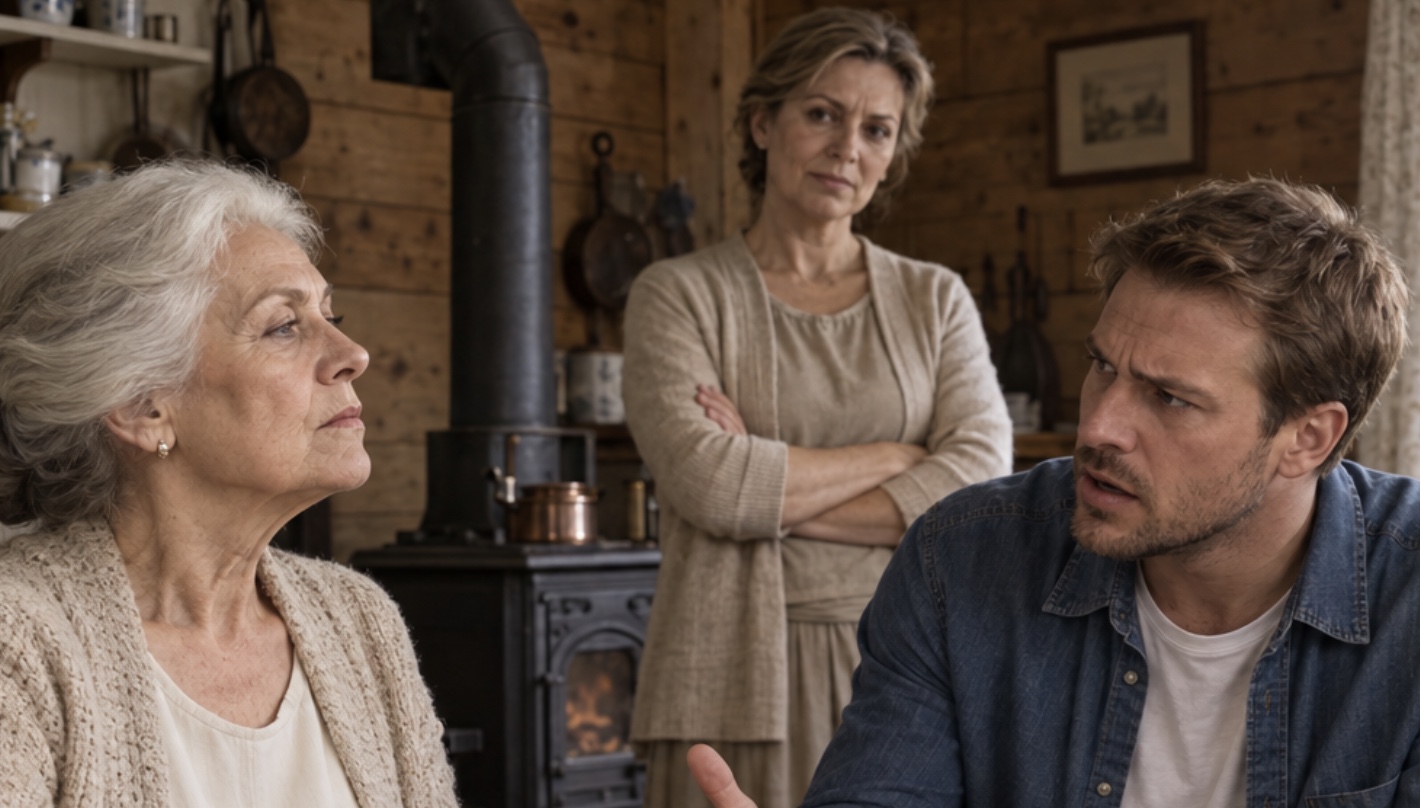
We’re transferring the country house to Svetlana. Don’t be upset—you already have an apartment,” Marina’s mother-in-law said, calmly sliding the documents across the table as though they concerned nothing more important than an extra jar of jam.
Marina froze with her teacup in her hand. The mint tea was still steaming, and the small kitchen smelled of the apple pie Tamara Sergeyevna had taken out of the oven before they arrived. Outside, a quiet September evening had settled over the neighborhood. Somewhere beyond the village stood the very house into which Marina’s husband had poured every free weekend, every week of vacation, and nearly all their savings for the past three years.
Andrei blinked. He looked at the papers, then at his mother, and finally at his younger sister, Svetlana, who sat in the corner staring at her phone and pretending that none of this concerned her.
“What do you mean, you’re transferring it to Svetlana?” His voice faltered, but he forced a smile, apparently believing this had to be some ridiculous joke. “Mom, we had an agreement. I replaced the roof, repaired the foundation, and installed the heating. We were supposed to go to the notary next month. You said so yourself.”
 
Tamara Sergeyevna adjusted the collar of her cardigan. Her face took on that familiar expression of gentle but immovable determination that she wore during every disagreement as comfortably as a pair of house slippers.
“Andryusha, why do you need a house in the countryside? You and Marina already have a lovely apartment in the city. Svetochka is raising a child alone. She needs to live somewhere with fresh air—it will be good for the little boy. As a mother, I can’t sleep peacefully knowing that my grandson is growing up in a cramped, stuffy rented room. Besides, the house belonged to your father. It should go to the person who needs it most.”
The story of the house had begun four years earlier, shortly after Andrei’s father passed away. When the inheritance was settled, both Andrei and Svetlana gave up their shares in favor of their mother. At the time, nobody wanted the crooked old house with its leaking roof. It stood at the edge of the village, slowly sinking into the ground. Tamara Sergeyevna had no intention of living in the countryside, while Svetlana changed cities and hobbies more often than she changed gloves.
Marina and Andrei lived modestly in those days, carefully counting every ruble. They owned a small two-room apartment, but it felt cramped, and they dreamed of eventually moving somewhere larger. Andrei worked as a supervisor at a furniture factory and could build or repair almost anything with his hands. Marina worked in the accounting department of a construction company, and her practical mind was every bit as valuable as her husband’s craftsmanship.
It was Tamara Sergeyevna who first suggested that Andrei take the country house. During a family dinner, she brought up the subject herself.
“Why should we let it rot?” she sighed while placing another helping of food on her son’s plate. “Your father wouldn’t have wanted the house to fall apart. Take it, Andryusha. Fix it up and make it comfortable. Think of it as your inheritance from your father. You can spend weekends there, grill meat outdoors, and raise your children close to nature.”
Andrei’s face lit up like a boy’s. The house stood on a large plot in a peaceful area, with a river nearby. The only problem was the amount of work it required. The roof leaked, the foundation was cracked, the wiring was dangerously old, and there was no proper heating. The ancient stove could barely warm one room.
That evening, Marina and Andrei sat in their kitchen with a calculator. Even by the most conservative estimate, the renovation would cost nearly a million rubles—and that was only if Andrei did most of the work himself.
“Marina, it will be worth it,” he assured her, scribbling figures on a sheet of paper. “We’ll have our own house outside the city. Our children will be able to grow up surrounded by nature. Mom said she would sign the house over to me as soon as I finished renovating it.”
Marina had doubts. Her professional instincts told her that any agreement should be put in writing before the first ruble was invested. But this was Andrei’s mother. She looked at her son with such affection when she handed him the keys that Marina felt ashamed of her suspicions. They seemed petty and inappropriate.
 
So she agreed.
For three years, Andrei devoted nearly all his free time to the house. He left on Friday evenings and returned on Sundays, exhausted, smelling of wood and paint, with splinters in his palms and absolute happiness in his eyes.
He replaced the roof and cleaned and reinforced the foundation. He installed the heating system and a new boiler with his own hands. He replaced all the wiring, covered the walls with wooden paneling, installed heated floors in the future children’s room, and built the veranda he had dreamed about since childhood.
Marina handled the finances. She kept meticulous records, just as she did at work. She found cheaper building materials, watched for discounts, and negotiated with suppliers through acquaintances. Every purchase was paid for using her bank card, which was linked to the couple’s joint savings account.
On her laptop, she created a separate folder titled “Country House.” It contained receipts, invoices, and contracts for the boiler, windows, furniture, and appliances. The final total came to 893,000 rubles.
Marina knew the amount down to the last ruble.
At last, the house was finished. It was warm, bright, and full of life. The previous weekend, Marina and Andrei had completed the final task: hanging curtains in the children’s room.
They had come to Tamara Sergeyevna’s apartment that evening to proudly invite her to see the completed house and to arrange their long-awaited visit to the notary.
Instead, documents transferring the property to Svetlana lay on the kitchen table.
“Mom, wait,” Andrei said, rubbing his forehead as though trying to erase what he had just heard. “What happened to our agreement? You promised to transfer the house to me.”
“I said it at the time,” Tamara Sergeyevna replied, dismissively waving her hand as if shooing away a fly. “Circumstances have changed. Svetlana has a child now. You and Marina are doing well. You’re settled and comfortable.”
“Exactly!” Svetlana suddenly said, looking up from her phone. “It’s difficult for Misha and me in the city. The house has a garden and clean air. Mom is right—it’s the perfect place for a child.”
Marina placed her cup on the table. Her voice remained even, although everything inside her was trembling.
 
“Tamara Sergeyevna, we invested almost nine hundred thousand rubles from our family budget in that house. Andrei gave three years of his life to it. He installed every board and hammered every nail. You were the one who offered him the house.”
Her mother-in-law looked at her, and her expression changed almost imperceptibly. The warm maternal smile disappeared, and hard, cold lines appeared around her mouth.
“Marina, first of all, that house belonged to my husband, and as his heir, I decide who gets to live there. Second, Andrei renovated it for the family. He is a man, and he enjoys that kind of work. And third…”
She paused and glanced pointedly at her daughter-in-law’s neat hands.
“I don’t remember seeing you sawing any boards. You sat comfortably in your warm office while my son worked himself to exhaustion. So you have no right to count our family’s money. Both of you earn salaries, while Svetlana is raising a child alone. You should be helping her.”
Marina looked at her husband.
Andrei sat pale and silent, his teeth clenched. In his world, his mother had always been fair. Yes, she spoiled her younger daughter. She had forgiven Svetlana for dropping out of several colleges, constantly moving from one place to another, and abandoning one failed project after another.
But with him, her eldest child, she had always been honest.
Until that moment.
“So there will be no deed of gift,” Andrei said quietly.
“Why do you need a piece of paper?” his mother replied in a conciliatory voice. “You can come and visit whenever you want. Who would stop you? The house will belong to Svetlana, but you will always be welcome guests.”
“Svetlana will not move into that house,” Andrei said, still quietly but firmly. He rose from the table. “Not until she reimburses us the 893,000 rubles we spent on the renovation.”
“What?” Svetlana jumped to her feet. “What eight hundred thousand? For that old wreck? Mom, are you hearing this nonsense?”
“Andrei!” Tamara Sergeyevna pressed both hands to her chest. “How can you demand money from your own sister? Are you really presenting her with a bill? She is your own flesh and blood, and Misha is your nephew!”
 
“My own flesh and blood, Mom, will be my future children,” Andrei replied evenly. “They are the reason we rebuilt that house. Come on, Marina. We’re leaving.”
He turned and walked into the hallway. Marina silently stood, put on her coat, and followed him.
Behind them, Tamara Sergeyevna lamented that money had ruined a good man and insisted that Andrei’s father would never have tolerated such behavior.
They drove home in complete silence. Andrei gripped the steering wheel and stared straight ahead. Marina watched the occasional streetlights pass outside the window and did not try to begin a conversation.
Her husband needed time.
It was one thing to vaguely suspect that someone was taking advantage of you. It was another to hear them explain directly, with a smile, why exploiting you was supposedly fair.
At home, Andrei stood under the shower for a long time. Eventually, he came into the kitchen, where Marina was making tea.
“Marina, forgive me,” he said, sinking into a chair and covering his face with his hands. “I truly believed her. It never occurred to me that she might have planned to give the house to Svetlana all along. It turns out I spent three years renovating a house for my sister with our money.”
“I don’t think that was her plan from the beginning,” Marina said, placing a cup in front of him. “Four years ago, Svetlana didn’t have a child and had no desire to live in the countryside. The house was falling apart and needed to be saved. Offering it to you was convenient and profitable. But once the house became warm, beautiful, and ready to live in, Svetlana suddenly needed somewhere to stay with her son. Why should she build or renovate anything when a finished house is already waiting for her?”
“But the money? Mom knows how much we spent!”
“To her, our money is only a number. Svetlana and her child are standing right in front of her, so their needs feel more important.”
“I’m not letting this go.” Andrei raised his head. There was no anger in his eyes, only deep exhaustion. “I’ll go there and take the boiler. I’ll remove the windows. I’ll take everything I can unscrew.”
“You won’t, Andryusha.” Marina gently covered his hand with hers. “The house legally belongs to your mother, and soon it may belong to Svetlana. If you go there and start removing the boiler, Svetlana will cause a scene and your mother may call the police. Legally, they could accuse you of damaging someone else’s property. You know they are capable of doing that. Your mother already made her position clear: she considers it her inheritance.”
“So what are we supposed to do? Give them nine hundred thousand rubles? It took us three years to save that money!”
Marina opened her laptop and brought up the “Country House” folder.
“I’m not giving them anything,” she said, opening the summary spreadsheet. “Look. Everything is here—from the receipt for the screws to the contract for the boiler installation. Every purchase, date, amount, and bank-transfer confirmation. The total is 893,000 rubles. Tomorrow, I’ll save it as a PDF and send it to the family group chat.”
 
“Do you think they’ll repay us?”
“No. Svetlana will say she doesn’t have that kind of money. Your mother will accuse us of being greedy and petty. But at least the amount will be formally recorded. And from this day forward, you and I will have new rules.”
The following day, during her lunch break, Marina sent the file to the family chat shared by her, Andrei, Tamara Sergeyevna, and Svetlana.
She attached a short message explaining that because the house was being transferred to Svetlana, she was enclosing an itemized record of the restoration expenses paid from Marina and Andrei’s family budget. The amount to be reimbursed was 893,000 rubles.
The reaction came quickly.
First, Marina received an angry private voice message from Svetlana. She shouted that Marina was an insane, penny-pinching miser. She reminded her that she was a single mother and insisted that Andrei was obligated to help instead of sending bills through his calculating wife.
Then Tamara Sergeyevna called her son.
Marina did not hear the entire conversation, but that evening Andrei told her that his mother had cried on the phone. She tried to make him feel guilty, saying that he was heartless, that he had betrayed his family over a piece of land, and that his father would turn in his grave if he knew what his son had done.
Andrei stood his ground. He did not argue or defend himself.
He simply said, “Mom, when Svetlana returns our money, we can talk. Until then, don’t call us.”
The first few weeks were strangely quiet.
Svetlana and her son moved into the house. Marina learned about it from other relatives in a family chat. Before the conflict, Marina and Andrei had transferred fifteen thousand rubles to Tamara Sergeyevna every month to help her, even though she received a decent pension and was far from poor.
At the beginning of the next month, the day of the usual payment arrived. Andrei sat holding his phone, staring at the banking app.
“Should I send it?” he asked, looking at his wife.
“Andryusha, she is your mother. I can’t forbid you from helping her. It has to be your decision.”
He stared at the screen for a long time, then closed the app.
“Eight hundred and ninety-three divided by fifteen,” he calculated aloud. “That comes to almost five years. We can reconsider helping her in five years.”
The decision was his, and it was not an easy one.
When the usual payment failed to arrive, Tamara Sergeyevna called several days later. She did not ask about the money directly. Instead, she approached the subject indirectly, complaining about rising prices, her health, and something broken in the house that would be expensive to repair.
Andrei listened calmly.
“Mom, I understand. But we are living under a strict savings plan now. We are trying to recover what we invested in the country house. We don’t have any spare money.”
Tamara Sergeyevna hung up.
The real turning point came in December, when the first bitter cold arrived.
On Saturday morning, Andrei’s phone rang. It was Svetlana, and her voice was trembling.
“Andrei, can you come over?” she pleaded. “It’s freezing in the house, and the boiler isn’t working. Misha is cold. I don’t know what to press. Everything is flashing.”
Andrei put the call on speaker. He and Marina were having breakfast, so Marina could hear every word.
“Did you check the pressure in the system?” Andrei asked calmly, taking a sip of coffee. “There’s a pressure gauge on the boiler. I showed it to you when I set everything up.”
“What pressure gauge? I don’t know!” Svetlana snapped. “I don’t understand anything about boilers. Come here and fix it. You know how!”
 
“Call a technician who services gas boilers. You have a job and a salary. Pay someone to inspect it.”
“I don’t have money for a technician! Mom told me to call you. You’re my brother!”
“The brother who supposedly refuses to help you,” Andrei replied evenly. “The house has an owner. Soon, that will be you. It also has someone living in it, and that is you as well. So take responsibility for your own property.”
He ended the call.
The phone rang several more times. Then messages from his mother began arriving, each filled with accusations about his cruelty and lack of compassion. Andrei silenced the phone and placed it on a shelf.
“Are you going to help her?” Marina asked quietly.
“No.” He shook his head. “If I go, I’ll become their free handyman again. They won’t understand anything until they have to pay for their mistakes themselves. An emergency weekend visit from a boiler technician, plus a replacement valve or some other part, could cost five to seven thousand rubles. Maybe then Svetlana will understand the value of the boiler I installed.”
He walked over to the window and looked out at the snow-covered courtyard.
“You know, Marina,” he said thoughtfully, “that evening in Mom’s kitchen, I initially thought you were making the conflict worse when you started talking about the money and receipts in front of everyone. I thought you were destroying our family. Now I understand that the family I imagined hadn’t existed for a long time. What existed was a convenient system in which I was expected to serve everyone else’s interests without asking uncomfortable questions. You simply said aloud what I refused to admit.”
Andrei never went back to rescue the house.
Svetlana eventually called a boiler technician. The problem turned out to be nothing more than low system pressure, and the repair took only half an hour. Still, she had to pay for the service.
A month later, a pipe on the veranda froze and burst because Svetlana had turned off the heating overnight to save money. Andrei had warned her that the heating must never be switched off during winter, but she had ignored him.
The repair was expensive.
Tamara Sergeyevna announced that she would not contribute another ruble from her savings. Soon afterward, Svetlana took her son and moved back to their rented room in the city.
 
The house stood empty once again. It was now warm, comfortable, and beautifully restored, yet nobody wanted it.
Naturally, Marina and Andrei never received their money back.
Tamara Sergeyevna continued telling relatives that her son had married a cold, calculating woman who had turned him against his own mother. Marina and Andrei no longer tried to argue with her.
In the spring, they finally did what they had dreamed of doing for years. They sold their cramped two-room apartment, added the money they had managed to save over the previous months, and bought a spacious three-room apartment in a pleasant neighborhood.
Creating a home that truly belonged to them felt far more rewarding than repairing the foundation of someone else’s property.
They would not be discussing financial assistance for their relatives again anytime soon. The months being counted against that unpaid debt were nowhere near finished.
Marina sometimes thought about that evening in her mother-in-law’s kitchen. She remembered how easily a warm smile could lower a person’s defenses—and how painful it was to admit afterward that someone had simply used you.
 
Personal boundaries are strange things. Sometimes, you do not realize you never had any until someone crosses them so shamelessly that you can no longer look away.
What would you have done in Marina’s position? Would you have demanded repayment through the family group chat, or would you have let the money go to preserve peace with the relatives?
And do you think it is fair for an older son to be expected to sacrifice everything for his younger sister throughout his life?
Share your thoughts in the comments. I would genuinely like to know what you think.