Anna stood by the window, watching the rain wash over the city. The clock showed six in the morning. It was still dark outside, and the streetlights blurred into hazy yellow patches behind the wet glass. The coffee in her mug had gone cold long ago, but she drank it anyway. Saving money on everything had become second nature.
She was desperately short of cash. Her main job in the accounting department of a failing company paid next to nothing, while her freelance spreadsheet work kept her awake late into the night. Her back ached, and her eyes burned from staring at the screen, but Anna never complained.
There was no one to complain to.
Her mother called at half past six, as usual choosing the worst possible moment.
“Anya, forgive me, but my medicine has gone up in price again. I’ve done the math, and I’m about two thousand short. Could you lend it to me until my pension comes?”
Anna pinched the bridge of her nose.
Two thousand.
Of course she could find it. She would take the money from what she had set aside for the utilities and somehow figure things out later. Her mother had been ill for years, and Anna had no intention of abandoning her, even when she herself had to tighten her belt to the final notch.
“Of course, Mom. I’ll bring it over tonight.”
 
The minibus smelled of damp clothes and someone’s cheap alcohol. Anna pressed herself against the window and watched the raindrops crawl across the glass.
Her thoughts returned to her former husband.
Slava. Vyacheslav Igorevich. A mother’s boy with a perfect side part and a permanently guilty expression.
They had been divorced for two years, yet the wound still burned inside her, as though someone had rubbed salt into it and forbidden her from touching it. She had given that marriage ten years of her life—ten years sold on an installment plan in exchange for the illusion of having a family.
She remembered meeting Slava. She had been young, foolish, and in love with his shy smile and the way he asked permission before taking her hand.
His mother, Antonina Pavlovna, had made her opinion clear from the very beginning: Anna was not good enough for her son. A provincial nobody. A country bumpkin.
But Anna had believed love could overcome anything.
What a naïve fool she had been.
The two-bedroom apartment in the city center had been registered in Slava’s name before their marriage. His parents had bought it for him. But Anna and Slava had renovated it together—or rather, Anna had renovated it while Slava watched.
She sold her grandmother’s cottage, the last physical reminder of her childhood, and poured all the money into their new life. The kitchen, the bathroom, the laminate flooring, the wallpaper—she had chosen the tiles, bargained with the contractors, and even carried bags of plaster herself.
Slava had merely signed the receipts and frowned whenever she asked him to help.
“I’m not a builder, Anya. Why should I go there? You understand these things better than I do.”
Then came the accident.
A drunk driver ran into her at an intersection. The impact struck the side of the car, and Anna woke up in the hospital surrounded by pain and unfamiliar voices.
She survived by a miracle. But the doctors told her something that destroyed the future she had imagined.
She would never be able to have children.
For the first time, Antonina Pavlovna looked at her with something resembling sympathy. Yet beneath that expression, Anna saw a glimmer of triumph.
Barren. Broken. No longer useful.
Slava left quietly. He packed his things while Anna was still in the hospital and left a note on the table.
“I’m sorry. I can’t live like this anymore.”
There was no conversation and no explanation. Only a phone call from his mother a week later.
“Anya, please don’t be angry with him. Slavik needs a normal family. He needs children. Surely you understand.”
Anna understood perfectly.
She understood that she had been a convenient wife for as long as she was useful. The moment she became damaged, she was discarded.
Slava had allowed her to continue living in the apartment, perhaps because some small piece of his conscience remained. But the ownership documents stayed with him, and Anna knew that sooner or later, this arrangement would come back to haunt her.
It happened on a Thursday evening.
The doorbell rang sharply and insistently. Anna had been sorting through old boxes of belongings she had never managed to throw away after the divorce.
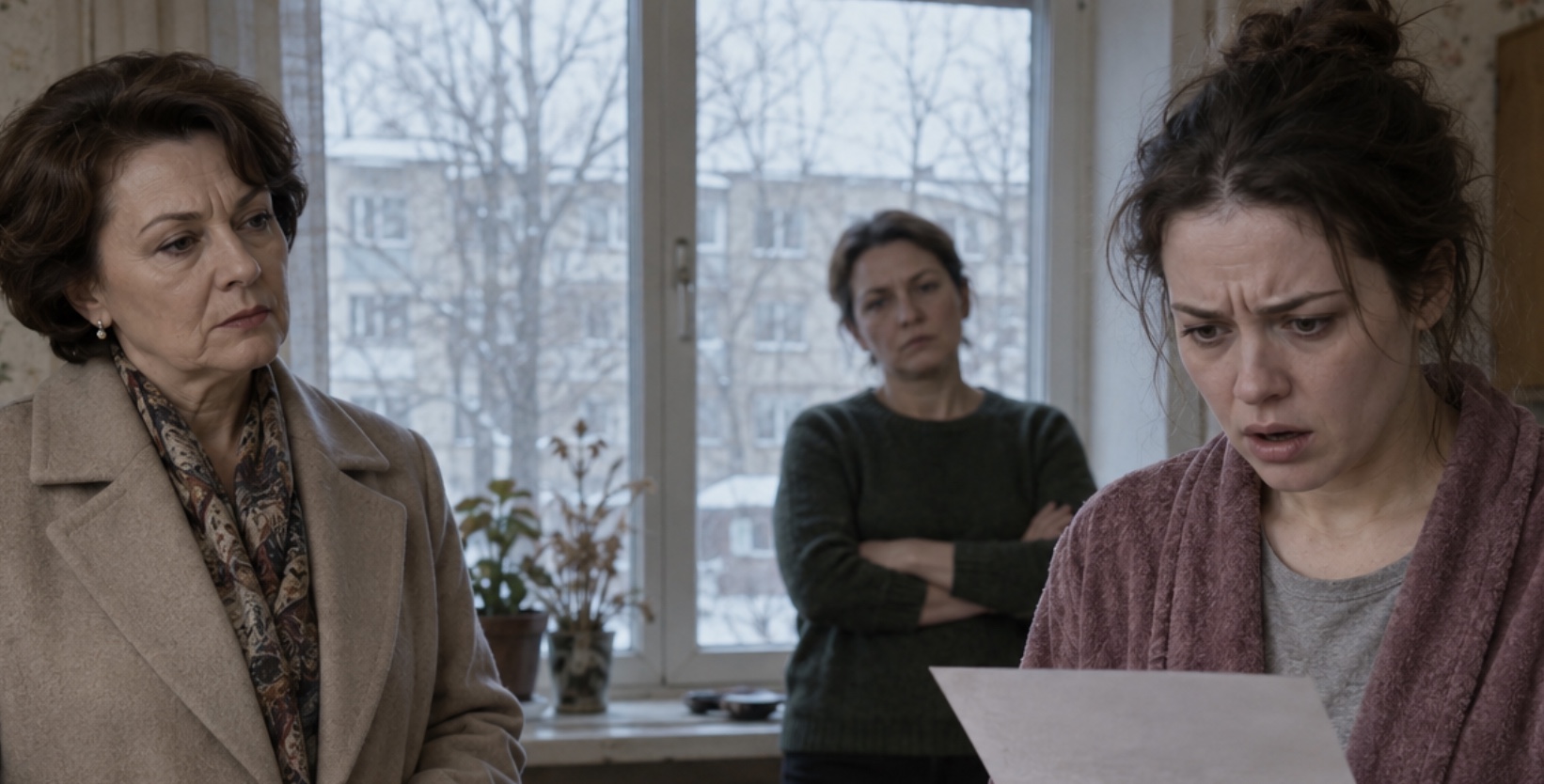
Her reflection flashed in the mirror: messy bun, faded bathrobe, and dark circles beneath her eyes.
 
What a beauty, she thought bitterly.
She opened the door and froze.
Two women stood on the landing: her former mother-in-law, Antonina Pavlovna, and Antonina’s younger sister, Aunt Raya. Both wore heavy coats and solemn expressions, as though they had come to attend a funeral.
Antonina Pavlovna gave Anna a disgusted once-over and stepped into the hallway without waiting to be invited.
“Hello, Anya. Let us in. We need to talk.”
Anna moved aside, feeling a dull irritation rising inside her.
Don’t lose your temper, she told herself. Don’t give them the pleasure of seeing you break.
“Come in.”
Her former mother-in-law walked into the kitchen, examined it as if she owned the place, and grimaced. Her sister silently sat on a stool and folded her hands in her lap.
“So, how are you managing?” Antonina Pavlovna asked in the tone people used when speaking to the terminally ill. “I see you never finished the renovations. And you claimed you knew how to make a home comfortable.”
“What do you want?” Anna had no intention of making polite conversation.
Antonina Pavlovna sighed as though preparing to announce the death of a loved one.
“You know our building is being demolished. They’ve offered us an apartment on the outskirts, in the middle of nowhere. With our health, we can’t possibly live there. We discussed it and came to a decision: you must move out. We’ll exchange apartments. You’ll get the one-bedroom place on the outskirts, and we’ll take this two-bedroom apartment.”
Anna stared at her, unable to believe what she had heard. For a moment, she wondered if she had misunderstood—or simply lost her mind.
“Are you serious? Why would I agree to that?”
“What do you mean, why?” Antonina Pavlovna threw up her hands. “This apartment belongs to my son. And, by extension, to me. We bought it. You’re only living here because we allowed you to remain after the divorce. Two years have passed. It’s time you understood when you’ve overstayed your welcome.”
Something snapped inside Anna—not from pain, but from rage. From the woman’s shameless, self-satisfied arrogance, which recognized no argument except her own convenience.
“Why did you come to me?” Anna’s voice trembled, but she controlled it. “You have your beloved son—the one you gave this apartment to. Go to him!”
Antonina Pavlovna did not flinch. Instead, she smiled coldly and reached into her handbag.
She placed a folded sheet of paper on the table.
“You should read this when you have time, Anya. Then think carefully. I expect you at the notary’s office tomorrow at ten. If you refuse, you’ll discover what real problems look like.”
Anna picked up the paper.
It was a copy of a handwritten loan agreement. The amount contained six zeros.
And the signature at the bottom belonged to her late father.
Anna did not sleep that night.
The agreement had been written by hand on yellowed paper. The handwriting did resemble her father’s—large, sweeping letters leaning to the right. But the signature looked strangely unsteady, as if the hand had trembled.
Or as if someone had traced it from an original.
Anna stared at the lines while memories surfaced before her eyes.
Her father had died ten years earlier. An engineer by training, he had survived on temporary jobs after the factory where he worked collapsed. During his final years, he lived somewhere in the countryside. He rarely called and visited even less often.
Anna had been married then, endlessly busy and constantly struggling to keep her life together. She never seemed to have enough time for him.
Then he died.
A heart attack.
He had been alone in his crumbling village house, without a telephone or anyone to help him. The neighbors found him three days later.
Anna told herself she did not feel guilty about her father.
She hated herself for that lie.
Now the loan agreement felt like a cruel message from beyond the grave.
She got out of bed, poured herself a glass of cold water, and drank it in one gulp.
It had to be forged.
But who could have imitated her father’s handwriting? And why?
In the morning, she called Slava. The phone rang for a long time before he answered in a sleepy, irritated voice. Someone giggled in the background.
“Slava, has your mother completely lost her mind? What loan agreement is she talking about? My father never borrowed money from her!”
There was silence, followed by a heavy sigh.
“Anya, you know how these things are. Mom says your father borrowed money for construction. There are witnesses. You should cooperate and settle this peacefully. Why do you need a two-bedroom apartment when you live alone? You can move into the smaller place. Lena and I have twins now. We need the extra room.”
“Extra room?” Anna could barely believe what she was hearing. “Do you even hear yourself? You left me with nothing, and now you want to take away the last thing I have?”
“I left you the apartment!” anger entered Slava’s voice. “You’ve lived there long enough. But nothing lasts forever. If you refuse to move, at least repay your father’s debt.”
“What debt, Slava? You know perfectly well this is nonsense!”
“I know my mother never lies.”
The call ended.
Anna threw her phone aside, and it landed against the sofa with a dull thud.
Her blood boiled.
So they were all involved. Slava needed money for his new family, and his mother had decided to collect an imaginary debt from her former daughter-in-law.
It was a clever scheme.
At ten that morning, Anna stood outside the notary’s office. Antonina Pavlovna was waiting by the entrance, her sister holding her arm.
“So you came after all,” Antonina said with a satisfied smile. “Good girl. I was beginning to think we’d have to involve the local police.”
They entered the office. An older notary with an indifferent expression sat behind the desk.
 
Antonina Pavlovna placed a folder of documents in front of Anna.
“Here is the original agreement. As you can see, everything is legitimate. Your father was an honorable man, unlike you. His debt passed to his heirs. We’re willing to settle this as a family, without going to court.”
Anna picked up the document.
The paper was thick and slightly rough, but its edges were far too clean for an old sheet. In one place, the ink had not faded at all, as though someone had recently gone over it.
She brought the paper closer and noticed a faint chemical odor. Bleach? Stain remover? No, it smelled like fresh toner from a newly refilled printer cartridge.
Anna straightened and looked directly into her former mother-in-law’s eyes.
“Did you know that forging documents and committing fraud on this scale can earn someone up to ten years in prison?”
Antonina Pavlovna turned pale but refused to back down.
“What are you talking about? What forgery?”
“Any handwriting expert will expose my father’s signature,” Anna said calmly, although her heart was pounding in her throat. “You could at least have found proper old paper instead of printing this on a modern sheet.”
At that moment, the office door flew open.
A tall man wearing a justice major’s uniform entered. Anna recognized him immediately. It was Andrei, Antonina Pavlovna’s nephew and Slava’s cousin.
He locked the door and smiled, though his eyes remained cold.
“Well, Anya, now we’ve got you. Did you really think you were the smartest person in the room?”
He strode over, snatched the phone from her hand, and slipped it into his pocket.
“Sit down and think carefully. You’ll leave this office in one of two ways: after signing your consent to the apartment exchange, or under guard for fraud. We’ve already recorded your accusations about forged documents. As for proving your father’s signature, that could take months. By the time the experts finish, you’ll have been sued for failing to repay the debt, and your accounts will be frozen.”
“This is a bluff,” Anna whispered, although her voice lacked conviction.
“Test me,” the major said, spreading his hands. “I have your phone, so you can’t call a lawyer. If you scream, we’ll use force. Sign voluntarily, and we can all walk away.”
Antonina Pavlovna leaned toward Anna and whispered mockingly:
“Do you really think Slavik ever loved you? He pitied you. Now he has a real family. You were merely a mistake he made when he was young. This apartment belongs in the family, and you’re nothing but a thorn in our side.”
“Leave my father out of this.” Anna barely recognized her own voice. “He built your house, and now you’re slandering him.”
“If your father were still alive, he’d have beaten some sense into you himself!” Antonina Pavlovna snapped. “He ruined his health carrying sacks at our construction site, while you—”
She abruptly stopped.
Silence filled the office.
Anna stared at her, trying to understand what she had just heard.
Her father had been an engineer.
Why would he have been carrying sacks on a building site?
The major frowned.
“Auntie, that’s enough. You’ve already said too much.”
Anna looked at them and understood that there was something important about her father’s life she had never known.
But this was not the time to investigate.
First, she had to escape.
She let her body go limp, lowered her shoulders, and pretended to surrender.
“All right. I need to use the bathroom. And I need some water. I feel sick.”
The major exchanged a glance with Antonina Pavlovna. She nodded.
“Take her.”
He left the office first, and Anna followed.
In the corridor, she noticed that the door to the neighboring room was open. A folder lay on the desk, with her passport resting on top. She had handed it to the notary for verification.
The major turned away for a moment to unlock the bathroom.
Anna rushed into the neighboring office, grabbed her passport, and snatched another document from the desk—the one she believed was the loan agreement.
Then she ran to the window.
They were on the ground floor.
She opened it, climbed over the windowsill, and ran.
 
The major shouted behind her.
“Stop! Catch her!”
But Anna was already racing across the courtyard, leaping over puddles. She reached the road, flagged down a taxi, and jumped inside.
“Drive! Hurry!”
The car pulled away.
Anna collapsed against the seat and struggled to catch her breath. Her heart pounded as if she had just run a marathon.
She opened her clenched fist and looked at the document in her hand.
It was not the loan agreement.
It was a deed of gift.
According to the document, Anna Sergeyevna had voluntarily surrendered all rights to the apartment in favor of Vyacheslav Igorevich.
Her signature appeared at the bottom.
It was her own signature.
But she had never knowingly signed that document.
When had they done it? How?
Then she remembered.
The hospital.
After the accident, Slava had visited her every day. He took care of her and fed her with a spoon. He also brought papers and asked her to sign them “for the insurance company.”
She had been under the influence of strong painkillers and barely understood what was happening. She signed whatever he placed in front of her.
She had unknowingly signed her own sentence.
The taxi driver glanced at her through the rearview mirror.
“Where are we going?”
Anna swallowed and gave him the address of the only person she still trusted.
Irina rented an apartment in an old neighborhood beside the park. Anna stumbled into her hallway, trembling uncontrollably.
Her friend listened to the fragmented story, poured her a cup of tea, and sat opposite her to study the deed.
“It’s a crude forgery,” Irina concluded. “It hasn’t been properly notarized, and the stamps are blurred. But an ‘original’ could suddenly appear in court. The real question is who will testify that you signed it voluntarily.”
“Slava,” Anna whispered. “He brought papers to the hospital. I signed them without reading.”
“That’s bad. We need to investigate the past. Find out whether your father really owed them anything.”
Anna traveled to the village where her father had spent the final years of his life.
His house was in ruins. Part of the roof had collapsed, and the windows were boarded up.
A neighbor called Granny Nyura, a thin elderly woman in a faded headscarf, greeted Anna suspiciously. But when she learned whose daughter Anna was, her expression softened.
“May your father rest in peace. He lived on the outskirts during his final years. Drank a little. He worked at Antonina’s construction site. They treated him terribly and paid him almost nothing, though they let him sleep in a storage room. Before he died, he burned some documents. It was as if he felt guilty about something he’d done to you.”
“What did he feel guilty about?” Anna could hardly breathe.
“I don’t know, child. He kept repeating, ‘Nyura, if anything happens to me, tell Anya… under the floor… the box…’ Then, just like that, he was gone. A heart attack.”
Anna rushed toward the ruined house.
 
The boards were rotting, and sections of the floor had collapsed. Beneath an old wooden chest, she discovered a hiding place containing a metal tea box.
Inside was a photograph.
Her father, dressed in work clothes, stood in front of a cracked wall. Beside him was a tall man in a suit wearing a deputy’s badge.
A message was written on the back:
“This building will kill people. The S. family is responsible.”
There was also a note.
“If anything happens to me, take this to the prosecutor’s office. It concerns the land beneath Antonina’s building.”
Anna squeezed the photograph in her hand.
Everything inside her turned upside down.
Her father had not merely worked at the construction site. He had discovered the truth about stolen cement and a dangerously weak foundation.
They had silenced him.
Perhaps they had not killed him directly, but they had driven him into the ground.
Her phone rang.
It was Irina.
“Anya, get out of the city! They’ve reported you to the authorities. The database shows that your former husband took out a two-million-ruble loan in your name yesterday. Bailiffs and debt collectors are looking for you!”
Anna froze.
So that was it.
They had declared war.
She rented a room in a hostel on the outskirts of the city. The receptionist, an elderly Tatar woman, looked at her with sympathy and allowed her to stay without identification as long as she paid in cash.
Sitting on the sagging bed, Anna examined the documents from her father’s box.
A horrifying picture began to take shape.
Her father had not been an ordinary laborer. He had supervised a team of workers at a construction project owned by Antonina’s family. He discovered that the building was sinking because of its defective foundation and the low-quality cement being used.
He intended to expose the fraud, but someone “persuaded” him to remain silent.
Then came his accident.
Then his death.
Anna tracked down an elderly retired investigator who had once been her father’s friend. He studied the photograph for a long time before speaking.
“The case involving that defective construction project was buried. Now they’re preparing to commission the building. Antonina invested everything she owned in it and took out enormous loans. If the defects become public, her family will face bankruptcy and criminal charges. That is why she needs your apartment. They want to move their remaining assets somewhere safe.”
Everything finally made sense.
The apartment was not merely a place to live. It was a lifeboat for a family drowning in the consequences of its own corruption.
That evening, Anna returned to the hostel and saw the major’s car parked outside.
She hid behind a neighboring apartment block.
Slava and the major were searching her room. Through a partly open window, she heard fragments of their conversation.
“Just find that idiot!” Slava shouted. “Mom is losing her mind. If those documents surface, we’re all finished!”
“We’ll find her,” the major replied. “She has nowhere to go.”
“What do you mean she’s like a sister to you? She’s nobody! She’s just my former wife!”
Anna began backing away.
A branch snapped beneath her shoe.
 
Slava turned and stared directly into the darkness where she stood.
Anna ran.
Footsteps sounded behind her.
She darted into one alley and then another, but her pursuers were getting closer.
Suddenly, someone grabbed her and covered her mouth.
“Quiet. I’m on your side,” a man whispered.
He pulled her into a dark entrance hall. Anna struggled, but the stranger held her firmly.
“Don’t scream. My name is Prokhorov. I worked with your father.”
She stopped resisting.
Prokhorov.
He was the construction foreman who had been fired from that very building site. He hated Slava’s family because they had framed his son and sent him to prison in their place.
Prokhorov possessed copies of documents bearing official seals that proved the family had stolen and substituted building materials.
“Your father gave them to me,” he explained. “He said that if anything happened to him, I had to help you.”
Anna stared at the man, uncertain whether she could trust him.
But she had no other choice.
Together, they devised a plan.
Anna called Slava and arranged to meet him in a café. He arrived carrying a bouquet and smiling as though nothing had happened.
“Anya, why are you causing all this panic? Mom is simply nervous. Let me give you money to rent another place, and we’ll forget the whole thing.”
Anna looked at him with contempt.
“Did you know my father wasn’t a drunk? Did you know he asked you to bring me to the hospital? You killed him, Slava. You abandoned him and let him die.”
Slava turned pale but immediately denied everything.
“What are you talking about? I didn’t know anything!”
Anna placed a recorder on the table and pressed a button.
Slava’s voice came through the speaker:
“Just find that idiot! Mom is losing her mind. If those documents surface, we’re all finished!”
Slava jumped to his feet.
“You’ll regret this!”
“No,” Anna said, rising from her chair. “You’re the one who will regret it.”
On the day the building was scheduled to open, Anna and Prokhorov attended the ceremony.
Antonina Pavlovna, dressed in an elegant white suit, cut the red ribbon and smiled for the journalists. Slava stood beside her, playing the role of the proud and devoted son. The major moved watchfully through the crowd.
Anna approached the microphone.
Security guards tried to stop her, but Prokhorov stepped in front of them.
“Antonina Pavlovna,” Anna’s voice rang across the square, “is it true that the entire façade of your building is cracked? Aren’t you afraid that the residents will collapse into the basement along with all your forged loan agreements?”
Her former mother-in-law froze. Her face twisted with fury.
 
“Get her out of here!” she screamed. “She’s insane!”
A restless murmur swept through the crowd. People who had already purchased apartments exchanged worried looks.
The major lunged toward Anna, but Prokhorov blocked his path.
Driven beyond the limits of his self-control, Slava shouted:
“Mom, just give her the damned apartment! Give it back! Otherwise, they’ll send all of us to prison!”
Anna raised one hand.
The crowd fell silent.
“Too late,” she said. “Everything has already been delivered to the prosecutor’s office.”
She looked at Slava and slowly exhaled.
“Do you know what the funniest part is? I lied too. The expert report isn’t ready yet.”
Everyone froze.
Antonina Pavlovna turned as white as a sheet. Slava stared at Anna with his mouth open.
“But now,” Anna continued, “you’ve confessed in front of witnesses. The expert report won’t be necessary.”
She turned and walked away.
Shouting erupted behind her, but Anna did not look back.
One week later, prosecutors opened a criminal investigation into construction fraud.
 
Antonina Pavlovna and the major were arrested. Slava attempted to escape but was caught at the railway station with a suitcase full of cash.
Anna sat inside her apartment—the same apartment that had started everything.
She now possessed documents confirming her full ownership. The deed of gift had been exposed as fraudulent, and in exchange for a reduced sentence, Slava had signed away any remaining claim to the property.
One final act of cowardice.
Anna studied the old photograph of her father.
A complicated mixture of bitterness, pain, and relief filled her chest. Her father had not been a perfect man, but he had tried to correct his mistakes.
Now the truth he had fought to reveal was finally out in the open.
The doorbell rang.
 
Anna opened the door and found a courier holding an enormous bouquet of white roses.
The card read:
“Freedom suits you much better than that old bathrobe. If you ever need me, I’ll be here. Prokhorov.”
Anna smiled, breathed in the fragrance of the flowers, and closed the door.
She placed the bouquet on the windowsill beside the ashes of the forged loan agreements.
Outside, the sun was shining for the first time in what felt like years.
And suddenly Anna realized she could breathe again—deeply, freely, with her whole heart.