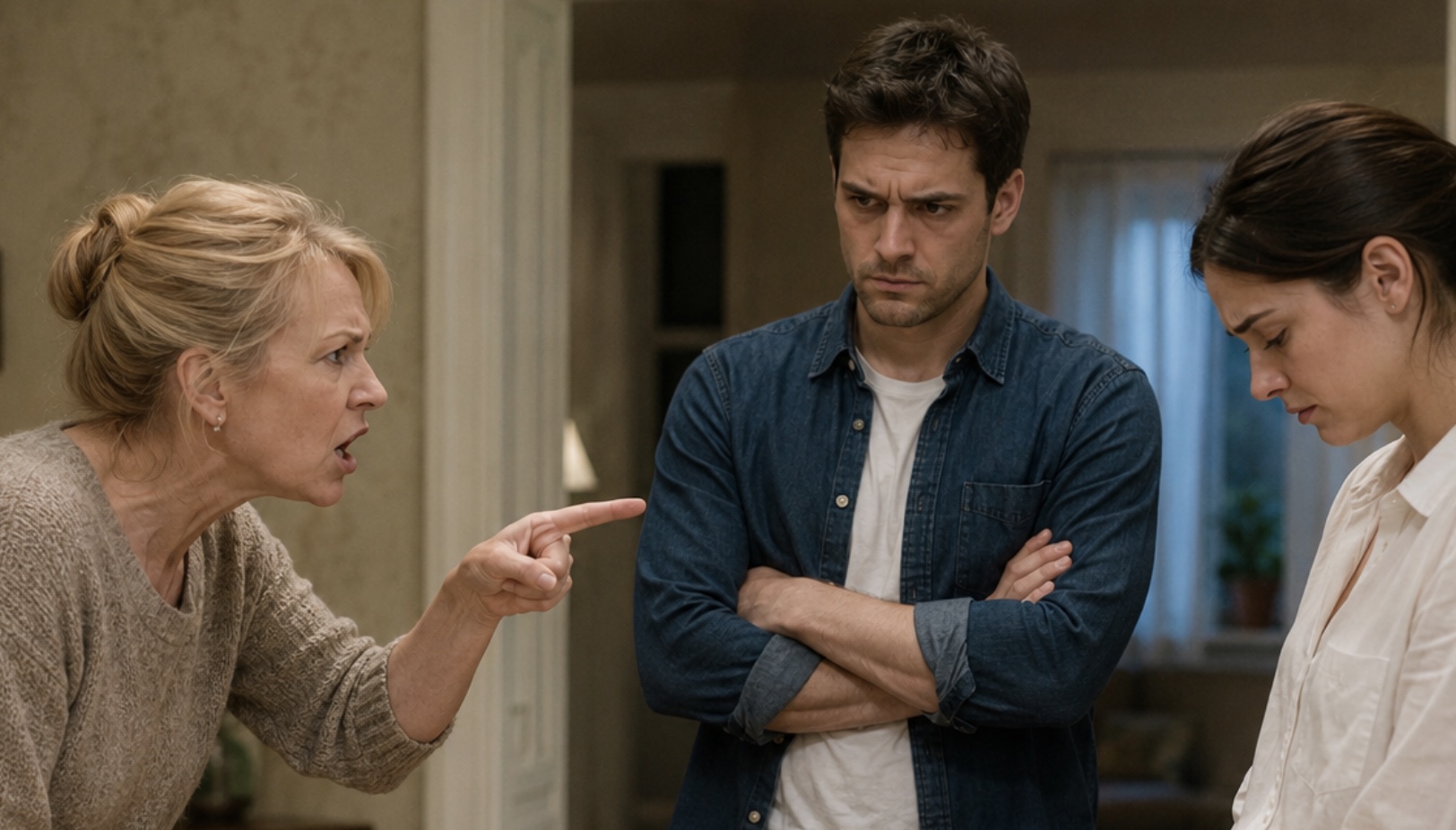
“Did you open the top cupboard again?” Lidia stopped in the kitchen doorway and immediately noticed that the door had not been closed all the way.
Sveta was standing by the table with a mug in her hand. It was ten minutes to seven in the morning. Dima was already putting on his shoes in the hallway, getting ready for work, while his wife calmly spread cheese on a slice of bread as though she were in her own home.
“I did,” she replied. “The sugar is in there.”
Lidia shifted her gaze to the sugar bowl.
“I’m not asking what’s in there. I’m asking why you opened it without permission.”
Dima came back into the kitchen with his keys in his hand.
“Mom, we bought that sugar.”
“It’s sitting in my cupboard.”
Lidia said it evenly.
She had learned long ago that you couldn’t be vague with young people. If you said, “Please be more careful,” they would pretend they hadn’t understood what you meant. But if you said, “That’s my cupboard,” there was nowhere for them to wriggle.
The apartment really did belong to her.
It was a two-room apartment she had worked hard for and eventually bought outright after her divorce. At sixty, Lidia could still recite from memory how much the new windows had cost, how much she had paid toward the building’s major repairs, and what year she had replaced the pipes.
No one had handed her the apartment as a gift, and that was exactly why she couldn’t stand people who treated someone else’s property as if it were their own.
When Dima had asked after the wedding whether he and Sveta could stay with her for a while, Lidia hadn’t agreed immediately.
Her son explained that it would only be for a year, eighteen months at most. They wanted to save enough for a down payment instead of throwing money away on rent.
Dima himself offered to pay her for staying there.
 
Lidia named fifteen thousand a month plus half the utilities.
Not because she needed their money, as she later told her neighbor Tamara, but because grown adults shouldn’t live somewhere for free.
At first, everything seemed perfectly respectable.
Sveta cleaned the bathroom and occasionally bought groceries. Dima fixed the leaking faucet. During the first month, Lidia even tried cooking for all three of them: soup, stuffed cabbage rolls, casseroles.
But she quickly noticed that the young couple’s gratitude seemed strangely effortless.
Sveta said thank you. Dima kissed his mother on the cheek.
And that was it.
No one seemed particularly impressed that dinner had appeared only after Lidia went shopping, stood in line, cooked everything, and washed the dishes afterward.
To them, home-cooked food seemed to materialize by itself.
One day Sveta came home carrying two large bags of groceries and announced that from then on she would buy the main food for the week herself.
Lidia almost took it as a challenge.
Inside the bags were expensive coffee, cheese, turkey, vegetables, and nuts.
She could have bought something cheaper and put more money aside for the apartment, Lidia thought.
She didn’t say anything out loud, but later she calculated the approximate cost of everything in her head.
What irritated her wasn’t exactly that Sveta wasted money. She didn’t.
It was that Sveta allowed herself things Lidia would have denied herself at that age if she had been saving toward an important goal.
Dima was easier to understand.
 
He had known since childhood that if you wanted something expensive, you saved for it first. At fifteen, he had put money aside for a bicycle. At university, he worked evenings in a warehouse. He bought his first car without taking out a loan.
Lidia considered that one of her greatest accomplishments as a mother.
And that was why every time Dima said that he and Sveta had decided something together, an unpleasant feeling stirred inside her, as though someone had taken years of her work and quietly claimed the credit.
Within a couple of months, Lidia began noticing things her son seemed blind to.
Butter disappeared faster.
Tea ran out sooner.
Two or three eggs vanished at a time.
Sveta liked cheese, yogurt, apples—and all those things cost money.
Yes, the young couple often bought groceries themselves.
But who could keep track of whose sugar ended up in the communal sugar bowl, or whose milk had been poured into someone’s coffee?
If nobody counted anything, everything became mixed together, and then sooner or later it turned out that one person was constantly replacing things while the other simply kept opening the refrigerator.
“Write down what you take,” Lidia said one morning.
Sveta froze with a sandwich in her hand.
“Write down what, exactly?”
“Cheese. Bread. Sugar.”
“We bought those yesterday.”
“Then there shouldn’t be any problem. Write it down and carry on.”
Dima frowned.
“Mom, we are not going to keep records of every sandwich.”
“As long as you live here, I decide how things are done.”
“We pay for the room.”
“For the room. That doesn’t make the kitchen yours.”
Sveta wrapped the sandwich in a napkin and put it into her bag.
“I’ll eat at work.”
She left without saying goodbye.
Lidia watched her go and felt the familiar irritation rising.
That was how Sveta always behaved. She never argued to the bitter end, never shouted. She simply walked away with an expression that suggested the conversation was beneath her.
Lidia found that more infuriating than open rudeness.
The next day, a sheet of squared paper appeared on the refrigerator with three columns:
“What was taken.”
“How much.”
“Who.”
Lidia even tied a pen to the refrigerator magnet so no one could claim they had nothing to write with.
By evening, the sheet was in the trash.
 
“Was that you?” she asked her son.
“Yes.”
“Why?”
“Because it’s ridiculous.”
“What’s ridiculous about knowing where the food goes?”
“Making my wife account for a spoonful of sugar is ridiculous.”
Lidia said nothing.
There was no point arguing with Dima once he started answering in short sentences.
He had been the same before playground fights as a boy: calm face, clipped words, stubbornness already locked into place.
The following day, Lidia put up a new sheet.
If they refused to keep track, she would do it herself.
She started a small notebook.
Not every day, only when she noticed something: two eggs, a cup of milk, a piece of butter.
Sometimes she wrote down an estimated price beside each item.
The notes calmed her.
On paper, everything looked objective.
Not a mother-in-law being petty.
Just numbers.
What especially bothered Lidia was that Sveta, in her opinion, didn’t earn the kind of money someone aspiring to own an apartment ought to earn.
A receptionist at a private dental clinic—was that really a serious profession?
She sat behind a desk, answered calls, and smiled at patients.
Dima, meanwhile, drove from one work site to another, came home late, and sometimes left town on business trips.
Lidia saw how tired he was.
She was certain that once they took out a mortgage, the real burden would fall on him.
One day she casually asked Sveta how much she had earned that month.
 
“Why do you need to know?” her daughter-in-law replied.
That exact phrase—why do you need to know?—stayed in Lidia’s mind for days.
Not “thirty thousand.”
Not “fifty.”
Not “here’s my payslip.”
Straight to defensiveness.
Which meant she had something to hide.
Lidia did not consider herself greedy.
A greedy person saved simply for the sake of hoarding.
She had always been careful with money because she understood what carelessness could cost.
Her ex-husband could spend half his salary on fishing equipment and then stare in disbelief when they were broke before payday.
After the divorce, Lidia had raised Dima alone. She took side jobs, saved for furniture, his education, repairs.
Nobody had ever come along and told her, “Lida, stop counting. Relax. Live a little.”
Even now, she kept separate envelopes for medication, utilities, household expenses, and emergencies.
She always knew in advance roughly how much she could spend before her pension came in, and she was rarely off by more than a few hundred.
When Sveta once said she couldn’t remember the exact price of the groceries because she had paid by card, Lidia genuinely could not understand how an adult could live like that.
To her, the total printed on a receipt was not a trivial detail.
It was proof of whether you controlled your life or allowed life to control you.
That was why every one of Sveta’s casual “We’ll figure it out later” comments sounded almost like irresponsibility.
So when Lidia watched her in the evenings opening the refrigerator and taking her time deciding what she wanted to eat, a heavy resentment would rise inside her.
Choosing.
In someone else’s home.
Among things she hadn’t spent years being responsible for.
At first, Lidia divided the refrigerator shelves.
The left side was hers.
The right side belonged to the young couple.
Then she bought plastic containers and wrote a large “L” on each lid.
Butter, sausage, apples, biscuits—everything was separated.
Dima laughed.
“Mom, at this rate you’re going to set up passport control for the saucepans.”
“Laugh all you want. At least no one will ever accuse me of eating their food.”
“No one is accusing you.”
“Not yet.”
Sveta stayed out of the argument.
More and more often, she brought home small takeaway bags from a café near work and ate in their room.
Lidia noticed that too and somehow interpreted it as another demonstration.
If I’m not welcome here, I’ll buy my own food.
Then Sveta started coming home later in the evenings.
Lidia told Dima several times that his wife was spending too much time at work.
“She’s taking extra shifts,” he explained. “We’re saving.”
“You’re already saving.”
“We both are.”
He used the word “we” more and more often.
He used to say:
“I’m fixing the car.”
“I want to go on vacation.”
“I got a bonus.”
Now it was:
 
“We’re looking at apartments.”
“We decided.”
“We want somewhere closer to the metro.”
Lidia understood that her son was married and that this was natural.
But natural things could still hurt.
Sometimes it seemed to her that Sveta had not simply appeared beside Dima.
She was gradually pushing his mother toward the edge of his life.
And the most frustrating part was that she did it without openly fighting for anything.
She never told him not to call.
Never argued.
She simply existed beside him, and Dima increasingly chose her opinion all by himself.
At the end of October, Dima returned early from a business trip and caught his mother with the notebook.
“What are you writing?”
“My own business.”
He reached for it.
“Let me see.”
“Absolutely not.”
But Dima had already caught sight of the page before Lidia could close it.
“‘Sveta—milk, one hundred and fifty milliliters.’ Mom, what is this?”
“Keeping track.”
“You’re measuring milk by the milliliter?”
“Approximately.”
“Why?”
Lidia snatched the notebook away.
“Because money disappears on small things before you even notice.”
“Half of those small things are bought by us.”
“Not half.”
“What difference does it make? Are you seriously recording how much Sveta eats?”
“I want to understand my expenses.”
“Then record what we buy too.”
“Why would I care what you buy?”
Dima looked at her in a way that made Lidia briefly uncomfortable.
But it was too late to retreat.
“You just don’t understand,” she said. “I see how hard you work. I don’t want someone living off you.”
“Sveta works more weekends than you and I put together.”
“Oh, she works, does she?”
“Yes, Mom. She does.”
“We’ll see what happens when the mortgage starts.”
“She contributed more than half of our savings.”
That stung.
Lidia didn’t know the exact numbers and had assumed the opposite.
“So later she’ll say the apartment is hers.”
“She’ll say it’s ours. Because it will be ours.”
There was that word again.
“You’ve completely forgotten that you had a family before Sveta came along.”
Dima was silent for several seconds.
“My family hasn’t gone anywhere. But Sveta is my wife.”
“I’m aware.”
“Then stop talking about her as though she’s some random stranger.”
He walked into their room.
Through the wall, Lidia could hear them talking quietly.
She couldn’t make out the words, but she was almost certain Sveta was complaining about her.
After that, Lidia decided she was done with pointless explanations.
 
If people couldn’t understand simple rules, then rules needed to be replaced with boundaries they physically couldn’t cross.
That Saturday, she took the doors from two kitchen cupboards to a furniture repairman she knew.
By evening, both had small built-in locks.
She wore one key on a cord and hid the spare in her bedroom.
When Dima saw them, he didn’t even smile.
“Are you serious?”
“Completely.”
“There’s cereal and coffee in there.”
“So?”
“Who exactly are you locking them away from?”
“I don’t want anyone taking things without asking.”
Sveta was standing near the sink.
“Lidia Petrovna, why don’t we buy a small refrigerator for our room? We’ll pay for it ourselves.”
“There will be no refrigerator in the bedroom.”
“Why?”
“Because this is my furniture, my electrical wiring, and my apartment.”
“But we pay for the room.”
“You pay for the right to live in the room, not for the right to remodel my home.”
Dima pushed his chair back.
“Mom. Stop.”
“I’m not doing anything.”
“Putting locks on food is ‘nothing’?”
“It makes me feel more comfortable.”
“We pay fifteen thousand a month, half the utilities, and buy groceries. Sveta cleans. I replaced the faucet and the electrical outlets with my own money. What else do you want from us?”
Lidia answered before she had time to think.
“I want you to remember who your mother is.”
Dima narrowed his eyes.
“What does that have to do with a cupboard full of rice?”
Lidia realized immediately that she had said too much, and that only made her angrier with herself.
“Everything. Every time I give an inch, you two treat this place more and more like it belongs to you.”
“We’re planning to buy an apartment.”
“With your money.”
“With our money.”
Lidia looked at Sveta.
“There. She’s already trained you well.”
Sveta quietly placed a plate on the drying rack.
“Dima, come on.”
They went into their room and shut the door.
Lidia remained alone in the kitchen, rearranging containers that were already perfectly straight.
That evening, for the first time, she seriously considered that the young couple might move out sooner than planned.
The thought was unpleasant, but she quickly found an advantage in it.
Let them try paying forty thousand a month to a stranger, plus utilities and groceries.
Then they would understand what living with her had really been worth.
The next day, they actually went to look at an apartment.
Dima came home irritated.
Sveta looked exhausted.
Lidia understood immediately.
They hadn’t found anything.
So they would stay.
She felt relieved and explained that relief to herself in the simplest possible way: there was no reason to change an arrangement because of one argument.
Four days later, everything ended.
On Thursday, Sveta came home close to ten at night.
 
Lidia was frying meat patties for Dima. He had messaged that he would be late at the site.
She had bought good meat, ground it herself, added onion, bread, and pepper.
A large glass bowl filled with golden-brown patties already stood on the table.
Sveta entered the kitchen looking pale, her hair messy.
“Good evening.”
“Good evening.”
She opened the refrigerator and checked her shelf.
Empty.
“Dima probably took the container,” she murmured, more to herself than to Lidia.
Then she took out her phone, tapped the screen a few times, and sat down.
“Lidia Petrovna, may I have one patty? I’ll buy you more meat tomorrow.”
Lidia looked at the bowl.
There were twenty-four patties.
She had counted deliberately.
Some for Dima’s dinner.
Some for tomorrow.
Some to freeze.
“No.”
Sveta looked surprised, as though she had still hoped the rules might stop applying when someone was genuinely in need.
“All right.”
She ordered food delivery.
Lidia saw the screen.
More than forty minutes until arrival.
Then Lidia’s phone rang in the bedroom.
It was Tamara asking which repairman she had used for her windows.
The conversation lasted about three minutes.
When Lidia returned to the kitchen, Sveta was standing beside the table wiping her fingers on a napkin.
Lidia immediately looked at the bowl.
Something had changed.
Not its appearance.
Not the arrangement.
The number.
She picked up a fork and counted.
“Did you take a patty?”
“Yes. One.”
“I told you not to.”
“I know. I’m sorry. I’ve barely eaten all day. I’ll replace the food.”
 
Lidia counted again.
“Twenty-three.”
“Yes. Because I ate one.”
“So you deliberately waited until I left the room?”
“No. I was just really hungry.”
“Hungry, so now stealing is acceptable?”
Sveta looked up.
“Please don’t call eating one patty stealing.”
And something in Lidia snapped.
It wasn’t even the act itself.
It was the tone.
Calm.
Exhausted.
Almost condescending.
As though Lidia were some petty old woman creating a tragedy over food.
“What else am I supposed to call it? I told you not to take one. You took one.”
“I offered to replace the meat.”
“I don’t want your meat. I want people to listen to me in my own home.”
“And I want to be able to eat sometimes without filing a report.”
“Oh, really?”
“Yes. Really.”
Lidia felt heat rising into her face.
“You live in my apartment, use my kitchen, my refrigerator, my stove, and now you’re laying down conditions for me?”
“I’m not laying down conditions. I’m saying this has become abnormal.”
“What exactly is abnormal?”
“The locks. The lists. The counting. And now an argument over one patty.”
“You’re the one creating an argument.”
Sveta stood up.
“I’m exhausted. My food will be here soon. I’ll pay you three times what that patty cost if you want. Just please stop.”
“And now you’re mocking me too?”
At that moment, a key turned in the front door.
Dima came in and immediately heard his mother’s raised voice.
“What happened?”
Lidia felt almost relieved.
At last, the person she had been trying to protect all this time was here.
Now he would see it himself.
Sveta would admit that she had deliberately taken something she was told not to touch, and maybe Dima would finally stop pretending his mother invented problems.
“Ask your wife.”
 
Dima looked at Sveta.
“What happened?”
“I ate one patty,” she said. “Lidia Petrovna told me not to. I ate it anyway because I was hungry. That’s all.”
Dima looked at the bowl.
“You’re shouting over that?”
Over that.
Those two words were enough.
Everything Lidia had swallowed for months rose at once.
Sveta’s “Why do you need to know?”
Dima’s constant “we.”
Her list thrown into the garbage.
The jokes about her containers.
The conversations behind a closed door.
The apartment they planned to buy, where she would probably be reduced to the role of an occasional guest.
She stepped toward the refrigerator and stopped trying to sound calm.
“In this house, I decide who gets what food! And you went and ate a patty I made for my son?! Listen to me, little girl—you are nobody here! Nobody! If you want to eat, go earn money and buy your own food! And don’t even look at what’s inside my refrigerator! Son, your wife is eating us out of house and home! Throw her out!”
Sveta stepped backward toward the wall.
There was such genuine fear on her face that for a moment even Lidia heard just how loudly she was screaming.
Dima removed his jacket and carefully placed it over a chair.
“Repeat the last part.”
“Dimochka, I don’t want to fight with you. I’m explaining that I cooked those for you. You come home hungry after work, while she—”
“She’s been working since morning.”
“Everyone works.”
“She pays you rent. She buys groceries. She cleans this place. Last Sunday she spent two hours scrubbing the oven because you asked her to.”
“I could have done it myself.”
“But you asked her.”
Lidia felt the conversation slipping away from what mattered.
“What difference does that make? The point is that she doesn’t respect me.”
“No, Mom. The point is that you just told my wife she is nobody here.”
“Because she acts like she owns the place.”
 
“How?”
“With one patty?”
“Today it’s a patty. Before that it was milk. Sugar. Apples.”
Dima fell silent.
“You’re still writing it down?”
Lidia looked away—and immediately realized she had exposed herself.
“You never stopped?”
“I have a right to know where my food goes.”
“You’ve spent six months tracking how much Sveta eats?”
“Because otherwise you deny everything!”
“Deny what?”
And finally Lidia said what, to her, had always been obvious.
“She isn’t right for you. You work yourself to death, drive all over those sites, wear your car into the ground. Then you’ll take out a mortgage and the whole burden will fall on you. She’ll get used to you carrying everything.”
“I work,” Sveta said quietly.
“I’m talking to my son.”
Dima stepped forward.
“No. Answer her.”
“I don’t owe her an explanation.”
“But she owes you one for sugar?”
Lidia pressed her lips together.
“I’m protecting you.”
“From what?”
“From a life you won’t be able to handle later.”
Dima gave a humorless laugh.
“Do you know how much Sveta has put into our savings?”
“I don’t care.”
“Four hundred and seventy thousand. I’ve contributed three hundred and sixty. Because I had to repair the car and help you pay for the windows. She works almost every weekend.”
Lidia felt an unpleasant jolt.
She disliked those numbers precisely because she trusted numbers.
“Money doesn’t automatically make her a good wife.”
“What does? Your notes about milk?”
“Don’t you dare speak to me like that.”
“How should I speak to you? You’ve pushed a grown woman to the point where she’s afraid to open the refrigerator.”
“She’s not afraid of anything. Look how she argues.”
Sveta stood silently.
And that silence somehow irritated Lidia all over again.
It made it look as though the mother-in-law was doing all the attacking while the daughter-in-law appeared to be the victim.
Dima turned toward his wife.
“Sveta, pack our things.”
Lidia did not immediately understand.
 
“What things?”
“Ours.”
“Where are you planning to go in the middle of the night?”
“A hotel. Tomorrow we’ll rent a place.”
“Don’t be ridiculous. You’ll calm down by morning.”
“No.”
“You’re abandoning your mother over a patty?”
“It isn’t about the patty.”
Sveta spoke softly.
“Dima, maybe tomorrow—”
“Tonight.”
They went into their room.
Lidia remained in the kitchen, shaking with indignation.
So that was it.
She cooked dinner for her son, tried to maintain order, tried to protect him—and somehow she was the one being made out to be guilty.
She paced the hallway several times.
She could hear drawers opening, suitcase zippers closing.
Finally, she couldn’t stand it anymore and went into the bedroom.
Dima was folding shirts.
Sveta was holding a stack of clothes.
“Can I talk to you for a minute?” Lidia asked.
“Talk here.”
“I want to speak to you without her.”
“Then there’s nothing to discuss.”
Lidia looked at her son and suddenly felt real fear.
Until that moment, she had assumed the whole moving-out performance was simply a dramatic gesture.
But the two open suitcases looked far too convincing.
“You’ll regret this later.”
“Maybe.”
“I took you in. I gave you a chance to save money. I tolerated a stranger in my apartment.”
Sveta flinched.
Dima slowly zipped the suitcase shut.
“That’s exactly why we’re leaving. You always treated her as a stranger you could remind whenever you wanted that she was nobody here.”
“Well, who is she to me?”
“My wife.”
“She’s your wife. She’s nobody to me.”
“Then I don’t live here anymore either.”
Lidia stared at him.
“What does that have to do with you?”
“That’s the entire problem, Mom. You think you can separate me from her. As if I’m supposed to remain your son exactly the way I was before, while you slowly push Sveta out piece by piece.”
“I didn’t push anyone out.”
“What were the locks on the cupboards?”
“Order.”
“The notebook?”
“Accounting.”
“‘Throw her out’?”
Lidia did not answer.
Dima sat down on the edge of the bed.
“Tell me honestly. Why did you do all this?”
She wanted to repeat the arguments about money, the mortgage, unreliable women.
But for the first time, they sounded strangely small.
“I was afraid you would leave,” she said.
Her son looked up.
And once Lidia started, she could no longer stop.
“You got married and started visiting less. Then you moved in here with her, but even here everything became ‘we.’ You look at apartments together. You choose neighborhoods together. You plan vacations together. I sit beside you and realize you don’t need my opinion anymore.”
“Mom, I’m an adult.”
“I know.”
“No. You know how old I am. But in your mind you still don’t allow me to live separately from you.”
“That’s not true.”
“It is. And instead of telling me you were lonely, you decided to make Sveta miserable because you thought she would put up with it to save money.”
Lidia felt humiliated.
She wanted to object, but Sveta was standing there, and admitting loneliness in front of her felt unbearable.
“Do whatever you want,” Lidia said. “Just don’t come crying to me later.”
She left.
Twenty minutes later, two suitcases and a sports bag stood in the hallway.
Dima came into the kitchen alone.
The large bowl of patties was still sitting on the table.
“I’ll leave the keys. We’ll come tomorrow for the rest.”
“You come alone.”
 
“With Sveta.”
“She has no reason to come back here.”
“Then I’ll hire movers and take everything with them.”
“Are you threatening your mother?”
“I just don’t want another argument.”
He placed the keys on the table.
“And I won’t transfer money for next month. We moved out tonight.”
“Choke on your money.”
Dima looked at her for a long, tired moment.
“You see? Even now, all you can talk about is money.”
“Go on, then. She’s waiting for you.”
The door closed quietly.
No slamming.
No final words.
Lidia went back into the kitchen and sat down in front of the bowl.
The patties were getting cold.
She caught herself counting them again.
Twenty-three.
The next day, the young couple came for the rest of their things.
Lidia stayed in her bedroom almost the entire time.
In the kitchen, she had placed a bag filled with jars of homemade jam.
Dima loved her plum jam.
When they left, the bag was still sitting on the table.
Her son didn’t call for a week.
Neither did Lidia.
Then the utility bill arrived, and she couldn’t resist sending him a message saying the amount was somehow higher than usual even though they had already moved out.
Dima didn’t reply.
A month later, Lidia sent another message.
“Are you coming for New Year’s?”
His reply came an hour later.
“We’ll be together.”
She called immediately.
“So you’ve decided to punish me after all?”
“No, Mom. We just won’t be coming.”
“How long are you planning to stay angry?”
“We’re not angry. We live separately now.”
“I could apologize if you gave me a chance to talk properly.”
“Apologize now.”
Lidia fell silent.
The word “sorry” was right there.
Almost within reach.
But behind it she sensed defeat.
As though saying it would mean admitting that for all those months she had not been a careful, concerned mother.
She had been a woman tormenting her daughter-in-law because she was terrified of being pushed aside.
“I’m not going to humiliate myself for worrying about you.”
“Then don’t.”
Dima ended the call.
After New Year’s, Lidia heard from Tamara that the young couple were renting a one-room apartment.
Later she heard that they were saving again.
Once, Tamara cautiously mentioned that she had seen Sveta near the metro and that she looked well.
Lidia replied that she wasn’t interested.
But that evening, she thought about nothing else.
Some part of her had wanted to hear that the young couple were struggling.
That the rent was eating through their savings.
That they had finally realized she had been right.
Not because she wished anything bad on her son, she told herself, but because people ought to understand the value of someone else’s help.
But Dima never complained.
He never asked to borrow money until payday.
Never asked if they could come back.
 
That hurt more than open arguing would have.
It meant that life without her control had not collapsed.
Worse, her son seemed to have deliberately stopped sharing the details he once told her without being asked.
How much his bonus had been.
Where he was going for the weekend.
What had broken on the car.
In spring, Dima sent a short message saying they had chosen a new-build apartment in another neighborhood.
He didn’t ask for advice.
Lidia typed and deleted several replies.
“Can I come and see it?”
Too intrusive.
“Congratulations.”
Too cold.
“I hope you’ve calculated the payments properly.”
Even she realized that sounded exactly like the old pressure.
In the end, she sent only one word.
“Understood.”
On her son’s birthday, she went to the butcher first thing in the morning.
The seller offered her ready-made ground meat, but Lidia refused.
Dima had always preferred it when she ground the pork and beef herself.
She fried twenty-four patties, just as she used to, and placed them in the large glass bowl.
Then she took out three plates.
She looked at them.
And put one back.
By four in the afternoon, no one had arrived.
At six, she called, but Dima didn’t answer.
At seven, a message appeared.
“Thanks for the birthday wishes. We’re spending today with friends.”
Lidia placed her phone face down on the table.
The patties had long since gone cold.
She transferred them into the plastic containers marked with the letter “L,” closed the lids, and opened the kitchen cupboard.
The lock was still attached to the door.
The key—the same one on its thin cord—lay in the drawer beside the spoons.
Lidia picked it up and turned it slowly between her fingers.
Then she suddenly realized that she hadn’t locked those cupboards for months.
There was no point anymore.
No one drank her tea.
No one used her sugar.
The apples sometimes spoiled because she forgot to eat them.
She had started buying milk in small cartons.
Everything in the refrigerator stayed exactly where she left it, and she could always know precisely where every last piece of food had gone.
She had finally achieved the perfect order she had demanded.
There was only one problem.
Now there was no one left to argue with about it.