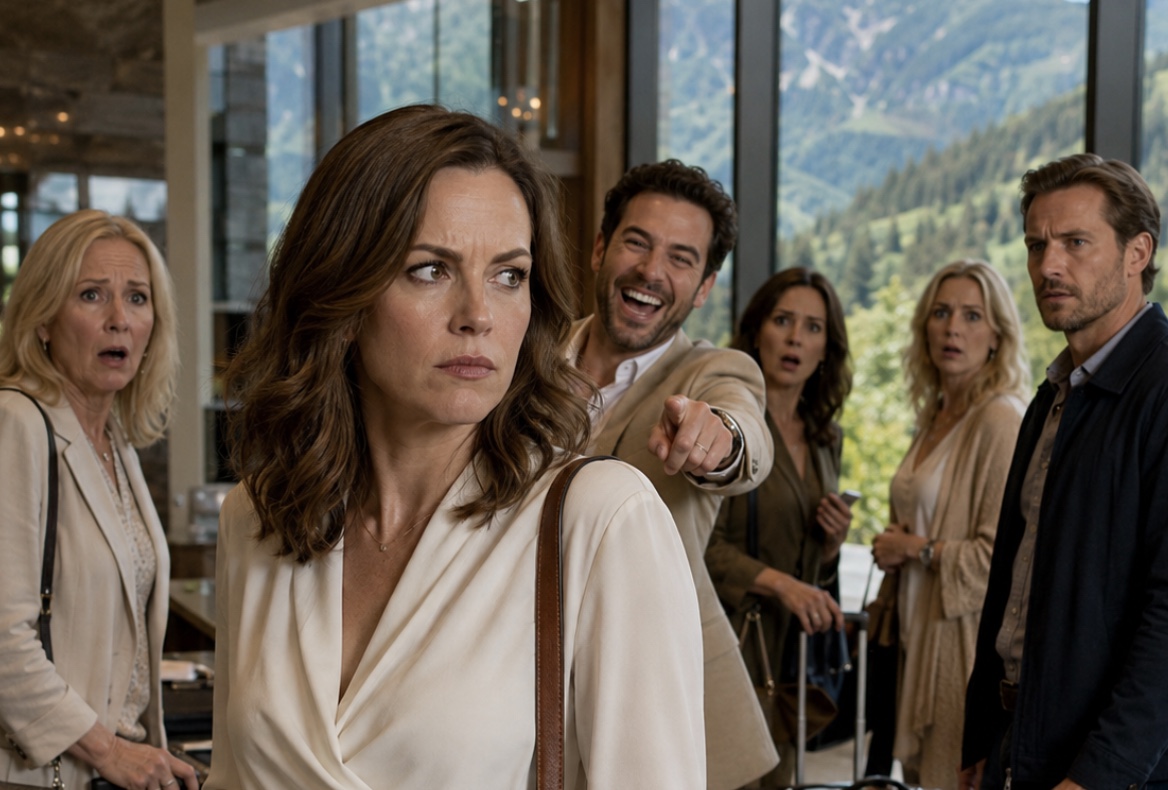
“Alright, let’s sort out the rooms. Aelita and I are taking the corner one with the mountain view. The rest of you can have whatever’s left.”
Rostislav said it before he had even climbed out of the car. He rested one arm on the open door and surveyed the guesthouse grounds as though he already owned the place.
I stood nearby with my phone in my hand.
On the screen were reservations for four rooms, a group chat called “Off to the Mountains!” with eleven people in it, and my banking app—the same one I had used a week earlier to pay for the entire group.
Six years of marriage. Six family trips together.
And for the sixth time, everything had been charged to my card.
The air smelled of pine trees and sun-warmed asphalt. Somewhere below us, a mountain river rushed over stones. From a gazebo nearby came the clatter of dishes; some of our relatives were already unpacking food without even waiting for the room keys.
Gury silently pulled bags from the trunk.
He always became quiet whenever trouble was brewing.
 
“Rost, wait,” I said. “Why don’t we split everything evenly this time? Room by room. Whoever stays in a room pays for it.”
He laughed.
Loudly, of course. Rostislav always knew how to laugh louder than everyone else.
“Oh, come on. It’s not like you’re short of money. You’re the rich one in the family.”
He slapped his brother on the shoulder.
“Gury, tell her.”
Gury stared at the bag in his hands as though the correct answer had been written somewhere on the fabric.
Aunt Sima, their aunt on their father’s side, fluttered her little hands.
“Oh, really, why are you arguing over pennies? We’re family.”
That was exactly how it had worked for years.
Nobody ever directly ordered me to pay.
They used laughter.
They used Aunt Sima.
They left me with one convenient role—the family cash register that never argued.
I knew the numbers because numbers mattered to me.
I worked from home doing embroidery: monograms, baptism shirts, traditional ceremonial towels, wedding pieces. Every stitch represented time and money, and I had learned long ago to count both carefully.
During the previous five trips, the family had promised to “pay me back later.”
Exactly zero times had they actually done it.
 
The group chat still contained years of unpaid expenses. If I added everything together, the amount was nearly equal to two years of my income from embroidery.
This trip alone cost fifty-five thousand just for accommodation: five nights, four rooms.
Standing there beside the cars, I scrolled backward through the chat.
“Fanya, you’re good at finding cheap places. Book for everyone and we’ll split it afterward.”
“We’ll split it afterward” appeared before every trip.
The first one.
The third one.
Last year’s.
Yet beneath none of those messages was there a single transfer to my bank account.
Only heart emojis.
“You’re amazing.”
“You’re a treasure.”
Apparently, their treasure was free of charge.
Three years earlier, I had once cautiously written in the group chat:
“Guys, nobody has sent me the money for Krasnaya Polyana yet.”
 
Someone replied with a money emoji.
Then silence.
That evening Gury asked me not to embarrass him in front of his relatives “over such a small amount.”
After that, I stopped asking.
I simply paid.
And stayed quiet.
Just like a convenient cash register should.
If I had been home, I probably would have had a needle and thread in my pocket. I was always mending something, even while sitting in the kitchen.
Now my fingers almost instinctively searched for something to fix, tighten or smooth over.
I had been smoothing things over for six years.
“Seriously, Rost,” I said, refusing to drop the subject. “You and Aelita are taking the best room. It makes sense that you should pay for it.”
“Oh, here we go,” he groaned, making a face as though I had started discussing some embarrassing illness in public. “Counting everybody’s money again. That’s ugly, Faina. We’re not sitting in an accounting office.”
“I’m not counting everybody’s money. I’m counting who pays for what.”
Aunt Sima hurried closer and lowered her voice just enough to pretend she was whispering while still making sure everyone could hear.
“Sweetheart, not in front of people. Look, there are strangers standing on the porch listening. Aren’t you ashamed?”
There it was.
The second weapon.
When laughter didn’t work, shame usually did.
If “you can afford it” failed, then it became “people are watching you.”
“We’ll figure it out later,” Rostislav muttered at last before pulling Aelita toward the corner room.
It was a tiny victory.
But he had said, “We’ll figure it out,” instead of, “You’ll pay.”
For the first time in six years, I had said the words “split it equally” in front of everyone.
And the sky hadn’t fallen.
I exhaled quietly and carried my bag toward whichever room nobody else wanted.
Gury and I ended up on the first floor.
Our window faced the blank wall of the neighboring building. The radiator hummed even though the weather was warm.
The bed creaked when I sat down.
Through the wall I could already hear laughter from Rostislav’s room and the sound of furniture being moved around.
Their room had sunlight.
And mountains outside the window.
I opened my suitcase and immediately pulled out my embroidery hoop and a small pouch of threads.
I could never sleep properly away from home unless I had some work in my hands.
 
Gury came inside, put down the suitcase and looked around.
“It’s fine,” he said, apparently addressing the room itself. “What more do you need?”
I didn’t need anything more.
I simply wanted the person staying in the expensive mountain-view room to pay for that room.
Apparently that concept was impossible to explain to someone who already had everything arranged exactly the way he liked it.
That evening, everyone gathered in the gazebo beside the river.
The table looked as though we had come there not to relax but to bankrupt ourselves.
Aelita brought out appetizers that I wouldn’t have served even at my own holiday dinners.
And I already knew whose card everyone expected to “split them later” on.
The river flowed steadily below us.
Smoke from someone else’s barbecue drifted through the air.
Drops of condensation glistened on bottles across the plastic tablecloth.
Aunt Sima arranged jars of homemade pickles while giving a detailed report about how well the cucumbers had grown that year.
Glasses clinked.
Then Rostislav stood up with a shot glass in his hand.
He looked around the table.
I knew immediately what was coming.
 
“I want to make a toast. To our Faina!”
He swept one hand dramatically over the table as if he were presenting the entire feast to me.
“Who pays for everything around here? Who’s never stingy? Our rich girl! You’ll pay for everyone’s vacation, won’t you? You’re the rich one!”
He burst into laughter, delighted with himself.
Laughter rolled around the table.
Someone shouted, “To Faina! God bless her!”
Aelita joined in while chewing on a chicken wing.
“And make sure you count our two-room suite with the balcony. Rostik and I aren’t just anybody. We deserve something decent.”
I held my fork but didn’t eat.
That label—“the rich one”—had never really been about money.
It was permission.
As long as I was considered “rich,” nobody had to respect my money.
If I supposedly had plenty of it, then it somehow became nobody’s money.
Family money.
Shared money.
 
Money that could be spent without asking.
In six years, nobody had once wondered where all that supposed wealth came from.
The truth was simple.
My grandmother had left me the apartment where Gury and I lived.
And I didn’t complain about prices in front of his relatives.
That was the full extent of my enormous fortune.
Yet they had built six years of free vacations around that label.
“I’m not a bank, Rost,” I said when the laughter finally paused. “And I’m not anyone’s sponsor. Tomorrow morning we’ll settle everything fairly. Everyone pays for the room they stayed in.”
The table went silent.
Aunt Sima blinked several times and dropped her fork.
“Oh, Faina, why are you doing this in front of strangers? Don’t humiliate yourselves.”
“Fanya, what are you doing?” Gury hissed beside me and tugged at my sleeve. “He’s my brother. He’s not some stranger.”
“Exactly. He isn’t a stranger.”
I pulled my sleeve away.
“You don’t send strangers the bill after they’ve paid for five of your vacations. Family says thank you. Has anyone thanked me even once for paying for the last five trips?”
Silence.
Rostislav stopped smiling, but he didn’t look away.
He wasn’t giving up.
 
He was simply changing tactics.
I could see it from the way he slowly sat down and reached for the bottle.
He was taking a pause.
I stood so abruptly that my hip bumped the table and the glasses rattled.
Then I walked out of the gazebo and stopped by the railing.
The river below looked icy. I could almost feel its cold rising from the wet rocks.
My palms burned as though I had been pulling coarse thread through my fingers until it cut into the skin.
For a few moments, there was silence behind me.
Then the conversation started again.
Rostislav was explaining something to the others in a low voice.
I didn’t need to hear the words.
His tone told me enough.
He was talking about me.
And he wasn’t saying anything kind.
It was strange.
All my life I had believed that family was different from the marketplace.
That people didn’t calculate things at home.
That family relationships were built on love.
But apparently everyone was calculating.
I was simply the only person who wasn’t allowed to.
The moment I mentioned money, I became greedy.
 
Petty.
Embarrassing.
Everyone was allowed to count except the woman whose money was actually being spent.
The evening was completely ruined.
Aunt Sima went back to her room crying.
Aelita loudly banged dishes around.
Gury refused to look at me.
I had embarrassed his brother in public, and the entire evening became my punishment.
And I knew it wasn’t over.
Rostislav would come to me in the morning.
Nicely.
I knew him too well.
And sure enough, he came nicely.
“Fanya, what happened yesterday?”
Rostislav caught me beside the coffee machine in the lobby.
He looked rested, cheerful and friendly.
“I said something stupid. It happens. But we’re family. Why start counting every penny?”
Right on cue, two figures appeared behind him.
Gury.
And Aunt Sima.
Three against one.
One glance was enough for me to understand the arrangement.
They hadn’t come to make peace.
 
They had come to finish the job.
“You need to understand something important,” Rostislav continued softly, almost confidentially, moving a little closer. “People heard everything yesterday. If you refuse now, they won’t blame me. They’ll blame you. Everyone will say you humiliated your own family in public over a few pennies. Do you really want that kind of reputation?”
There it was.
The most expensive thing on the table.
Not fifty-five thousand.
My reputation inside this family.
What they would call me from now on.
He twisted the situation so skillfully that my refusal to pay for him became my own shame.
And my husband stood beside him.
Shoulder to shoulder with his brother.
Not with me.
“Faina,” Gury said quietly, staring at the floor. “Can’t we settle this normally? Everyone pays half together, and you cover the other half. Then it’s over. Everyone’s happy.”
Aunt Sima nodded rapidly, crushing a handkerchief in her fist.
 
“Give in, sweetheart. For the sake of the family. God will remember that you weren’t greedy.”
“You know what?” Rostislav said suddenly. “I’ll even give you money for gas. Both ways. Honestly. Brother to brother. You just cover the rooms. It’s not difficult for you.”
Gas.
Three thousand against fifty-five thousand.
Even when he negotiated, the arrangement had to leave me losing.
And he presented his offer as generosity.
All three of them stared at me, waiting for gratitude.
I stood trapped between the coffee machine and their three faces.
Something inside me tightened like thread being slowly pulled into a knot.
My fingers instinctively searched for a needle.
Something to mend.
Something to hide.
Something to smooth over.
There was no needle.
And I gave in.
“Fine. Half,” I said. “We split it fifty-fifty. But after this, I don’t want to hear another word about it. Not today. Not when we get home.”
Rostislav’s face broke into a huge grin.
 
“There! That’s more like it! That’s how family does things!”
He wrapped an arm around my shoulders and turned me toward the lobby, where the rest of the relatives were sitting on sofas.
Then he announced loudly enough for everyone to hear:
“Alright, everyone, it’s settled! Faina admitted herself that she owes us! She’s one of us after all. I told you!”
Behind me, Gury sighed with relief.
Problem solved.
Thank God.
Except I stood there inside Rostislav’s embrace and understood that I hadn’t bought peace.
I had lost.
I had compromised for silence, and he immediately presented my compromise as surrender.
As an admission of a debt that had never existed.
Now the story would travel through the entire family:
Faina admitted it herself.
So apparently she really had owed everyone.
Which meant they had been right to take money from her all those years.
Giving in had made things worse than staying silent.
Rostislav walked away to announce his victory to the others.
Someone laughed as he approached.
Aunt Sima hurried after him, pleased that everything had been “settled peacefully.”
I remained beside the coffee machine holding a paper cup that had already gone cold.
I hadn’t even taken a sip.
The mineral taste of the machine coffee scratched my throat.
Across the lobby, I watched Rostislav gesture dramatically as he apparently told everyone how he had “talked sense into greedy Faina.”
And suddenly something became very clear.
Give them half once, and next time they’ll demand everything.
And they’ll believe they have every right to do it because you “admitted it yourself.”
Peace purchased through surrender is not peace.
It is merely an installment plan for the next humiliation.
 
That was when I took out my phone.
On the final day, everyone came down to reception together.
Checkout.
Payments.
Departure times.
Rostislav was in excellent spirits.
He stood beside the reception desk with his hands on his hips and introduced me to the receptionist as though he had won me in a raffle.
“And here comes our sponsor! She pays for everything. All money questions go to her. Our rich girl! Ha-ha!”
Beside him, Aelita was already complaining to the receptionist that they hadn’t received enough mineral water the previous day and that someone had given them the wrong towels.
Gury was studying a display of excursions through the nearby gorge.
He still refused to look at me.
The lobby smelled of fresh paint from the newly painted railings and the same coffee from the machine.
I walked to the counter and placed my phone screen-up beside the registration book.
The previous evening, after I had been left alone, I had called reception and asked one simple question:
Since I had booked and prepaid all the rooms myself, could I cancel payment for the rooms occupied by other people?
The receptionist, Vera, had told me yes.
The rooms could be reassigned to the actual guests, and each person could settle their own bill at checkout.
“Vera,” I said calmly. “Do you remember our conversation last night?”
She nodded.
“I’d like to cancel my payment for all the rooms except one. I’ll keep the room where my husband and I stayed on my account. Please transfer the other three rooms to the people who actually occupied them. They can each pay for themselves.”
The lobby became completely silent.
I could hear the river outside.
I could even hear the clock above the reception desk ticking.
“What do you mean, pay for ourselves?” Rostislav asked.
He was still smiling, but the smile had begun sliding off his face.
“Fanya, what are you doing?”
“Exactly what I warned everyone about.”
My voice remained level.
 
“I’m not a bank. I said that on the first day, beside the cars. Your room is your responsibility. The two-room suite with the balcony that Aelita wanted. It’s a nice room. And it costs accordingly.”
Vera was already typing at the computer.
“Your payment has been removed from that room and refunded,” she said professionally. “The guests occupying the other three rooms can come forward one at a time and settle their accommodation charges.”
Aelita opened her mouth.
Then closed it again.
Aunt Sima gasped and sat down heavily on the edge of a sofa.
Rostislav’s face turned dark red.
He spun toward his brother.
“Gury! Are you seeing this? Say something to your wife!”
And that was the moment that decided everything.
Gury raised his eyes.
He looked at his brother.
Then at me.
He opened his mouth.
Then his gaze drifted back toward the excursion display as though the correct answer might somehow be printed there.
All my life, I had been mending things.
Tightening loose seams.
Hiding crooked stitches.
Folding rough edges inward so nothing stuck out and everything looked neat.
For six years, I had done the same thing with this family.
Whenever there was a hole, I quietly patched it with my bank card so that from the outside everything looked smooth and respectable.
For the first time, I didn’t repair the tear.
I cut the thread.
 
“Everyone pays for their own room,” I said, putting my phone back into my pocket. “Completely fair. Exactly what I suggested on the very first day.”
Aelita grabbed her husband’s arm and hissed into his ear that she had warned him not to keep making jokes about me being their sponsor in front of everyone.
Aunt Sima muttered about how terrible it was that relatives were discussing money in front of strangers.
Meanwhile, a line was already forming.
Gury’s cousin.
Her husband.
One after another, they pulled out their cards and silently calculated how much those five nights were going to cost without their “rich girl” paying for them.
Finally, Rostislav took out his card.
His fingers trembled slightly.
He missed the payment terminal the first time.
Then he paid for his two-room suite with the balcony.
Without a joke.
Without a speech.
Without a laugh.
For the first time during the entire trip, Rostislav was truly silent.
I watched the back of his head and felt none of the triumph I had imagined during those six years.
I was simply exhausted.
It felt like finishing an enormous embroidery order after sitting awake over it night after night.
No excitement.
Only emptiness in my hands and tiny marks from the needle on my fingers.
We drove home separately.
Rostislav and Aelita left first without saying goodbye to anyone.
Their car disappeared in a cloud of dust.
Two weeks have passed.
Rostislav still hasn’t called me.
He told Gury that I’m greedy and that I “humiliated the whole family in front of the entire guesthouse, even in front of that strange girl behind the desk.”
Aunt Sima is deeply offended.
She keeps saying, “How can you treat relatives that way in front of other people? Now I’m ashamed to look the family in the eye.”
Aelita posted something online about “stingy women who pretend they’re poor.”
Gury spends some nights at home and other nights at his brother’s place.
His silence has changed too.
Before, it was the silence of someone trying to avoid conflict.
Now it is heavy and resentful, as though I were the one who betrayed him.
 
But the shared family wallet is closed.
For the first time in six years, nobody in the “Off to the Mountains!” chat is writing:
“Fanya, can you pay the booking? You’re good at handling all that.”
They’re already planning an autumn trip to the sea.
This time, they are dividing every expense themselves.
Right down to the last thousand.
They didn’t invite me.
I don’t regret canceling the payments.
There is only one thing I still sometimes question.
Maybe I shouldn’t have done it there at the reception desk, in front of everybody, with a stranger watching from behind the counter.
Maybe I could have quietly recovered the money afterward, once we were home.
Then nobody would have had the chance to laugh in my face.
 
But perhaps that was exactly the point.
For six years, they had been comfortable spending my money publicly while expecting me to object only privately.
And the first time I stopped hiding the torn seam, everyone finally had to see who had been holding it together.