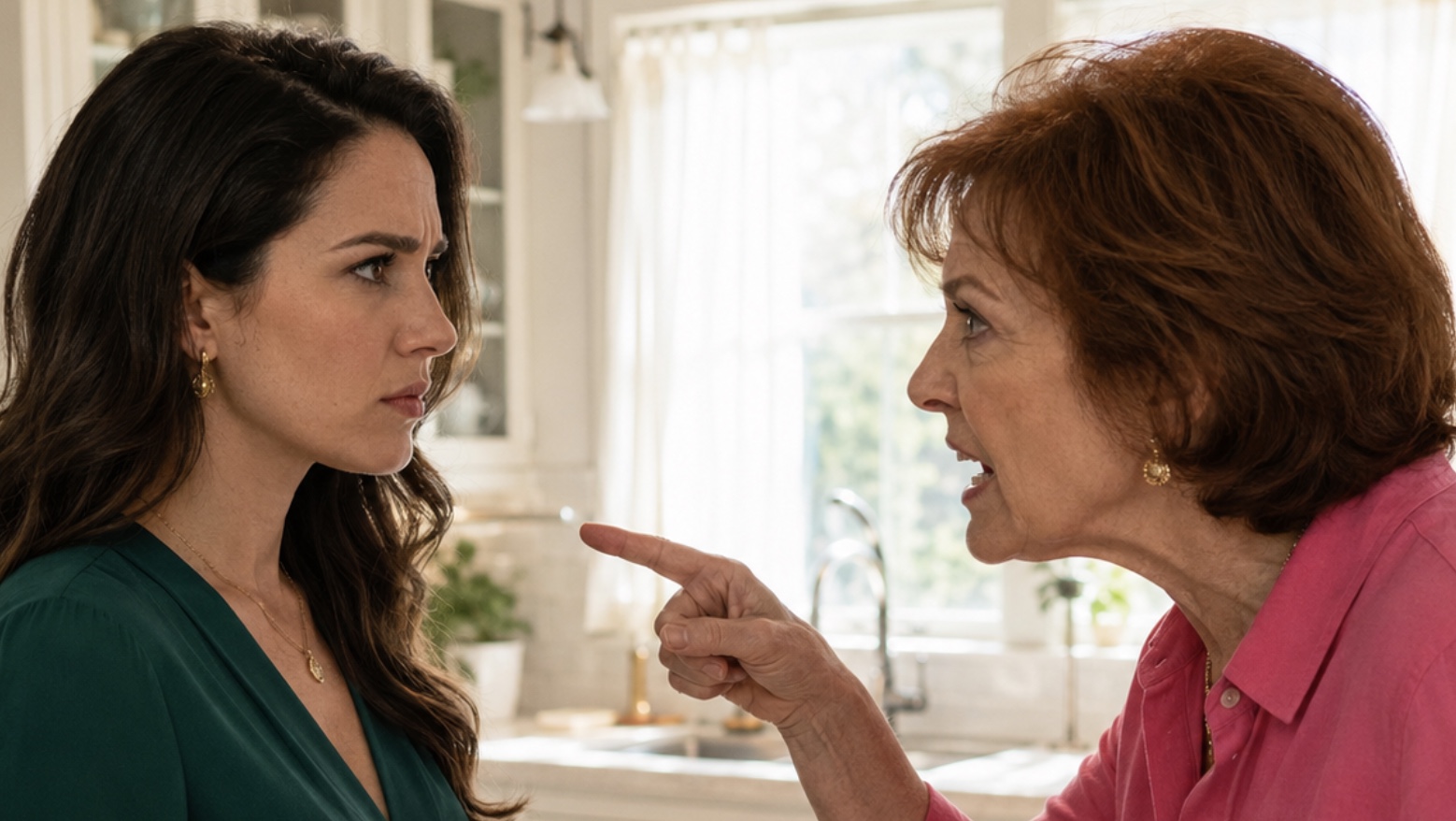
“You know, Vika, I thought for a long time before coming here,” Maria Glebovna said, setting her cup down on the saucer with a quiet but distinct clink. In the sudden silence of the kitchen, it sounded almost like the first rumble of thunder. “I kept trying to figure out what kind of person you really are. And I think I finally understand.”
Victoria stood by the window with one shoulder pressed against the cold glass. Outside, a miserable November drizzle blurred the lights of the neighboring apartment building into murky yellow smudges.
She had known this conversation was coming. She had known it ever since that evening when Fyodor, avoiding her eyes, first brought up the idea of selling her apartment.
“And what exactly have you figured out, Maria Glebovna?” Victoria asked without turning around.
“That you’re greedy. You always have been. We were just too foolish to notice.”
 
Fyodor, who had been sitting at the table studying the pattern on the plastic tablecloth as if it were the most fascinating thing in the world, finally lifted his head.
“Mom, why would you say that?”
“What did I say that was wrong?” his mother replied, spreading her hands. The large ring with a dark stone on her finger caught the dull light from the chandelier. “I’m telling the truth. She owns two apartments, yet she refuses to help her husband’s own brother. What else would you call that?”
Victoria finally turned away from the window. She tried to keep her voice calm, though irritation was already beginning to boil inside her.
“I call it my property, Maria Glebovna. I bought that apartment myself. Before I married Fyodor. I saved for eight years. I denied myself everything—vacations, decent food, new clothes. I wore the same old coat while my coworkers were updating their wardrobes. And you know that perfectly well because you made plenty of comments about how I looked back then.”
“Oh, so now that’s my fault too?” Maria Glebovna exclaimed dramatically. “You walked around looking like a gray mouse, and apparently I was wrong to worry about you? I thought maybe my son and his wife were struggling financially. I thought maybe you needed help!”
“Help?” Victoria gave a bitter laugh. “You never once offered me help. You only criticized me. The wallpaper in my hallway wasn’t modern enough. My refrigerator was too old. My job wasn’t a ‘real job’ because, according to you, I was just ‘a girl sitting in an office pushing papers around.’ And after I bought my second apartment, you practically stopped speaking to me normally. You just pursed your lips and sighed every time you saw me.”
“Well, excuse me!” Maria Glebovna placed one hand against her chest in offended dignity. “I have always been happy about your success!”
“Really? Last year, when Fyodor got promoted and received a bonus, you said, ‘Finally. He’s been living off his wife long enough.’ I heard you say it. You were talking on the phone, but I heard every word.”
 
Fyodor interrupted, more firmly this time.
“Vika, Mom, can we stop digging up the past? We’re talking about Kostya now.”
“Kostya?” Victoria turned toward her husband. “You mean the same Kostya who sold his country house two years ago to invest in some questionable auto-parts business? The same Kostya who mocked me for ‘showing off’ with my apartments while he kept taking out one loan after another? The same Kostya who got drunk at our wedding and told everyone that you married me for money?”
“He was drunk!” Maria Glebovna snapped. “You can’t hold something stupid like that against him forever!”
“I remember it,” Victoria said calmly. “Because it was humiliating. For me and for Fyodor. But I stayed quiet at the time. For the sake of peace in the family.”
“Exactly! You stayed quiet!” her mother-in-law shot back, leaning forward as red blotches spread across her face. “And now suddenly you’ve decided to show some character? I always suspected you weren’t easy to deal with, but this…”
“Maria Glebovna,” Victoria said, stepping toward the table, “let me explain this one more time. Clearly, so there is no misunderstanding. I am not selling my apartment. Not because I’m greedy. Because that apartment represents years of my work, my health, my sleepless nights. And I will not throw all of that away to cover the debts of a man who has never once asked me how I was doing.”
 
“Oh, I see!” Maria Glebovna stood abruptly. The chair scraped unpleasantly across the linoleum. “So now you think you’re better than us? Better than Kostya? Better than me?”
“I don’t think anyone is better or worse. I simply expect you to respect what I worked for.”
“Your work?” her mother-in-law laughed, a sharp, unpleasant sound. “What work? Sitting in an office clicking on a keyboard? What have you actually done in your life to think so highly of yourself? You couldn’t even manage to have a child!”
The kitchen fell completely silent.
Victoria felt the blood drain from her face before rushing back all at once, burning her cheeks.
It was the cruelest blow Maria Glebovna could have chosen.
Victoria and Fyodor had been trying unsuccessfully to have a baby for years. It was a deeply personal wound, one that never truly healed.
“Mom!” Fyodor jumped to his feet, though even now his voice lacked conviction. “That’s too much.”
“What is?” Maria Glebovna continued, realizing she had struck a nerve. “Someone had to tell her! She thinks because she earns money she can look down on everyone. She’s sitting on those apartments like a dog guarding a pile of hay! Kostya has a family! Children! And she’s leaving them on the street!”
Victoria stared at her for several seconds, unable to speak.
Then she inhaled deeply.
And slowly exhaled.
“Get out.”
“What?” Maria Glebovna blinked.
“I said get out of my apartment,” Victoria repeated.
Her voice was quiet, but there was such coldness in it that her mother-in-law froze for a moment.
 
“You came into my home and insulted me. You spoke about my inability to have children when you have absolutely no right to touch that subject. You demand that I hand over something that belongs neither to you legally nor morally. So get out.”
“Fedya!” Maria Glebovna turned to her son in disbelief. “Do you hear this? She is throwing your mother out!”
Fyodor stood helplessly, his arms hanging at his sides. His eyes moved from his mother to his wife and back again.
“Say something!” Maria Glebovna demanded.
“Vika, maybe you don’t have to be so…” he began.
“So what, Fedya?” Victoria turned toward him. “Your mother just called me less of a woman because I can’t get pregnant, and you’re asking me not to ‘be like this’? Are you serious?”
 
“I just want everyone to calm down.”
“And I want your mother to leave. Now.”
Realizing that her son was not going to openly defend her, Maria Glebovna grabbed her handbag from the windowsill.
“Fine! I’ll leave!” she declared. “But remember this day, sweetheart. Your pride will cost you. You’ll pay for this one way or another. Fyodor, walk me out.”
She stormed out of the kitchen without saying goodbye.
Fyodor gave Victoria one helpless glance before following his mother.
Victoria remained alone.
She stood in the middle of the kitchen with both hands pressed against her face, trying to stop her entire body from trembling.
Only one thought kept circling in her mind.
How did we get here?
They had met five years earlier at a mutual friend’s birthday party.
At the time, Fyodor had seemed quiet, dependable, calm—the complete opposite of Victoria’s endless rush, deadlines, and stress.
Exhausted after yet another difficult project, she had been drawn to him as if he were a peaceful harbor.
 
He was not ambitious. He had no desire to climb the career ladder. But he was kind, attentive, and told her he loved her.
Back then, Victoria believed that was enough for happiness.
At first, everything was good.
She continued working, her income increased, and they took their first vacation together in Turkey. They bought new bedroom furniture. Fyodor helped around the house and sometimes met her after work.
She felt loved.
But gradually, she began to notice something beneath his calmness that she had not wanted to see before.
Indifference.
Fyodor showed little interest in her work. He rarely asked how her day had gone unless she started talking about it herself. He was perfectly comfortable in his small world—work, home, occasional meetings with friends.
Whenever there was conflict, he avoided taking sides.
“You know I hate arguments,” he would say whenever Victoria tried to explain how much one of his mother’s cutting remarks had hurt her.
And Maria Glebovna’s remarks became more frequent.
 
At first, they were minor.
“Oh, why is your blouse so wrinkled?”
“You bought a new armchair? I liked the old one better.”
Then they became more personal.
“Fyodor said you got a bonus. Aren’t you embarrassed to make that much money? Other people work themselves to death, and you…”
Eventually, the criticism became openly cruel.
“You probably don’t even want a baby. Why would you? You have your career.”
Victoria endured it.
For her husband.
For the sake of that precious “peace in the family.”
She helped his relatives whenever they needed something. She sent money for Fyodor’s father’s medical treatment. She lent money to Valeria when her washing machine broke. She brought expensive gifts back from vacations. She ordered groceries for Maria Glebovna when she was sick.
Every gesture was treated as something completely natural.
 
“Well, you can afford it,” her mother-in-law would say while accepting another box of expensive food.
Never a sincere thank-you.
Never a warm word.
Only cold judgment mixed with envy.
The argument about the apartment was merely the visible part of something that had been growing for years.
The final drop.
After his mother left, Fyodor returned to the kitchen and sat down without looking at his wife.
“She’s gone.”
“Good.”
 
“Vika…” He hesitated. “Mom is furious. She expects you to apologize.”
Victoria laughed, but there was no amusement in it.
“I’m supposed to apologize? For what? For being insulted in my own home?”
“She was emotional. You understand she’s worried about Kostya. And then you…”
“And then I what?” Victoria felt another wave of anger rising. “Am I responsible for refusing to give away my apartment? Am I guilty because I can’t get pregnant? Because I earn more than you?”
“I didn’t say you were guilty. But maybe you could be wiser about this. Give in a little. Call her. Talk calmly. She’ll settle down.”
“Fyodor.”
Victoria looked at him with such pain that he lowered his eyes.
“Are you seriously asking me to apologize after everything she said?”
“What am I supposed to do, Vika?” desperation finally appeared in his voice. “Take your side against my own mother? Destroy everything?”
“Whose side are you on now?”
He said nothing.
And his silence told her more than words ever could.
 
The following days became unbearable.
Fyodor walked around the apartment gloomy and resentful. He barely spoke to Victoria and kept giving her reproachful looks. He slept on the sofa in the living room.
Victoria began to feel like an outsider in her own home.
She replayed the years of their marriage over and over in her mind.
And with each memory, one truth became clearer.
Fyodor had never really been on her side.
He always chose comfort instead of doing what was right.
He chose his mother, his brother, anyone who made fewer demands on him.
Anyone except Victoria.
A week after the argument, he approached her while she was folding clean laundry.
“Vika, Mom called.”
 
“And?”
“She says she’s willing to let this go if you come over and apologize to her personally. And maybe reconsider helping Kostya. At least partially.”
Victoria stopped folding a towel.
“For example,” Fyodor continued carefully, “you could take out a loan for him using your apartment as collateral.”
Victoria slowly turned toward him.
“Are you serious?”
“What’s so terrible about that? It’s a reasonable compromise.”
“A compromise?”
She stared at him in disbelief.
“Fyodor, do you hear yourself? Your mother humiliated me, and I’m supposed to go apologize to her? And then take on debt for your brother?”
“Well, if you hadn’t been so harsh that day…”
“I was harsh?”
Victoria threw the towel into the laundry basket.
“That’s enough. I’m done, Fyodor. I’m leaving.”
“What? Where?”
“It doesn’t matter. I need time to think. I need to be alone.”
She went to stay with her friend Olga, who lived alone in a spacious two-bedroom apartment across town.
Olga listened as Victoria told the story in broken fragments.
She offered no advice.
She simply poured her tea, wrapped a blanket around her shoulders, and said, “Stay as long as you need.”
Victoria stayed for three days.
For three nights she barely slept, turning from side to side while the same question ran through her mind again and again.
Why am I expected to sacrifice myself for people who don’t respect me?
 
She remembered buying Maria Glebovna a new phone and hearing her complain instead of saying thank you.
“You could’ve bought an iPhone instead of this Chinese thing.”
She remembered giving Valeria and Kostya an expensive anniversary gift, only to later hear that Konstantin joked behind her back, “She probably stole the money. That’s why she gives gifts like that.”
She remembered how Fyodor had always remained silent when those jokes were made in front of him.
And finally, she understood.
The problem was never the apartment.
It was never really about money.
The problem was her inability to set boundaries.
Her lifelong need to be good for everyone.
And her refusal to see the man she had married for who he really was.
When Victoria returned home, Fyodor was sitting in the kitchen drinking tea and scrolling through his phone.
He did not stand when he saw her.
He did not hug her.
He did not ask how she was.
“You’re back.”
 
“Yes.”
“I’ve been waiting.”
“For what?” Victoria asked as she removed her jacket.
“I thought you’d cool down and realize I was right.”
“I cooled down,” she replied. “And I realized a lot.”
“So? Are you going to Mom’s?”
Victoria looked at him.
At his calm, familiar face that suddenly seemed completely foreign.
At the emptiness in his eyes.
There was no love there.
No respect.
Not even fear of losing her.
“No, Fyodor. I’m not going to your mother. I’m not apologizing. I’m not taking out a loan. And I’m not selling my apartment.”
“Then what?”
“I’m filing for divorce.”
The words hung between them like a final verdict.
For several seconds, Fyodor seemed unable to understand what she had said.
Then his face changed.
“Divorce? Because of this?”
“Not because of this.”
Victoria shook her head.
“This only exposed what had been happening for years. You were never truly my husband, Fyodor. You were a roommate living in my apartment. You never defended me. You never stood beside me. I needed a partner, not another person who believed I owed everyone something.”
“You can’t destroy everything like this!” panic crept into his voice. “We’re a family! I’ll fix it! I promise! I’ll talk to Mom!”
“It’s too late.”
Victoria walked into the bedroom and pulled a suitcase from the wardrobe.
“You can talk to her as much as you like. None of it concerns me anymore.”
 
The divorce itself was surprisingly quiet.
There were no dramatic scenes and no major arguments.
Once Fyodor realized that Victoria would not change her mind, he seemed to deflate. He moved back in with his mother.
There was little property to divide. Almost everything valuable had either belonged to Victoria before the marriage or had been purchased with her money.
Fyodor took his personal belongings and the television his parents had given them as a wedding present.
Two months after the divorce, Victoria unexpectedly ran into Valeria at a shopping center.
Konstantin’s former wife looked tired and noticeably thinner.
They ended up sitting together in a café.
At first the conversation was awkward, but slowly they began to speak more openly.
“You know, Vika,” Valeria said, turning the paper coffee cup between her hands, “I never blamed you back then. I honestly didn’t understand why Kostya and Maria Glebovna went after you because of that apartment. It was yours. But your mother-in-law put so much pressure on everyone. And Kostya… he was always completely under her control. Just like Fyodor. Both of them.”
“I know,” Victoria said quietly.
“When you filed for divorce, I admired you so much. I mean it. I don’t think I would’ve had the courage.”
“I didn’t really have a choice. I wouldn’t have survived if I had stayed.”
 
Valeria was quiet for a moment.
Then she added softly, “Do you know the ironic part? Kostya eventually admitted you were right.”
Victoria raised an eyebrow.
“He said once, ‘We never should’ve gone after Vika like that. My jealousy ruined everything. And Fedya was an idiot for not supporting her.’”
Valeria sighed.
“But by then it was already too late.”
Victoria listened without satisfaction and without sadness.
She felt only peace.
Everything had finally fallen into place.
Now, six months after the divorce, Victoria sat on the windowsill in her cozy kitchen, holding a mug of hot cocoa and watching snow fall over the courtyard outside.
She felt like herself again.
She was working on a new project that brought both enjoyment and good money.
She had returned to the gym.
She had started learning Spanish.
And for the first time in years, she did not feel “too proud,” “greedy,” “selfish,” or “less of a woman.”
She simply felt like Victoria.
Strong.
Free.
Happy.
She finally understood that the apartment had never truly caused her divorce.
 
It had merely revealed a truth she had refused to see for far too long.
Her marriage had not been built on mutual respect and love.
It had been built on her endless willingness to be convenient.
To stay quiet.
To forgive.
To give.
To avoid conflict.
To make everyone else comfortable.
And the moment she stopped being convenient, everything she had mistaken for a family collapsed.
Victoria smiled at her reflection in the dark window.
Then she looked toward the snowy morning outside.
For the first time in a very long time, the life ahead of her belonged entirely to her.