The anniversary celebration had gone well, which in itself felt like a small miracle. The candles had gone out on the first try, the cake with the golden numbers had arrived intact, and nobody had argued over where to sit at the table. Ksenia was heading home in the lightest mood she had experienced in months.
“Did you see the way she held that knife over the frosting?” Artyom laughed as he turned the wheel. “Like the cake had personally offended her.”
“You spent half an hour straightening the number sixty-five,” Ksenia replied. “It kept tilting sideways, just like your mood by Friday evening.”
“At least the photos turned out nice.”
“They did,” she agreed. “I even put my phone away so I wouldn’t spoil the moment.”
Their apartment was quiet, warm, and pleasantly empty when they got home. Ksenia took off her shoes, lined them up neatly, stretched, and rolled her neck. The hallway smelled of nothing in particular, and that was comforting. Just their home. Just an ordinary evening. Just the end of a very long day.
“I’m glad it’s finally over,” she said. “Another week of preparations like that and I would’ve started having conversations with the dishes.”
“Speaking of a week…” Artyom walked into the living room, sat on the sofa, and rested his elbows on his knees. “We need to talk.”
 
Ksenia looked at him.
“Promising beginning. Sounds like one of those ads saying, ‘Kitten free to a loving home,’ and then you find out the kitten is four years old and weighs eighteen pounds.”
“You’ll stay with my mother for a week,” her husband said calmly. “She’s still shaken up after the anniversary.”
Ksenia stopped in the middle of the room.
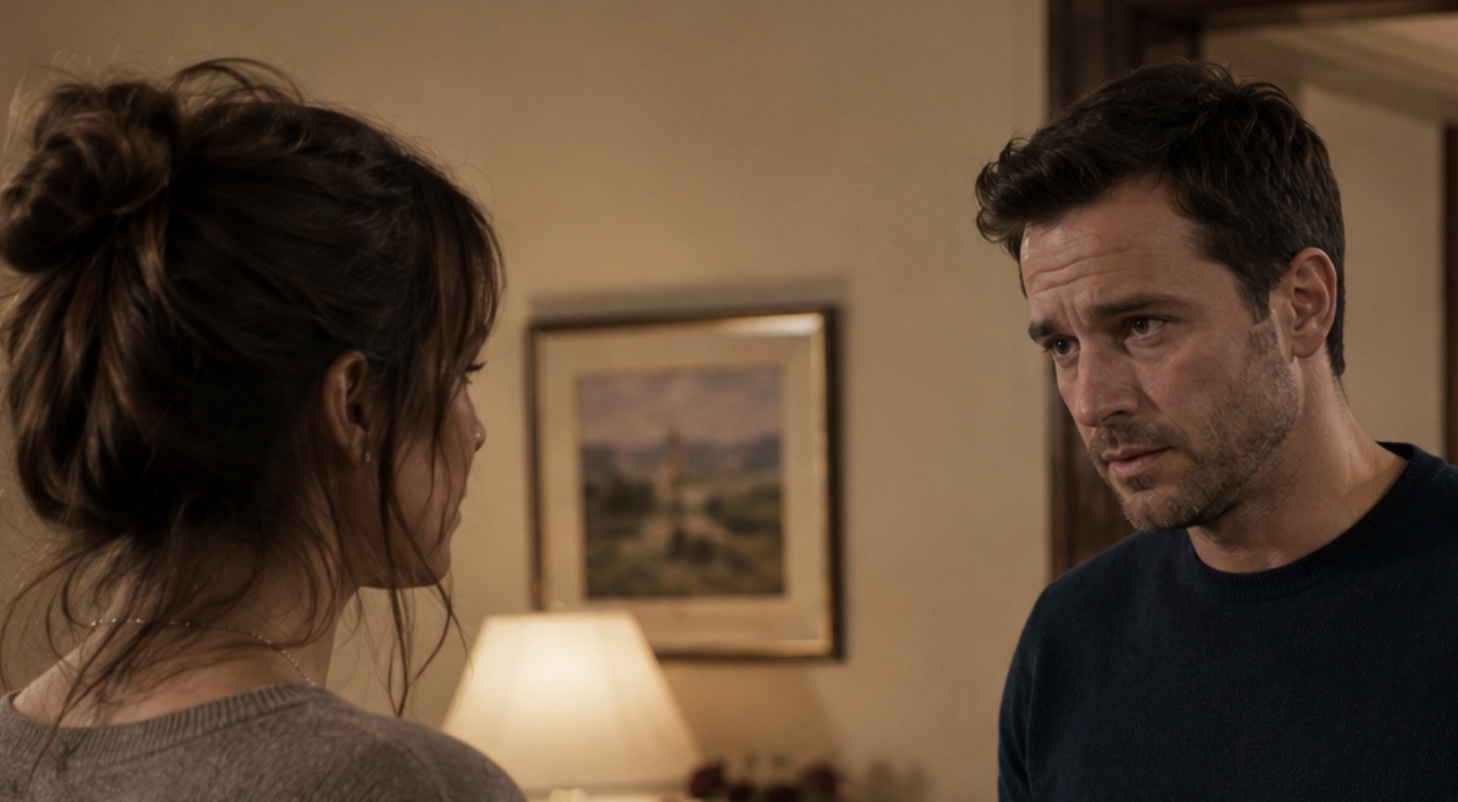
Her expression barely changed. She only raised her eyebrows slightly and stepped closer so she could see his eyes. Clearly, this conversation was heading somewhere very different from where it had begun.
“Shaken up?” she repeated. “Yesterday we practically had to carry her around because she was so cheerful. She sang. Twice.”
“She was cheerful, and then she looked at the photographs,” Artyom said with a grimace. “That’s when she realized she was sixty-five. She stayed awake until morning saying her life was over. Are you capable of feeling sorry for anyone at all?”
“I am. But sympathy isn’t a subscription with automatic renewal,” Ksenia replied. “Give me the details. Why me, and why a week?”
Artyom straightened.
 
Those hard metallic notes immediately appeared in his voice, the ones he reserved for matters he considered already settled. Ksenia knew that tone well. It meant the decision had been made without her and she was merely being informed afterward.
“Because you’re a woman. Things like this come more naturally to you,” he said. “You can talk to her, sit with her, distract her. I don’t know what to say to her. I’m no good at that emotional stuff.”
“Excellent logic,” Ksenia said with a nod. “You don’t know how to talk to your own mother, so naturally the job should go to the person she’s spent eight years communicating with through you like you’re an interpreter.”
“Don’t exaggerate. You two get along fine.”
“We behave politely toward each other. That’s a different sport entirely.” Ksenia sat in the armchair opposite him. “And politeness is fragile, you know. It breaks easily when two people start sharing one apartment and one bathroom.”
“It’s only a week. That hardly counts as living together.”
“A week at your mother’s is never just a week,” Ksenia said. “It’s a probation period. Then it becomes, ‘Well, you’re already used to it.’”
Artyom looked away.
And in that exact moment, Ksenia knew she had hit the target.
He reached for his phone too quickly. Scrolled through the screen too intently. Stayed silent far too long for a man with nothing to hide.
“Artyom.”
“What?”
“How many weeks is it really?”
“You’re about to create a scandal out of nothing,” he snapped. “As usual. I come to you with a perfectly reasonable suggestion, and suddenly I’m being interrogated.”
“You’re not coming to me with a suggestion. You’re handing me a schedule for my own life,” she corrected him. “And I like reading schedules all the way to the end. Especially the fine print.”
He stood, paced across the room and back, then started speaking quickly, swallowing his words as if he were afraid she might interrupt him.
“Fine. Fine! Not one week. Three months. Maybe four. She needs someone there. She’s scared. She finally looked at herself and saw an old woman staring back! Meanwhile this apartment could be making money instead of just sitting here while we throw money away every month!”
“Hold on.” Ksenia raised a hand. “The apartment is sitting empty? We’re sitting in it right now. I even sleep here sometimes, believe it or not.”
“You know exactly what I mean! I’m talking about money! We rent this place out and bring in some income. You stay with my mother, make yourself useful, and I…”
 
“And you?” she asked quietly.
“And I’ll live somewhere else for a while,” Artyom exhaled. “I need to be alone. I’m tired. I want to feel like I actually have my own life, you understand? Just a little freedom.”
Ksenia slowly leaned back in the chair.
She watched him carefully and calmly, and her calmness made the muscle in his cheek twitch.
“So let me summarize the plan,” she said. “You send me to your mother as a caregiver and emotional punching bag. You rent out the apartment. The money goes into our so-called shared budget, which somehow always seems to be controlled by you. And you get your freedom, where you can finally ‘feel your own life.’ Tell me, does your version of freedom include a wife at all, or is she an optional extra that costs more?”
“Don’t twist everything!”
“I’m not twisting anything. I’m simply reading aloud what you’ve written,” Ksenia said. “And you forgot one small detail. This apartment is mine. My grandfather left it to me. You’re a guest here. A guest I love very much, but still a guest.”
“Here we go again with your apartment!” he shouted. “For eight years I’ve had to hear about it! We’ve been married for seven—”
“Don’t,” she interrupted gently. “Used that way, the word ‘married’ starts sounding like a discount coupon.”
Artyom sat down again and rubbed his palms across his knees, trying to shift into a calmer, more reasonable tone.
It didn’t work.
His voice kept rising like water coming to a boil.
 
“Ksyusha. She’s sixty-five. She’s alone. You want her sitting there talking to the walls?”
“I want her talking to her son,” Ksenia replied. “Her own son. The same son who liked imagining her as a convenient mother and grandmother until suddenly he discovered she’s a human being who’s afraid of getting old and dying.”
“I don’t have time!”
“And apparently I have nothing but time,” she said. “Fine. I’ve got a counterproposal. You go live with your mother. Three months. I’ll stay here, miss you sincerely, and bring groceries once a week. How does that sound?”
“That’s ridiculous!”
“Why?” She spread her hands. “She’s your mother. You’ve known her for thirty-eight years. You know what television programs she watches and how she feels about open windows. I don’t even know which side of the bed she sleeps on.”
“Because a man can’t just—”
“He can,” Ksenia said. “A man can do anything a human being can do. Sometimes it’s simply more convenient to call certain things ‘women’s work.’”
Artyom jumped to his feet and stepped toward her.
There was so much anger in his face that Ksenia found herself thinking: There. Finally. At least this is honest. No wrapping paper anymore.
“You’re heartless!” he burst out. “You’re empty inside! You don’t care about anyone except yourself!”
“Notice something,” Ksenia replied evenly. “I haven’t said I don’t care about anyone. I said I refuse to move in with your mother. The difference between ‘I won’t live with your mother’ and ‘let her die’ is roughly the same as the difference between ‘I don’t want soup’ and ‘burn down the entire farm.’”
The phone rang at exactly the wrong moment.
Artyom grabbed it as if someone had thrown him a rescue rope.
He switched to speakerphone, whether from habit or deliberately so Ksenia could hear what he considered the correct version of events.
“Artyom, sweetheart, did you speak to her?” came Lyudmila Arkadyevna’s trembling voice. It sounded broken and fragile, almost suspiciously well-practiced. “Did she agree?”
“We’re discussing it,” Artyom said quickly.
 
“What is there to discuss?” His mother’s voice grew noticeably stronger. “I didn’t sleep a wink last night. I saw those photographs and there was some strange old woman looking back at me. I need a living person beside me, not an empty apartment! Ksenia, can you hear me?”
“I can, Lyudmila Arkadyevna,” Ksenia replied. “And happy anniversary again. The cake turned out beautifully.”
“What cake!” the older woman cried. “You’re talking to me about cake while my whole life is collapsing! You have nothing to do anyway. You sit at home with those pieces of glass of yours…”
“I don’t actually work with stained glass, if that’s what you mean,” Ksenia corrected calmly. “And I don’t simply sit at home. I work from home. It’s a bit like fishing. A person appears to be sitting there, but something is still being produced.”
“Don’t get clever with me!” her mother-in-law snapped. “Your family is asking you for help!”
“You’re asking me to move out and provide a service,” Ksenia said. “That isn’t the same as asking for help. I would discuss the first. I refuse the second.”
“Do you hear that, Artyom?!” Lyudmila Arkadyevna’s voice shot upward. “She’s refusing me! Me! After everything!”
“After what, exactly?” Ksenia asked politely. “Just so I understand how much I supposedly owe. I have an excellent memory. I don’t owe people things, and I don’t let people invent invoices for me.”
 
Artyom switched off speakerphone so violently he nearly dropped the phone.
He disappeared into the bedroom and spent about fifteen minutes talking there in a quick, quiet, apologetic tone — the special voice he seemed to reserve exclusively for his mother.
Ksenia didn’t eavesdrop.
She simply sat where she was and arranged the facts in her mind, piece by piece, like someone studying individual parts in order to understand what kind of machine had been assembled behind her back.
When Artyom returned, he looked composed, almost ceremonial.
He had the air of a man who had received new instructions.
“All right,” he announced. “The tenants are coming Sunday. To look at the apartment.”
Ksenia stared at him.
“Coming where?”
“Here.” He paused. “A couple. Quiet. No pets. I already showed them photographs.”
Ksenia stood up.
Slowly.
Without any sudden movements.
And something about that deliberate calm made him instinctively take one step backward.
 
“You showed strangers photographs of my apartment without saying a single word to me,” she said. “Artyom, this isn’t about your mother anymore. This is about you.”
“I’m taking care of practical issues!” he exploded. “Someone has to think about money!”
“Thinking is wonderful. But you weren’t thinking. You were making decisions for me,” Ksenia replied. “There’s a difference between ‘let’s calculate whether this makes sense’ and ‘I’ve already sold everything, now sign here.’”
“You always make everything complicated! Normal women—”
“Stop.” Ksenia raised one finger. “The second ‘normal women’ appears in an argument, I know the actual arguments are over and we’ve moved on to stage decorations.”
“You’re going to ruin everything!” he shouted. “Everything I’ve been arranging!”
“You’ve been arranging a system where I’m furniture with an empathy function,” she replied. “Unfortunately for you, the furniture has an opinion. Especially when it owns the room.”
The doorbell rang shortly before nine.
Veronika walked in without even taking off her coat.
Her eyes moved from the room to her brother and then to Ksenia, and it was immediately obvious she hadn’t come to make peace.
“So, family meeting?” she asked. “Artyom, did you tell her about the vacation yet?”
Silence lasted exactly two breaths.
Artyom opened his hand as though he were about to explain something.
Nothing came out.
 
“What vacation?” Ksenia asked, turning toward her husband’s sister.
“Twelve days,” Veronika said. “Yesterday he spent half an hour telling me how exhausted he was and how badly he needed to reset. Alone. He already paid for it with the money he took in advance from those tenants. Three months’ rent.”
“Veronika!” Artyom roared.
“What, ‘Veronika’?” She took off her coat and threw it over the arm of a chair. “I’m tired of this. I’m tired of listening to Mother moan on the phone every day about how her life is over while you agree with everything she says and promise you’ll send Ksenia over to her. Do you know what he told her? ‘Don’t worry, she’ll come. Where else is she going to go?’”
Ksenia looked at her husband.
He was standing there breathing quickly and angrily, like a man whose carefully drawn blueprint had just been ripped out of his hands.
“So you already took the deposit,” she said. “For an apartment you don’t own. And you spent it on a vacation I’m not even part of.”
“I had every right! I put money into this renovation!”
“You picked the tiles and argued with the contractor once,” Ksenia replied. “For achievements like that, people give you a thank-you card, not ownership rights. But really, darling, there’s only one thing I want to understand. You wanted freedom. Nobody was stopping you from having freedom. Why did your freedom require renting out my apartment and renting out me?”
“Because it’s more convenient!” he shouted. “It’s more convenient for everyone! She calms down, you have something useful to do, and I get some rest!”
“By ‘everyone,’ you mean you,” Ksenia said. “You’ve simply confused the words ‘family’ and ‘service.’”
Veronika pulled out her phone, found what she was looking for, and placed it face-up on the table so everyone could see.
“Here’s the conversation,” she said. “Here he writes, ‘My wife can stay with Mom until winter, and after that we’ll see.’ Here he writes, ‘I need to dump Mom on someone because I can’t take it anymore.’ Dump, Ksyusha. That’s the word he used about his own mother.”
“Is that why you came here?” Artyom asked through clenched teeth. “To destroy me?”
“I came here because I’m done being your accomplice,” Veronika shot back. “I love our mother. But I’m not helping you turn another human being into unpaid staff so you can lie on a beach somewhere. And by the way, Mom doesn’t need a caregiver. She needs her son to visit once a week and sit with her for two hours without staring at his phone.”
“I work!”
“You avoid responsibility,” Ksenia said. “That’s an activity too. It just doesn’t pay very well.”
 
Artyom spun toward her, and his voice cracked into an ugly, high-pitched shout.
“Who the hell do you think you are?! Who are you without me?! You’ll end up alone, do you understand? Nobody needs someone with your personality!”
“Artyom,” Ksenia said without raising her voice, “you’re threatening me with loneliness while standing in an apartment I can ask you to leave before the evening is over. I’d say that’s a fairly weak position from which to make threats.”
He fell silent.
Veronika snorted and sat down, crossing one leg over the other like a spectator who had finally been shown an interesting scene.
Ksenia walked over to the table, picked up a sheet of paper — the same one that had held the grocery list that morning — turned it over, and wrote three lines.
Then she placed it in front of her husband.
“Read.”
“What is this?” he asked, grimacing.
“Conditions. First: tomorrow you return the money you took from those people. With an apology. Nobody is renting my apartment.”
“You don’t have the right—”
“I do,” she said. “Second: you visit your mother yourself. Not for three months. Weekends will do. Every weekend if necessary. And instead of borrowing sympathy from someone else, you give her your actual presence. I’m willing to visit her. I’ll help with doctors. I’ll bring groceries. I’ll talk to her. Helping — yes. Moving in — no.”
“And the third?” he asked quietly.
“The third…” Ksenia looked directly into his eyes. “You decide whether you actually need freedom from me. If you do, take it. I’ll even hold the door open for you. But if you choose freedom, then you choose it without my apartment, without my energy, and without me as your personal support staff. Freedom doesn’t come bundled with conveniences.”
“You’re giving me an ultimatum?” he hissed.
“You? No.” She shook her head. “You gave yourself one. Three times tonight. I’m simply reading you the bill.”
 
Artyom picked up the paper, crushed it in his fist, then slowly opened his hand again and put it back on the table.
Wrinkled, but still intact.
“So you’re never going to tolerate anything,” he said, almost accusingly. “You’ve never tolerated anything.”
“That’s true,” Ksenia agreed. “Tolerance is a terrible currency. It always loses its value right when someone finally tries to cash it in. I respect your mother. I respect Veronika. I respected you. But respect does not give anyone the right to reach into my life with both hands and rearrange it.”
Veronika stood, picked up her coat, and paused near the door.
“Ksyusha, I’ll call Mom myself,” she said. “I’ll tell her the truth. About the deposit, the vacation, and the part where he said, ‘Where else is she going to go?’ Let her hear what kind of son she raised.”
“Don’t say anything about what kind of son she raised,” Ksenia replied wearily. “She’s struggling enough already. Just tell her I’ll come on Wednesday. Without a suitcase. We’ll sit together, talk, look through her photo albums. She loves those albums.”
“You’re seriously going to visit her?” Artyom asked, lifting his head.
“I am,” Ksenia said. “Because I don’t mind giving two hours to someone who’s frightened. What I do mind is giving eight years to someone who thinks I’m a disposable resource.”
 
The door closed behind Veronika.
Two people remained in the room, along with the crumpled sheet of paper on the table and a silence that suddenly seemed both very loud and very clear.
Neither of them rushed to break it.
“Ksyusha,” Artyom finally said. “What happens now?”
“Now you call those people,” she replied. “Then you call your mother. Yourself. And you tell her you’re coming on Saturday. Alone. Without bringing me along like some kind of gift.”
“And us?” He swallowed. “What happens to us?”
“Us…” She looked at him for a long moment, without anger now. “We’re hanging by a single thread, Artyom. I didn’t tear it. You kept pulling it tighter and tighter. If you want to find out whether it can still hold, go ahead. Just remember one thing: the thread doesn’t owe you anything.”
He reached for his phone.
His hand was uncertain, like that of a schoolboy about to sit an exam he had somehow scheduled for himself.
Ksenia sat back down in the armchair, rested her hands on the armrests, and prepared to listen.
It was going to be a long evening.
And it was ending very differently from the way her husband had planned that morning.