The train from Yaroslavl pulled in four minutes ahead of schedule, and Polina took it as a personal gift from fate. The contract had been signed on the very first day, the second had been spent exchanging polite smiles, and the third she had simply given back to herself. The platform was warm, her bag felt light, and her mood was as carefree as it had been when she was seventeen.
At a kiosk near the exit, she bought a box of éclairs—the ones with chocolate icing that Gleb always called “my little weakness.” After nine years of marriage, she still enjoyed watching a grown man light up over a box of pastries. As she walked, she called her mother.
“I’m back. How’s Eva doing?” Polina asked, shifting the box to her other hand.
“Alive and cheerful. Yesterday she cut her doll’s bangs and announced that it was fashionable,” Tamara Vitalyevna replied. “When are you picking her up?”
“Saturday. I want to surprise Gleb today. He thinks I’m coming back the day after tomorrow.”
“Oh, you’ll surprise him,” her mother said with a chuckle. “It’s good to surprise men every now and then.”
Polina laughed and promised to bring a cake on Saturday.
 
She went up to her floor, took out her keys, and opened the apartment door as quietly as possible. She wanted to catch the exact moment of his surprise.
There was a pair of unfamiliar sandals in the hallway, neatly placed with their toes pointing toward the wall.
Polina took three steps and stopped at the kitchen doorway.
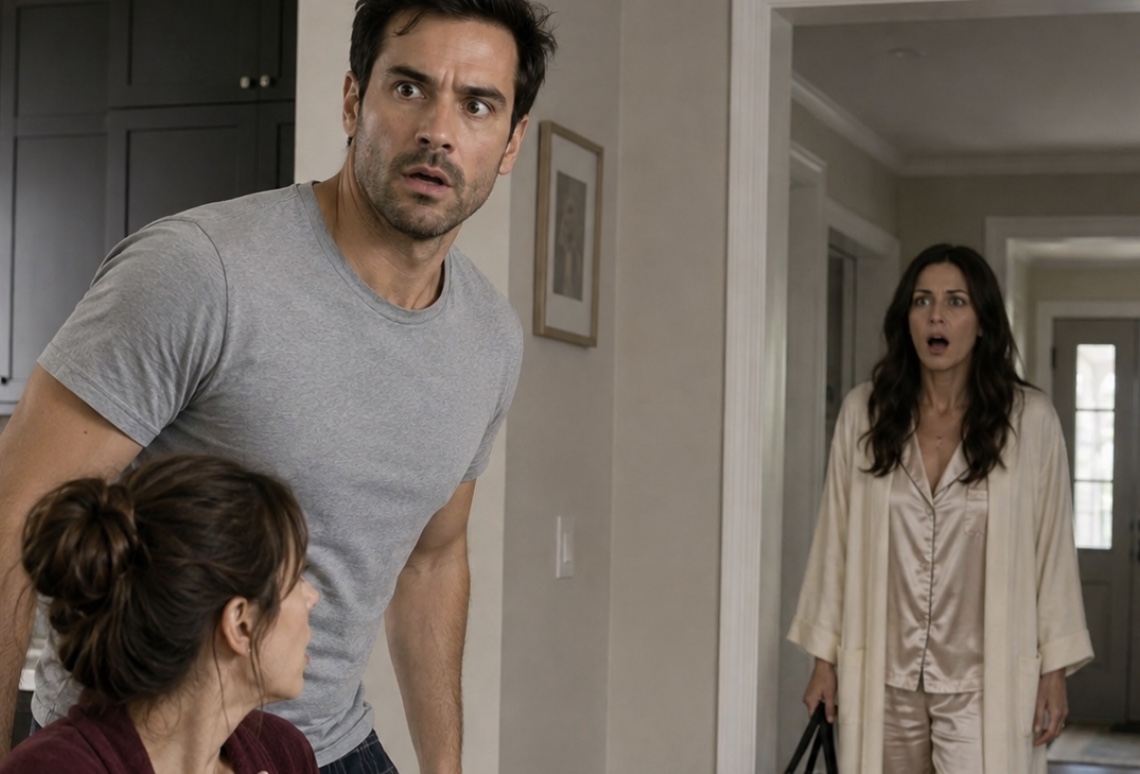
Gleb was sitting at the table in his robe, elbows resting on the tabletop. Across from him sat Alisa, the upstairs neighbor, wearing a light dress with her hair pinned up. There were two cups, a small dish of cookies, and on the white porcelain of one cup was a pink lipstick stain.
“Why are you back so early?” Gleb blurted out, jerking his cup so sharply that coffee splashed onto the tablecloth.
“Trains are unpredictable things, Gleb. Sometimes they actually arrive on time,” Polina replied, placing the box of éclairs on the windowsill.
“They let me leave early. Things got rearranged at work,” he began quickly. “Well, I mean, first they didn’t, and then they said I could go, and I thought…”
“You thought. That alone is an event,” she said with a nod. “Good morning, Alisa. I see those are our cookies.”
“Oh, Polinochka, I only stopped by for a minute!” the neighbor cried, jumping to her feet and straightening her dress. “I came to return the drill. Yours, you know. Gleb lent it to me.”
“The drill,” Polina repeated evenly. “It must be quite heavy if you needed to sit down and have coffee after carrying it.”
“Oh, come on, why are you starting this already?” Gleb snapped, his face flushing. “Someone needed help, so I helped her and offered her coffee!”
“I haven’t started anything yet. I haven’t even put my bag down.”
Alisa slipped into the hallway, chirping something about having forgotten to turn off her stove. A moment later, the front door clicked shut.
Polina took off her shoes, washed her hands, and opened the box of éclairs.
 
“Eat,” she said. “Your little weakness.”
“Thanks,” her husband muttered without looking up.
That night, Polina nearly convinced herself she was imagining things.
Alisa lived one floor above them. Her husband worked away from home for months at a time. Neighbors helped one another. There was nothing extraordinary about that.
Polina had always despised suspicious people and had no intention of turning into a woman who examined every detail through a magnifying glass.
The following morning, she was gathering clothes for the laundry and, out of habit, checked the pockets of Gleb’s jeans.
Coins.
A supermarket receipt.
A crumpled piece of paper.
And two movie tickets from the previous Friday. Evening showing. Seats next to each other.
“Gleb,” she called calmly. “Come here, please.”
“What is it?” He appeared in the doorway, chewing on an éclair.
“Last Friday evening, you called me from the office and told me you were buried under reports. I felt sorry for you. I even told my friend, ‘My husband works like a dog.’”
“So?”
“So here are two movie tickets. Row six. Apparently your reports were being shown on a very large screen.”
“You’re searching my pockets now?” His voice shot up instantly.
“I’m sorting laundry. Usually, pockets contain coins, receipts, and occasionally unexpected truths,” Polina replied. “I didn’t order this particular truth, but it fell out anyway.”
 
“I went with Timur! We watched some stupid comedy! Happy now?”
“Not particularly. I know how comedies work. Both people are supposed to laugh.”
“Are you accusing me of something?” He stepped closer. “You come home and immediately start interrogating me!”
“I asked one question. If one question feels like an interrogation to you, your biography must be quite alarming.”
She carefully placed the tickets on the shelf.
“Finish your breakfast. I’m not going to eat you.”
He walked away and slammed the bedroom door.
Polina started the washing machine and sat on the small bench in the hallway, staring at a scratch on the baseboard they had been meaning to paint over for four years.
That evening, they drove to the store in strange silence.
Once, a short drive had never been long enough for them to finish a conversation. Now two traffic lights were more than enough for everything to run out.
“Are you angry?” Gleb asked at an intersection.
“I’m concentrating.”
“Same thing.”
“No. They only look similar from the outside.”
On Saturday, Gleb’s mother, Lyudmila Sergeyevna, arrived carrying a bucket of country apples.
She spread them across the kitchen table, patted her son affectionately on the shoulder, and began her usual speech about what a tidy, responsible boy he had always been.
“My Glebusha was taught to keep everything in order from childhood,” she said proudly. “Everything on its shelf, everything in its proper place.”
“That’s obvious,” Polina agreed. “Even the things in his pockets are carefully organized. Movie tickets included.”
Gleb coughed so hard that one of the apples rolled off the table.
On Monday, Ksenia came over.
 
She was the only friend Polina trusted both with the keys to her apartment and with all her private foolishness.
Ksenia walked in, sat on the sofa, and spent nearly five minutes twisting the strap of her handbag before finally speaking.
“I probably shouldn’t say this…”
Polina looked directly at her.
“But two weeks ago, I saw Gleb at that café on Polevaya Street.”
“With whom?”
“With your neighbor. Alisa. He was holding her hand and saying something to her. She was laughing.”
“Why didn’t you tell me?”
“Because I was afraid I might be wrong,” Ksenia said, blushing. “What if I destroyed your family over nothing? Polina, please don’t make any sudden decisions, okay? Just watch him for a while.”
“Ksyusha, I don’t make impulsive cuts. I don’t even use an axe,” Polina replied, sitting beside her. “But I’ve never been good at swallowing resentment for years either. I’m not the kind of woman who stacks grudges away like jars on a balcony.”
“Maybe there really is nothing going on.”
“Then we’ll know within a week. Truth is like a bad renovation—you can always see where someone cut corners.”
Two days later, Polina and Gleb drove Eva to summer camp.
Their daughter sang almost the entire way, demanded they stop for ice cream, and confidently announced that she was going to be the bravest girl in her group.
Polina laughed, and for a brief moment she caught herself thinking that everything almost felt normal again.
 
At the camp entrance, Eva ran off toward her group while Gleb stayed near the registration desk.
A young woman in a yellow T-shirt was explaining something to him. Gleb laughed, straightened his shoulders, tilted his head slightly, and turned on that effortless charm Polina remembered very well.
It was exactly how he had looked ten years ago when he used to walk her home and invent excuses to linger outside her building.
“All done,” he said brightly when he returned. “Alena’s in charge of Eva’s group. Nice girl.”
“You talked to her for eight minutes,” Polina said. “You’ve spoken to me for four minutes today.”
“You’re counting now?” he scoffed.
“I know how to count. It’s part of my profession,” she replied, opening the car door. “I just never needed to before.”
At home, Polina took out the bottle of wine they had been saving for their anniversary.
She opened it, poured two glasses, and placed one in front of her husband.
“Sit down. We need to talk.”
“I’m listening,” Gleb said, stretching out his legs with the expression of a man being pulled away from something far more important.
“Two movie tickets for Friday—one. Coffee with lipstick on the cup while I was away—two. The café on Polevaya Street, where you were holding Alisa’s hand—three,” Polina counted calmly. “I called Timur. He was very surprised to hear that the two of you had supposedly watched a comedy together because he spent Friday with his parents in Kovrov.”
“You’re spying on me?” Gleb jerked forward. “Are you out of your mind? You’re checking up on me like I’m a child!”
“I asked questions. People spy when they’re afraid of the answer. I’m not afraid of anything.”
She took a sip of wine.
 
“Go on. Your version is becoming quite entertaining.”
“Nothing happened! She’s alone, her husband is away working, she has nobody to help her! I was just supporting her like a normal human being, and you’re turning it into something filthy!”
“There are different kinds of support. Most of them don’t require locking doors and lying about being overloaded at work.”
“You’re accusing me of cheating?” He jumped to his feet, his voice rising. “What are you thinking? We have a daughter! Do you want to leave our child without a father?”
“Our daughter didn’t appear yesterday,” Polina said. “And somehow she didn’t seem to stop you from going to cafés.”
“I work myself to death for you two! I renovated this apartment with my own hands! The outlets, the laminate flooring, the bathroom!” He pointed angrily at the wall. “So don’t start telling me about how this is ‘your grandmother’s apartment’!”
“Now this is finally an honest conversation,” Polina said, setting down her glass. “You’re not worried about the family. You’re worried about the square footage. I’ll give you the laminate back. Feel free to take it apart.”
“Do you even hear yourself?”
“Better than you hear yourself, because I don’t have to keep two versions of the same evening in my head. Lying is exhausting, Gleb. It’s like carrying a suitcase with a broken handle—you don’t want to throw it away, but dragging it around is miserable.”
“Nothing. Happened!” He slammed his palm against the table.
“Then explain to me why a woman with whom ‘nothing happened’ placed her sandals neatly in my hallway with the toes toward the wall. People arrange their shoes like that when they expect to stay.”
He fell silent, breathing heavily.
Then his voice dropped. He began speaking quickly, swallowing the ends of his words.
“Polina, okay, maybe I crossed a line somewhere. We talked. We went out once or twice. A man isn’t made of steel. But I didn’t cheat on you, do you hear me? Not really. Nothing actually happened!”
“You know what’s funny?” Polina looked at him almost curiously. “You’re bargaining like a market seller trying to unload a rotten apple for half price. The problem is, I’m not buying.”
 
“So what now?” His face went pale. “You’re throwing me out? I’m your husband!”
“You have twenty-four hours to pack. The apartment belonged to my grandmother, the paperwork is clean, and you’ll leave your keys on the shelf.”
“You’re going to reg—”
He stopped when he saw her expression.
“Finish the sentence,” Polina said. “I’ll write it down. Promises should always be documented.”
He left an hour later with two stuffed travel bags, leaving the wardrobe doors hanging open.
At the front door, he turned around as if waiting for her to call him back.
Polina simply closed the door and drove to her mother’s house.
Tamara Vitalyevna asked no questions.
She quietly set the table, put a bowl of borscht in front of her daughter, and sat opposite her.
“Eat. You can talk afterward if you want.”
“We’re getting divorced,” Polina said.
“I see.” Her mother nodded. “Twenty years ago, your father came home near dawn once. And I forgave him. For the sake of the family. For your sake. For the sake of the home.”
“You never told me.”
“And I regretted it until the day he died,” Tamara Vitalyevna said, smoothing the tablecloth. “Not because he was a bad man. Because that night I betrayed myself. And that kind of betrayal never really heals. I’m not giving you advice. I just want you to know how it can turn out.”
Polina returned home late that night, lay down, and fell asleep immediately.
The calls from unfamiliar numbers began the following morning.
She ignored them.
Then roses wrapped in cellophane appeared outside her door. Polina carried them downstairs and gave them to the woman on the first floor, who happened to be celebrating her birthday.
Gleb started waiting outside the building.
 
He would intercept Polina near her car, walk beside her, and talk endlessly.
“Polina, let’s not make any rash decisions. We’re adults.”
“Adults take responsibility for their actions. They don’t chase their former wives around the courtyard.”
“I’m not your former husband!”
“Legally, not yet. In reality, you have been since last Friday. Row six.”
“You’ve become cruel.”
“I’ve become honest. When you’re standing next to a liar, honesty can look like cruelty.”
She opened the car door.
“Move, please. I have things to do.”
He sent long messages late at night.
She neither read them nor replied.
Arguing with a person who lied even to himself was like trying to explain to a mirror that it was crooked.
At the end of the week, Lyudmila Sergeyevna came to see her.
This time she brought no apples and no stories about her perfect son.
“I didn’t come to argue,” she said immediately, stopping in the hallway. “I know everything. He told me himself when he had nowhere left to hide.”
“Come in.”
“I raised him, so I’ll blame him myself,” the woman said, sitting on the edge of a chair. “Polina, I’m only asking you for one thing. Don’t take Eva away from me. I’m her grandmother. I will never say one bad word about you to her. Never.”
“Lyudmila Sergeyevna, I’m not at war with you,” Polina replied. “You’re a good grandmother. Eva spends summers with you, and she’ll continue doing so. A child is not a bargaining chip. I don’t play those games.”
“Thank you.” The older woman lowered her head. “I thought you’d throw me out.”
“For what? Because your son failed to control himself? That debt belongs to him, not to you.”
Eva returned from camp tanned, with scraped knees and a backpack overflowing with little stones.
She hugged her mother, dumped a collection of shells onto the floor, and suddenly froze.
 
“Where’s Dad? He promised he’d come pick me up.”
“Daddy lives somewhere else now, sweetheart,” Polina said, crouching in front of her. “He and I aren’t going to live together anymore. But he will always be your dad, and he loves you.”
“Is it because of me?”
“No. This is only about grown-ups. You didn’t do anything wrong. You are the very best thing your dad and I ever made together.”
That night, after Eva fell asleep, Polina sat on the floor beside the sofa and looked through old photographs.
Their wedding.
The maternity ward.
Gleb holding a tiny newborn bundle in his arms, his face red from crying and happiness.
Polina honestly tried to find the exact moment when everything had broken.
She couldn’t.
Maybe the crack had been spreading quietly for years, like a thin fracture running through glass.
Ahead of her were divorce proceedings, documents, dividing belongings, and uncomfortable conversations.
But the fear was gone.
And that felt far better than she had expected.
Meanwhile, Gleb sat alone in a rented apartment, tormenting himself over every decision he had made.
He cursed the moment he had allowed himself to smile at the neighbor a little longer than necessary.
Then he defended himself again.
Nothing had really happened.
 
He hadn’t cheated.
So what if there had been thoughts?
Thoughts didn’t count.
He repeated the same excuses over and over like a spell, yet somehow they never made him feel even slightly better.
The next morning, he was standing outside the building again.
Polina walked past him holding her daughter’s hand and did not even turn her head.
Not because she was angry.
She was simply in a hurry.